
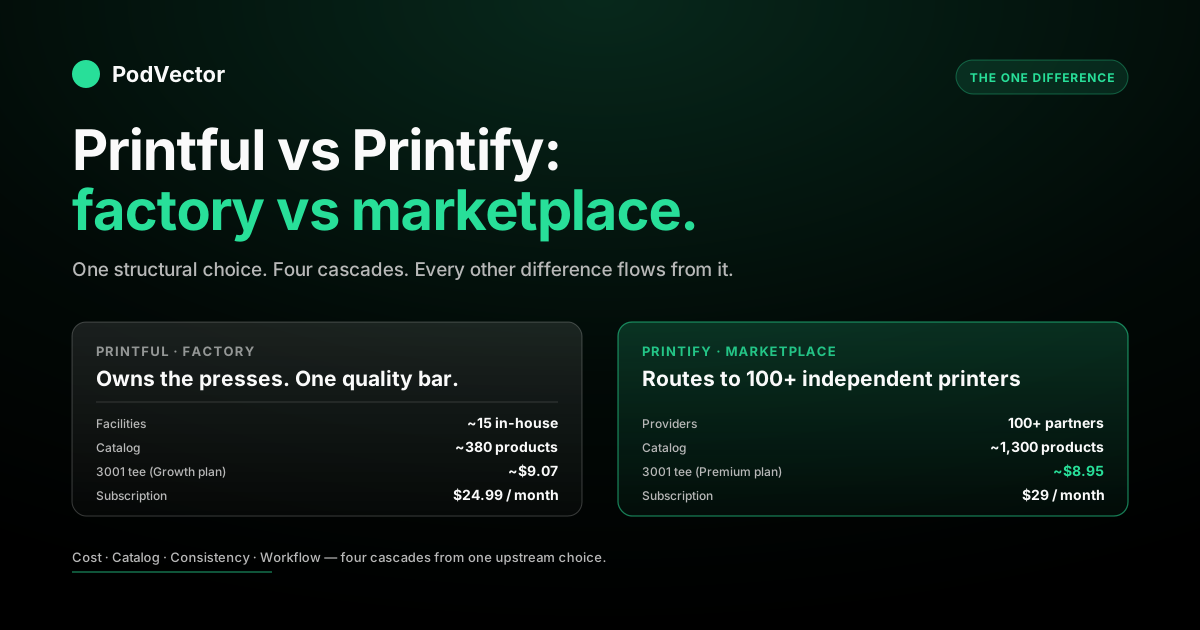
Quick Answer: Printify is the better default for cost-sensitive POD sellers who want catalog breadth and lower base costs; Printful is better when quality consistency, branding, and simpler operations matter more than unit cost. The Printful vs Printify difference is one structural choice — Printful prints in its own factories; Printify routes your order to one of 100+ independent print providers. Everything else (price, catalog size, quality consistency, shipping speed, branding) is a downstream effect of that one decision.
That single difference explains why a Bella+Canvas 3001 tee has a base cost around ~$8.95 on Printify versus ~$11.69 on Printful, why Printify's catalog is roughly 1,300 products versus Printful's few hundred, and why Printful now ships tighter (2–5 days) while Printify stays more flexible.
Below: the one difference, the four cascading impact areas it creates, and the per-SKU framework that beats picking one platform for everything.
The one difference: factory vs marketplace
Forget the feature checklists for a minute. The Printful vs Printify difference is one decision both companies made at the start, and that decision ripples into everything you'll experience as a seller.
Printful is a factory. It owns ~15 fulfillment facilities across the US, Europe, Canada, and Mexico. Same machinery, same inks, same printers, same packaging stack at every location.
When you place an order, Printful prints it. There's no third party in the loop.
Printify is a marketplace. It owns no presses. Instead, it routes your order to one of 100+ independent print providers — Monster Digital, SwiftPOD, Dimona Tee, Print Geek, T-Shirt and Sons, dozens more.
Each provider runs its own gear, staffing, quality bar, and shipping arrangement. Printify is software and a routing layer, not a printer.
Everything else flows from this. Pricing, catalog, consistency, branding, shipping speed, support — every operational gap traces back to that one upstream choice.
Why a structural difference matters more than feature diffs
Most Printful vs Printify articles enumerate 10–15 features and tell you to pick the platform that wins more rows.
That misses the point. Features change, catalogs expand, prices shift. By the time you read this, half the feature deltas may have moved.
What doesn't move is the architecture. Printful will still be a factory next year, and Printify will still be a marketplace. The structural difference is the part that's stable enough to make a decision on.
Cascade 1: cost and margin
Factories optimize for consistency. Marketplaces optimize for price competition. That's the cost cascade in one sentence.
Per-unit pricing on the same shirt
A Bella+Canvas 3001 unisex tee — the most-printed garment in POD — is the cleanest apples-to-apples test:
- Printful: base ~$11.69, Growth subscription drops it to ~$9.59 (up to 33% off).
- Printify: base ~$8.95 from a provider like Monster Digital, Printify Premium drops it to ~$7.16 (20% flat off) — and the cheapest providers run lower still.
Same blank shirt, a ~$2–3 spread per unit at the discounted tier that widens further if you route to Printify's lowest-cost providers. The full Bella+Canvas 3001 cost picture — including the ink-coverage line items most calculators miss — is broken down in our Printful Bella+Canvas 3001 price and shipping breakdown and the deeper price, shipping, and time breakdown.
Why the gap exists
Printful has to pay for its own real estate, machines, staff, retirement plans, and HR. Those fixed costs land in every blank cost.
Printify's print providers compete with each other. When Monster Digital raises prices on a tee, sellers route to SwiftPOD. The marketplace dynamic forces base prices down.
The subscription math
Both platforms put their best pricing behind a paid plan.
- Printful Growth: $24.99/month (free once you clear ~$12K in annual sales), up to 33% off premium product groups.
- Printify Premium: $24.99/month billed annually (higher month-to-month) for the first shop, 20% flat off the entire catalog.
Printify Premium hits break-even faster on volume sellers (the 20% is broader). Printful Growth pays off harder on specific premium SKUs where the discount is meaningful. Neither is universally better.
Shipping costs
Printful's shipping is consistent because it ships from its own warehouses. Printify shipping varies by provider — same product can ship from a different state or country depending on routing, which moves the shipping bill.
For a US-only seller printing in the US, shipping is roughly even. For an international seller, Printify's broader provider network often shortens the route and cuts cost. For a Canada-only seller, Printful's owned Canadian facility cuts customs hassle that Printify routing sometimes doesn't.
Cascade 2: catalog and product mix
A factory has whatever it stocks. A marketplace has the union of what every provider stocks. That's why the catalog numbers diverge so hard.
The numbers
- Printful: a few hundred products across apparel, accessories, home goods, and Printful-warehoused brand merch (published counts range from ~350 to ~500 depending on how sub-variants are tallied).
- Printify: ~1,300+ products across the aggregated provider catalog.
Printify wins raw catalog. That doesn't automatically mean Printify wins for your store.
The catalog-quality trade
Most of the extra Printify products come from niche providers — small custom-product specialists who plug into the network. That's where Printify's catalog explodes past Printful's: weird mug shapes, specific shoe lines, hyper-niche home goods, regional drinkware, and apparel from providers Printful doesn't carry.
The trade is consistency. A neoprene drink holder from Provider A and a baseball jersey from Provider B will arrive in different packaging, with different ship times, from different states.
That's fine for sellers who treat catalog breadth as a feature. It's a headache for sellers who want one branded unboxing experience.
When catalog actually matters
Catalog size is decisive in two cases. First, when your niche depends on a product type Printful doesn't carry — pet bowls, specific drinkware shapes, certain footwear. Second, when you're testing a wide product mix and want to see which products convert before committing to a single supplier.
For a focused store selling 3–5 SKUs of the same core garments? Catalog size is mostly irrelevant. Both platforms cover the basics.
Cascade 3: quality and consistency
Quality on a single order is a coin flip on either platform. Quality at scale is where the structural difference shows up.
Printful: one quality bar
Printful runs the same DTG and embroidery equipment, same inks, same color profiles, and same training across its facilities. Two shirts printed in Charlotte and Riga should look near-identical.
If quality drifts at one facility, Printful is the entity responsible for fixing it. There's no finger-pointing between layers. It shows in the numbers: Printful reports a reshipment rate around 0.19% and ships roughly 97–98% of orders within five days — the kind of tail-risk a single owner can drive down and hold.
Printify: a quality range
Print quality on Printify isn't bad — most providers are professional shops. But it's a range, not a point. Quality varies by provider, by garment type, even by season.
Monster Digital, SwiftPOD, and Dimona Tee each have a track record. So do the smaller providers. The variance is the issue — not the absolute quality bar.
The standard playbook for serious Printify sellers is: order samples from 2–3 providers for the same SKU, pick the one whose quality holds up, then route all that SKU's production to that single provider. This works, but it's homework Printful never asks you to do.
What "consistency" actually costs you
Inconsistent shirts produce return tickets, refund requests, and replacement orders. Each one chews 15–30 minutes of operator time plus the replaced product cost.
For a hobby store at 50 orders a month, this is noise. For a store at 500+ orders a month, a 2% return spike from inconsistent quality compounds into hundreds of dollars and dozens of hours every month. The structural difference shows up in your support inbox, not your spreadsheet.
Cascade 4: workflow and branding
The factory-vs-marketplace split changes how branding and operations work day-to-day.
Branded unboxing
Printful's branding tools — pack-ins, custom labels, sleeve labels, custom packaging slips — run uniformly because the same warehouse handles every order. You design the unboxing once.
Printify's branding capability depends on which provider produces the order. Some providers support custom neck labels and pack-ins; others don't.
Printify gives you a branding control panel, but the actual execution depends on which provider catches that order.
White-label dropshipping
Both platforms ship blind (no Printful or Printify return address on the package by default). Printful's blank packing slip is reliably the same. Printify's varies by provider — most are clean, some sneak provider branding into the slip or tape.
Customer support flow
A defect on Printful: open a ticket, Printful processes the refund or reprint. One vendor in the loop.
A defect on Printify: open a ticket, Printify mediates with the provider that printed the order. Two vendors in the loop. Most cases resolve fine; complex ones (lost packages with no scan, repeat quality issues from one provider) take longer because there's a routing layer between you and the actual printer.
Production speed
Printful: 2–5 business days now, with ~97–98% of orders shipping inside five days across its owned facilities.
Printify: 2–7 business days, varying by provider — the better providers average closer to 3, while slower or overloaded ones drift toward the 7-day end.
This has actually flipped since 2023, when Printful was the slower of the two. Printful tightened its in-house SLA, so its fulfillment window is now the more predictable one; Printify's range is wider because each provider sets its own pace. Pick a fast Printify provider and you'll match Printful; leave routing on autopilot and you inherit the slowest shop in the network.
Integrations: where the difference disappears
This is the section where the cascade stops cascading.
Both Printful and Printify integrate with Shopify, Etsy, eBay, Amazon, TikTok Shop, WooCommerce, Wix, Squarespace, BigCommerce, and Walmart Marketplace. Both auto-sync orders, push tracking back to the storefront, and handle inventory states. The mockup generators, file managers, and order dashboards are roughly at parity.
If you only ever evaluated the integration side, you'd think the platforms were near-identical. They are — for the surface workflow. The structural difference doesn't show up in the order sync; it shows up in the orders after they sync.
For deeper trade-offs on integration mechanics, our head-to-head Printful vs Printify guide walks through each storefront connector. The three-way Printful vs Printify vs Teespring breakdown adds the marketplace angle if you're also weighing Teespring's built-in audience. And the longer-form three-way comparison guide covers the full feature-by-feature matrix.
The 2026 merger: does the difference still matter?
Printful and Printify announced a merger in November 2024. By mid-2026, both brands still operate separately — different dashboards, different catalogs, different provider relationships, different subscriptions.
The structural difference between them — factory vs marketplace — hasn't merged either. That's not a feature you can integrate away. The combined entity could theoretically run both models in parallel forever (it makes commercial sense to), and the factory product and the marketplace product would still feel different to a seller.
What might change post-merger: catalog overlap, subscription bundling, shared shipping economics. What probably won't change: which orders get printed in which kind of facility, and the consistency-vs-flexibility trade that goes with it.
Bottom line — make a decision now based on how things work today, not on a merger outcome that may not converge for another 2+ years.
The per-SKU framework
The hidden answer most "which platform is better" articles miss: sellers don't have to pick one.
The math runs differently per garment, per region, per order volume. The same merchant can profitably sell hoodies on Printful and tees on Printify — same store, same brand, two suppliers behind the curtain.
How the per-SKU split actually works
Take a 5-SKU store: classic tee, premium tee, hoodie, mug, sticker.
- Classic tee (high volume, price-sensitive): Printify wins on base cost. Margin matters more than packaging here.
- Premium tee (lower volume, brand-focused): Printful's consistency and tighter unboxing matter more than $2 of base cost.
- Hoodie (mixed): depends on the specific blank — Printful's owned hoodie line vs Printify's provider options.
- Mug: often Printify, where the catalog has more shape options.
- Sticker: usually Printify, where small-form-factor providers compete hard.
This is the unlock — but it requires you to actually know the per-SKU economics. Most sellers don't, because their P&L lumps "fulfillment cost" into a single line.
The number you actually need
The question isn't "which platform is cheaper" — it's "what does my blended margin look like per SKU per supplier, after returns, shipping, and ad spend?"
Plain English: if Shirt X costs $9 on Printify and $12 on Printful but Printify routes it through a provider with a 4% return rate while Printful runs at 1%, the cheaper platform may not be the more profitable one. The difference shows up in cumulative refunds, not unit cost.
This is exactly the math an AI employee connected to your store's live data can answer. Connect Shopify orders, Printify and Printful product costs, and Meta and Google ad spend, and the question becomes one plain-English query.
"Which supplier is more profitable for my catalog, by SKU, this month?" — answered in seconds, not in a 40-tab spreadsheet. That's what PodVector AI's AI employee Victor does for POD sellers.
A simple decision rule
If you're starting from zero and just need to pick one to launch with, here's the rule of thumb the structural difference points to:
- Pick Printful if your store is brand-led, your unboxing matters, you sell mostly to one region, and you'd rather pay $2–3 more per unit to skip the supplier-shopping homework.
- Pick Printify if margin is the primary lever, your catalog is wide or your customer base is global, and you're willing to sample-test providers to lock in quality.
- Run both once you have ~3+ months of order data — split SKUs by which platform's strengths each product actually needs. Most $10K+/month POD stores end up here.
For more angles on this same comparison: cost-first breakdown, quality-first breakdown, or the side-by-side feature matrix, see the full Printful comparison cluster. For the broader Printful resource hub, the Printful topic hub rolls up every Printful-related guide.
FAQs
What is the main difference between Printful and Printify?
Printful prints in its own factories with one consistent quality bar. Printify routes orders to 100+ independent print providers who compete on price. That single structural choice drives every other gap — cost, catalog, consistency, branding.
Which is cheaper, Printful or Printify?
Printify is cheaper on most directly comparable products — typically $2–3 less per unit on a Bella+Canvas 3001 tee at the base tier, and more if you route to its lowest-cost providers. With Printify Premium ($24.99/mo billed annually, 20% off) versus Printful Growth ($24.99/mo, up to 33% off select items), Printify wins on volume; Printful Growth can win on specific premium SKUs.
Which has better quality, Printful or Printify?
Printful's quality is more consistent because every order runs through the same in-house equipment. Printify's quality is provider-dependent — the top providers (Monster Digital, SwiftPOD, Dimona Tee) match Printful, but the range across all 100+ providers is wider. Order samples before committing.
Can I use both Printful and Printify on the same Shopify store?
Yes. Both apps install side by side, and each product connects to one supplier at a time — for example, tees on Printify and hoodies on Printful.
Shopify and your customer never know which supplier produced which order. This is how most established POD stores actually operate.
Does the 2024 merger change which one I should pick?
Not yet. As of mid-2026, both platforms operate as separate products with separate catalogs and subscriptions. Make your pick based on how the platforms work today — the factory-vs-marketplace structural difference isn't the kind of thing a corporate merger dissolves overnight.
Which has faster shipping, Printful or Printify?
Printful production is now 2–5 business days, with roughly 97–98% of orders shipping inside five days. Printify production runs 2–7 business days depending on which provider prints the order — the fastest match Printful, the slowest lag. Shipping speed after production is comparable in major markets and depends more on carrier than platform.
Which is better for Etsy sellers specifically?
Both integrate with Etsy. Printify tends to win for Etsy sellers focused on margin and catalog breadth, since Etsy's competitive pricing rewards lower base costs. Printful tends to win when the Etsy shop is brand-led with premium positioning.
Stop guessing which supplier is more profitable for your store
The Printful vs Printify difference matters in theory. What matters in practice is which supplier nets more profit, per SKU, in your store, this month. That answer lives in your Shopify data, your supplier costs, your ad spend, and your return rates — across four dashboards no human is willing to reconcile every week.
PodVector AI connects your store, your Printful and Printify accounts, your Shopify orders, and your Meta and Google Ads into one live data layer. Ask Victor, your AI employee, plain-English questions like "which supplier is more profitable for my hoodies this month?" — and get a SKU-by-SKU answer in seconds. Victor can also propose specific actions like price changes, BXGY discounts, or new collections, and execute them on Shopify on your approval. And connect your store in under 10 minutes.
Try Victor free