
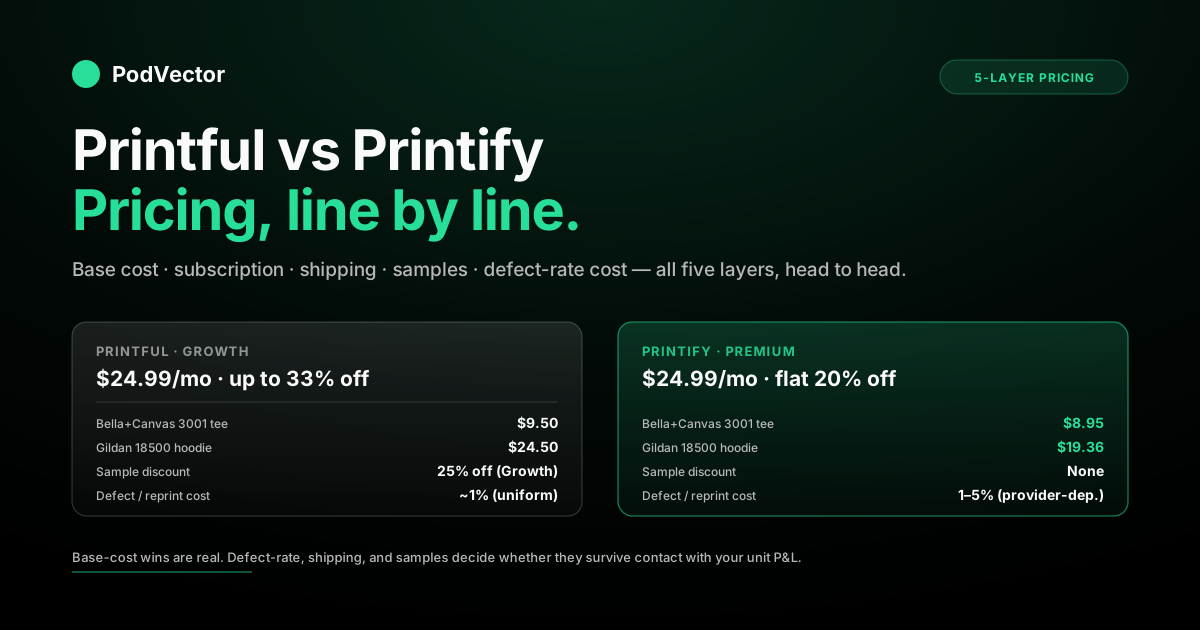
Quick Answer: On base product cost, Printify is cheaper on almost every line item — a Bella+Canvas 3001 tee runs $8.95 on Printify Premium versus $9.50 on Printful Growth, and the gap widens to $5–7 on hoodies and all-over-print SKUs. But the gap is narrower than it was: Printful cut base prices 6–9% across much of its catalog in 2025–26, and Printify raised Premium to $39/month ($24.99 if billed annually). Printify still wins on raw product cost; the all-in margin difference is smaller than the headline.
Base cost is the headline, not the answer. The right comparison runs five cost layers, not one: base unit cost, subscription discount, shipping by region, sample-order cost, and defect-rate cost. A $4 base-cost win disappears fast if the cheaper supplier ships slower or reprints more often.
Below is the pricing-side-by-side every POD seller actually needs — product-by-product tables, subscription break-even math, shipping math by region, and the question no public guide answers: which supplier wins on your catalog.
The five layers of POD pricing
Most Printful vs Printify pricing comparisons quote a single number — usually a tee base cost — and stop. That works for picking a t-shirt in a hurry. It does not work for picking a supplier for a store.
A real pricing comparison runs across five layers. Each shows up as a separate line in your unit P&L. Skipping any one of them produces the wrong answer.
- Base product cost — what the supplier charges you per unit before any discount, shipping, or order processing.
- Subscription discount — what Printful Growth or Printify Premium knocks off that base cost, and the unit volume needed to break even.
- Shipping cost — what the supplier charges to ship the unit, by destination region. Often as large as the product cost itself.
- Sample-order cost — what you spend testing quality before listing, plus what you spend on per-order replacements for defects.
- Defect-rate cost — the customer-facing cost of returns, reprints, and reviews. The line nobody publishes but every operator pays.
We will run each layer head-to-head below. If you only have ten minutes, the snapshot table covers the punchline. If you are picking a supplier for the next quarter, read the layers — the answer is rarely as clean as the snapshot suggests.
At-a-glance pricing snapshot
The 30-second version of the comparison. Every row is unpacked below.
| Pricing layer | Printful | Printify |
|---|---|---|
| Bella+Canvas 3001 tee, US base | $12.95 (Free) / $9.50 (Growth) | $10.95 (Free) / $8.95 (Premium) |
| Gildan 18500 hoodie, US base | $31.95 (Free) / $24.50 (Growth) | $22.99 (Free) / $19.36 (Premium) |
| 11oz ceramic mug, US base | $11.95 (Free) / $9.49 (Growth) | $7.62 (Free) / $6.21 (Premium) |
| Subscription plan | Growth: $24.99/mo (free above $12K/yr), up to 33% off | Premium: $39/mo ($24.99 annual), up to 20% off |
| Subscription break-even (tees/mo) | ~8 units | ~12 units |
| US standard shipping, first item tee | $4.69 | $4.39 (provider-dependent) |
| EU shipping (Riga/Spain → DE) | ~$5.50 (auto-routed) | $4–12 (depends on provider region) |
| Sample-order discount | 20% off (25% on Growth) | No discount |
| Defect / reprint rate | ~1% (uniform) | 1–5% (provider-dependent) |
| All-in cost, mid-volume seller, US tee | ~$14.20 | ~$13.35 |
Printify is cheaper on every base SKU. The all-in cost gap narrows once shipping, samples, and defects are layered in — to roughly $0.85 per unit on the US tee benchmark. That is still a margin win, but smaller than the base-cost headline.
Layer 1: Base product cost, by category
Printify wins on base product cost across nearly every category in 2026. The size of the win depends on the category — and it shrank in 2025–26, when Printful pushed a 6–9% price cut across much of its catalog to close the gap. Printify is still cheaper on the SKUs below; the spreads are just tighter than they were a year ago.
Apparel — the bulk of POD volume
On standard tees, hoodies, and sweatshirts, Printify Premium beats Printful Growth on every SKU we benchmarked. The gap runs $0.55–$5 per unit before shipping, with hoodies and heavier garments showing the largest spreads.
| Garment | Printful Growth | Printify Premium | Gap |
|---|---|---|---|
| Bella+Canvas 3001 tee (S–XL) | $9.50 | $8.95 | $0.55 |
| Bella+Canvas 3001 tee (2XL) | $11.50 | $10.95 | $0.55 |
| Gildan 5000 tee | $8.45 | $6.21 | $2.24 |
| Gildan 18500 unisex hoodie | $24.50 | $19.36 | $5.14 |
| Independent SS4500 heavyweight hoodie | $36.75 | $30.55 | $6.20 |
| Comfort Colors 1717 garment-dyed tee | $12.45 | $10.39 | $2.06 |
Why the gap is wider on hoodies: Printify routes hoodies through providers that buy garments in much higher volume than Printful's smaller-volume facilities. The supplier-side cost spread translates straight into the price you pay.
Non-apparel — drinkware, accessories, home
The Printify advantage is largest here. Ceramic mugs, phone cases, posters, and tote bags are categories where Printify's network of category specialists prices well below Printful's curated catalog.
| Product | Printful Growth | Printify Premium | Gap |
|---|---|---|---|
| 11oz ceramic mug | $9.49 | $6.21 | $3.28 |
| 15oz ceramic mug | $10.79 | $7.41 | $3.38 |
| iPhone 15 tough case | $15.50 | $10.49 | $5.01 |
| 18x24 matte poster | $12.49 | $8.20 | $4.29 |
| Cotton tote bag, large | $9.95 | $6.55 | $3.40 |
The hidden tradeoff: Printful's quality on these categories is uniform across orders, because every mug ships from the same set of facilities. On Printify, a $6.21 mug from one provider may differ in color and finish from a $7.50 mug from another. Provider selection is doing the work that platform-level QA does on Printful.
Where Printful is competitive on base cost
Three categories where the gap closes or reverses. On embroidered apparel, Printful's in-house embroidery facility undercuts most Printify embroidery providers by $1–3 per unit. On premium garment-dyed apparel where Printful's curated supplier list runs tighter, the gap shrinks to under $1. On all-over-print apparel, Printful doesn't offer most SKUs at all — comparison isn't possible, and Printify wins by default.
Branding and packaging — a Printful-only cost line
One pricing layer most base-cost tables ignore: branded inserts and custom packaging. Printful sells inside-label printing (~$2.49/unit), custom packing slips, and branded pack-in inserts as paid add-ons — a real per-unit cost, but the only turnkey way to ship a white-label parcel under your own brand. Printify largely doesn't offer this; branding is provider-dependent and mostly unavailable, so the line is $0 because the option doesn't exist. If you're building a premium brand where unboxing matters, price Printful's branding add-ons into the unit cost before you call Printify cheaper — for a brand-first store the $2–3 branding premium can be worth more than the base-cost gap. If you're competing on price, skip branding entirely and Printify's base-cost win stands clean.
Layer 2: Subscription plans and break-even
The flagship plans no longer cost the same. Printful Growth is $24.99/month; Printify Premium is now $39/month, or $24.99/month if you pre-pay annually. The discount math runs different ways on top of that.
Printful Growth — $24.99/mo
Growth offers up to 33% off product costs, with the discount tier scaling by spend. The headline number is generous but only applies on a subset of high-volume SKUs. The blended discount most Growth sellers actually see runs closer to 15–22% across their full catalog. One change worth noting: Growth is now waived entirely once your store clears roughly $12,000 in annual sales, so high-volume sellers get the discount without the monthly fee.
Break-even on Growth: roughly 8 standard tee equivalents per month. Below that, Free is cheaper. Above that, Growth compounds — and at 100+ tees per month, the discount is large enough that Growth members effectively buy product at provider-network rates close to Printify's. Read the full Printful Premium and Pro membership math in the complete guide to Printful Premium, Plus, and Pro memberships.
Printify Premium — $39/mo ($24.99 annual)
Premium is a flat 20% discount on most products from most providers, and it now supports up to ten connected stores. There's no spend-tier scaling — the 20% kicks in from the first order and applies to every Premium-eligible SKU equally. Some providers exclude themselves from the Premium discount; the catalog filter tells you which. The 2025–26 price change matters here: at $39/month the break-even moved up, so most sellers should pre-pay annually to hold the effective rate at $24.99/month.
Break-even on Premium: roughly 12 standard tee equivalents per month on the annual rate, closer to 18 if you pay monthly at $39. Below that, Free is cheaper. Above that, Premium pays for itself comfortably and continues to compound on volume.
The plan-vs-plan math, side by side
| Monthly order volume (tee equivalents) | Printful: Free vs Growth | Printify: Free vs Premium |
|---|---|---|
| 10 | Free still cheaper by ~$10 | Free still cheaper by ~$3 |
| 25 | Growth saves ~$10/mo | Premium saves ~$25/mo |
| 100 | Growth saves ~$320/mo | Premium saves ~$175/mo |
| 500 | Growth saves ~$1,725/mo | Premium saves ~$975/mo |
At low volume, the plans don't matter — Free is the right call on both sides. At mid volume, both plans pay for themselves. At high volume, Printful Growth saves more in absolute dollars because the underlying discount percentage is larger. That doesn't mean Printful is cheaper — Printify Premium is still cheaper on raw base cost. It means Growth narrows the gap on volume more than Premium narrows it.
Layer 3: Shipping cost by region
Shipping is the line where Printful's owned-facility network earns its keep. Printify's provider network can match Printful's shipping economics only when the seller sets it up that way.
US shipping — both platforms competitive
For a single-tee US order, Printful charges $4.69 standard. Printify charges $4.39 on most US providers. The gap is $0.30 and either side wins by $0.50 or so depending on the specific provider.
Multi-item orders compound the math. Printful charges a flat first-item rate plus $1.50–2.50 per additional item. Printify follows the same pattern but the per-additional-item charge varies by provider — some providers bundle aggressively (additional items at $0.99), others charge as much as the first item.
International shipping — where the gap widens
Printful auto-routes every order to its nearest facility. A US-listed tee ordered by a German customer ships from Riga, not Charlotte. That auto-routing is what makes Printful's international shipping price-competitive without seller setup.
Printify does not auto-route. The order ships from whichever provider you selected when you listed the product. A US-only listing shipping to Germany ships internationally from the US — slow and expensive. The fix is to list the same SKU through a Printify EU provider, then let Printify match the order to the closer one. Done right, this is cheaper than Printful for EU orders. Done lazily, it is materially more expensive.
| Destination | Printful (auto-routed) | Printify (multi-region listing) | Printify (single US listing) |
|---|---|---|---|
| US 48 | $4.69 | $4.39 | $4.39 |
| Canada | ~$7.50 | $6.99 | $12.95 |
| UK | ~$5.99 (Riga) | ~$5.49 (UK provider) | $14.49 |
| Germany / EU | ~$5.50 (Riga) | ~$5.00 (EU provider) | $13.95 |
| Australia | ~$6.99 (AU facility) | ~$6.50 (AU provider) | $17.95 |
For a US-only store, the shipping difference is small. For a store with meaningful international traffic — common for organic Etsy and TikTok Shop catalog — the routing question is decisive. The lazy single-listing Printify setup destroys margin on every international order.
Layer 4: Sample-order pricing
Sample orders are where Printful prices aggressively and Printify doesn't bother. The discount-vs-no-discount difference shapes how often each platform's sellers can iterate on quality.
Printful sample-order discounts
- Free account: 20% off sample orders, one sample order per month (up to three products per order).
- Growth subscribers: 25% off sample orders, same cadence.
- Bonus sample orders unlock at sales milestones — $100, $300, $500, and $1,500 in store revenue — so an active store earns several discounted samples a month beyond the base allotment.
The 20–25% discount is the right side of the cost-benefit on iterating designs. A Printful Growth subscriber can test three SKU variants per sample order for roughly $30–40, and the milestone bonuses keep iteration cheap once the store is selling.
Printify sample-order pricing
Printify charges full base price plus full shipping on sample orders. No discount tier, no per-month allotment, no perks. The argument: Printify's base prices are already discounted by ~20% on Premium, so the sample is already cheaper than Printful's discounted sample.
That argument holds on a single-SKU comparison. It breaks once you account for provider-selection discipline. On Printify, you should order a sample from every provider you list a product through — that is 3–5 sample orders per SKU before you commit. The platform doesn't subsidize that discipline, so sellers under-order samples, then eat the defect-rate cost downstream.
Sample-order cost, head to head
| Scenario | Printful Growth | Printify Premium |
|---|---|---|
| Single tee sample, US shipping | $7.13 + $4.69 = $11.82 | $8.95 + $4.39 = $13.34 |
| 5-variant color test, US shipping | $35.65 + $13.50 = $49.15 | $44.75 + $13.95 = $58.70 |
| 3-provider quality test (same SKU) | N/A — single facility | $26.85 + $13.17 = $40.02 |
Printful is cheaper per sample. Printify forces more total sample orders for the same quality confidence. The seller who skips that second cost ends up with the third one: a higher defect rate in production.
Layer 5: Defect-rate cost (the hidden line)
This is the line every public comparison guide skips. It is also the line that most often flips the supplier decision.
Printful's defect-and-reprint rate runs around 1% on average across its facility network. Printify's runs anywhere from 1% (top-tier providers like Monster Digital and SwiftPOD on premium tier) to 4–5% on lower-tier providers in the same catalog.
Why the gap matters: every defect is a triple cost. You pay for the original unit. You pay for the reprint. You eat the customer-support time and the negative review risk. On a $25 sale with a $12 cost and $5 ad-spend per order, a defect doesn't just zero out the contribution dollar — it produces a $17 loss plus the LTV hit.
The math at scale:
| Monthly orders | 1% defect rate cost | 4% defect rate cost | Margin gap from defects |
|---|---|---|---|
| 250 | $42 (2.5 reprints) | $170 (10 reprints) | $128/mo |
| 1,000 | $170 (10 reprints) | $680 (40 reprints) | $510/mo |
| 5,000 | $850 (50 reprints) | $3,400 (200 reprints) | $2,550/mo |
The base-cost win from a lower-tier Printify provider has to clear that defect-rate cost before it's a win. On a $4 per-unit base-cost win at 1,000 orders/month, the seller saves $4,000/mo on product. If the defect rate is 4 points higher, they lose $510/mo of that back, plus the customer-experience cost. Net win is still real — but smaller than the base-cost table suggests.
The escape hatch: only list Printify SKUs through providers whose sample-order quality you've verified. That keeps the defect rate at the 1% floor, where the full base-cost win comes through. The full Printful operational picture lives in the complete Printful guide for POD sellers.
A full-unit P&L on one SKU
Walking the math end-to-end on the benchmark SKU. Bella+Canvas 3001 tee, $25 retail, shipping to a US customer, paid social with $5 blended customer acquisition cost.
| Line | Printful Growth | Printify Premium (top-tier provider) | Printify Premium (lower-tier) |
|---|---|---|---|
| Retail price | $25.00 | $25.00 | $25.00 |
| Base unit cost | $9.50 | $8.95 | $8.95 |
| Shipping (customer-paid pass-through) | $4.69 in / $4.99 out → +$0.30 | $4.39 in / $4.99 out → +$0.60 | $4.39 in / $4.99 out → +$0.60 |
| Platform / processor fee | $1.05 | $1.05 | $1.05 |
| Ad spend (blended CAC) | $5.00 | $5.00 | $5.00 |
| Defect-rate allowance | $0.10 (1%) | $0.10 (1%) | $0.40 (4%) |
| Contribution per order | $9.65 | $10.50 | $10.20 |
Three takeaways from the full math. Printify on a top-tier provider produces $0.85 more contribution per order than Printful Growth. Printify on a lower-tier provider only produces $0.55 more — the defect-rate cost eats most of the base-cost win. Printful's worst case is the no-subscription seller, where the same SKU produces roughly $8.30 of contribution — a real gap that closes the moment Growth kicks in.
The picture changes by category. On hoodies, Printify wins by $4–5 per order even at higher defect rates. On embroidered apparel, Printful wins. On all-over print, Printify wins because Printful doesn't compete in the category.
Channel economics: Etsy, Shopify, TikTok Shop
The same supplier-side unit cost produces different contribution dollars depending on the sales channel. Channel-level fees and ranking signals stack on top of supplier-level math.
Etsy
Etsy charges $0.20 listing fee, 6.5% transaction fee, plus 3% + $0.25 payment processing on the gross. On a $25 sale, that's roughly $2.85 in Etsy fees before product cost. The margin pressure is real, which is why most Etsy sellers default to the cheaper supplier — Printify wins on Etsy economics for most catalogs.
The exception: new Etsy listings get ranked partly by ship-on-time and review score. A 4% defect rate on a fresh listing tanks both signals before review buffers exist. New Etsy sellers often start on Printful for the consistency, then migrate high-volume SKUs to Printify once the listings have a review buffer.
Shopify
Shopify charges 2.9% + $0.30 transaction processing (on Basic), plus the monthly plan fee amortized per order. Shopify economics are cleaner than Etsy, which gives Printful's higher base cost more room. Paid social driving Shopify orders shifts the math further: a 4% defect rate cratering paid-social ROAS hurts more than a $4 base-cost gap, because ad spend amortizes per defect.
TikTok Shop
TikTok Shop charges 8% commission plus transaction fees. The margin is thinner than either Etsy or Shopify. Printify's lower base cost is more decisive here. The catch: TikTok Shop runs on tight fulfillment SLAs, and lower-tier Printify providers struggle to hit them. The right TikTok Shop setup is Printify Premium on top-tier providers only.
When to pick which on pricing alone
Collapsing the five layers into decision rules, holding everything else constant.
Pick Printify (Premium) on pricing alone if:
- Your catalog is apparel-heavy and weighted toward hoodies, all-over print, or non-Bella+Canvas tees.
- Your catalog includes drinkware, phone cases, posters, or tote bags — the categories where the gap is widest.
- You have provider-selection discipline (sample-order every provider before listing).
- Your monthly volume justifies Premium's break-even (~12 tee equivalents).
Pick Printful (Growth) on pricing alone if:
- Your catalog leans on embroidered apparel, where Printful undercuts most Printify providers.
- You ship internationally and don't want to maintain multi-region SKU listings.
- You run paid social where defect-rate variance hurts more than $2–4 per unit.
- You sample-order frequently and need the 20–25% sample discount to keep iteration cheap.
Pick neither in isolation if:
- You're running 20+ SKUs across multiple categories — the optimal supplier varies by SKU, and a single-supplier decision leaves money on the table.
- You ship 30%+ international traffic — the right move is Printful for some SKUs, Printify multi-region listings for others. For the broader supplier picture, see Gelato vs Printful vs Printify for the third-supplier comparison, and the deeper line-by-line Printful vs Printify cost comparison for the full per-unit math.
- You sell across multiple channels with different margin structures — Etsy, Shopify, and TikTok Shop favor different suppliers for the same SKU.
For the 2025–2026 cross-supplier picture including Gelato as a third option, the Gelato vs Printful vs Printify 2025–2026 comparison covers the third-supplier math.
The pricing comparison that actually matters
Everything above produces averages. The Bella+Canvas 3001 tee at $25 retail with $5 CAC is a useful benchmark, not the right answer for your store.
Your unit economics depend on your specific SKU mix, your specific top-customer regions, your specific channel fee structure, and your specific ad spend per order. Two POD stores running the exact same SKU in the same retail price band can produce different supplier winners — because their customer region split, their channel mix, and their ad costs differ.
The right comparison is per-SKU and lives in your own data. It means tracking every order's supplier-charged cost, shipping cost, and refund alongside revenue and ad spend in a single source of truth. Running the math per-SKU and per-supplier. Surfacing it fast enough to act on — switching a single SKU's supplier weekly is high-leverage if the data is fresh, useless if it's a quarter old.
This is the architecture PodVector AI built Victor on. A unified data warehouse ingests Shopify, Printful, Printify, Meta, and Google per-order data, then lets you ask "which supplier is more profitable on my hoodies shipping to the EU?" in plain English. The answer changes by SKU. A POD seller without per-SKU supplier data is guessing on the most expensive lever in their business.
For the cluster-wide framing of how comparison decisions roll up to operator strategy, see the Printful comparison hub. For the broader topic, the Printful topic hub pulls together every pricing, integration, and operational angle.
FAQs
Is Printify always cheaper than Printful?
On base product cost, almost always — yes. On all-in cost (base + shipping + samples + defect rate), the gap narrows from $2–5 per unit to roughly $0.50–1.50 per unit for most apparel SKUs. On embroidered apparel and certain international-shipping scenarios, Printful can be cheaper end-to-end.
What's the cheapest Printful vs Printify plan combination?
Printify Premium (20% off, $24.99/mo on the annual plan or $39/mo monthly) on top-tier providers is the cheapest blended setup for most apparel-focused stores doing 100+ units a month — pre-pay annually to hold the effective rate down. For sub-25-units-per-month sellers, Printify Free is the cheapest — neither subscription pays for itself at that volume.
How much does Printful Growth actually save vs Printify Premium?
Printful Growth's headline 33% discount narrows the gap with Printify Premium but rarely closes it. At 100 tee-equivalents per month, Growth saves roughly $320 against Printful Free, while Premium saves roughly $175 against Printify Free. Printify Premium still produces lower absolute cost per unit at every volume tier.
Do Printful and Printify charge separate shipping per item?
Both use a first-item + per-additional-item model. Printful charges $4.69 first item / $1.50–2.50 additional. Printify varies by provider — top-tier providers bundle aggressively ($0.99 per additional item), lower-tier providers charge close to first-item rates on every unit. Multi-item orders favor whichever supplier you've selected for bundle pricing.
Why is Printful's hoodie pricing so much higher?
Printful manufactures hoodies in its own facilities at lower volume than the third-party providers on Printify's network. The provider-network volume advantage flows through to base price. Printify Premium hoodies run $5–7 cheaper than Printful Growth hoodies on equivalent garments.
Which has cheaper international shipping?
Printful for low-config international shipping — auto-routing to EU, MX, JP, AU, and CA facilities is set-and-forget. Printify for optimized international shipping if you list the same SKU through multiple regional providers. The second approach is cheaper, but only if you set up multi-region listings; the lazy single-region setup makes Printify materially more expensive on international orders.
Does the defect rate really change the pricing comparison?
At 1,000 orders a month, a 3-point defect-rate gap costs roughly $510/month in reprints and reshipments. That's meaningful — but smaller than the base-cost win Printify produces. The defect-rate cost is decisive when you compare against a lower-tier Printify provider; less so against a top-tier one.
Are samples cheaper on Printful or Printify?
Per sample, Printful is cheaper — the 20% discount on Free accounts (25% on Growth) beats Printify's no-discount pricing. Per quality-confidence dollar, Printful is much cheaper, because Printify often requires 3–5 sample orders per SKU to verify multiple providers. Printful runs a single facility set, so one sample tests the whole supply chain.
Did Printful and Printify merge, and does it change pricing?
As of mid-2026 the two platforms still run separately — separate brands, catalogs, dashboards, pricing, and subscriptions — despite the recurring merger rumors. Pick based on current line-by-line economics, not the speculation. The relevant 2025–26 changes are real and on the pricing side: Printful's 6–9% base-cost cut and Printify's move to $39/month Premium. Both narrow the gap without erasing Printify's base-cost edge, and both strengthen the case for piloting a third supplier (Gelato, Gooten, CustomCat) as a pricing-diversification hedge.
Stop comparing platforms. Compare suppliers per SKU.
Printful Growth wins on some SKUs. Printify Premium wins on others. The right answer changes by garment, region, channel, and season. Static comparison tables go stale within weeks. Victor pulls every order, every supplier-charged cost, every shipping line, every refund into one live data warehouse — then lets you ask "which supplier is more profitable on my hoodies shipping to the EU?" in plain English. POD-native unit economics, no spreadsheets.
Try Victor freeFor a different framing of the same axes, the 2026 comparison from Merch Titans covers similar ground with a slightly different weighting on the margin math. To round out the Printful side, see the complete Printful guide for POD sellers and the complete guide to Printful Premium, Plus, and Pro memberships. The full Printful comparison cluster lives at the Printful comparison hub, and the broader Printful topic at the Printful topic hub.