
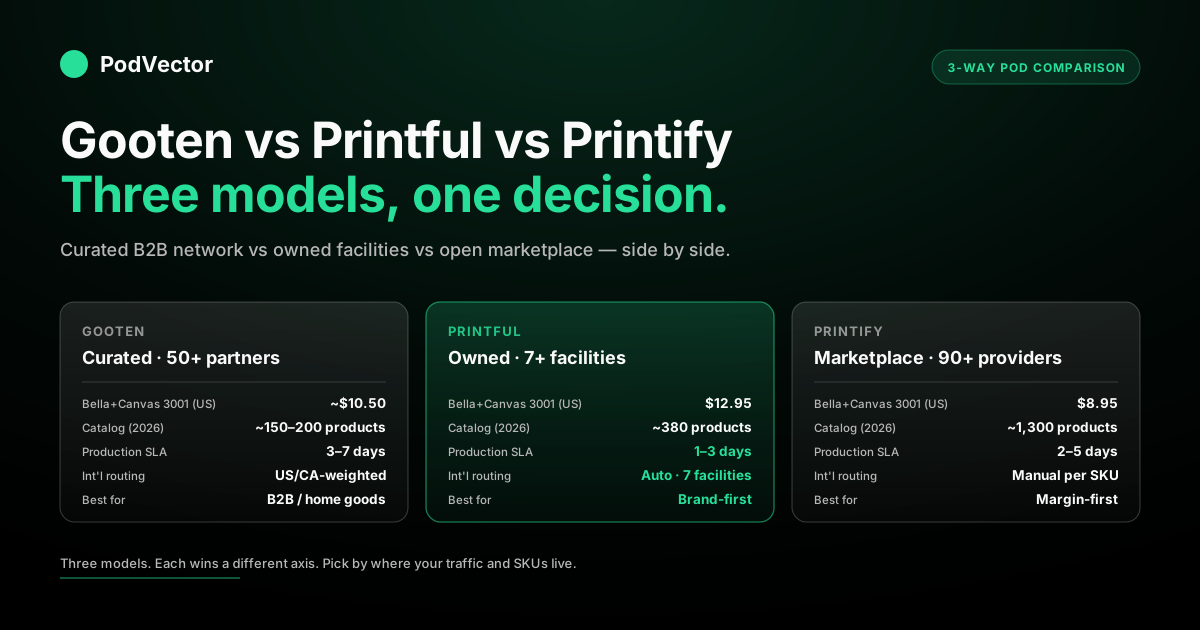
Quick Answer: For most indie POD sellers, Printful or Printify is the right pick — Printful if you're building a brand and want consistent quality, Printify if you're optimizing margin and catalog breadth. Gooten is the right pick for a narrower profile: B2B and high-volume D2C sellers with home-goods-heavy catalogs who want custom packaging and flat pricing without a subscription.
The reason is that the three run different production models — curated third-party network (Gooten), owned facilities (Printful), and open marketplace (Printify) — and each dominates on a different axis. Printful wins on quality consistency. Printify wins on per-SKU base cost and catalog breadth. Gooten wins on B2B-style supplier curation, home-goods depth, and predictable bulk pricing. None of the three wins on every axis, and Gooten's slower shipping is the consistent trade-off across head-to-head tests.
Below is the side-by-side framework — model, pricing, catalog, quality, fulfillment, integrations, branding — plus the per-SKU profitability question no platform-level comparison can answer.
The three production models explained
The single fact that explains every other difference between these three: they don't run the same production model.
Printful owns its facilities. Roughly seven owned print and embroidery centers across the US, EU (Riga and Barcelona), Mexico, Japan, Australia, and Canada. Every order routes through a Printful-run building with Printful-trained staff and Printful-owned machines. Quality control is one set of standards applied uniformly.
Printify is an open marketplace. When a customer orders, Printify routes the line item to whichever provider you picked when listing the product — Monster Digital, SwiftPOD, Drive Fulfillment, Dimona, and roughly 90 others across 140+ locations. Providers compete on base price inside the catalog. The marketplace doesn't enforce a quality floor; the seller does.
Gooten runs a curated third-party network — somewhere between Printful's owned-facility tightness and Printify's open marketplace. Roughly 50+ vetted manufacturing partners across categories, with Gooten managing the routing rather than asking the seller to pick a provider per SKU. The network was built originally for B2B clients and high-volume D2C operators, which shapes the catalog (broad home goods, lifestyle, custom packaging) and the pricing model (volume-friendly, less spiky on outliers).
Each model is the right answer to a different question. Owned facilities maximize consistency at the cost of catalog breadth. Open marketplaces maximize catalog and base-cost flexibility at the cost of variance. Curated networks like Gooten's split the difference — fewer providers, less per-SKU configuration, broader non-apparel coverage, but a smaller mindshare and fewer indie-seller integrations than the other two.
Side-by-side snapshot table
Every axis is unpacked in its own section below. This is the 30-second version.
| Axis | Gooten | Printful | Printify |
|---|---|---|---|
| Model | Curated network (~50 partners) | Owned facilities (~7) | Open marketplace (~90 providers) |
| Bella+Canvas 3001 tee, US base | ~$10–11.50 | $12.95 | $8.95 (Premium) / $10.95 (Free) |
| Subscription | None — flat catalog pricing, custom B2B tiers | Growth $24.99/mo, up to 33% off | Premium $24.99/mo, up to 20% off |
| Catalog (2026) | ~150–200 products, deep home goods | ~380 products | ~1,300 products |
| Median production SLA | 3–7 business days | 1–3 business days | 2–5 business days (provider-dependent) |
| International routing | Limited — US/CA-weighted | Auto across 7+ owned facilities | Manual — list SKUs through multiple regional providers |
| Quality consistency | Medium-high, partner-vetted | High and uniform | Variable — depends on provider |
| Branding inserts | Available, custom packaging strong on B2B tier | Native across all orders | Provider-specific, partial coverage |
| Best for | B2B, bulk D2C, home-goods-heavy stores | Brand-first, paid-social-heavy US/EU stores | Margin-first, broad catalog, organic Etsy |
Pricing and subscription tiers
Pricing is the axis sellers fixate on first. We'll cover it properly here, then move on — because the cheapest base cost is rarely the most profitable supplier.
Base costs, head-to-head
On the benchmark Bella+Canvas 3001 tee shipping in the US:
- Gooten standard: ~$10.50 (no subscription required)
- Gooten high-volume (VIM) tier: custom — Gooten's Very Important Merchant program lands roughly $1–2 below standard for sellers committing to bulk monthly volume, negotiated rather than subscription-gated
- Printful (no subscription): $12.95
- Printful Growth ($24.99/mo, up to 33% off): ~$9.50
- Printify Free: $10.95
- Printify Premium ($24.99/mo, up to 20% off): $8.95
Printify Premium is the cheapest on this SKU. Gooten's standard pricing lands roughly mid-pack — cheaper than Printful's no-subscription rate, more expensive than Printify Premium, but with no monthly fee in the way. The gap shifts on heavier garments and home goods, where Gooten's curated supplier set sometimes beats both Printful and Printify on items like ceramic mugs, throw pillows, and shower curtains.
Subscription math
Gooten doesn't ship a public consumer subscription. Pricing is flat catalog plus custom volume tiers negotiated for B2B and high-volume sellers. That removes the break-even calculation indie sellers run on Printful Growth or Printify Premium.
- Printful Growth recovers its $24.99 in roughly 8 tee-equivalents per month at 33% off.
- Printify Premium recovers $24.99 in roughly 12 tee-equivalents per month at 20% off.
- Gooten standard has no recurring fee — what you see in the catalog is what you pay.
For low-volume sellers (under 30–50 orders/month), Gooten's no-subscription model is a real advantage. For higher-volume sellers, the Printful Growth and Printify Premium discounts close most of the gap and then some.
The all-in cost most comparisons skip
Sticker price is one line in your unit P&L. The full picture includes shipping (paid by customer or by you, varies by region), platform fees, refund allowance for defects, and ad spend amortized per order.
A $2 base-cost win can disappear if the provider's defect rate is 3 points higher, or if shipping to your top customer region costs $3 more. Gooten's slower production SLA can quietly pile on costs through abandoned cart emails, customer service overhead, and refund requests on missed delivery dates. For the line-by-line Printful-side breakdown, see the Printful vs Printify pros and cons.
Product catalog
Catalog size and shape differ meaningfully across all three.
Gooten (~150–200 products): the smallest catalog of the three by SKU count, but with notable depth in home goods — throw pillows, shower curtains, blankets, framed canvas, ceramic mugs, glassware, and lifestyle accessories. Apparel coverage exists but is narrower than the other two; standard tees, hoodies, and a handful of all-over print options. The catalog skew is clearly toward non-apparel categories where Gooten's curated supplier base outperforms.
Printful (~380 products): standard apparel (tees, hoodies, sweatshirts, hats), drinkware, basic wall art, embroidered goods. Every SKU is reviewed and mockup-tested by Printful's in-house team before listing. The curation reduces decision overhead — you're picking from a known-good list.
Printify (~1,300 products): roughly 3.4x the Printful catalog and 6–8x Gooten's. Strong in all-over-print apparel (bombers, leggings, swimwear), framed canvas at unusual sizes, ceramic mugs from multiple makers, pet products, phone cases, niche home goods. The breadth introduces a new question per SKU: which of the providers offering this product handles it best?
For sellers building tight brand-led apparel lines, Printful's catalog is enough. For sellers running broad catalog tests, Printify's breadth is decisive. For sellers leaning into home goods, lifestyle merchandise, or bulk B2B custom packaging, Gooten's curated set still earns its place.
Print quality and consistency
All three platforms produce quality work in 2026. The right framing isn't "which prints better" — it's "which is more consistent for the customer-experience profile you need."
Printful runs the same Kornit Atlas and Avalanche printers, the same garment-prep workflow, and the same QA pass across every owned facility. A Riga-printed shirt and a Charlotte-printed shirt come out within tight tolerances on color, ink saturation, and placement. Uniform quality is the brand-builder's case for paying more.
Printify's quality is provider-specific. Top-tier providers — Monster Digital, SwiftPOD on premium tier, Drive Fulfillment for embroidery — produce work indistinguishable from Printful's. Lower-tier providers in the same catalog produce visibly worse output: ink that cracks after two washes, off-axis placement, color drift between runs. Provider-selection discipline is mandatory, not optional.
Gooten sits between the two on consistency. The vetted partner network produces solid output at the median, with quality reportedly running below Printful but above the bottom half of Printify's marketplace. The curated approach means there's no per-SKU provider screening required, which is genuinely useful — but the smaller network also means fewer fallback options when one partner has capacity issues.
Defect-rate variance compounds in unit economics. Printful's roughly 1% reprint rate is stable across orders. Printify's reprint rate ranges from 1% (top-tier providers) to 4–5% (lower-tier providers). Gooten's reprint rate sits in the 2–3% band based on operator reports — better than the worst of Printify, worse than Printful's tight uniformity. On a paid-social store running 1,000 orders a month, the gap between 1% and 3% is $200–$400 of margin a month, plus the customer-experience hit.
Fulfillment and shipping
Production speed and shipping cost are two halves of the same axis. This is where Gooten's biggest weakness shows up.
Production SLA
Printful publishes 1–3 business days and hits it consistently across owned facilities. Order placed Monday morning ships Wednesday afternoon for the median US order.
Printify publishes 2–5 business days. The actual experience depends on the provider — SwiftPOD and Monster Digital regularly hit 1–2 day production, lower-tier providers run 4–6 business days, and Q4 spikes push some providers to 7+ days.
Gooten publishes 3–7 business days for most categories — meaningfully slower than the other two. Operator-reported averages run closer to 5–9 business days during normal periods and longer during seasonal peaks. The slower SLA is the single most-cited complaint in third-party comparisons of Gooten against Printful and Printify, and it's a real customer-experience cost on stores where shoppers expect a 5-day delivery window.
The gap shows up clearly in head-to-head delivery tests. Independent 2026 comparisons ordering the same tee from all three reported total door-to-door times around 6 days for Printful, 8 days for Printify, and 11 days for Gooten — with Gooten landing roughly $4 cheaper per unit on that order. That's the trade Gooten asks you to make: a few dollars of base-cost savings against several extra days of transit. On a low-price impulse category it can be worth it; on a paid-social store where delivery-window expectations drive refunds and chargebacks, it usually isn't.
Regional routing
Printful auto-routes each order to the nearest owned facility (US East, US West, EU/Riga, EU/Spain, MX, JP, AUS, CA). For a US-heavy store, 60–80% of orders ship domestically with no setup work. For an EU-weighted store, EU orders ship from Riga or Barcelona automatically.
Printify routes each order to whichever provider you picked when listing the product. If you listed a tee through a US provider and the order ships to Germany, that order goes international — slow and expensive — unless you also listed the same SKU through a Printify EU provider.
Gooten's network is heavily US-weighted with limited Canadian and select international coverage. EU-bound orders typically ship from US facilities, which adds 8–15 days of transit and meaningful international shipping cost. For a US-only store, Gooten's routing isn't a problem. For any store with meaningful EU, UK, or AU traffic, Gooten loses to Printful's auto-routing and to a properly-configured Printify multi-region setup.
Integrations and storefronts
Printful has the broadest and tightest integration set of the three. Native Shopify, Etsy, WooCommerce, eBay, TikTok Shop, Wix, Squarespace, Amazon (US), and a robust API for custom builds. Variant sync, mockup generation, and fulfillment status updates run with the fewest edge cases.
Printify keeps pace on Shopify, Etsy, WooCommerce, eBay, and TikTok Shop. Longer-tail integrations (Squarespace, Wix, smaller marketplaces) show rough edges more often but aren't deal-breakers for most sellers.
Gooten integrates with Shopify, Etsy, WooCommerce, BigCommerce, and a strong public API designed for the B2B and high-volume D2C use cases that built the company. The integration list is shorter than Printful or Printify, and the smaller indie-seller userbase means fewer community plugins, fewer YouTube tutorials, and fewer Reddit threads when something breaks. For an established Shopify or Etsy seller, the core integrations work. For sellers building on TikTok Shop, Wix, or Squarespace, Gooten is a meaningfully thinner option.
Branding and customization
Printful's branding options are the deepest and apply uniformly. Custom packing slips, branded stickers, branded inside-collar labels, and pack-in marketing inserts work on every order regardless of which Printful facility fulfills it. The "feels like a real brand, not a POD store" experience is on rails.
Printify's branding options are provider-specific. Some providers support packing slips with your logo; some don't. Inside-collar relabeling is available on premium providers like Monster Digital but isn't a catalog-wide feature.
Gooten is unusually strong on custom packaging at the high-volume tier — branded boxes, custom inserts, and bulk packaging configurations that Printful and Printify don't match for low-volume indie sellers. Below that tier, branding is closer to Printify's middle ground than Printful's catalog-wide consistency. The split makes sense given Gooten's B2B roots: bulk customers get the customization, low-volume hobby sellers get a more limited set.
Pros and cons summary
Gooten — pros
- No subscription — flat catalog pricing with no monthly fee for low-volume sellers.
- Strong custom-packaging options for high-volume and B2B sellers.
- Deep home goods catalog (throw pillows, shower curtains, ceramic, blankets) where curated suppliers outperform.
- Curated supplier network — no per-SKU provider screening required.
- Robust API and B2B-grade tooling for high-volume D2C operators.
Gooten — cons
- Production SLA of 3–7 days is the slowest of the three, with operator-reported peaks worse than that.
- US/CA-weighted network — international shipping economics lag both Printful and a configured Printify setup.
- Smaller catalog (~150–200 products) and notably narrower apparel coverage.
- Smaller indie-seller community — fewer plugins, tutorials, and troubleshooting threads.
- Fewer storefront integrations (no native TikTok Shop, no Wix, no Squarespace as of 2026).
Printful — pros
- Consistent quality across every order, every facility, every SKU.
- Tighter Shopify, Etsy, and TikTok Shop integrations with cleaner mockups.
- Native branded inserts, packing slips, and inside-collar relabel on every order.
- Auto-routing across 7+ owned facilities — minimal seller config.
- Lower defect and reprint rate, which matters disproportionately on paid social.
Printful — cons
- Base costs run $1–7 higher than Printify per garment depending on category.
- Smaller catalog (~380 products) than Printify — limited all-over print, fewer non-apparel SKUs.
- Subscription discount helps but doesn't fully close the gap with Printify Premium.
Printify — pros
- Lower base costs, especially on Premium tier — meaningful margin lift per order.
- ~1,300 product catalog with deep coverage of all-over print, framed canvas, ceramics, pet products.
- Multi-provider network lets you route per region for cheaper international shipping (with setup work).
- Top-tier providers match Printful's quality at lower cost.
Printify — cons
- Quality varies by provider — sample-ordering discipline is mandatory.
- Branding inserts and inside-collar relabel are provider-specific and partial.
- International routing requires the seller to list SKUs through multiple providers.
- Defect rates on lower-tier providers can run 3–5%, silently killing paid-social unit economics.
Decision matrix: pick X if Y
The framework collapses cleanly into decision rules.
Pick Printful if:
- You're building a long-term brand where customer-experience consistency is part of the product.
- Your traffic is US-weighted, or split US + EU only, and you want auto-routing with zero per-SKU setup.
- Your product mix lives in apparel + drinkware + wall art and you don't need exotic SKUs.
- You run paid social where return rates above 5% kill the unit economics.
Pick Printify if:
- You're optimizing for margin and willing to do per-provider sample-ordering.
- Your product mix needs catalog breadth Printful and Gooten don't cover — all-over print, niche home goods, pet products.
- You run organic Etsy or TikTok Shop where unit economics are thin and $2–4 per order matters.
Pick Gooten if:
- You're a B2B or high-volume D2C operator where custom packaging, bulk pricing, and a managed supplier relationship matter more than catalog breadth.
- Your product mix is home-goods-heavy — throw pillows, shower curtains, blankets, ceramic mugs — where Gooten's curated suppliers outperform.
- You're a low-volume seller who wants flat pricing without a monthly subscription fee.
- Your customers are US/Canadian and a 5–9 day delivery window is acceptable for your category and price point.
Run two of them if:
- Your store has 15+ SKUs and the optimal supplier varies by garment, region, or season.
- You want supplier diversification — single-supplier outages have been a real risk in 2024–2026.
The two-supplier combination most apparel-heavy operators converge on in 2026 is Printful + Printify (consistency for hero SKUs + margin on long-tail). Gooten is a less common pick for that pairing — it earns its place when home goods or B2B custom packaging is part of the catalog, not when the question is purely "Printful or Printify." See the broader Printful vs Printify quality comparison for the two-platform decision when Gooten isn't in the mix.
Where Gooten actually fits in 2026
Most Gooten vs Printful vs Printify comparisons treat the three as direct competitors. They aren't, and that's the part the SERP keeps missing.
Gooten was built for a different customer than Printful or Printify. The original product targets B2B brands, agencies, and high-volume D2C operators that need a managed supplier relationship, custom packaging at scale, and bulk pricing negotiations. Indie Etsy sellers and Shopify hobby stores are a secondary audience, not the core.
That positioning shows up everywhere — narrower indie-seller integrations, smaller community, longer SLA on small orders, deep home-goods catalog rather than trend-driven apparel. Operator reviews calling Gooten "slow" or "less polished than Printful" are usually comparing it on the indie-seller axis where it isn't trying to compete.
Where Gooten beats both is on volume merchandise programs, B2B custom-packaging runs, and home-goods-heavy catalogs. Where it loses is on the indie-seller default — Shopify or Etsy store, paid-social-driven, US-EU split, mostly apparel. For that profile, Printful or Printify is the right pick almost every time. Compare the Printful vs Printify quality reviews for the framing that fits the indie-seller default.
The per-SKU profitability question
Every comparison guide above — including this one — treats the choice as platform-level. That framing produces a platform-level answer: pick A for brand, B for margin, C for B2B and home goods.
The actual question every POD seller has to answer is per-SKU. On your Bella+Canvas 3001 in heather grey, shipping to your top region, with your ad-blended customer acquisition cost, which supplier produces a higher contribution dollar per order? The answer flips by garment, region, volume, and season.
None of the public comparison articles fill this gap. They quote averages — $4 base-cost difference, 99% accuracy, 1–3 day fulfillment — and stop there. Your P&L runs on specifics, not averages.
Closing the gap takes three pieces working together. Every order's supplier-charged cost has to flow into a single source of truth alongside revenue, ad cost, refunds, and processor fees. The math has to run per-SKU and per-supplier so a tee that's profitable on Printify and a throw pillow that's profitable on Gooten both show up clearly. The answer has to surface fast enough to act on — switching a single SKU's supplier weekly is high-leverage if the data is fresh, useless if it's a quarter old.
This is the architecture PodVector AI built Victor on — a unified data store that ingests Shopify, Printful, Printify, Meta, and Google per-order data, then lets you ask "which supplier is more profitable on my throw pillows shipping to California?" in plain English. The answer isn't always Printful or always Printify. The answer is per-SKU, and a POD seller without per-SKU supplier data is guessing on the most expensive lever in the business.
For the cost-side picture across membership tiers — which is where most of the per-unit margin shifts hide — see the Printful Premium membership cost full breakdown and the deeper membership price and benefits breakdown.
FAQs
What's the cleanest one-line Gooten vs Printful vs Printify comparison?
Gooten is a curated B2B-leaning network with strong home goods and slower SLA. Printful is owned facilities with consistent quality at a higher base cost. Printify is an open marketplace with lower base costs and quality that depends on which provider you pick. All three integrate with Shopify and Etsy; only Printful and Printify integrate cleanly with TikTok Shop in 2026.
Which is best for a brand-new POD seller?
Printful by default. The owned-facility model means zero per-SKU provider research, the mockup generator is the cleanest of the three, and the all-in customer experience is most predictable. Printify is the second pick if margin is your hard constraint. Gooten is rarely the right starting point for an indie seller — its strengths show up at higher volume.
Which is cheapest for a Bella+Canvas tee?
Printify Premium at $8.95 wins on US apparel. Printful Growth lands around $9.50. Gooten standard sits around $10.50 with no subscription required. On a per-SKU US-shipping basis, Printify Premium is the cheapest of the three.
Which is best for home goods like throw pillows and shower curtains?
Gooten and Printify both have strong coverage in this category. Gooten's curated supplier set tends to win on consistency for the categories it carries; Printify wins on catalog breadth and provider competition. For a home-goods-only catalog, sample-order both before committing.
Why is Gooten so much slower on shipping?
Gooten's network is smaller and more concentrated, and its catalog leans toward made-on-demand home goods that take longer to produce than DTG apparel. The 3–7 day SLA reflects real production complexity, not lack of effort. For sellers where customer-perceived speed is the conversion driver, Printful's 1–3 day SLA is the right call.
Can I run all three in the same store?
Yes — all three integrate with Shopify without conflict, and you can route different SKUs to different suppliers based on margin, geography, and category fit. Most established POD sellers run two suppliers, not three. The three-supplier configuration only earns its place when the catalog is large enough to justify the per-supplier mockup, sample-ordering, and reconciliation overhead.
Does Gooten have a subscription tier?
Not a public consumer subscription. Gooten's pricing model is flat catalog plus negotiated B2B and high-volume D2C tiers. For low-volume sellers, this is a cleaner model than Printful Growth or Printify Premium. For higher-volume sellers, the lack of a Premium-style discount tier means Printful and Printify catch up on price.
Which is best for international shipping?
Printful by default for non-US customers, with auto-routing across 7+ owned facilities including EU/Riga, EU/Barcelona, MX, JP, AUS, and CA. A properly-configured Printify setup with multiple regional providers can match Printful internationally on apparel. Gooten lags both — its US/CA-weighted network is the wrong pick for stores with meaningful EU, UK, or AU traffic.
Is Gooten still relevant in 2026 vs Printful and Printify?
Yes, but for a narrower customer than the other two. The B2B and high-volume D2C niche Gooten was built for is real and underserved by Printful and Printify, both of which are optimized for indie-seller and prosumer catalogs. For that niche, Gooten earns its place. Outside it, Printful or Printify is almost always the right answer.
Stop comparing platforms. Compare suppliers per SKU.
The right Gooten, Printful, or Printify answer changes by garment, region, and season. Spreadsheet comparisons go stale within weeks. Victor pulls every order, every supplier-charged cost, every ad spend, and every refund into one live data layer — then lets you ask "which supplier is more profitable on my throw pillows shipping to California?" in plain English. POD-native unit economics, no spreadsheets.
Try Victor freeFor an independent operator's framing of the same three-way trade-off across shipping speed and cost, the Atoship shipping comparison covers similar ground from a logistics-first perspective. The full Printful comparison cluster lives at the Printful comparison hub, and the broader Printful topic at the Printful topic hub.