
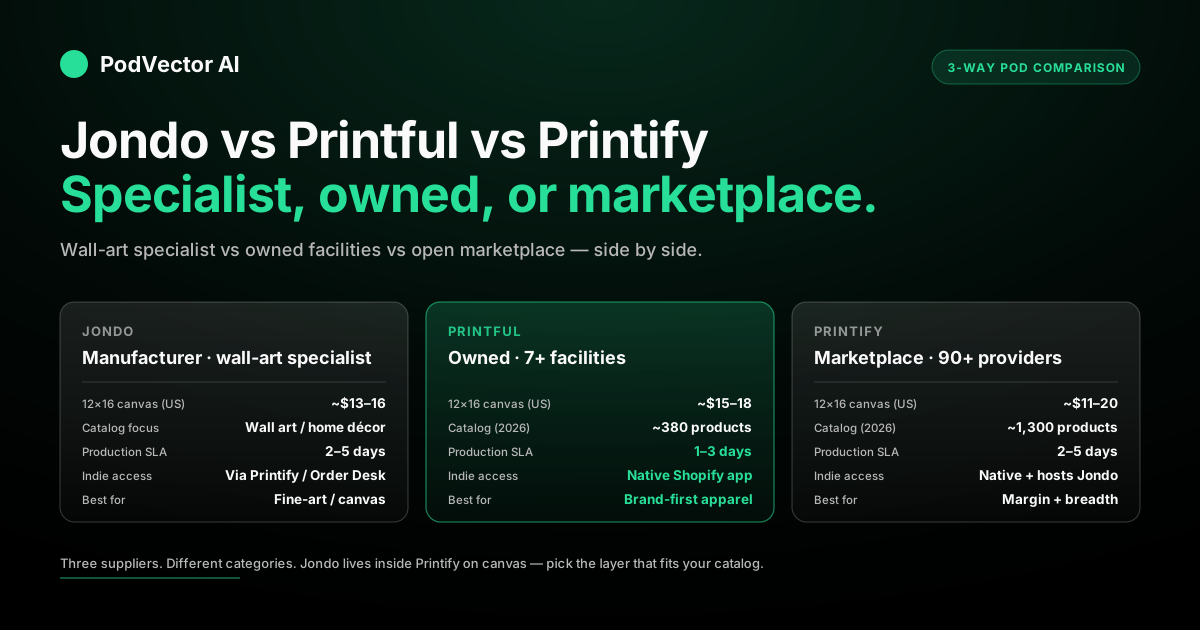
Quick Answer: A correct Jondo vs Printful vs Printify comparison starts with one fact most guides miss — Jondo isn't a peer competitor to the other two. Jondo is a wall-art and home-décor specialist that POD sellers reach mostly through Printify as one of its print providers, or via direct B2B integration. Printful and Printify are the two indie-seller platforms; Jondo is a manufacturer behind one of them.
For apparel-heavy stores, the real question is Printful vs Printify. For wall-art and fine-art catalogs, the real question is whether to use Jondo through Printify, through Order Desk, or via a direct B2B account.
Below is the side-by-side framework — production model, pricing, catalog, quality, fulfillment, integrations — plus the per-SKU profitability question no platform-level comparison can answer.
The three production models explained
The single fact that explains every other difference between these three: they don't run the same production model — and Jondo isn't even in the same category as the other two.
Printful runs its own facilities. A global network of roughly 15 print and fulfillment centers across four continents — owned and operated centers plus a handful of vetted partner sites — spanning the US, EU (Riga and Barcelona), Mexico, Japan, Australia, and Canada. Every order routes through a Printful-controlled workflow with Printful-trained staff and Printful-owned machines. Quality control is one set of standards applied uniformly.
Printify is an open marketplace. When a customer orders, Printify routes the line item to whichever provider you picked when listing the product — Monster Digital, SwiftPOD, Drive Fulfillment, Dimona, and roughly 90 others across 140+ locations. Providers compete on base price inside the catalog. The marketplace doesn't enforce a quality floor; the seller does.
Jondo is a print manufacturer, not a POD platform. A 30+ year company built around premium wall art and home décor — canvas prints, framed prints, metal prints, acrylic prints, paper prints, pillows, and blankets — with regional facilities across three continents. Jondo serves three customer types: POD platforms (Printify is the biggest one), B2B and enterprise clients with direct API integrations, and artists routing orders through Order Desk or the Sensaria GO platform.
That's the part most comparison guides get wrong. Jondo doesn't compete with Printify the way Printful does. Jondo is inside Printify as a print provider you can choose for canvas and framed art. The honest question for most POD sellers isn't "Jondo or Printify" — it's "if I'm using Printify, do I pick Jondo or one of the other wall-art providers in the catalog?"
Side-by-side snapshot table
Every axis is unpacked in its own section below. This is the 30-second version.
| Axis | Jondo | Printful | Printify |
|---|---|---|---|
| Model | Manufacturer (B2B + Printify provider) | Owned + partner network (~15) | Open marketplace (~90 providers) |
| Indie-seller access | Via Printify or Order Desk only | Native platform with Shopify/Etsy app | Native platform with Shopify/Etsy app |
| Bella+Canvas 3001 tee, US base | Not in catalog (no DTG apparel) | $12.95 / ~$9.50 with Growth | $10.95 Free / $8.95 Premium |
| 12×16 canvas print, US base | ~$13–16 (via Printify or direct) | ~$15–18 | ~$11–20 depending on provider |
| Subscription | None — B2B contracts or Printify tier | Growth $24.99/mo, up to 33% off | Premium $24.99/mo, up to 20% off |
| Catalog focus | Wall art, fine art, home décor only | ~380 products (apparel-heavy) | ~1,300 products (full mix) |
| Median production SLA | 2–5 business days | 1–3 business days | 2–5 business days (provider-dependent) |
| International routing | Multi-continent facilities, B2B routed | Auto across 7+ owned facilities | Manual — list SKUs through multiple regional providers |
| Quality on canvas/framed art | High — fine-art specialist | Medium — generalist coverage | Variable — Jondo is one of the better providers in catalog |
| Native Shopify app | No | Yes | Yes |
| Best for | Wall-art stores routed via Printify or direct B2B | Brand-first apparel stores, paid social, US/EU | Broad catalog, margin-first, organic Etsy |
Pricing and subscription tiers
Pricing is the axis sellers fixate on first. We'll cover it properly here, then move on — because the cheapest base cost is rarely the most profitable supplier.
Base costs, head-to-head
Jondo doesn't run a public consumer price list. The catalog prices you see depend on where you reach Jondo from — Printify, Order Desk, Sensaria GO, or a negotiated B2B contract. Inside the Printify catalog, Jondo SKUs start as low as roughly $1.93 for small paper prints, so the "premium specialist" label doesn't mean an expensive entry point on the small-format end — the cost weight sits in large canvas and framed pieces.
On a benchmark 12×16 canvas gallery wrap shipping in the US:
- Jondo via Printify Free: ~$15.50
- Jondo via Printify Premium ($24.99/mo, up to 20% off): ~$13–14
- Jondo via direct B2B contract: negotiated — typically $11–13 at volume
- Printful canvas (no subscription): ~$17.95
- Printful Growth ($24.99/mo, up to 33% off): ~$13.50
- Printify alternative canvas providers: $11–20 depending on which provider you select
On apparel, Jondo isn't in the conversation — there's no DTG t-shirt, no hoodie, no embroidered cap in the Jondo catalog. For the apparel comparison, Printify Premium is the cheapest at $8.95 on a Bella+Canvas 3001 tee, Printful Growth lands around $9.50, and Jondo simply doesn't compete in that category.
Subscription math
Jondo has no public subscription tier for indie sellers. If you access Jondo through Printify, your discount comes from Printify Premium ($24.99/month, up to 20% off). If you go direct B2B, pricing is negotiated against volume commitments and there's no monthly fee in the way.
- Printful Growth recovers its $24.99 in roughly 8 tee-equivalents per month at 33% off.
- Printify Premium recovers $24.99 in roughly 12 tee-equivalents per month at 20% off — and this is also the path to discounted Jondo pricing inside the marketplace.
- Jondo B2B direct has no recurring fee but typically requires a monthly volume floor (varies by account).
For low-volume wall-art sellers, Printify Free with Jondo selected as the provider is the cleanest starting point. For mid-volume sellers doing 50+ canvas orders a month, Printify Premium starts paying for itself. For high-volume operators doing 500+ wall-art orders monthly, a direct Jondo B2B contract is worth pricing out.
The all-in cost most comparisons skip
Sticker price is one line in your unit P&L. The full picture includes shipping (paid by customer or by you, varies by region), platform fees, refund allowance for defects, and ad spend amortized per order.
Wall art has a unique cost profile compared to apparel. A 16×20 canvas is heavier, larger, and more expensive to ship than a folded tee — often $12–18 in carrier cost domestically, $25–40 internationally. A 2-point shift in defect rate on a $15 canvas costs you more dollars per order than the same shift on a $5 mug.
For the line-by-line cost picture on Printful's side specifically, see the Printful API pricing full breakdown and the Printful base cost t-shirt full breakdown.
Product catalog
Catalog shape is where the three diverge hardest — and where most beginner POD sellers misread the trade-off.
Jondo (wall art and home décor only): stretched canvas (multiple sizes from 8×10 up to 30×40+), framed canvas, paper prints and posters, metal prints, acrylic prints, throw pillows, blankets, and personalized home décor pieces. No t-shirts, no hoodies, no mugs, no drinkware. The catalog is narrow on purpose — Jondo built its expertise around fine-art reproduction, color management, and large-format finishing rather than chasing breadth.
Printful (~380 products): standard apparel (tees, hoodies, sweatshirts, hats), drinkware, basic wall art including canvas and posters, embroidered goods. Every SKU is reviewed and mockup-tested by Printful's in-house team before listing. The wall-art slice exists but isn't the depth or finish quality you get from a specialist like Jondo.
Printify (~1,300 products): roughly 3.4x the Printful catalog. Strong in all-over-print apparel, framed canvas at unusual sizes, ceramic mugs from multiple makers, pet products, phone cases, niche home goods. Critically, Printify's wall-art catalog includes Jondo as one of the providers you can select per SKU — alongside Wall Art Garage, Sensaria, and others. You get Jondo's quality inside Printify's marketplace shell.
For a brand-led apparel store, Printful's catalog is enough and you can ignore Jondo entirely. For a broad catalog tester, Printify's breadth is decisive — and you can dial up Jondo specifically on canvas SKUs while running other providers for everything else. For a pure wall-art catalog, Jondo (via Printify, Order Desk, or direct) is the right specialist; Printful's wall-art finish is fine but not the same league.
Print quality and consistency
All three produce quality work in 2026. The right framing isn't "which prints better" — it's "which is most consistent for the customer-experience profile you need, in the product category you're actually selling."
Printful runs the same Kornit Atlas and Avalanche printers, the same garment-prep workflow, and the same QA pass across every owned facility. A Riga-printed shirt and a Charlotte-printed shirt come out within tight tolerances. On canvas and wall art specifically, Printful's output is solid but generalist — color accuracy is good, wrap quality is acceptable, but the finish isn't the fine-art-gallery standard a specialist delivers.
Printify's quality is provider-specific. The 90+ provider network ranges from top-tier (Monster Digital on apparel, Jondo on canvas, Drive Fulfillment on embroidery) down to lower-tier providers with visibly worse output. Provider-selection discipline is mandatory, not optional. The good news: if you pick Jondo as your Printify canvas provider, you're getting fine-art-grade output inside a marketplace shell.
Jondo's quality is the specialist case. 30+ years of fine-art reproduction means tight color management (typically ICC-profiled workflows), gallery-grade canvas wrapping with hand-applied finishing on premium tiers, and consistent output across the multi-continent facility network. On canvas, framed prints, metal, and acrylic, Jondo's reputation sits at the top of the POD-accessible wall-art market — not as good as a dedicated boutique fine-art printer charging 3x more, but meaningfully better than the median POD canvas provider.
Defect-rate variance compounds in unit economics. Printful's roughly 1% reprint rate is stable. Printify's reprint rate ranges from 1% (top-tier providers including Jondo) to 4–5% (lower-tier providers). Jondo's reprint rate sits in the 1–2% band based on operator reports, with the failure mode usually being shipping damage on large canvases rather than print error. On a 200-orders-a-month canvas store, the gap between 1% and 4% reprint rate is $30–60 of margin a month plus the customer-experience hit.
Fulfillment and shipping
Production speed and shipping cost are two halves of the same axis. Wall art has a different profile than apparel here — canvas is slower to produce, harder to ship, and more sensitive to damage in transit.
Production SLA
Printful publishes 1–3 business days and hits it consistently across owned facilities. On canvas specifically, expect the upper end of that window — gallery wraps take longer than DTG tees.
Printify publishes 2–5 business days. Actual experience depends on the provider. Jondo as a Printify provider typically runs 2–4 business days on canvas and framed art, which is competitive with Printful's wall-art SLA.
Jondo direct (via B2B or Order Desk) publishes 2–5 business days for most wall-art categories. Operator-reported averages run 3–5 business days during normal periods and longer during seasonal peaks (Q4 wall-art ordering is a serious spike for gift purchases).
Regional routing
Printful auto-routes each order to the nearest facility in its ~15-site network (US East, US West, EU/Riga, EU/Spain, MX, JP, AUS, CA, and additional partner sites). For a US-heavy store, 60–80% of orders ship domestically with no setup work. For an EU-weighted store, EU orders ship from Riga or Barcelona automatically.
Printify routes each order to whichever provider you picked when listing the product. If you listed a canvas through a US-based provider and the order ships to Germany, that order goes international — slow and expensive — unless you also listed the same SKU through a Printify EU provider.
Jondo operates regional facilities across three continents (North America, Europe, Asia-Pacific based on company materials). For B2B accounts and Sensaria GO users, Jondo manages the routing on its end. For sellers accessing Jondo through Printify, regional routing depends on whether Jondo has a facility configured in that region of the Printify catalog — typically US-strong with some EU coverage.
Shipping cost on wall art specifically
Canvas shipping is the cost most apparel-trained POD sellers underestimate. A 16×20 stretched canvas costs $12–18 to ship domestically in the US, $25–40 internationally. A 24×36 canvas can run $20–30 domestic and $50+ international. Customers expect free shipping on art under $50, which means you absorb the shipping cost into the base price — and a $4 base-cost win evaporates fast against a $10 shipping cost surprise.
Jondo's regional facility network helps here for international orders — a UK customer ordering a canvas via Jondo's EU facility ships within-region rather than US-to-UK, saving meaningful dollars. Printful's auto-routing does the same thing on a smaller wall-art catalog. Printify's regional setup depends on whether you listed your canvas through multiple regional providers.
Integrations and storefronts
Printful has the broadest and tightest integration set of the three. Native Shopify, Etsy, WooCommerce, eBay, TikTok Shop, Wix, Squarespace, Amazon (US), and a robust API for custom builds. Variant sync, mockup generation, and fulfillment status updates run with the fewest edge cases.
Printify keeps pace on Shopify, Etsy, WooCommerce, eBay, and TikTok Shop. Crucially, Printify is also the easiest path to Jondo for indie sellers — you get Shopify-native integration on the Printify side, with Jondo running fulfillment behind the scenes when you select it as your provider on a wall-art SKU.
Jondo direct has a meaningfully thinner integration story for indie sellers. There's no native Shopify app branded as "Jondo." Direct integration paths are Order Desk (third-party order routing app that connects Shopify/Etsy/WooCommerce to Jondo), Sensaria GO (Jondo's own order-management platform aimed at photographers and artists), and the OnePoint API (B2B integration for enterprise clients). For a Shopify or Etsy seller who doesn't want the middleware overhead, accessing Jondo through Printify is the path of least resistance.
Branding and customization
Printful's branding options are the deepest for apparel and apply uniformly. Custom packing slips, branded stickers, branded inside-collar labels, and pack-in marketing inserts work on every order regardless of which Printful facility fulfills it.
Printify's branding options are provider-specific. Some providers support packing slips with your logo; some don't. When using Jondo as your Printify canvas provider, branded packing slips are typically available, but inside-product branding (the equivalent of inside-collar relabel on apparel) doesn't really apply on canvas anyway.
Jondo direct (via B2B or Sensaria GO) is unusually strong on white-label and custom packaging — branded boxes, custom inserts, and bulk packaging configurations built for B2B and gallery clients. The strength shows up at volume; low-volume indie sellers reaching Jondo through Printify get a more standard packaging experience.
Pros and cons summary
Jondo — pros
- Specialist-grade fine-art reproduction with color-managed workflows.
- Multi-continent facility network — better international shipping economics on wall art than US-only providers.
- Available as a Printify provider, so you can use Jondo quality inside a Shopify-native marketplace shell.
- Strong B2B and white-label options for high-volume gallery and reseller clients.
- Lower defect rate on canvas and framed art than the median POD wall-art provider.
Jondo — cons
- No DTG apparel, no drinkware, no embroidered goods — wall art and home décor only.
- No native Shopify app branded as Jondo; you reach Jondo via Printify, Order Desk, or B2B integration.
- Limited public pricing — actual base costs depend on which channel you use.
- Smaller indie-seller community and fewer tutorials than Printful or Printify.
- Sensaria GO and Order Desk add middleware complexity vs. native Shopify integration.
Printful — pros
- Consistent quality across every order, every facility, every SKU.
- Tighter Shopify, Etsy, and TikTok Shop integrations with cleaner mockups.
- Native branded inserts, packing slips, and inside-collar relabel on every order.
- Auto-routing across a ~15-facility network — minimal seller config.
- Lower defect and reprint rate on apparel, which matters disproportionately on paid social.
Printful — cons
- Base costs run $1–7 higher than Printify per garment depending on category.
- Wall-art catalog is generalist — fine for a brand selling tees that also sells some canvas, weaker for a wall-art-first catalog.
- Smaller overall catalog (~380 products) than Printify.
Printify — pros
- Lower base costs across most categories, especially on Premium tier.
- ~1,300 product catalog with deep coverage of all-over print, ceramics, pet products, niche home goods.
- Provider choice on wall art — you can route canvas through Jondo and keep margin on other SKUs.
- Multi-provider network lets you set up regional routing for cheaper international shipping (with setup work).
Printify — cons
- Quality varies by provider — sample-ordering discipline is mandatory.
- Branding inserts and inside-collar relabel are provider-specific and partial.
- International routing requires the seller to list SKUs through multiple providers.
- Defect rates on lower-tier providers can run 3–5%, silently killing paid-social unit economics.
Decision matrix: pick X if Y
The framework collapses cleanly into decision rules.
Pick Printful if:
- You're building a brand-led apparel store where consistency is part of the product.
- Your traffic is US-weighted or US/EU-split and you want auto-routing with zero per-SKU setup.
- Your product mix lives in apparel + drinkware + basic wall art and you don't need fine-art-grade canvas.
- You run paid social where return rates above 5% kill the unit economics.
Pick Printify if:
- You're optimizing for margin and willing to do per-provider sample-ordering.
- Your product mix needs catalog breadth Printful doesn't cover — all-over print, niche home goods, pet products.
- You run organic Etsy or TikTok Shop where unit economics are thin and $2–4 per order matters.
- You want Jondo-grade canvas quality without the direct-B2B integration overhead.
Pick Jondo (via Printify) if:
- Your store is wall-art-heavy and you want a fine-art specialist behind your canvas SKUs.
- You're a Shopify or Etsy seller who doesn't want to deal with Order Desk middleware.
- You're already on Printify and just need the right provider for canvas, framed art, and metal prints.
Pick Jondo direct (B2B or Sensaria GO) if:
- You're a photographer, gallery, or art-licensing business with predictable monthly volume.
- White-label packaging and custom inserts are part of your customer experience.
- Your catalog is 95%+ wall art and you don't need POD platform tooling for apparel.
For most indie POD sellers, the decision isn't actually "Jondo or Printful or Printify." It's "Printful or Printify for the apparel-heavy default — and if I'm doing serious canvas volume, run Jondo as my Printify provider on those SKUs." See the broader Printful vs Printify quality breakdown and the Printful vs Printify quality reviews for the apparel-side framing.
Where Jondo actually fits in 2026
Most Jondo vs Printful vs Printify comparisons treat the three as direct competitors. They aren't, and that's the part the SERP keeps missing.
Jondo was built for a different customer than Printful or Printify. The original product targets photographers, fine artists, galleries, B2B reseller networks, and POD platforms that want a specialist manufacturer behind their wall-art catalog. Indie Etsy and Shopify hobby sellers are a secondary audience reached via Printify or Order Desk, not the core.
That positioning shows up everywhere — no DTG apparel, no embroidery, narrower indie-seller integrations, deeper fine-art finishing options, and pricing that hides behind channel-specific contracts. Operator reviews calling Jondo "hard to access" or "fewer products than Printful" are usually comparing it on the indie-seller axis where it isn't trying to compete.
Where Jondo beats both is on wall-art quality, fine-art reproduction, and the specialist case for stores whose catalog is 50%+ canvas, framed art, or metal prints. Where it loses is on the indie-seller default — Shopify or Etsy store, paid-social-driven, US-EU split, mostly apparel. For that profile, Printful or Printify is the right pick, and if you sell some canvas alongside the apparel, Jondo as a Printify provider gives you the specialist quality without leaving the marketplace.
One specific case where Jondo-via-Printify pulls ahead: UK and EU-weighted wall-art stores. Jondo's regional facilities let a canvas order ship within-region instead of crossing the Atlantic, which is why UK sellers routing canvas through Jondo on Printify often see faster delivery and lower shipping cost than a US-only provider can offer — a routing edge that matters more on a bulky $15 canvas than on a folded tee.
The most underrated path for serious wall-art sellers in 2026 is the Printify + Jondo combination — Printify-native Shopify integration on the front, Jondo's fine-art-grade output on the back, no Order Desk middleware. Compare the Printful vs Printify Reddit operator threads for the unfiltered take on this routing approach from sellers running it in production.
The per-SKU profitability question
Every comparison guide above — including this one — treats the choice as category-level. That framing produces a category-level answer: pick Printful for apparel quality, Printify for catalog breadth and margin, Jondo for wall-art specialist work.
The actual question every POD seller has to answer is per-SKU. On your 16×20 gallery wrap canvas in matte finish, shipping to your top region, with your ad-blended customer acquisition cost, which supplier produces a higher contribution dollar per order? The answer flips by product, size, region, volume, and season.
None of the public comparison articles fill this gap. They quote averages — $4 base-cost difference, 99% accuracy, 2–5 day fulfillment — and stop there. Your P&L runs on specifics, not averages.
Closing the gap takes three pieces working together. Every order's supplier-charged cost has to flow into a single source of truth alongside revenue, ad cost, refunds, and processor fees. The math has to run per-SKU and per-supplier so a canvas that's profitable on Jondo and a tee that's profitable on Printify both show up clearly. The answer has to surface fast enough to act on — switching a single SKU's supplier weekly is high-leverage if the data is fresh, useless if it's a quarter old.
This is the architecture PodVector AI built Victor on — a unified live data store that ingests Shopify, Printful, Printify (including Jondo SKUs routed through Printify), Meta, and Google per-order data, then lets you ask "which supplier is more profitable on my 16×20 canvases shipping to the UK?" in plain English. Victor doesn't just answer the question — he proposes specific Shopify actions (price changes, BXGY discounts, collection creation) and executes them on approval, with a full audit trail. The answer isn't always Printful, always Printify, or always Jondo. The answer is per-SKU, and a POD seller without per-SKU supplier data is guessing on the most expensive lever in the business.
FAQs
What's the cleanest one-line Jondo vs Printful vs Printify comparison?
Jondo is a fine-art wall-décor manufacturer you reach mostly through Printify, Order Desk, or B2B. Printful is owned-facility full POD with consistent quality at a higher base cost. Printify is an open marketplace with lower base costs, broader catalog, and quality that depends on which provider you pick. Jondo isn't a peer competitor to the other two — it's a specialist supplier inside the category.
Is Jondo a Printify provider?
Yes. Jondo is one of the print providers you can select inside the Printify catalog for wall art and home décor SKUs. For most indie sellers, this is the easiest way to use Jondo — Shopify-native integration on the Printify side, Jondo quality on the manufacturing side, no Order Desk middleware required.
Which is cheapest for canvas prints?
It depends on the size and region. On a 12×16 canvas shipping in the US, Printify with a budget provider can land as low as $11; Jondo via Printify lands around $13–16 depending on tier; Printful canvas sits around $15–18 without subscription. Cheapest base cost isn't the same as highest contribution margin once you factor defect rates and shipping cost on large pieces.
Does Jondo do t-shirts?
No DTG apparel. Jondo's catalog is wall art and home décor — canvas, framed prints, paper prints, metal, acrylic, pillows, and blankets. For tees, hoodies, and embroidered goods, Printful or Printify is the right answer.
How does Jondo compare on quality vs Printful?
On wall art and fine-art reproduction, Jondo's specialist focus typically beats Printful's generalist coverage — better color management, gallery-grade canvas wrapping, lower defect rate on large pieces. On apparel, the comparison doesn't apply because Jondo doesn't make apparel. Sample-order both before committing for canvas if quality is your hard constraint.
Can I run all three suppliers in the same store?
Yes — and for serious wall-art sellers, this is actually the optimal setup. Printful for branded apparel and consistency on hero apparel SKUs. Printify (with provider mix) for catalog breadth on niche products. Jondo as your Printify-selected provider on canvas, framed art, and metal prints where the specialist quality matters. All three integrate cleanly via the Printful Shopify app + Printify Shopify app combination.
Why is Jondo harder to compare on pricing?
Jondo's pricing is channel-specific rather than published as a public catalog. The price you see depends on whether you reach Jondo through Printify (marketplace pricing with subscription discount), Order Desk (third-party routing), Sensaria GO (Jondo's own platform), or a direct B2B contract (negotiated volume tiers). Printful and Printify both publish base pricing in a public catalog with subscription multipliers — Jondo doesn't.
Which is best for international shipping on wall art?
Jondo's multi-continent facility network is competitive for international wall-art orders, with regional facilities that can ship within-region rather than US-to-international. Printful's auto-routing covers a smaller wall-art catalog across more owned facilities. Printify depends on whether you listed your canvas SKUs through multiple regional providers. For a wall-art-heavy international catalog, Jondo via Printify or Jondo direct is usually the right routing answer.
Is Jondo still relevant in 2026 vs Printful and Printify?
Yes, but for a narrower customer than the other two. The fine-art and wall-art specialist case is real and underserved by Printful (generalist) and Printify (marketplace with quality variance). For that niche, Jondo earns its place — typically reached via Printify rather than direct integration. Outside the wall-art use case, Printful or Printify is almost always the right answer.
Stop comparing platforms. Compare suppliers per SKU.
The right Jondo, Printful, or Printify answer changes by garment, size, region, and season. Spreadsheet comparisons go stale within weeks. Victor pulls every order, every supplier-charged cost, every ad spend, and every refund into one live data layer — then answers "which supplier is more profitable on my 16×20 canvases shipping to the UK?" in plain English and proposes the Shopify move to act on it (price change, discount, collection), executing on your approval. An operator that closes the loop, not another dashboard to read.
Try Victor freeFor a wider POD supplier roundup that covers Jondo alongside the other major options, the Michael Essek POD companies guide provides an independent operator's view of the category. The full Printful comparison cluster lives at the Printful comparison hub, and the broader Printful topic at the Printful topic hub.