
Quick Answer: The biggest difference between Printful and Printify is the business model. Printful runs its own factories. Printify is a marketplace of 90+ independent print shops. Everything downstream — cost, quality variance, shipping, branding, catalog size — flows from that one structural fact.
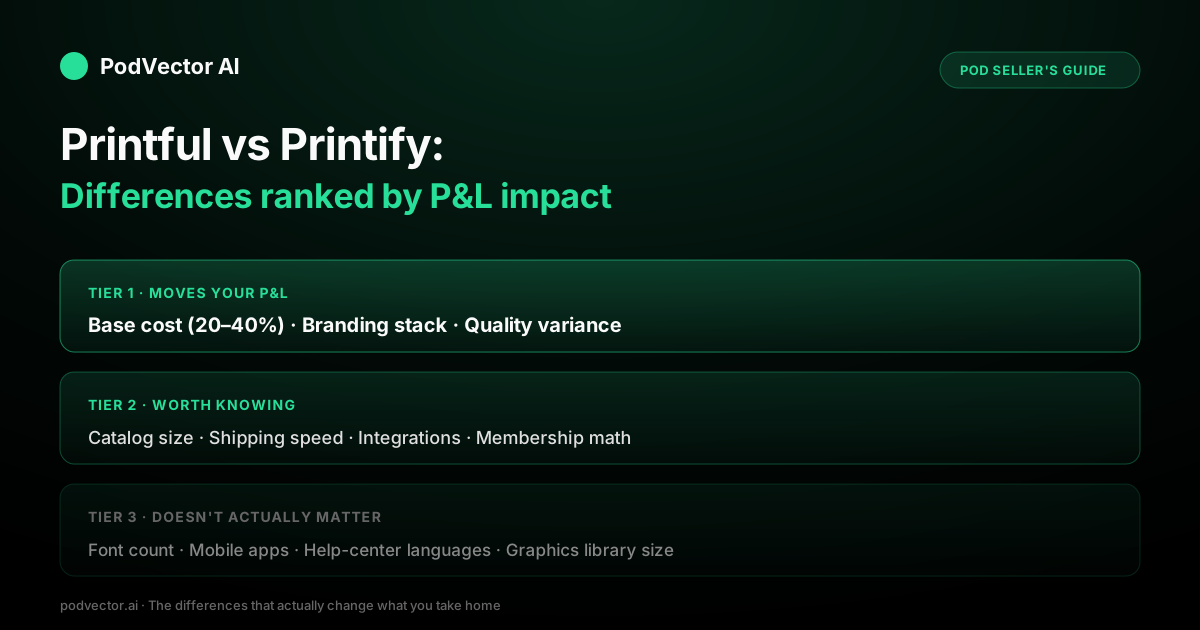
For a POD seller running real volume, three differences actually move your P&L: base cost (Printify is 20–40% lower), branding capability (Printful has the full stack), and quality variance (Printful is consistent, Printify is provider-dependent).
The other dozen "differences" the comparison articles list — font count, mobile apps, help-center languages — are operationally irrelevant. This guide ranks the differences by what actually matters when you're shipping orders.
The one core structural difference
Printful is a vertically integrated print-on-demand company. It owns eight factories — Charlotte, Los Angeles, Dallas, Tijuana, Riga, Birmingham, Toronto, Sydney. Every order ships from a Printful building, on Printful's equipment, by Printful's staff.
Printify is a marketplace. It doesn't print anything. The company operates the catalog, mockup generator, and order-routing software, then hands the actual printing off to one of 90+ independent print shops located across the US, EU, UK, Australia, and Asia.
That is the difference. Every other difference you'll read about — cost, quality, branding, shipping, even the catalog size — is a consequence of that one structural choice. Once you internalize that, the rest of the comparison stops being a list of disconnected facts and starts being a chain of cause and effect.
Tier 1 differences that move your P&L
These are the three differences that actually change your operating numbers. If you're picking a platform, these are the only three that should drive the decision.
Difference 1: Base cost — Printify is 20–40% lower
On a standard Gildan 64000 unisex t-shirt printed front-only via DTG, Printify's mid-tier providers land around $7.45 per shirt. Printful charges $11.95. That's a $4.50 gap on a single SKU before shipping.
The gap holds across most apparel SKUs, narrows on premium garments, and widens on lower-cost basics. Across an average POD catalog, Printify will be 20–40% cheaper on base cost. At 100 orders a month, that's $400–$500 in extra gross margin. At 500 orders, it's $2,000–$2,500.
This is the single biggest difference in dollars-per-order, which makes it the difference most new operators should weight heaviest. The deeper read on these numbers lives in our Printful vs Printify pricing comparison.
Difference 2: Branding capability — Printful has the full stack
Custom neck labels, inside labels, branded packing slips, branded inserts, custom packaging tape — Printful does all of these on every order, consistently, across every facility. The cost is built into the per-item price; you don't pay extra per branded element.
Printify offers some of these via specific providers, but the availability varies by provider, the quality varies by provider, and the consistency across orders varies by provider. If your brand depends on the unboxing — which is true for repeat-customer DTC stores — Printful's branding stack is materially better.
For sellers running Etsy or marketplace traffic where the buyer doesn't care about packaging, this difference is irrelevant. For sellers building a DTC brand, it's a defining one.
Difference 3: Quality variance — Printful is predictable, Printify is provider-dependent
Printful's published return rate sits around 0.2%. The variance between any two Printful orders of the same SKU is tiny — every facility runs the same QA standard.
Printify's quality is provider-dependent. Monster Digital's Bella+Canvas 3001 is a different product, from a different facility, on different equipment, than Marco Fine Arts' Bella+Canvas 3001 — even though Printify shows them under the same listing. A great provider on Printify matches Printful quality. A mediocre provider generates chargebacks.
The operator skill on Printify is provider selection (and sample ordering before scaling a SKU). Sellers who skip that step almost always end up with refund rates in the 3–8% range. Sellers who do it well land near Printful's variance — at Printify's lower base cost.
Tier 2 differences worth knowing about
These four differences matter at the margin. They're not the primary driver of the platform choice, but they will affect your operations in real ways.
Catalog size — Printify is ~1,300 products vs Printful's ~370
Printify aggregates whatever its 90+ providers can manufacture. That gives it about 1,300 distinct products in 2026, spanning apparel, accessories, home goods, drinkware, pet products, seasonal items. Printful's catalog is narrower — about 370 products — because every SKU has to be one Printful can produce in-house.
Whether this difference matters depends on what you sell. If you sell t-shirts, hoodies, and mugs, Printful's catalog is sufficient and you'll never notice the gap. If you sell into niches that require all-over-print joggers, specific drinkware shapes, or seasonal items, Printify's depth is non-negotiable.
Shipping speed and geography
Printful fulfills orders in 2–5 business days on average, with consistent turnaround across facilities. Printify ranges from 2–7 business days depending on the provider.
The bigger difference is geography. Printful's eight owned facilities cover North America, EU, UK, and Australia with predictable routing. Printify's network reaches further into Asia and South America, which matters if you sell internationally outside the major Western markets.
Sales channel integrations
Printful integrates with about 19 sales channels — Shopify, Etsy, eBay, Amazon, WooCommerce, Wix, BigCommerce, TikTok Shop, Squarespace, and others. Printify integrates with about 10. Both cover the major channels.
The integration that doesn't exist on either is "all of them simultaneously without breaking your inventory schema," which is a problem for multi-channel sellers regardless of which platform they pick. Most operators end up with one source-of-truth store and use the platforms' integrations to mirror to secondary channels.
Membership economics
Printful Growth costs $24.99/month and gives up to 33% off base costs plus free embroidery digitization. Printify Premium costs $29/month and gives roughly 20% off base costs. Both pay back at modest order volume — around 30 orders/month for Printful Growth, 50 orders/month for Printify Premium — but only on orders that actually use the respective platform.
Tier 3 differences that don't actually matter
Comparison articles love these because they fill space. They almost never affect a POD seller's P&L. Skim them and move on.
- Font count in the mockup tool. Printful offers 700+ fonts, Printify around 350. Both numbers are way more than any seller actually uses. Your real font count is the 3–5 fonts that match your brand.
- Built-in graphics library size. Printful: 25,000+. Printify: ~200. Almost no successful POD seller uses platform-stock graphics — original art wins.
- Mobile app availability. Printful has iOS and Android apps. Printify has a beta Android app. You do not operate a POD business from your phone. The desktop app is what matters.
- Help-center language count. Printful supports six languages, Printify is English-only. Almost every POD seller can read English; this is a corporate-procurement-checklist concern, not an operator concern.
- Number of "premium tier" features. Both platforms have a paid tier. The discount math is what matters. The bullet-point feature list is marketing copy.
- Warehousing services. Printful offers warehousing with a $150+ minimum. Printify does not. If you need warehousing, you are no longer running a pure POD model and you should pricecompare against actual 3PLs.
The full difference matrix
For sellers who want every dimension side-by-side, here's the consolidated table:
| Dimension | Printful | Printify |
|---|---|---|
| Business model | In-house factories | Marketplace of providers |
| Facilities | 8 owned | 90+ independent providers |
| Catalog size | ~370 products | ~1,300 products |
| Base cost (apparel avg) | 20–40% higher | 20–40% lower |
| Quality variance | Low, predictable | Provider-dependent |
| Branding stack | Full (labels, inserts, packaging) | Limited, provider-dependent |
| Production time | 2–5 business days | 2–7 business days |
| US shipping (1st item, tee) | ~$4.99 | ~$4.50 |
| International shipping | Cheaper on most lanes | Cheaper into Asia / South America |
| Sales channel integrations | ~19 | ~10 |
| Free plan | Yes (1 store) | Yes (5 stores) |
| Paid plan | Growth, $24.99/mo, up to 33% off | Premium, $29/mo, ~20% off |
| Warehousing | Yes ($150+ minimum) | No |
| Sample discount | 20% off | None |
| Published return rate | ~0.2% | Not disclosed |
Which differences should drive your decision
If you internalize the Tier 1 / Tier 2 / Tier 3 framework, the decision becomes mechanical. Three operator profiles cover most cases:
Profile A: New seller testing niches. Tier 1 differences favor Printify — lower base cost protects you while you're still figuring out what sells. Start on Printify, master the provider-selection workflow, and revisit Printful once you have repeat-buyer SKUs.
Profile B: DTC brand with repeat customers. Tier 1 favors Printful's branding stack. The cost premium is real but it's a marketing investment in retention. If your repeat-purchase rate is above 15%, Printful's consistency starts paying back through reduced refund rates and stronger unboxing reviews.
Profile C: Mid-scale operator on multiple channels. Use both. Map each SKU to the platform that fits its margin profile and branding requirement. The dual-platform workflow is covered in the Printify-first operator guide.
For the head-to-head opinion read, see which is better: Printify or Printful.
Measuring the differences in your own numbers
The list-based comparison is useful for the platform decision, but it doesn't tell you what your specific store's per-order P&L looks like once you're running real volume. That requires measuring the costs as they actually land — not as they're listed in marketing copy.
True per-order margin is retail price minus base cost minus shipping minus payment processor fees minus return reserves minus attributable ad spend minus amortized platform memberships. Most POD operators measure two or three of those and stop. The result is a P&L that looks healthy at gross level and quietly hemorrhages at net.
The pattern that holds for operators above $10k/month is to pipe Shopify, Printful, and Printify order data into a single data layer — a live data warehouse where one row equals one order with every cost line itemized. Then run margin queries off that layer.
That's the work Victor — PodVector AI's AI operator for POD sellers — automates. Connect Shopify and your fulfillment platforms once, and the agent maintains the per-order P&L across both. Ask it "what's my real margin on SKU X this month?" and it returns a number that nets out every cost line, not the two most operators stop at. Start a free Victor account if you don't want to build the data layer yourself.
Does the 2025 merger collapse the differences?
Printify and Printful jointly announced a planned merger in late 2025. As of mid-2026, the two platforms still operate independently — separate logins, separate catalogs, separate pricing, separate provider networks. None of the differences above have collapsed yet.
The long-term implication is plausible unification of catalog and routing. The short-term implication is: nothing has changed. The differences in this guide are still operative. We track the merger's actual integration milestones in our did-Printful-and-Printify-merge breakdown.
FAQs
What's the single biggest difference between Printful and Printify?
The business model. Printful owns its factories. Printify is a marketplace that routes your orders to independent print shops. Every cost, quality, branding, and shipping difference flows from that one structural choice.
How much cheaper is Printify than Printful?
Roughly 20–40% on apparel base cost. On a standard Gildan 64000 t-shirt, that's about $4.50 per shirt before shipping. At 100 orders/month it's $400–$500 in extra gross margin; at 500 orders, $2,000–$2,500.
Is Printful really higher quality than Printify?
Printful is more consistent, not necessarily higher peak quality. A great Printify provider matches Printful's quality at lower cost. A mediocre Printify provider generates refunds. The operator skill is provider selection — if you do it well, you get Printful-level quality at Printify-level cost.
Which platform has more products?
Printify has about 1,300 products versus Printful's ~370. The gap matters if you sell into niches Printful doesn't cover (all-over-print joggers, certain drinkware, seasonal items). If you sell standard t-shirts, hoodies, and mugs, both catalogs are sufficient.
Which is better for international shipping?
It depends on the destination. Printful is cheaper on most US-to-EU and intra-EU lanes thanks to its Riga and Birmingham facilities. Printify is cheaper into Asia and South America thanks to its broader provider network. Map your customer geography against each platform's facility list before committing.
Does the merger change which platform I should pick?
Not in 2026. Both platforms still operate independently with separate catalogs, pricing, and accounts. Make the platform decision on today's differences, and revisit if and when the combined entity ships actual unified tooling.
Should I use both Printful and Printify together?
Yes, if you're above ~$5k/month in POD revenue. Map each SKU to the platform that fits its margin and branding profile — Printify for catalog-breadth and lower-margin SKUs, Printful for branded reorder SKUs. The dual-platform workflow is covered in our Printify-first guide.
Where can I read more comparisons?
See our which is better head-to-head, the Etsy-specific comparison, and the pricing-only comparison. The Printful topic hub collects every related guide. For an external read, the Shopify blog comparison covers the structural differences from a platform-agnostic angle.
Stop guessing which differences actually matter for your store
Most POD comparison content lists 15 differences without telling you which three move your P&L. The right answer is store-specific — and it depends on your SKU mix, customer geography, and refund rate.
Victor connects your Shopify, Printful, and Printify accounts, then surfaces which differences actually affect your margin. Ask it "would switching this SKU to Printful improve my net margin?" and it answers with your numbers, not a generic comparison table.
Try Victor free