
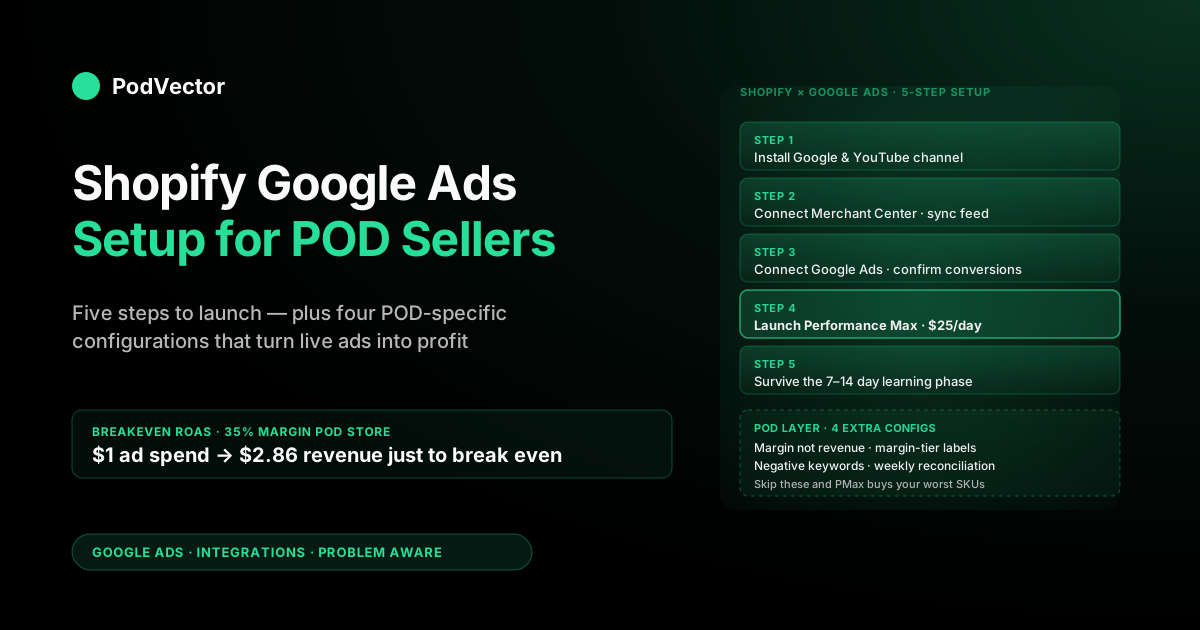
Quick Answer: To set up Google Ads on Shopify, install the Google & YouTube channel app, then connect Google Merchant Center and Google Ads through its guided flow. The channel syncs your product feed and creates the Purchase, Begin Checkout, and Add to Cart conversion actions automatically. Hands-on time is under an hour.
Then launch one Performance Max campaign at $20–$40/day and leave it alone for two weeks while the algorithm learns. That's the full mechanical setup.
The POD-specific layer most guides skip comes after launch: send contribution margin (not gross revenue) as conversion value, segment your feed by margin tier, and reconcile ad spend against real margin weekly. This guide covers the setup steps first, then the four POD configurations that turn "ads are running" into "ads are profitable."
What "Shopify Google Ads setup" actually means in 2026
Shopify Google Ads setup in 2026 is a four-system integration, not a single configuration screen. You're wiring together Shopify (catalog and checkout), Google Merchant Center (product feed), Google Ads (campaigns and bidding), and Shopify Customer Events (conversion pixel) so that a click on a Google ad lands a customer on a Shopify product page, the resulting purchase is reported back to Google Ads with a value Google can optimize against, and Google's bidding algorithm learns which products and audiences to spend more on. The Google & YouTube channel app collapses most of that wiring into a guided OAuth flow, but it doesn't make the underlying systems disappear — when something breaks two months in, you're debugging across all four.
For a print-on-demand store specifically, the setup carries one extra concern that doesn't apply to a normal Shopify catalog: every dollar of Google Ads spend is being optimized against whatever signal you send back, and on POD the gross sale price hides a 35–55% supplier-cost cut that varies by product. Send revenue and the algorithm will systematically push spend toward your worst-margin SKUs (oversized hoodies, all-over-print sublimation, premium substrates).
Send contribution margin instead and the algorithm pushes spend toward products you actually keep money from. The mechanical setup is identical either way; the value-configuration step is where the difference between "Google Ads is running" and "Google Ads is profitable" gets decided. We'll cover the mechanical setup first and then the POD layer at the end.
If you want the architectural overview before walking through the steps, our complete guide to Google Ads + Shopify integration for POD covers the four-system topology in more depth; this guide is the hands-on tutorial.
Prerequisites before you start
Confirm five things before you touch any setup screen. First, Shopify store admin access (not staff access — the channel install requires owner-equivalent permissions).
Second, your store is on a paid Shopify plan with checkout enabled; trial and dev plans don't fire production-grade Customer Events and the channel will silently misbehave. Third, a Google account that you'll use as the linked owner of both Google Ads and Google Merchant Center — using the same Google identity for both prevents most of the cross-property permission errors that come up in week two.
Fourth, a payment method on the Google Ads account (Google requires one before the OAuth handshake completes). Fifth — and this one is POD-specific — a written list of supplier cost per product variant.
The Printify or Printful base price plus print fees plus shipping. You will need these numbers for the conversion-value step in the POD layer, and trying to reconstruct them after launch is what causes most operators to default to revenue-based bidding and never come back to fix it.
Two budget guardrails worth deciding before you start. First daily budget: $20–$40 USD for the first two weeks, regardless of how much you intend to spend long-term.
The learning phase is real, and $300–$500/day campaigns that change targeting every other day never exit it. Second, total ad-account budget cap: a number you would not be horrified to lose entirely if the conversion tracking turns out to be misconfigured for week one. We've seen POD operators spend $4,000 in a week on a campaign that was reporting Add-to-Cart values as Purchase values, which the cap would have caught.
Step 1: Install the Google & YouTube channel
From your Shopify admin, go to Sales channels → add channel → search "Google & YouTube" → install. The app installs as a sales channel, which means it appears in the same place as your Online Store, POS, and Shop channels in the left sidebar.
Total time: under a minute. You're not configuring anything yet — you're just adding the channel surface that the next steps will configure.
The channel is free, first-party (built jointly by Shopify and Google), and the right default for any POD store under roughly $200K monthly recurring revenue. Above that scale you may want a dedicated GTM/server-side stack, but starting with the channel is correct even then — you can swap to a more custom setup later without losing data. Skipping the channel and going straight to manual GTM tag installation is the most common avoidable mistake POD operators make in setup, because it doubles the surface area you have to maintain forever.
Step 2: Connect Google Merchant Center and sync your feed
Open the Google & YouTube channel from the Shopify left sidebar. Click "Get started" → "Connect" under the Google Merchant Center section.
You'll be redirected through Google's OAuth consent flow — sign in, grant permissions, and either create a new Merchant Center account (the channel will offer this) or select an existing one. The channel auto-claims and verifies your store domain inside Merchant Center; this used to be a 30-minute manual nightmare and is now a single click. Confirm the verified status under Merchant Center → Tools → Settings → Business information.
Once Merchant Center is connected, the channel begins syncing your Shopify product catalog into the Merchant Center feed. The first sync usually takes 2–24 hours depending on catalog size; for a typical POD store with 50–500 SKUs it's done within a couple of hours. While you wait, two configuration jobs are worth doing inside the channel:
First, set the target country and language for your feed. The channel defaults to the country your Shopify store has configured as primary; verify this matches where you actually want to advertise. POD stores selling internationally should add additional target countries here, not in Google Ads campaign settings — feed-level targeting is what determines product eligibility, campaign targeting is downstream of that.
Second, map any required product attributes Shopify doesn't capture by default. For POD, the most commonly missing attributes are GTIN (most POD products don't have one — set the channel to "I do not have GTINs" under feed configuration to avoid disapprovals), brand (Shopify stores it; the channel maps it automatically if you have it set on the product), and age group / gender (apparel-heavy POD catalogs need these for Shopping ad eligibility — set them on the Shopify product as metafields or in the channel's bulk attribute editor).
Once the first sync finishes, go to Merchant Center → Products → Diagnostics and confirm the count of "Active" products is what you expect. Disapprovals at this stage are normal and not yet a problem; we'll address them in Step 5.
Merchant Center is deep enough to deserve its own walkthroughs. Our Shopify Google Merchant Center setup guide covers the account-level configuration in detail, and the Merchant Center integration guide for POD sellers goes deeper on how the channel maps Shopify fields into the feed.
Step 3: Connect Google Ads and confirm conversion actions
Back in the Shopify Google & YouTube channel, click "Connect" under the Google Ads section. OAuth flow as before — sign in with the Google account that has admin rights on the target Google Ads account, grant permissions, select which Ads account to link if you have multiple. The channel then shows "Connected" with the Ads customer ID displayed.
Google now also surfaces this link from its side: in Google Ads, Tools → Data Manager (Google's hub for first-party data connections) lists Shopify as a connectable product. Either direction produces the same link — start from the Shopify channel, since it also handles feed sync and pixel firing in the same flow. Google documents the tag behavior in its official Shopify Google tag setup guide.
One hygiene step if this store ever had a hand-installed Google tag: remove any legacy gtag snippet or Google Tag Manager conversion tag before the channel's conversions go live. Duplicate tags double-count purchases, and inflated conversion values mistrain Smart Bidding from day one. Keep the Shopify-created Purchase action as the only primary purchase conversion.
Within 30 minutes of the link, Shopify automatically requests creation of three conversion actions in your Google Ads account: Shopify Purchase (set as the account's primary conversion), Shopify Begin Checkout, and Shopify Add to Cart. To verify, go to Google Ads → Goals → Conversions → Summary. You should see all three listed, with categories Purchase, Begin Checkout, and Add to Cart respectively, source "Shopify," and Tracking status "Recording conversions" (or "No recent conversions" if you haven't had any orders since the link — that's also fine).
Critical detail: by default, only the Purchase conversion is set as a primary action. Primary conversions are what Google's Smart Bidding algorithm optimizes against; secondary conversions are imported for visibility only.
Leave it that way. Promoting Add to Cart to primary is one of the most common rookie mistakes in POD Google Ads accounts and trains the algorithm to optimize for cart adds that may never convert into orders, which on POD with its higher cart abandonment rates is a serious cost trap.
While you're in the conversions screen, do one more thing: turn on enhanced conversions for your Shopify Purchase action. Click the conversion action → Diagnostics tab → Turn on enhanced conversions for web → choose "Google tag" as the integration method.
The channel handles the customer-data hashing and forwarding automatically once you've enabled it. Typical recovered conversions for a POD store after enabling enhanced is 8–18% inside 30 days.
It takes two minutes and roughly half of POD operators we audit never get around to it. The full configuration walk-through, including the conversion-value layer, is in our Shopify Google Ads conversion tracking setup guide.
Step 4: Pick your first campaign type (PMax vs Standard Shopping)
For your first Google Ads campaign on a Shopify POD store, you have two real choices: Performance Max (PMax) or Standard Shopping. Search-only campaigns without product feeds are a third option but rarely the right starting point for POD because product visuals are how POD products sell. The channel app makes both available; the choice shapes everything downstream.
Performance Max is Google's automated multi-surface campaign type — your products show up across Search, Shopping, YouTube, Display, Gmail, and Discover, and Google's algorithm decides where and when. The promise is reach and conversion volume; the cost is opacity.
You see aggregate ROAS by asset group but not granular spend allocation by surface. For a POD store with a clean product feed, decent margin tracking, and the patience to let the algorithm run for two weeks before judging it, PMax is the default first campaign in 2026. The reason it's the default is simple: Google's other campaign types are slowly being deprecated in favor of PMax, and starting on the platform's preferred surface gets you the most algorithmic effort.
You'll also see Demand Gen in the campaign-type picker — Google's visual campaign format for YouTube, Shorts, Discover, and Gmail placements. It behaves more like Meta ads than like Shopping: creative-driven, audience-first, strongest for retargeting and lookalike-style expansion. For POD it's a scaling-phase test once PMax is profitable, not a setup-day choice.
Standard Shopping is the more traditional campaign type — your products show in Google Shopping results and Search, and you control bids, product groups, and budget allocation manually. The right choice if (a) you want full transparency into where spend is going, (b) you're under $50/day budget where PMax's learning phase consumes too much of your spend before the algorithm has data, or (c) you have a small focused catalog (under 30 SKUs) where manual product-group management is tractable. Many POD veterans we work with run Standard Shopping for their core hero products and PMax for catalog-wide expansion — but that's a Phase 2 decision, not a setup-day one.
Our recommended setup-day choice for a typical POD store: a single Performance Max campaign with a $25/day budget, all products eligible (we'll segment with custom labels in the POD layer), Maximize Conversion Value bidding strategy without a target ROAS for the first two weeks, and standard auto-generated assets from your product feed. If you want a deeper comparison of campaign types and when each one earns its budget, see our complete guide to Google Ad types for POD sellers.
Step 5: Launch and survive the learning phase
From Google Ads → Campaigns → New campaign → choose your goal (Sales) → choose campaign type (Performance Max) → select your conversion goals (the Shopify Purchase action you confirmed in Step 3) → name it descriptively (something like "PMax — All Products — 2026-04") → set the budget ($25/day) → set bidding (Maximize Conversion Value, no tROAS target for now) → choose target locations (the country / countries your Merchant Center feed targets) → upload or auto-generate text assets, image assets, and video assets → set a final URL expansion strategy of "On" so PMax can route traffic to the most relevant product pages → publish.
The first 7–14 days are the learning phase. Google's algorithm is gathering enough conversion data to bid effectively, and during this period two things will happen that look bad and are not: ROAS will be lower than your eventual steady state (often by 30–50%), and spend pacing will be erratic (some days you'll hit budget, some days you won't).
Do not pause the campaign during the learning phase. Do not change the budget.
Do not add or remove products. Do not switch bidding strategies.
Every change resets the learning phase and prolongs the period of bad performance. The single most expensive mistake in POD Google Ads setup is reactive twiddling during week one.
The one exception worth handling immediately is product disapprovals. Go to Merchant Center → Products → Disapproved and address the most common POD-specific causes: missing GTIN errors (set "I do not have GTINs" globally), image quality errors (upload higher-resolution mockups in Shopify; PMax penalizes ads with thumbnails under 800x800), and trademark issues (typical on POD designs that incidentally reference a brand or a copyrighted character — disapprove the SKU and don't try to fight the appeal). Disapprovals don't pause the campaign but they shrink the inventory PMax has to bid on, which inflates effective CPCs.
The POD layer: four configurations no other setup guide covers
The mechanical setup above is what every Shopify Google Ads guide on the internet documents. The POD layer is what the others miss, and it's the difference between a campaign that loses money quietly and one that compounds. There are four configurations to add, in order of impact.
Configuration 1: Send margin instead of revenue as conversion value
By default, the channel app sends Shopify's order total as the conversion value on the Purchase event. For a POD store, the order total includes the supplier cut you'll pay to Printify or Printful — it's not the number you want Smart Bidding to optimize against.
The simplest fix is a value rule in Google Ads: Tools → Conversions → Value rules → New rule → "All conversions" → adjust value by your average margin ratio (e.g., if supplier cost averages 42% of revenue, set the rule to 58%). PMax then optimizes against the corrected number. This is the 80% solution and takes ten minutes to configure.
For finer accuracy, the conversion-value layer can be made per-line-item — overriding the conversion value at fire time using each line's actual supplier cost from a Shopify metafield or a warehouse lookup. The full implementation, including the metafield pattern and the per-line-item gtag override, is detailed in the conversion tracking guide linked above.
Configuration 2: Margin-tier custom labels in the feed
Conversion value tracking handles bid optimization. Custom labels handle product-group segmentation — what PMax is allowed to spend on in the first place.
The cleanest pattern: in Shopify, set a metafield called margin_tier on each product (values: tier_1_high for embroidered apparel and posters and mugs, tier_2_mid for standard print apparel, tier_3_thin for oversized hoodies and AOP sublimation), then map that metafield to custom_label_0 in the Google channel's feed configuration. In Google Ads PMax, build asset groups that filter by custom_label_0 and assign different target ROAS values per tier — higher tROAS for tier 3 (so PMax spends less on it) and lower tROAS for tier 1 (so PMax spends more there). This converts PMax from a black box into a system you steer.
Configuration 3: Negative keyword list scoped to brand and free-tier search terms
PMax doesn't expose its search terms report the way Search campaigns do, but it does respect campaign-level negative keyword lists you provide. For a POD store, the two negative-keyword categories worth setting on day one are: branded competitor terms (Printify, Printful, Teespring, Spreadshirt — you don't want to pay Google to rank for someone else's brand and sell your own product on their search), and free / freebie / discount-coupon-site terms ("free t-shirt template," "free hoodie design") which on POD attract a high-volume low-conversion traffic class. Add these as a campaign-level negative list before launch; adding them later is a learning-phase reset.
Configuration 4: Weekly margin reconciliation between Google Ads and Shopify+supplier data
The single most useful POD-specific operating discipline isn't a configuration screen — it's a weekly process. Pull a week of orders from Shopify, compute true contribution margin by joining against Printify or Printful supplier exports, and compare against the conversion value Google Ads reported for the same orders.
If the gap is more than 5%, your value rule is mis-calibrated or your supplier costs have shifted. This is the single check that distinguishes "tracking is set up" from "tracking is correct," and it's the one that takes the most ongoing discipline.
Most store owners skip this step. Your costs, orders and ad spend all live in different places, and matching them up by hand takes forever. Victor connects all of this for you automatically, pulling your Shopify orders, your supplier costs and your ad spend together. He checks your numbers regularly, so you don't have to pull reports and match them up yourself every week.
What to monitor in week 1, week 2, and week 4
Different metrics matter at different stages. Watching the wrong number at the wrong time is what produces reactive twiddling.
Week 1. Watch only two things: are conversions firing at all (Google Ads → Conversions → Summary should show non-zero Recorded conversions for Shopify Purchase within 24–72 hours of the first ad-driven order), and are products serving (Google Ads → Insights → Asset details should show non-zero impressions for at least 60% of your products). If conversions are zero after 72 hours and you've had ad-driven orders, your tracking is broken — debug Tag Assistant before anything else.
If product impressions are concentrated in 10% of your catalog, your feed has disapprovals — fix in Merchant Center. ROAS in week 1 is noise; ignore it.
Week 2. ROAS becomes interpretable but is still volatile. Calculate cumulative ROAS week-over-week (not day-over-day).
Compare it against the breakeven ROAS for your store, which is calculated as 1 ÷ contribution margin ratio. For a POD store with 35% contribution margin after Printify costs, breakeven ROAS is ~2.86 — you need every $1 of ad spend to produce $2.86 of revenue just to break even.
Below breakeven, the campaign is losing money; above breakeven, it's contributing. Most week-2 PMax campaigns sit at 60–90% of breakeven; that's normal and improves through week 4. How the Shopify link changes what ROAS Google reports — and why it differs from what Shopify shows — is covered in our guide to Shopify Google Ads integration for ROAS reporting.
Week 4. Now you can start steering. Add a target ROAS to your bidding strategy (set it 10–15% below your actual realized ROAS so PMax has room to bid up; setting tROAS too high constrains spend and the algorithm starves).
Reallocate budget across asset groups based on per-tier performance. Begin testing creative variants on the top-performing asset groups. By week 4, the learning phase is unambiguously over and the campaign should be in steady state.
Troubleshooting the five POD-specific failure modes
Failure 1: Most products are disapproved in Merchant Center
Three usual causes: missing GTINs (set "I do not have GTINs" at the feed level rather than per product), image quality below 800x800 (re-export Shopify product images at higher resolution; the Shopify default image-resize settings are usually the culprit), or trademark / copyright matches on POD designs (these you can't fight — disapprove the SKU and move on). Run through Merchant Center → Products → Diagnostics in order of issue count. If disapprovals trace back to a mis-wired feed connection rather than product data, redo the connection using our Shopify Merchant Center integration steps.
Failure 2: Conversion count is way lower than Shopify orders
Three causes in order of likelihood: enhanced conversions not enabled (8–18% loss), GCLID parameter not preserved through your checkout (rare on standard Shopify checkout, common on apps that rewrite cart URLs — audit any cart-modification apps), or the Customer Events pixel set to "Permission required" with no consent banner that ever grants permission (check Settings → Customer Events → Google & YouTube → permission setting). Enhanced conversions is the first thing to verify.
Failure 3: PMax is spending heavily on a single SKU you know is unprofitable
Either your conversion value is being sent as revenue (PMax sees the SKU as high-revenue and rewards it) or you have no custom labels and PMax has no signal that the SKU is in your thin-margin tier. Fix in this order: enable margin-aware conversion value (Configuration 1), add margin-tier custom labels (Configuration 2), set higher target ROAS for tier 3 in the asset group, exclude entirely if it's chronically loss-making.
Failure 4: Spend pacing is erratic during week 1
This is normal during the learning phase and not a failure. PMax spends what it can find profitable opportunities to spend on, and during learning that varies day to day.
Resist the urge to investigate it. If it persists into week 3, the cause is usually a too-narrow campaign (small geo, restrictive product set) or a too-aggressive bidding constraint (tROAS set too high before the algorithm has data).
Failure 5: ROAS looks great but you're losing money
The classic POD trap. ROAS reported in Google Ads is revenue ÷ ad spend, and if your conversion value is the gross order total (no margin adjustment), reported ROAS is inflated by the supplier-cost ratio.
A reported 4x ROAS on a 40% supplier-cost catalog is actually 2.4x against revenue you keep — and against breakeven of 2.86, that's losing. The fix is Configuration 1 above.
Until that's in place, treat reported ROAS as a vanity metric and reconcile against contribution margin manually using the Configuration 4 process. The mechanics of where reported ROAS numbers come from are unpacked in our Shopify Google Ads ROAS reporting integration explainer. The same dynamic explains why we recommend reading our complete Google Ads playbook for print-on-demand sellers before scaling spend.
FAQs
How much should I budget for the first month?
$600–$1,200 total ($20–$40/day for 30 days) is the right range to give the algorithm enough data to learn without losing more than you're willing to in case tracking turns out to be misconfigured. Below $20/day, PMax struggles to exit learning. Above $40/day in month one, the cost of any setup mistake compounds faster than you can detect it.
Can I run Google Ads on Shopify without using the Google & YouTube channel?
Yes, but you shouldn't on day one. The channel handles feed sync, conversion-action creation, and pixel firing in three OAuth flows — replicating it manually with a custom GTM container, a manual feed upload, and hand-coded conversion tags is roughly 8–12 hours of engineering and twice the surface area to maintain. The channel is the right starting point even for stores that eventually graduate to a more custom stack.
Do I need Google Merchant Center if I'm only running Search ads?
For pure text Search ads with no product extensions, no. For Performance Max, Shopping, Display, or any campaign with product visuals, yes — the feed is what the campaign serves. We recommend setting up Merchant Center on day one regardless, because the moment you want to run Shopping or PMax (which is usually within month one) you don't want to be blocked on a 24-hour feed sync.
How long until I can tell if Google Ads is working?
Two weeks for a directional signal, four weeks for a steady-state read, eight weeks for a confident decision on whether to scale or kill the campaign. The eight-week number comes from PMax's optimization cycle — week 1–2 is learning, week 3–4 is initial steady state, week 5–8 is creative optimization and audience expansion. Most POD operators who declare PMax "didn't work" did so in week 2.
What's the difference between Performance Max and Smart Shopping?
Smart Shopping was deprecated in mid-2022 and has been fully replaced by Performance Max. If you see Smart Shopping referenced in older guides or third-party tutorials, treat it as PMax — the underlying technology and the "automated multi-surface" concept are continuous. PMax expanded coverage to Search, Display, YouTube, and Discovery beyond what Smart Shopping handled.
Can the same Google Ads account run ads for multiple Shopify stores?
Technically yes via separate campaigns and conversion-action sets, but it's almost always wrong. Conversion data, audience signals, and bidding strategies all benefit from being scoped per store. Use a Google Ads Manager Account (formerly MCC) to manage multiple per-store accounts under one login instead.
What about Microsoft Ads / Bing — should I set those up at the same time?
For most POD stores, no — Bing's POD-relevant audience is small enough that the setup overhead doesn't pay back until your Google Ads spend is well into five figures monthly. Bing's import-from-Google-Ads tool makes the eventual setup near-zero-effort once you decide to run it, so there's no opportunity cost in postponing.
How does this setup interact with Meta / Facebook ads?
Independently. Meta and Google Ads each have their own pixel, conversion actions, and bidding algorithm.
They don't share data and don't work together automatically. Both pixels fire from the same place in your store, but they don't get in each other's way. Victor sees your orders, costs and spend from both platforms together, so he can tell you which ads are really driving sales and show your true profit across channels — something neither ad platform's own dashboard can do on its own.
What's the right cluster of articles to read after this one?
For the next setup steps in the same flow, the Google Ads integrations cluster hub covers conversion tracking, enhanced conversions, and Merchant Center connection topics in depth. For broader Google Ads strategy, the Google Ads topic hub covers ad types, agencies, and learning resources. Operators who've completed setup typically want the best Google Ads agency for ecommerce comparison when they're deciding whether to keep managing in-house or hand it off.
Where does Google document its own Shopify setup behavior?
Google's official help page on the Shopify Google Ads integration covers the channel app behavior in their voice and is worth reading once for vocabulary alignment. It does not cover the POD-specific layer above, which is why most POD operators following only Google's docs end up with revenue-based bidding and the corresponding margin leak.
Setup gets ads running. Victor keeps them profitable.
Everything after Step 5 — the weekly margin reconciliation, the budget shifts, the tROAS adjustments — is ongoing operating work across Google Ads, Shopify, and your Printify or Printful account. Victor is an AI employee that does that work for you. He connects to all three, spots where Smart Bidding is over-spending relative to real margin, and proposes the fix — pause the SKU, shift the budget, adjust the target — then executes once you approve. You stay in control; Victor does the operating.
Try Victor free