
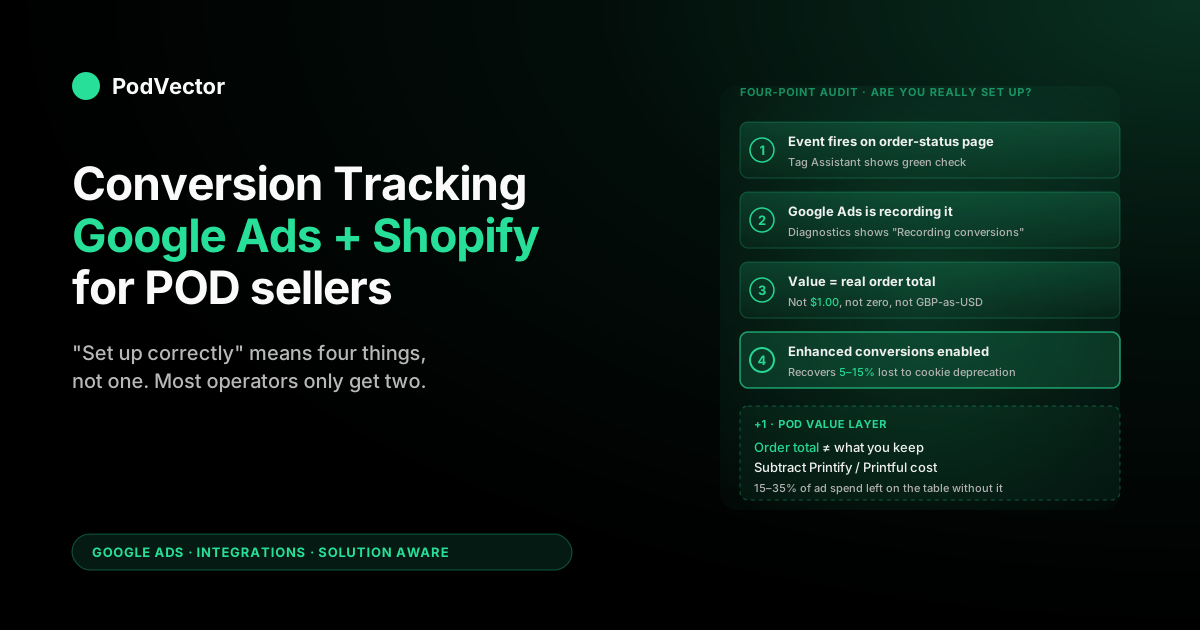
Quick Answer: The fastest way to set up Google Ads conversion tracking on Shopify is the free Google & YouTube channel app — install it, link your Google Ads account, and it creates the Purchase conversion action and fires the event automatically in about 15 minutes. But "set up" means four things in 2026, not one: a Purchase event firing on Shopify's order-status page, a Google Ads conversion action with the matching ID receiving that event, the conversion value mapped to a real number (not 1.00), and enhanced conversions enabled to recover cookie-deprecated attribution. Skip any of the four and Smart Bidding is optimising on a partial signal. Most POD operators get the first two right and silently miss the second two — which is why a "working" setup still produces a slowly drifting ROAS curve. This guide walks the install, then audits what "set up correctly" actually means, with a POD-specific layer on conversion value that no general guide covers.
The four pieces of a complete conversion-tracking setup
A complete Google Ads conversion-tracking setup on Shopify in 2026 has four pieces. Most online guides cover only the first two. The other two are where POD-specific value leaks live.
- Event firing. When an order completes, a Purchase event fires from Shopify's order-status page (or the equivalent Customer Events sandbox) and reaches Google Ads' conversion endpoint. Tag Assistant should show a green check.
- Conversion action receiving. Inside Google Ads, the Purchase conversion action shows "Recording conversions" within 72 hours of the first attributed click. Status, count, value, and attribution windows are all configured.
- Value mapped correctly. The number Google sees in the value field is the order's actual total — not the
1.00default that ships when a Liquid binding breaks, not GBP read as USD, not zero on partial-payment splits. - Enhanced conversions enabled. First-party customer data (email, phone, address) is hashed and shipped alongside the conversion event so Google can recover attribution lost to cookie deprecation, ITP, and ATT. As of 2026 this is no longer optional for any e-commerce store that wants accurate ROAS.
This guide walks the install of all four, then adds a fifth piece that only POD operators need: contribution-margin-aware conversion values that account for Printify's or Printful's variable supplier costs. If you're auditing an existing setup rather than installing from scratch, jump straight to the four-point audit.
Prerequisites: accounts, access, and one POD-specific data point
Five things should be true before you begin. Skipping any of them produces errors mid-install that look like Shopify or Google Ads bugs but are actually account-state problems.
- A Shopify store on a paid plan. The Google & YouTube channel app installs on Basic and above. Trial-plan stores can install but conversion data won't validate until billing is active.
- An existing Google Ads account. Shopify links to your Google Ads account; it doesn't create one. Three minutes at
ads.google.comif you don't have one yet. - Owner-or-admin access on that Google Ads account. Manager (MCC) access alone won't complete the OAuth callback that creates the conversion actions.
- Customer Data Terms accepted in Google Ads. Admin → Account access → Account settings → Customer data terms. Without this, conversion tracking will install but enhanced conversions and Customer Match will be greyed out and you'll have to come back.
- Admin permission on the Shopify store. Staff accounts can install the app but can't complete the OAuth callback.
One POD-specific prerequisite that nobody else lists: a current SKU-level supplier-cost spreadsheet. Printify or Printful base price plus print fee plus shipping for every variant you sell. You need this for the value layer in the section below, and trying to reconstruct it mid-install is what causes operators to silently default to revenue-based tracking and never come back to fix it.
Install the Google & YouTube channel app (the install path)
The Google & YouTube channel is Shopify's first-party integration with Google Ads and Merchant Center. Free, maintained jointly by Shopify and Google, and the right default for any POD store under roughly $200K MRR. End-to-end install: 15–25 minutes of hands-on time, then 24–72 hours of waiting for verification data.
Step 1: Install the channel from Shopify admin
From Shopify admin, click the green plus next to "Sales channels" in the left sidebar → search "Google & YouTube" → Add channel → accept permissions. Installation completes in about thirty seconds. The channel appears in the sidebar under Sales channels and the channel admin page opens to the setup wizard.
One warning: avoid the various third-party "Google Ads" apps in the Shopify App Store unless you have a specific reason. Most are wrappers around the same official APIs with a markup, and a few introduce a second pixel layer that conflicts with the channel-app pixel and double-counts conversions — which then takes longer to debug than the original installation saved.
Step 2: Connect the Google account that owns Google Ads
Inside the channel admin → Connect a Google account → Connect → OAuth pop-up. Use the Google account that owns your Google Ads account, not just one with manager access. Grant the requested permissions — read profile, manage Google Ads conversion tracking, manage Merchant Center, read YouTube channel — and the wizard advances when the callback completes.
If the OAuth pop-up closes without returning to the wizard, the cause is almost always third-party-cookie blocking. Safari and Brave with default settings block the postMessage callback that completes the handshake. Switch to Chrome or Firefox for the install, and the connection persists across browsers afterwards.
Step 3: Link the Google Ads account
The wizard's next step is "Conversion measurement" or "Set up Google Ads" depending on which version of the channel UI Shopify has rolled out — the wording changes a few times a year, the function is identical. Inside that step, find Your Google Ads account → Connect → pick your account from the dropdown.
If you have multiple Google Ads accounts (separate dev/prod, separate brands, MCC across clients), cross-reference the 10-digit customer ID against the one shown at the top of your Google Ads UI before confirming. Picking the wrong account here means uninstalling the channel and reinstalling to fix it.
Step 4: Accept the four default conversion actions
Once you confirm the link, Shopify creates four conversion actions inside Google Ads automatically: Purchase (set as primary), Begin Checkout, Add to Cart, and Page View. Customer Match is also turned on automatically — your Shopify customer list (hashed) imports into Google Ads as an audience for retargeting and lookalike modelling.
One adjustment worth making while you're here: switch the Purchase conversion's "count" setting from one to every if your POD catalog has repeat customers (it almost certainly does). The default counts only one purchase per click, which under-counts loyal customers and skews Smart Bidding away from acquisition campaigns that produce multiple orders.
Step 5: Confirm the conversion value is mapped before leaving the wizard
Click into the Purchase conversion action → Settings → verify the value field is mapped to {{ checkout.totalPrice.amount }} in modern Customer Events syntax (or {{purchase_total}} in legacy script-tag syntax). A surprising number of installs land with the value at $1.00 because of a Liquid binding error introduced by an earlier theme customisation. If you see "Value: 1.00" instead of order total, fix it now — Smart Bidding spends two weeks optimising against zero meaningful signal before the symptom becomes obvious.
Alternative: manual installation through Customer Events or GTM
Skip this section unless the channel-app path can't express something you specifically need. The channel app handles 95% of POD use cases. The reasons to go manual are narrow: conversion-value customisation the channel app can't do, multi-domain tracking spanning Shopify and an external landing page, or a tightly-controlled GTM container you maintain for compliance reasons.
The manual flow has three steps. Inside Google Ads → Goals → Summary → New conversion action → Website → "Add manually." Choose Purchase, set value to "Use different values for each conversion," count to "Every," and click Save and continue. Google returns two snippets: a global site tag (the gtag library) and an event snippet (the conversion fire).
Paste the global site tag into theme.liquid immediately after the opening <head> tag — once, not twice; if you already have GA4 installed via theme code, the gtag library is shared. Then paste the event snippet into Settings → Checkout → "Order status page" → Additional scripts, replacing the static value with {{ checkout.total_price | money_without_currency }} and the transaction_id with '{{ order_id }}' (the second prevents duplicate firing when a customer reloads the thank-you page).
If you'd rather wire this through Google Tag Manager — recommended only if you already maintain a GTM container — install the GTM container snippet instead of the gtag global, then set up the Google Ads Conversion Tracking tag inside GTM with a trigger of "All Pages — Order Status" and the same Liquid variables passed via dataLayer. The work is identical; the maintenance surface moves from theme code to GTM. For a focused walkthrough on the manual path, our Google Ads conversion tracking Shopify setup guide for POD sellers covers the full manual variant in depth.
Enhanced conversions: the 5% to 15% you'll otherwise lose
Enhanced conversions matter more in 2026 than they did in 2024. Third-party cookie deprecation in Chrome and Apple's Intelligent Tracking Prevention have eroded the share of conversions Google can attribute through cookies alone. Enhanced conversions recover roughly 5% to 15% of conversions that would otherwise show as unattributed, by hashing first-party customer data (email, phone, name) at fire time and matching against Google's signed-in user graph.
If you used Method 1 (channel app), enhanced conversions enable in one click: channel admin → Conversion tracking → "Enhanced conversions" toggle → on → accept the customer-data terms prompt. The channel app handles the user_data binding automatically.
If you used Method 2 (manual), enable in Google Ads at Goals → Conversions → click your Purchase conversion → Enhanced conversions → turn on → choose "Google tag" → provide the user_data fields (email, phone, address). Then update your event snippet to include a user_data object reading from the order's customer fields. Google's tag SHA-256-hashes everything client-side before it leaves the browser.
For a deeper walkthrough of enhanced conversions specifically — including consent-mode interaction and the dev-tools sequence for verifying the user_data payload is non-empty — see our enhanced conversions on Shopify setup guide.
Consent Mode v2: the gate enhanced conversions runs behind
If you sell to the EEA or UK, Google Consent Mode v2 is no longer optional — Google requires it to keep serving personalised ads and to model conversions for visitors who decline cookies. Without it, enhanced conversions and Customer Match data from European traffic stop flowing, and Google silently drops the affected conversions rather than warning you. The Google & YouTube channel app ships a Consent Mode v2-compatible pixel and integrates with most Shopify cookie-banner apps (Pandectes, iubenda, Shopify's own customer-privacy API) out of the box; the work is confirming your banner is actually passing ad_user_data and ad_personalization signals, not just analytics_storage. Verify in Tag Assistant: a compliant setup shows consent-state pings firing before the conversion event. A US-only POD store can run "advanced" consent mode loosely, but should still enable it — Google's behavioural modelling fills attribution gaps the same way enhanced conversions do.
Server-side tracking: when the channel-app pixel isn't enough
Client-side pixels — including the channel app's — lose conversions to ad blockers, ITP, and browser extensions that strip third-party requests. Server-side tracking moves the conversion fire from the browser to a server container (Stape, Google's own server-side GTM, or a managed equivalent), which recovers a slice of those lost events and hardens enhanced-conversions matching. For POD stores under roughly $200K MRR, the channel app plus enhanced conversions plus Consent Mode v2 is enough; server-side is the next upgrade once ad-blocker loss measurably dents your attributed-vs-actual order count. It's a maintenance commitment, not a one-time install, so don't reach for it until the four-point audit below is clean and you've confirmed the gap is real.
The four-point audit: are you really set up?
Most "broken" conversion-tracking setups aren't broken — they're partial. Run this four-point audit on every install, including ones a developer or agency claims is already complete.
Point 1: a Purchase event actually fires on the order-status page
Install the Google Tag Assistant Chrome extension. Place a small live test order through your store — use a $1 SKU, real card, refund yourself afterwards. The bogus-credit-card path doesn't trigger the full Customer Events conversion pipeline because the order doesn't transition to paid.
On the order-confirmation page, open Tag Assistant. You should see a Google Tag firing, a Google Ads Conversion event with the conversion ID matching your Google Ads account, conversion value populated with the actual $1, and (if enhanced conversions are on) a green indicator showing user_data attached. Anything missing means the pixel is firing partially.
Point 2: Google Ads is recording the event
Goals → Conversions → click into your Shopify Purchase conversion action → Diagnostics tab. After 72 hours of data, you should see "Recording conversions" with no flagged warnings. Common warnings on a fresh POD setup include "Tag firing on multiple domains" (your dev environment is also pixeling), "Inconsistent value" (variant prices flowing through with currency-conversion rounding), or "Low volume" (you simply haven't had enough conversions yet).
Point 3: the value is the actual order total
Goals → Conversions → Purchase → click the conversion in the table → check the "All conv. value" column over the past seven days. Divide by the conversion count to get average order value.
Compare it to your actual Shopify AOV from Analytics → Reports → Sales by channel → Online Store. The two numbers should match within roughly 5%.
If Google's number is exactly $1.00, the value field is hardcoded. If it's exactly zero, the value field is firing as a string. If it's roughly half your Shopify AOV, you're double-counting or splitting payment with a buy-now-pay-later provider that's filtering through differently.
Point 4: enhanced conversions are receiving user_data
Goals → Conversions → Purchase → Enhanced conversions section → Diagnostics. The status should show "Receiving user-provided data" within 48 hours of toggle-on. If it shows "Not receiving" despite conversions firing, your user_data binding is empty — fix at the channel-admin or manual-tag layer depending on which path you used.
If all four points pass, the install is correct in the standard sense. Now move to the POD-specific value layer.
The POD value layer: order total isn't what you keep
The standard install sends order total as the conversion value. That's what the customer paid you. It is not what you kept.
A $52 hoodie sold through Printify clears roughly $19 of contribution margin after the supplier blank cost, the print fee, the shipping you absorb, and Shopify's payment processing. A $24 mug clears around $11.
A $74 all-over-print sweatshirt clears about $22 because the substrate cost is what it is. Smart Bidding, fed order totals as the conversion value, sees the $52, $24, and $74 outcomes and optimises spend toward whichever ad groups produce the highest aggregate revenue. On a POD catalog, that systematically pushes spend toward the highest-list-price products, which are systematically the worst-margin products.
Three layers of fix, in increasing order of accuracy:
- Layer A (the 80% solution). A Google Ads conversion-value rule that multiplies all conversions by your blended margin ratio. If your average contribution margin is 38%, a value rule of 0.38 applied to the Purchase conversion gets Smart Bidding into roughly the right neighbourhood. Configure inside Google Ads → Goals → Conversions → Conversion value rules. Coarse but fast — most stores can implement Layer A in under thirty minutes.
- Layer B (the 95% solution). Victor already knows the real supplier cost for every product in your Printify or Printful account, even before you sell it. He can use that cost to tell Google Ads the true value of each sale — revenue minus supplier cost — instead of just the order total. This takes more setup, but it's much more accurate.
- Layer C (the 99% solution). Victor can also fix the conversion value after the order settles. Once your Printify or Printful invoice reconciles (usually 1–7 days after the order), he sends Google Ads a corrected value based on your real profit — including any refunds, returns, and reprints. This is the picture closest to the truth, and Victor keeps it running for you.
The reason this matters: a POD store running with the default channel-app value mapping is leaving 15% to 35% of effective ad spend on the table compared to one that has even Layer A in place. The setup you just completed is necessary but not sufficient.
What to track once tracking is live
"Conversion tracking is set up" enables a different question, which is "what are the conversions telling us?" Three reports become possible the day data starts flowing.
First, cost per acquisition by campaign type. Search, Performance Max, Shopping, and Display all flow conversions into the same Purchase conversion action, but their CPAs are radically different. Most POD stores find Search at $30–$60 CPA, branded Search at $4–$12, Performance Max anywhere from $25–$70, and Display burning money at $90+. The conversion-tracking layer is what lets you see those splits and reallocate.
Second, true ROAS once the value layer is fixed. The standard "ROAS" metric in Google Ads is conversion value divided by cost where conversion value is whatever you sent. If you send order total, ROAS is gross-revenue ROAS. If you implement Layer A, ROAS is margin-corrected and the headline target shifts (a 4x gross ROAS becomes roughly a 1.5x margin ROAS at 38% blended margin — same business, different number, much more useful for decisions).
Third, cross-channel attribution. Google Ads conversions are now flowing, but so are Shopify-native conversions, Printify supplier costs, Meta ads spend, and so on. None of those data sources naturally agree on what a "conversion" is or what it cost to acquire. Reconciling them is the next-largest analytics project after the install you just finished.
For the architectural pillar that ties all of this together, see the complete guide to Google Ads + Shopify integration for POD. For the broader strategic context — what to do with Google Ads beyond the integration question — see our Google Ads playbook for print-on-demand sellers.
Five symptoms that mean something isn't wired
Symptom 1: "Connected: not receiving data" after 72 hours
Most likely cause: you've had no Google Ads-attributed conversions yet — confirm in Campaigns that you actually have spend and click volume. Second cause: cross-domain checkout isn't firing the conversion on the production domain — fix by setting cross-domain measurement in your gtag config. Third cause: a developer's Customer Events customisation is suppressing the channel-installed pixel — diagnose with Tag Assistant.
Symptom 2: conversion value firing as $1.00 on every order
The value field in your pixel isn't reading the correct Liquid variable. Should be {{ checkout.totalPrice.amount }} in Customer Events syntax.
The default channel-app pixel does this correctly out of the box, so a "$1.00 on every order" symptom usually means a previous developer customised the pixel and broke the binding. Restore from the channel-app default if you don't need the customisation.
Symptom 3: Google reports more conversions than Shopify orders
Double counting. Three causes account for nearly all of them: you ran both channel-app and manual install (pick one), your theme has a legacy Google Ads conversion script left over (search theme.liquid for AW- and remove duplicates), or GA4 is also linked to Google Ads as a conversion source (uncheck the GA4-imported Purchase conversion's "Include in Conversions" toggle so only the Google-tag pixel is counted).
Symptom 4: Smart Bidding goes weird after 2–4 weeks of "successful" tracking
The classic symptom of a value-layer problem. Connection is correct, conversion data is flowing, but Smart Bidding is optimising against a value signal that doesn't reflect actual margin. Solution lives in the POD value layer above — implement at least Layer A.
Symptom 5: ROAS in Google Ads disagrees with your Shopify dashboard by >20%
Several possible causes. Different attribution models (Google Ads uses data-driven by default; Shopify uses last-non-direct-click), different conversion windows (30 days vs. 30 days might both nominally apply but differ on the click vs. view treatment), or different definitions of "conversion" (Google Ads counts Purchase events; Shopify Analytics counts orders that may include manual orders, draft orders, and POS sales). Reconciling these is the cross-channel attribution problem mentioned above.
FAQs
How long does the full conversion-tracking setup take?
Channel app path: 15–25 minutes of hands-on time, plus 24–72 hours of waiting for verification data. Manual path: 30–60 minutes of hands-on time depending on whether you wire through GTM, plus the same waiting period. Most POD operators are done with the active install in under an hour.
Do I need both Google Ads conversion tracking and GA4?
For Smart Bidding, no — Google Ads' own pixel is the right primary signal. GA4 is useful for cross-channel attribution analysis and for understanding the broader funnel above the conversion event, but if you import GA4 conversions into Google Ads and have the Google-tag pixel firing, you double-count. Run the Google-tag pixel as your bidding signal; treat GA4 as a parallel analytics layer rather than a second conversion source.
Will conversion tracking work if my checkout is on a different domain?
Yes, with cross-domain measurement configured in gtag. The default channel-app installation handles this for the standard Shopify shop.com → checkout.shopify.com path. If you've added a third domain (a custom landing page on Webflow or WordPress that links to Shopify checkout), you'll need to add it to the channel-app's domain list and to your enhanced conversions configuration.
Should I count purchases as "every" or "one"?
"Every" for almost all POD stores. The default "one" counts only one purchase per click, which under-counts loyal customers placing repeat orders within the conversion window. POD catalogs typically have meaningful repeat-purchase rates (especially niche-themed stores), so "every" is closer to truth.
What attribution window should I use?
30-day click, 1-day engaged-view is the standard 2026 default and works for almost all POD stores. Drop the click window only if your customer journey is genuinely shorter (impulse-buy stores with one ad campaign and high CTR can sometimes benefit from a 7-day click window). Don't extend past 30 days; the marginal attribution gain is small and Smart Bidding gets noisier.
Can I track offline conversions (returns, supplier-side adjustments) too?
Yes — through Google Ads' offline conversion import API. After your Printify or Printful invoice reconciles, you can push corrected values (or full retractions for returned items) back to Google Ads keyed off the GCLID stored at order time.
This is Layer C in the value-layer section above. Most POD stores skip it for the first six months and implement it once the rest of the analytics stack is stable.
Do I need Consent Mode v2?
If any of your customers are in the EEA or UK, yes — Google requires Consent Mode v2 to keep serving personalised ads and to model conversions from cookie-declining visitors, and enhanced conversions for European traffic won't flow without it. The Google & YouTube channel app ships a v2-compatible pixel that integrates with the common Shopify cookie banners; your job is confirming the banner passes the ad_user_data and ad_personalization signals. US-only stores aren't strictly required to run it but should anyway — Google's behavioural modelling recovers attribution the same way enhanced conversions do.
Is server-side tracking worth it for a POD store?
Not until you've confirmed ad-blocker and ITP loss is measurably denting your attributed order count against actual Shopify orders. For most stores under roughly $200K MRR, the channel app plus enhanced conversions plus Consent Mode v2 captures enough. Server-side tracking (via Stape or server-side GTM) recovers the remaining client-side loss but is an ongoing maintenance commitment, so treat it as a later upgrade rather than part of the initial install.
Where's the official documentation?
The Shopify-side reference is the Google Ads Help: Set up conversion tracking with the Google & YouTube app on Shopify page. Shopify's own walkthrough is at Shopify Blog: How To Set Up and Use Google Ads Conversion Tracking. Both are kept current and are the source of truth when channel-app UI text changes.
What's the right next article in this cluster?
If your tracking install is complete, the highest-leverage next read is the value layer — start with how to set up Google Ads conversion tracking on Shopify (step-by-step) for a focused install reference, or jump to enhanced conversions on Shopify for the first-party data recovery layer. The cluster's architectural pillar is the complete guide to Google Ads + Shopify integration for POD, and the Google Ads Integrations cluster hub indexes the rest.
"Set up correctly" is a milestone, not a destination.
Once Google Ads conversion tracking is firing on Shopify, the next question is whether the conversions Google sees match the profit you actually keep — and whether your Search, Performance Max, and Shopping spend is allocated against true contribution margin or against gross revenue. Victor connects your live Google Ads, Shopify, and Printify or Printful data, watches for the margin leaks above — the $1.00 value bug, the gross-revenue Smart Bidding drift, the Performance Max groups over-spending relative to actual margin — and acts on them: it adjusts bids and budgets on your behalf, with your approval, instead of leaving you a dashboard to read.
Try Victor free