
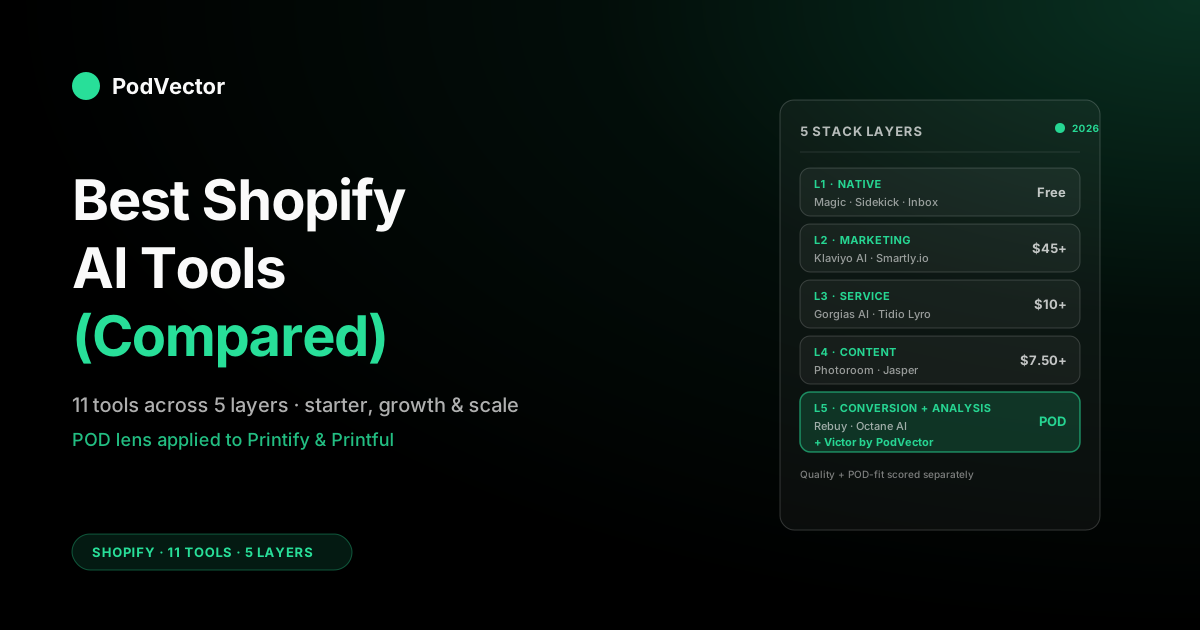
Quick Answer: The best Shopify AI tools in 2026 fall into five layers: native (Shopify Magic, Sidekick, Shopify Inbox AI — free with your plan), marketing (Klaviyo AI for email/SMS, Smartly.io for paid ads), service (Gorgias AI, Tidio Lyro), content & imagery (Photoroom, Jasper), conversion & analysis (Rebuy, Octane AI, and Victor by PodVector AI for POD operators). A sixth cross-cutting concern — GEO (generative engine optimization for AI search visibility) — now applies to every layer.
For most Shopify stores under $50K/month, the right move is to install the native Shopify AI features first, add Klaviyo AI and Gorgias AI when the volume justifies it, then layer in a category-specific tool — AI imagery, video ads, SEO, or onsite search — only once the basics are running.
For print-on-demand stores on Printify or Printful, the stack changes. Generic ecommerce AI rarely understands variable per-order supplier costs, so the operations layer needs a POD-native option that can act on real margin. This guide walks each tool, its pricing, where it shines on Shopify, and where the POD lens flips the answer.
Why Shopify AI Tools Are a Different Conversation in 2026
Three things changed in the last twelve months that made the "best Shopify AI tools" question harder, not easier.
First, Shopify built a lot of AI in-house. Magic shipped 150-plus features inside the admin across the 2026 Editions — product description generation, brand-voice tuning, Photo Editor background removal and AI model shots, Shopify Email subject line drafting, automated FAQ generation, store policy first drafts, and reply suggestions inside Shopify Inbox.
Sidekick became a real admin-side agent that can answer "how do I" questions and surface the right report. The free baseline that every Shopify AI app has to beat is much higher than it was in 2024.
Second, the Shopify App Store added an AI-only filter and merchants started actually using it. The Klaviyo AI suite, Gorgias's AI resolutions, Tidio's Lyro agent, Rebuy's predictive recommendations, and Octane AI's quizzes all matured from "demo features" to "tools that resolve tickets and trigger flows in production." A category that used to be "marketing checklist" became "operational stack."
Third, paid-ads AI got serious — and went video. Smartly.io and Pencil are now what real Shopify ad operators run for creative variation and bid logic, and AI video generators like Runway turn a single product shot into dozens of testable ad cuts. They earn the spend not because they're cheaper than manual ad work, but because they do what no human can at the volume DTC requires.
Fourth — and this one is new — AI search changed the discovery funnel. According to Shopify's own reporting, orders originating from AI search platforms like ChatGPT, Perplexity, and Google Gemini rose dramatically through early 2026. According to the Athos Commerce Connected Consumer 2026 report, roughly three in five consumers now incorporate AI platforms into their shopping research journeys. That means Generative Engine Optimization (GEO) — structuring your store content so AI assistants can cite and recommend it — has become a legitimate layer of the Shopify AI tool stack, not just an SEO afterthought.
So the question "what are the best Shopify AI tools" has become layered. The answer depends on what's already free in the platform you're paying for, what your store actually does (DTC inventory, dropship, print-on-demand), and what you can afford to install without re-platforming. This guide walks the eleven tools that earn a spot in 2026, organized by the layer they sit in — plus the new GEO layer every store needs to have a plan for.
How We Scored 11 Shopify AI Tools
Each tool was evaluated on five things — none of them include "how loud their marketing is."
- Native Shopify integration — does it install through the Shopify App Store, read from the admin natively, and respect Shopify's permission model? Tools that need a developer to wire a webhook lose points.
- Time-to-ROI — does it pay back inside 60 days for a typical Shopify store at the price tier where it's relevant? Tools with a 6-month payback window get downranked because most stores don't have the runway.
- Where Shopify Magic already wins — if a paid app duplicates what Magic does for free without measurably outperforming it, the rank drops.
- Pricing floor vs revenue floor — does the entry tier match the revenue tier of stores that need the tool? A $400/month app pitched at $5K/month stores is dead money.
- POD compatibility — for print-on-demand operators on Printify, Printful, Gelato, or similar, does the tool's data model handle variable per-order supplier costs and zero on-hand inventory? Most don't, and the score reflects that.
Quality and POD-fit are scored separately. A tool can be a 10/10 for a generic Shopify store and a 5/10 for a POD seller — that gap is the entire reason this list exists.
Comparison Table: 11 Best Shopify AI Tools
Two columns matter most: what the tool actually does, and what it costs to find out. The Quality and POD-fit scores are explained tool-by-tool below.
| Layer | Tool | Job-to-be-done | Starting price | Quality (/10) | POD fit (/10) |
|---|---|---|---|---|---|
| Native | Shopify Magic | In-admin generation | Free with Shopify | 9 | 9 |
| Native | Shopify Sidekick | Admin-side AI agent | Free with Shopify | 8 | 7 |
| Native | Shopify Inbox AI | Live chat reply drafts | Free with Shopify | 7 | 7 |
| Marketing | Klaviyo AI | Email/SMS automation | Free to ~250 contacts | 10 | 9 |
| Marketing | Smartly.io | Paid ads creative + bidding | Custom (mid-market+) | 9 | 6 |
| Service | Gorgias AI | Helpdesk auto-resolution | From $10/mo + $0.90/AI ticket | 9 | 8 |
| Service | Tidio Lyro | AI live chat agent | From $29/mo | 8 | 7 |
| Content | Photoroom | Product imagery | From $7.50/mo | 9 | 9 |
| Content | Jasper | Marketing copy at volume | From $39/mo | 7 | 6 |
| Conversion | Rebuy | Cart upsells + recs | From $99/mo | 9 | 7 |
| Conversion | Octane AI | Discovery quizzes | From $50/mo | 8 | 7 |
| Analysis | Victor by PodVector AI | POD-native AI employee | Free tier; paid plans | 8 | 10 |
The pattern: native Shopify features dominate the "free baseline" column, paid apps earn their slot only by doing something Shopify Magic can't, and POD-fit collapses to single digits for any tool that thinks of inventory as a fixed COGS line. The rest of this guide walks each layer in order.
Layer 1 — Native Shopify AI (Free with Your Plan)
The 2026 version of "what's the best Shopify AI tool" almost always starts here. Three native tools cover most of what a small-to-mid store needs before any paid app gets considered.
Shopify Magic — The Free AI Baseline
What it does: Magic is the umbrella name for Shopify's in-admin generative AI. As of the 2026 Editions it includes product description generation that adopts a configurable brand voice, blog post drafts, automatic FAQ generation pulled from your product details, store policy first drafts, Shopify Email subject line suggestions, AI-suggested replies inside Shopify Inbox, image background removal and editing inside the Photo Editor, and "ask Shopify" search inside the admin.
Pricing: free with any Shopify plan, including Basic.
Where it wins: bulk product description rewrites, standing up store policies fast, drafting blog scaffolding, and one-click image cleanup. Most paid "AI product description" apps don't beat what Magic does in 2026.
Where it doesn't: Magic is generation, not analysis. It can write a description; it can't tell you which products are profitable after Printify fees. It also can't read across orders, sessions, and ad spend the way a dedicated analytics or agent layer can.
Quality 9/10 · POD fit 9/10.
Shopify Sidekick — The Admin-Side AI Agent
What it does: Sidekick sits in the admin and answers operational questions ("how do I add a discount code that only applies to one collection?"), surfaces reports, and can take simple guided actions. It's Shopify's answer to "what should I be looking at?" for solo operators who don't want to learn the full admin.
Pricing: free with Shopify, currently rolling out by region.
Where it wins: shortening the time to find a report, explaining a Shopify feature without leaving the admin, and serving as a how-to assistant for operators who only touch the admin a few hours a week.
Where it doesn't: Sidekick answers questions about Shopify; it doesn't answer questions about your business with the depth a real AI employee layer would. It also doesn't reach across non-Shopify systems — your ad platform, your fulfillment provider, your bookkeeping. For a multi-channel POD operator, that's a real gap.
Quality 8/10 · POD fit 7/10.
Shopify Inbox AI — Reply Drafting in the Live Chat
What it does: Inbox is Shopify's free live chat. The AI layer drafts suggested replies based on the customer message and your store context, so an operator can review and send instead of typing from scratch.
Pricing: free.
Where it wins: small stores with manageable chat volume that don't yet need a full helpdesk like Gorgias. The AI suggestions cover the easy 60% of inbound messages — order status, sizing, return policy.
Where it doesn't: Inbox is a chat surface, not a ticket system. Once volume crosses roughly 40 conversations a day, the lack of routing, macros, and resolution analytics starts to hurt. That's when Gorgias or Tidio become the right answer.
Quality 7/10 · POD fit 7/10.
Layer 2 — Marketing & Email AI
The second layer is where most paid Shopify AI spend goes — and where the biggest revenue lift comes from for stores that have moved past pure setup.
Klaviyo AI — The Email/SMS Standard
What it does: Klaviyo is the dominant Shopify-integrated email and SMS platform, and the AI layer is now woven through the product. Predictive Customer Lifetime Value forecasts who's going to be valuable. AI subject line and preview text suggestions, send-time optimization per recipient, and generated email content that adapts to brand voice are all standard in 2026.
Pricing: free up to roughly 250 contacts; scales with list size from there.
Where it wins: any Shopify store with more than 1,000 active subscribers. The Shopify integration is deep — order data, browse data, custom events all flow. According to Commerce Pundit's implementation data across Shopify stores, properly configured Klaviyo AI flows and predictive segmentation can account for a significant share of total email-channel revenue.
Where it doesn't: the predictive features need data to work. A new store with 200 subscribers will get the same flows everyone else gets. Below roughly $10K/month in revenue, the AI lift is real but small in absolute dollars.
Quality 10/10 · POD fit 9/10.
Smartly.io — Paid Ads Creative & Bidding
What it does: Smartly is the AI ads layer that creative-heavy DTC brands run on top of Meta and Google. It generates creative variants from a template, ties asset performance back to spend, and automates bid adjustments based on performance signals. For Shopify stores running serious paid traffic, it removes the manual creative-iteration grind that kills ad teams.
Pricing: custom — Smartly is positioned at mid-market and up. Realistic floor is well above what most sub-$50K/month stores can justify.
Where it wins: Shopify stores spending heavily on Meta or Google ads where creative fatigue is the main bottleneck. The variant-generation feature alone can replace a junior designer's throughput.
Where it doesn't: if monthly ad spend is under $20K, the contract floor doesn't make sense. The Pencil/AdCreative.ai tier is a better fit at that scale.
Quality 9/10 · POD fit 6/10. POD fit drops because Smartly's bidding logic optimizes on conversion value reported by the ad platform — not on profit-after-supplier-cost, which is the number that actually matters for POD margin. For more on attribution pitfalls in this channel, see the guide to Google Ads data-driven attribution for POD sellers.
The video-ad tier below Smartly: the fastest-growing corner of Shopify ad AI in 2026 is video generation. Tools like Pencil, Runway, and AdCreative.ai turn one product image or mockup into dozens of short-form ad cuts — different hooks, aspect ratios, and openings — for a fraction of a Smartly contract. For POD stores this is high-leverage: a single design can be tested as a TikTok-style demo, a static carousel, and a UGC-style clip without a videographer. Treat the output as raw variation to test, not finished brand film — the winners still deserve a human pass. For a broader strategy framework, see the guide to Google Ads promotions strategy for print-on-demand.
Layer 3 — Customer Service AI
This is the layer where AI ROI is easiest to measure: tickets resolved without a human equals dollars saved per month. The two tools that lead the Shopify-integrated category are Gorgias and Tidio.
Gorgias AI — The Helpdesk That Resolves
What it does: Gorgias is the Shopify helpdesk standard. The AI layer reads incoming tickets, classifies intent, drafts replies, and — when configured — auto-resolves tickets without a human touching them. The auto-resolve feature is metered separately.
Pricing: from $10/month for the entry plan, plus $0.90 per AI-resolved ticket. Most stores end up on the $50–$300/month tiers as ticket volume grows.
Where it wins: Shopify stores doing 200+ tickets per month where order-status questions, return requests, and sizing inquiries make up the bulk of inbound. According to Commerce Pundit's implementation data, Gorgias AI auto-responders can reduce support ticket volume materially for stores with consistent inbound patterns. Gorgias's order-context lookup is fast because the Shopify integration is native.
Where it doesn't: below roughly 100 tickets/month, the platform fee is hard to justify against Shopify Inbox plus an extra hour of operator time. The per-resolution metering also makes pricing unpredictable in months with abnormal ticket spikes.
Quality 9/10 · POD fit 8/10. POD-specific note: for stores fulfilling through Printify or Printful, the production timeline and shipping cutoffs need to be added to the AI's knowledge base manually — Gorgias doesn't auto-pull from Printify by default. For context on what Printify timelines actually look like, see how long Printify takes to ship.
Tidio Lyro — AI Live Chat Agent
What it does: Tidio is a live chat platform; Lyro is its AI agent. Lyro autonomously handles the conversation for the first turns, escalating to a human only when it can't resolve.
Pricing: from $29/month for the starter; Lyro adds a per-conversation cost above the free quota.
Where it wins: Shopify stores in the $5K–$30K/month revenue range that need a live chat surface and want AI to do most of the lifting without paying Gorgias-tier prices. The setup is faster than Gorgias because the surface area is smaller.
Where it doesn't: Tidio isn't a full helpdesk. If you need ticketing across email, social, and chat with macros and routing, Gorgias still wins.
Quality 8/10 · POD fit 7/10.
Layer 4 — Content & Imagery AI
The category most affected by Shopify Magic getting better. Two tools still earn their slots — one for imagery, one for marketing copy at volume.
Photoroom — Product Imagery on Demand
What it does: Photoroom started as a background-removal tool and evolved into a full AI imagery suite — generative backgrounds for product shots, batch resizing for marketplace requirements, scene composition for lifestyle imagery, and shadow/lighting matching. The Shopify integration pulls product images directly from the catalog.
Pricing: from $7.50/month for the Pro plan; team plans scale up.
Where it wins: any Shopify store that ships visual content faster than a designer can edit. POD stores especially benefit — generating mockup variations, putting the same design on different t-shirt colors against different backgrounds, and cleaning up supplier-provided product photos for use in ads.
Where it doesn't: for stores with strict brand-photography standards, the generated imagery still needs a human eye. Photoroom is for volume, not for hero photography.
Quality 9/10 · POD fit 9/10. One of the few tools where the POD fit is just as high as the generic Shopify fit — visual variation is exactly what POD selling rewards.
AI model photography, the adjacent category: a newer crop of tools — OnModel and Shopify Magic's own AI model shots — put your apparel on generated human models instead of a flat lay. For POD sellers who only have a supplier mockup, that closes the gap to "lifestyle" imagery without a photoshoot. The catch is the same as all generated imagery: spot-check hands, fabric drape, and print placement before publishing.
Jasper — Long-Form Marketing Copy
What it does: Jasper is a marketing copy platform — templates for landing pages, email sequences, blog posts, and ad variations. The AI is fine-tuned on marketing patterns, which is what differentiates it from raw conversational AI.
Pricing: from $39/month for the Creator tier; team plans north of $125/month.
Where it wins: stores running content marketing as a real channel — publishing 4+ blog posts a month, running email sequences with multiple touches per campaign. Jasper's templates remove the "blank page" tax.
Where it doesn't: for short-form content (product descriptions, single email subject lines), Shopify Magic covers most of the same ground for free. Jasper is mainly worth it once content volume crosses a real threshold.
Quality 7/10 · POD fit 6/10.
Layer 5 — Conversion & Analysis AI
The last layer before GEO is where AI affects the dollar number, not the operational hour count. Three tools sit here: Rebuy and Octane on the merchandising side, Victor by PodVector AI on the operations side.
Rebuy — AI Cart Upsells & Recommendations
What it does: Rebuy is the Shopify-integrated personalization platform that runs AI-powered product recommendations across the cart, the post-purchase page, the PDP, and email. The recommendation engine adapts to browsing and purchase signals, and the merchandising rules layer lets a store overlay logic ("never recommend X with Y").
Pricing: from $99/month, scales with order volume.
Where it wins: Shopify stores with at least one high-frequency upsell or cross-sell opportunity — accessories with apparel, refills with consumables, complementary mugs/totes/posters in a POD context.
Where it doesn't: stores with single-SKU offerings or stores where every customer buys one of three products see negligible lift. The $99 floor doesn't pay back.
Quality 9/10 · POD fit 7/10. POD fit drops a notch because the recommendation engine doesn't know the supplier-cost difference between a $9 t-shirt and a $24 hoodie. It optimizes on cart value, not contribution margin.
Octane AI — Quizzes That Move Discovery
What it does: Octane is the leading AI-powered quiz and product discovery platform on Shopify. It builds quiz funnels that route visitors to a curated product subset based on their answers, then feeds the quiz responses into Klaviyo for personalized email follow-up.
Pricing: from $50/month, scales with quiz responses.
Where it wins: stores with a wide catalog where the buyer's biggest friction is "which one is right for me" — beauty, supplements, apparel sub-niches, anything with size or fit complexity. POD stores running broad design catalogs use quizzes well: "what kind of design vibe matches you" routes to a curated subset. According to NestScale's 2026 review, zero-party data collected through interactive elements like quizzes is increasingly the most reliable signal for personalization as background tracking cookies become less dependable.
Where it doesn't: stores where the catalog is small enough that browsing is faster than answering a quiz. If you have 30 products, a quiz adds friction without adding clarity.
Quality 8/10 · POD fit 7/10.
Victor by PodVector AI — POD-Native AI Employee
What it does: Victor is an AI employee purpose-built for print-on-demand sellers running on Shopify with Printify or Printful fulfillment. He reads live data from your Shopify store, Meta Ads, Google Ads, Printify, and Printful — then proposes specific actions on Shopify (repricing, collections, discounts) with a typed rationale for each. You approve or reject; Victor executes only what you approve.
Victor brings your orders, ad spend, and supplier costs together in one place. That means he can answer the questions you actually care about: "which designs lost money last week after Printify fees and ad spend?", "what's my real cost to get a customer, by product category, this month?", "which products are selling better each week on true profit?" Then he suggests a change you can make in Shopify, and you approve it before anything happens.
Pricing: free tier; paid plans scale with revenue.
Where it wins: Shopify stores running print-on-demand where the analytics question that matters is "what's actually profitable after supplier costs and ads," and where the answer changes per SKU because Printify's pricing varies by garment, supplier, and base color. Victor's operator loop — read the live data, propose a typed action with rationale, execute on approval — is built for that exact workflow. For more on what Shopify-side automation looks like in practice, see the guide to Shopify Admin API store modifications and automation.
<<<<<<< Updated upstreamWhere it doesn't: stores that own their inventory and treat COGS as a fixed line don't need POD-specific analytics. Victor reads exactly Shopify, Meta Ads, Google Ads, Printify, and Printful — if your stack runs outside those five platforms, the read surface won't cover it. He also has no cross-session memory and does not monitor your store around the clock; everything beyond the Weekly Health Report is query-driven.
=======Where it doesn't: stores that own their inventory and treat COGS as a fixed line don't need POD-specific analytics. Victor reads exactly Shopify, Meta Ads, Google Ads, Printify, and Printful — if your stack runs outside those five platforms, the read surface won't cover it. He also has no cross-session memory and does not monitor your store around the clock; everything beyond the Monday Weekly Health Report is query-driven.
>>>>>>> Stashed changesQuality 8/10 · POD fit 10/10. The POD-fit score is the whole reason Victor exists — it's the one tool on this list whose data model assumes variable per-order supplier cost from day one.
Layer 6 — GEO: AI Search Visibility
This layer didn't exist in most "best Shopify AI tools" lists a year ago. It does now because the discovery funnel has shifted.
Generative Engine Optimization (GEO) is the practice of structuring your store's content and schema so that AI assistants — ChatGPT, Perplexity, Google Gemini, Google AI Overviews — can discover, parse, and cite your products in their answers. According to Shopify's own data cited by Stormy AI's 2026 GEO guide, orders originating from AI search platforms have risen sharply since early 2025. According to the Athos Commerce Connected Consumer 2026 report cited by NestScale, roughly three in five consumers now incorporate AI platforms into their shopping research journeys.
For Shopify merchants, the practical GEO checklist has four parts:
- Structured data — Product, FAQ, Organization, and Review schema so AI engines can parse entity relationships, not just keywords.
- Answer-first content — product pages and blog posts that open with a direct answer to the question a buyer would ask an AI assistant, not a marketing opener.
- Fresh content signals — according to Stormy AI's GEO playbook, content that hasn't been updated recently loses its chance of being cited in AI Overviews; the implication is regular refreshes matter more than they did under classic SEO.
- Brand entity authority — mentions, reviews, and citations on third-party sites that AI models use as knowledge sources.
Tools that help: SEOAnt and Surfer AI handle bulk meta-tag generation, alt-text, and content briefs. Semrush's 2026 AI SEO Toolkit now tracks share of voice across AI Overviews and traditional search in a single view, according to Shopify Expert Agency's 2026 GEO guide. For Shopify stores that already publish blog content (a POD brand blog about design trends is a good example), Surfer AI integrates directly into the content workflow.
Where this intersects with POD: a POD store with a design-focused content strategy — blog posts explaining design styles, size guides, gift-guide roundups — is well-positioned to earn AI search citations if those posts are structured correctly. The same Printify and Printful integration content that helps with organic search also helps with AI search visibility. For context on how fulfillment timelines affect buyer questions, see how long Printify takes to ship — that's exactly the kind of question AI assistants now answer directly, citing the best-structured source they can find.
GEO is not a tool you install; it's a discipline you apply. The tools listed above help with the audit and content side. The schema side is a one-time technical setup that any Shopify developer or a theme like Dawn (which ships with basic Product schema) can handle. Start with the content and schema basics before paying for a dedicated GEO monitoring platform.
Three Recommended Stacks: Starter, Growth, Scale
The "best Shopify AI tool" is rarely one tool. It's a stack tuned to the store's revenue tier. Three sensible defaults:
Starter Stack — under $10K/month
- Shopify Magic — free
- Shopify Sidekick — free
- Shopify Inbox AI — free
- Klaviyo AI (free tier, ~250 contacts)
- Photoroom Pro — from $7.50/month
- GEO basics — schema setup (one-time, free or developer hour) + answer-first product copy via Magic
- Total: ~$8/month
The starter stack is almost entirely native plus one imagery tool. Don't add paid helpdesk, paid quizzes, or paid content tools at this stage — the volume doesn't justify the platform fees.
Growth Stack — $10K–$100K/month
- Everything in Starter, plus:
- Klaviyo AI (paid tier) — scales with list size
- Gorgias AI — from $10/month + $0.90/AI-resolved ticket
- Rebuy — from $99/month
- Victor by PodVector AI (POD only) — free or paid tier
- Total: variable by list size and ticket volume
This is the tier where AI starts to materially affect both revenue (Klaviyo + Rebuy) and operating cost (Gorgias). For POD operators, this is also where the analytics question goes from "nice-to-have" to "you're flying blind without it" — which is where Victor enters the stack.
Scale Stack — $100K+/month
- Everything in Growth, plus:
- Smartly.io — custom (mid-market+)
- Octane AI — from $50/month
- Jasper team plan — from $125/month
- Semrush AI SEO Toolkit or equivalent GEO monitoring — for share-of-voice tracking in AI Overviews
- Total: variable, depends on Smartly contract
At scale, the bottlenecks shift from "can we afford the tool" to "can we operate it." Most Scale-tier stores running this stack have a dedicated growth-marketing or operations hire whose entire job is making the tools earn their seat.
The POD Lens: What Changes for Printify & Printful Stores
If your Shopify store fulfills through Printify, Printful, Gelato, or any other on-demand supplier, three things on the standard Shopify AI list flip:
Analytics flips first. Shopify Analytics and most BI layers treat COGS as a fixed line — you set it once per product and the system assumes it doesn't change. POD costs do change, sometimes per order. A black hoodie in size XL from Printify's preferred Monster Digital provider costs different from the same hoodie in size 2XL from a backup provider when the first one runs out. Generic AI analytics tools don't model that, which means their "profit per product" numbers are wrong by the time they hit the dashboard. This is exactly why POD operators end up with a tool like Victor in the stack — it's built for variable supplier costs from day one. For a deeper look at how the Printify–Shopify integration works under the hood, see the guide to Printful and Printify integration with Etsy and Shopify.
Service AI flips second. Gorgias and Tidio Lyro are still the right tools, but they need POD-specific knowledge baked into their AI layer manually. Production timelines, shipping cutoffs by region, and what to do when a Printify order's selected provider is out of stock — none of that auto-pulls. The fix is straightforward (write the knowledge base entries once), but it's an extra setup step nobody warns you about. For reference on what realistic fulfillment windows look like, see how long Printify takes to ship.
Conversion AI flips third — but less. Rebuy still works for POD because cart upsells (recommend a matching mug with the t-shirt design) generate real lift. Octane AI's quizzes also work well for design-discovery flows. The caveat: the recommendation engine doesn't know that a $9 t-shirt has a different supplier cost than a $24 hoodie. Optimizing on cart value over-recommends low-margin items. The workaround is a manual merchandising rule that floors recommendations at a minimum supplier-cost ratio.
Apart from those three, the rest of the stack — Magic, Sidekick, Klaviyo AI, Smartly, Photoroom, Jasper — works the same on POD as it does for inventory-owning Shopify stores. The pattern is consistent: anything that touches the dollar math needs the POD lens applied; everything else is identical.
Additional POD-specific reading: best AI ecommerce tools for a small business, the best AI chatbot for ecommerce websites compared, and the Printify TikTok Shop setup guide for POD sellers if you're expanding beyond Shopify.
How to Pick Without Stack Bloat
The single most expensive mistake in Shopify AI tool selection is installing five apps before any one of them has been operationalized. A 90-day install rhythm beats a 30-day flurry.
The decision sequence that works for most stores:
- Use the native layer first for 30 days. Shopify Magic, Sidekick, and Inbox cover more ground than most operators realize — and they're free. Most stores discover the gaps in the native layer faster by using it than by reading lists like this one.
- Add the highest-leverage paid layer next. For nearly every Shopify store, that's Klaviyo AI. Email/SMS revenue is the most measurable AI lift in ecommerce. Install it, run it for 30 days, then evaluate.
- Add a second tool only after the first is operationalized. "Operationalized" means it has a person who owns it, a dashboard that's checked weekly, and at least one workflow that runs without manual intervention. If Klaviyo AI is sending three batch newsletters and nothing else, it's not operationalized — it's installed.
- Add the operations layer when the dollar math gets non-trivial. For POD operators, that's usually around $10K–$15K/month in revenue, which is where the per-order supplier cost variance becomes large enough to materially distort generic dashboards. That's the right entry point for an AI employee like Victor — he doesn't just flag the leak but proposes the fix, like repricing, collection changes, discount setup, or ad adjustments, with your approval before anything executes.
- Implement GEO basics alongside content production. Schema markup is a one-time technical task. Answer-first product and blog copy is something Shopify Magic already helps draft. Neither requires a paid platform at the starter level — they just require intent. For the analytics side of what drives organic and AI search for POD stores, the guide to best AI ecommerce tools for small businesses covers how to prioritize.
- Add ads AI last. Smartly is a real tool but it's also the easiest line item to misread. Don't add it until paid acquisition is already a significant fraction of revenue and creative iteration is the bottleneck. See the Google Ads promotions strategy guide for POD for a framework to evaluate when the ads AI layer earns its seat.
The opposite pattern — installing all tools in week one — produces a familiar end state: every dashboard tells a slightly different story, no one tool is fully tuned, and the monthly subscription bill becomes the loudest signal in the room. AI tools that aren't operationalized are just expensive tabs.
FAQs
What's the single best Shopify AI tool to start with?
Shopify Magic — and it's not close. It's free with your plan, it covers product descriptions, blog drafting, image editing, and policy generation, and most paid Shopify AI apps have to clear the bar of "more useful than what Magic gives you free." Use it for 30 days, then decide which paid layer to add.
Is Klaviyo's AI actually worth the upgrade from a free email tool?
For Shopify stores past roughly 1,000 active subscribers, yes. The combination of predictive customer LTV, AI subject line suggestions, and send-time optimization usually pays back the platform cost inside 30 days for stores that configure the flows correctly. Below 1,000 subscribers, the AI lift is real but small in absolute dollars.
Should I use Gorgias AI or Tidio Lyro for customer service?
If you do more than roughly 100 tickets/month and need full ticketing across email, chat, and social, Gorgias wins. If you're under 100 tickets/month and the main surface is live chat on the storefront, Tidio Lyro is faster and cheaper to set up. Both have strong Shopify integrations.
How is this list different from the dozens of "best Shopify AI tools" articles already out there?
Two ways. First, every tool is scored separately on Quality (how well it does its job for any Shopify store) and POD fit (how well it works for print-on-demand stores on Printify or Printful). Most lists ignore the second column entirely. Second, the recommendation isn't a single ranking — it's three tier-specific stacks plus a new GEO layer, because the right tool for an $8K/month store is different from the right tool for a $200K/month store.
Do I need a POD-specific AI tool if I'm already running Klaviyo and Gorgias?
For operations, yes. Klaviyo and Gorgias run your email and your helpdesk — neither one knows which products are profitable after Printify fees, let alone acts on it. Variable supplier cost per order breaks the assumption every generic ecommerce dashboard makes. An AI employee like Victor exists to close that gap: he reads the real per-order margin across Shopify, Meta Ads, Google Ads, Printify, and Printful, then proposes the Shopify-side action to act on it — with your approval before he executes anything.
What does Shopify Sidekick actually do that's different from a general AI assistant?
Sidekick lives inside the Shopify admin and knows your specific store — it can pull a report, answer "how do I set up a discount for Collection X," and surface the right setting without you leaving the admin. A general AI assistant can give you generic Shopify advice but doesn't have access to your store's live data. They're complementary, not substitutes.
Is Smartly.io worth it for a Shopify store under $50K/month in revenue?
Probably not. Smartly's pricing floor and its operational complexity are both calibrated for mid-market and up. For Shopify stores under $50K/month, the better paid-ads AI options are AdCreative.ai, Pencil, or running Meta's native Advantage+ campaigns and putting the saved money into more ad spend. See the Google Ads ecommerce promotions strategy guide for a more detailed framework.
What about AI tools for SEO and onsite search?
Both are real categories. For SEO and GEO, apps like SEOAnt and Surfer AI handle bulk meta-tag generation, alt-text, and content briefs — useful once you publish content as a real channel, redundant if Shopify Magic already drafts your descriptions. For onsite search and discovery, Boost AI, Wiser, and ViSenze add AI-ranked search results and visual "find similar" recommendations. They pay back on wide catalogs (think 200+ designs) where shoppers can't browse to the right product. On a 30-SKU store, native search is enough.
What is GEO and does it matter for a small Shopify store?
GEO (Generative Engine Optimization) is the practice of structuring your store content so AI assistants — ChatGPT, Perplexity, Google Gemini — can cite you in their answers. According to the Athos Commerce Connected Consumer 2026 report cited by NestScale, roughly three in five consumers now use AI platforms in their shopping research. For a small store, the practical GEO work (Product schema, FAQ schema, answer-first copy) is free and overlaps with what Shopify Magic already helps you write. The paid GEO monitoring platforms (Semrush AI Toolkit, etc.) are a Scale-tier concern, not a Starter-tier one.
Are AI video ad tools worth it for a POD store?
For stores already spending on Meta or TikTok, yes — it's one of the highest-leverage additions in 2026. Pencil, Runway, and AdCreative.ai turn a single design mockup into many testable video cuts, which is exactly the volume of creative variation paid social rewards. The discipline: generate widely, but read performance on profit-after-supplier-cost, not platform-reported ROAS. A video that wins on a low-margin item and a video that wins on a high-margin item are not equally valuable, and the ad platform won't tell you the difference. For more on how to interpret Google Ads attribution data correctly, see the guide to Google Ads data-driven attribution for POD sellers.
What about Shopify AI apps the major lists keep recommending — are any of them worth it?
Some are, most aren't. The pattern: any "AI product description generator" app released before mid-2025 is now duplicating Shopify Magic for $19/month. Skip those. AI apps that earn a spot in 2026 do something Magic doesn't — Photoroom for imagery, Klaviyo AI for email, Gorgias AI for ticket resolution, Rebuy for cart personalization, Victor for POD-native analytics and Shopify-side execution. The rest are mostly noise.
Hand off your POD ops to an AI employee
Generic Shopify AI tools don't know what a Printify order actually costs. Victor by PodVector AI reads your live Shopify, Meta Ads, Google Ads, Printify, and Printful data, then proposes Shopify-side actions — repricing, collections, discounts — with a rationale for each. You approve; he executes. Free tier, no credit card required.
Try Victor free