
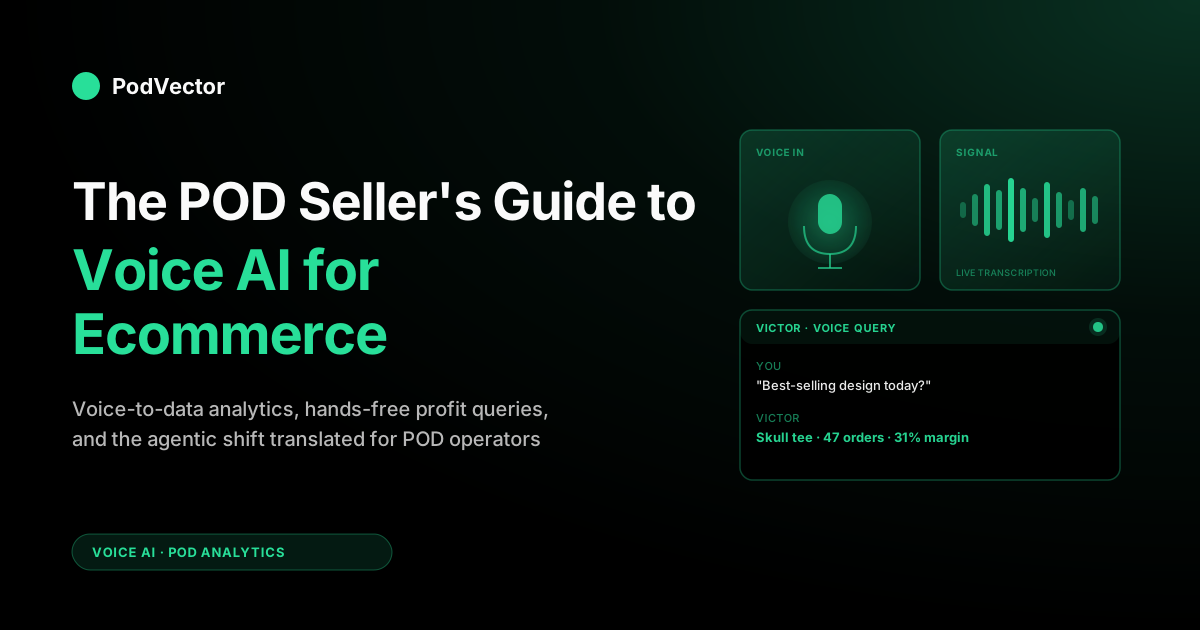
Quick Answer: Voice AI for ecommerce in 2026 is a $22B US market built mostly around customer-service automation and shopper voice search. For print-on-demand sellers, that framing misses the highest-leverage use case: voice-to-data analytics.
Most POD operators are solo or 2–3 people with no call center to automate, but they spend hours a week digging through Shopify, Printify, and ad dashboards. Voice AI that reads your live profit data and answers "what's my best-selling design today?" while you're driving or designing is the POD-specific version of voice commerce — and it's the layer everyone else's guides skip.
What "voice AI for ecommerce" means in 2026
Voice AI for ecommerce in 2026 is no longer the smart-speaker fantasy of 2018. The Alexa-orders-toilet-paper future never quite arrived. What did arrive is a quieter, more useful layer: voice interfaces embedded inside chat experiences, voice-driven customer support priced per minute (roughly $0.05–$0.07/minute on developer platforms like Retell or Vapi, or $59–$99/month on packaged tools like Goodcall) against the ~$5.60-per-call cost of outsourced human support in 2026, and — newer — voice agents that take actions on websites and operator dashboards instead of just answering questions. Latency has dropped below one second on the better platforms, which is what finally made voice feel like a conversation instead of a hold queue.
The US voice commerce market is estimated at $22.4 billion in 2026, with the global market projected to hit $186 billion by 2030 at a 24.6% CAGR per Alhena AI's 2026 voice commerce guide. Most of that volume sits in three buckets: shopper-side voice search, customer-service voice automation, and the early agentic layer where voice instructs an AI to take a multi-step action.
The three layers everyone else's guide describes
- Shopper-side voice search. A buyer asks "find me a red cocktail dress under $200" inside a chat or app, sees a visual carousel, and confirms by voice. Multi-modal — voice in, image out, voice confirm.
- Customer-service voice automation. Inbound calls answered by an AI voice agent that knows your order data, return policy, and supplier production status. Outbound calls to high-intent segments. SMS follow-up.
- Agentic voice on websites and dashboards. Voice agents that don't just respond — they click, fill, and submit. Tools like AnveVoice position around "voice AI that actually does things" — agentic DOM actions instead of conversation alone.
That's the standard 2026 framing. It's correct for most ecommerce categories. It's also mostly irrelevant to a print-on-demand operator under $5M ARR — and that's worth unpacking before recommending any tool.
Why POD operators need a different framing
Generic voice AI for ecommerce guides assume three things that don't hold for POD: that you have a call center, that your shoppers want voice search on your storefront, and that your highest-cost interaction is a human support agent. None of those are true for the typical POD seller.
Most POD sellers don't have a call center to automate
The headline ROI in every voice AI for ecommerce article — "automated calls cost 93–95% less than human agents" — assumes you were paying human agents in the first place. A solo POD seller running a Printify store is the support team.
There's no call center to replace; there's a Gmail inbox handled in batches. Voice AI sold as a customer-service replacement is solving a problem most POD operators don't have.
Your shoppers don't search your store by voice
Voice product search makes sense at scale (Amazon, Walmart, Kroger). It rarely makes sense on a niche POD store with 200 designs and a clear category structure.
The buyer found you through a Meta ad or an organic search; they're not voice-searching the storefront. Spending time on shopper-side voice search is mostly a distraction at POD scale.
Your highest-cost activity isn't customer support — it's data wrangling
Audit a typical POD operator's week and the most expensive activity isn't responding to "where's my order?" — it's reconciling Shopify revenue against Printify supplier invoices and ad spend to figure out which designs and campaigns are actually profitable. That's hours of dashboard hopping and spreadsheet wrangling. Voice AI that solves that problem — voice-to-data analytics — is the highest-leverage POD-specific use case, and it's the one nobody else's guide describes.
Margins punish wrong answers more than slow answers
POD margins typically run 20–35%. A voice AI agent that's friendly but wrong about delivery dates or stock costs the brand more than the same agent costs an inventoried brand running 60% margins.
For POD specifically, voice AI tools have to be wired to live, accurate data — not trained on a static FAQ — or they're a liability. We covered this exact failure mode in the POD seller's guide to AI for ecommerce brands.
6 voice AI use cases that actually fit POD
Reframed for the operator who is the support team, the buyer, and the founder all at once: here are the voice AI use cases that produce measurable margin or time gains in a POD operation.
1. Voice-to-data analytics (highest leverage)
"Hey Victor, what's my profit margin on the skull design across all suppliers this week?" Voice as an input layer to an AI employee that reads your live data — Shopify orders, Printify or Printful invoices, Meta and Google spend — and answers in plain language. The use case isn't replacing a phone call; it's removing the friction between a profit question popping into your head and getting the answer.
Most POD operators have profit questions all day and answer almost none of them because the dashboard is in another tab. Voice closes that gap.
2. Hands-free order and fulfillment monitoring
POD founders frequently work in two places at once — driving between print pickups, designing in Photoshop, dropping off shipping pickups. Voice access to "how many orders sent to Printify yesterday?" or "any Printful production delays this week?" turns five-minute dashboard checks into ten-second voice queries. Time savings are small per query, large in aggregate.
3. Customer-service voice automation (only when you've outgrown solo support)
The classic voice AI for ecommerce use case is real for POD brands above ~$2M ARR with a part-time support hire and a meaningful inbound call volume. Below that, the math doesn't pencil — your call volume is too low to justify the integration cost.
Above it, the numbers vendors report are genuinely good: 73% of calls resolved without a human at Ringly, "up to 80% automation" with a 94.7% CSAT at Siena, and deflection rates near 84% on the better order-status and returns flows. The two highest-value flows for a POD brand are inbound "where's my order?" calls answered against live supplier production status, and outbound abandoned-cart recovery — one Consio case study reports +$80K in phone sales in 30 days from recovery calls alone. Modern agents also handle 30+ languages with mid-call switching, which matters if you sell into the EU. The non-negotiable: the agent has to read live order and supplier data, or it lies about delivery dates the way a generic chatbot does. We covered the live-data requirement in the POD seller's guide to AI for ecommerce news.
4. Voice-driven supplier comparison
"Which Printful product had a price change this week?" or "what's the cheaper supplier for a 12oz mug shipped to Texas right now?" These are queries that mechanically belong in a dashboard but get asked in the moment, in your head, while you're sourcing or pricing. A voice AI that reads supplier rate cards in real time and answers in two seconds compounds across hundreds of small decisions per month.
5. Voice-assisted ad creative iteration
Walking back from coffee with a hook idea: "Victor, draft three Meta ad copy variants for the dad-joke t-shirt design targeting fathers 35–55." Voice as the input layer for AI ad copy generation — particularly useful when the idea hits between dashboard sessions. The voice itself isn't the creative engine; it's the friction reducer that captures the idea before it evaporates.
6. Voice-triggered agentic actions (the next 12 months)
The agentic frontier — and what tools like AnveVoice are pointing at. "Pause the Meta campaign for the skull design — its true ROAS dropped below 1.4 yesterday." Voice as the command surface for agents that take real actions in your store, ad accounts, or supplier integrations. Most POD operators won't run this in 2026 because the underlying agentic action layer isn't mature enough yet.
By late 2026 and into 2027, this becomes the highest-leverage voice use case for any operator running a multi-supplier, multi-channel POD brand. We dive deeper in the POD seller's guide to generative AI for ecommerce.
Voice vs. text chat: when each one wins
Most voice AI for ecommerce guides treat voice as a strict upgrade over text. It isn't. The two modalities solve different problems, and a POD operator should know which mode to deploy for which situation.
Voice wins when
- Your hands or eyes are busy (driving, designing, packing).
- The query is short and the answer fits in one sentence.
- You want a low-friction capture surface for ideas that would otherwise be lost.
- You're in a context where typing is slower than talking — phone, walking, multi-tasking.
Text chat wins when
- The answer is a table, a chart, or a long list.
- You want a record you can scroll back through.
- You're already at a desk with a keyboard.
- Privacy matters — you're in a coffee shop, on a plane, or sharing a co-working space.
The right voice AI for ecommerce stack uses both and lets the operator switch in the moment. Tools that force one mode lose to tools that don't. This is one of the design principles behind the POD seller's guide to AI for ecommerce's recommended workflow.
The agentic shift: from voice search to voice action
The biggest 2026 shift in voice AI for ecommerce isn't the audio quality or the latency improvements — it's the move from voice as a search interface to voice as an action surface. The Alhena guide calls it "agentic commerce." Intuz frames it as "voice-driven workflow automation." AnveVoice's whole positioning is "voice AI that actually does things." Same direction, different vocabularies.
For an inventoried brand, voice as action means an agent that places restock orders, schedules customer follow-up calls, and triggers refund workflows. For a POD brand, the action set is different — and arguably more interesting:
- Pausing an ad campaign whose post-supplier-cost ROAS drops below break-even.
- Routing a new order to whichever supplier is cheaper for that product-destination pair today.
- Drafting and queuing a product description in your brand voice for a new design upload.
- Flagging a return-rate spike on a design family and pausing its ads pending listing review.
- Triggering a sample reorder for a supplier whose quality complaints crossed a threshold.
None of these are storefront-facing. All of them are operator-facing. That's the agentic-voice opportunity for POD: a smaller shopper-side surface, a much bigger operator-side surface.
Where Victor sits on the voice agentic curve
Today, Victor — PodVector AI's AI employee — can answer your questions. Ask Victor a profit question in Slack or in the dashboard, and Victor looks at your orders, costs, ad spend and profit, then gives you the answer.
Voice as input is on the roadmap; voice-triggered actions are further out. The trajectory matches the broader market: answers today, actions tomorrow.
For POD operators, the right way to read this is: get the data foundation right now so the voice and action layers compound on top of accurate numbers later. Wrong numbers spoken faster aren't an upgrade.
A minimum voice AI stack for a POD store
Most generic guides recommend stitching together five or six voice AI vendors. For a POD operator under $5M ARR, the realistic stack is small.
- One AI employee with voice-friendly input. The spine of the stack. Has to read live Shopify, Printify or Printful, and ad-account data. Without it, every voice query downstream is built on the wrong numbers. This is where Victor sits, and where most POD voice AI conversations should start.
- One transcription/voice-input layer. Whisper API, Deepgram, or the native voice input on your phone or laptop. Cheap, mature, mostly invisible.
- One customer-service voice agent — only above ~$2M ARR. Packaged options like Goodcall ($59–$99/month) or Voice.ai, or developer-platform agents on Retell (~$0.07/min) or Vapi (~$0.05/min) if you want to wire it yourself. Watch for the 2026 shift toward outcome-based pricing (per resolved ticket) over per-minute, and toward setup measured in minutes rather than weeks. Skip below $2M; the integration cost outweighs the savings.
- One agentic voice tool — only when the underlying actions are stable. AnveVoice, Vapi, or similar for voice-triggered actions. Wait until your agent rules and integrations are reliable; voice on top of unreliable actions makes the unreliability faster, not better.
Three components for most POD operators, four for the larger ones. Brands that try to layer in six voice tools end up with a fragmented surface and worse decisions, not better ones. We compared the broader AI tooling landscape in best AI for ecommerce, compared.
Where to start in 30 days
Week 1 — Get your profit data into one place
Voice AI is only as good as the numbers behind it. If your supplier costs aren't tracked correctly, voice questions about profit will give you wrong answers — just faster.
Connect Shopify, Printify or Printful, Meta, and Google first, before adding any voice feature. The pillar hub at the complete guide to AI analytics for print-on-demand walks the foundational setup.
Week 2 — Add voice input to your AI employee
Whatever AI employee you use, enable voice input. For most operators this is just enabling Whisper-style transcription on the device you already use.
Ask three voice queries a day for a week. Track which ones returned useful answers and which ones returned wrong or vague answers. The wrong ones are usually data-quality issues from week 1, not voice issues.
Week 3 — Decide whether customer-service voice automation pays back
Pull last 90 days of customer-service contact volume by channel. If you're under 200 contacts/month or no agent on payroll, skip — the math doesn't pencil.
If you're above 500/month with a part-time hire, run a 30-day pilot with a voice agent wired to live order data. Below 500/month, start with text chat first.
Week 4 — Map your top 5 agentic voice candidates and wait
Write down the 5 repeated decisions in your operation that you'd want a voice command to trigger. Don't build yet. Revisit the list in 90 days. The agentic action layer is moving fast in 2026; what's brittle today may be production-ready by quarter-end. The map is the deliverable for week 4 — implementation comes later.
Common mistakes POD sellers make with voice AI
Buying a voice support agent before you have call volume
The biggest expense category in every voice AI sales deck is the support replacement use case. For most POD operators, that use case is theoretical — you don't have agents to replace. Don't buy the voice support agent until you've got the contact volume to justify it.
Trusting voice answers from a tool that isn't reading live data
If your voice AI is answering profit questions from a snapshot exported last night, it's giving you yesterday's reality with today's confidence. POD margins move daily — supplier price changes, ad cost shifts, return rate spikes. Voice on top of stale data is worse than text on top of stale data because it's faster to act on.
Optimizing your storefront for shopper voice search
It's a real category — but for niche POD stores it's mostly a distraction. The buyer found you through a Meta ad or an organic search and is browsing visually. Spend the same hours on the analytics layer instead.
Treating voice as a strict upgrade over text
Voice and text solve different problems. The right stack uses both. Tools that force one modality lose to tools that don't.
Skipping the data foundation
Voice AI without accurate numbers underneath is just for show. Get your supplier costs, ad spend, and per-product margins working correctly in text first. Then add voice on top. Do it backwards and you'll just spend money to spread wrong answers faster.
FAQs
Is voice AI for ecommerce actually being used by POD sellers in 2026?
Mostly as voice input to AI analytics tools, occasionally as voice support automation at the larger end. Storefront-side voice shopping is rare on POD stores because the catalogue size and buyer behavior don't fit the format. The voice-to-data analytics use case is what's growing fastest among POD operators specifically.
How much does voice AI for ecommerce cost?
Voice transcription and input is mostly free or near-free (Whisper API is fractions of a cent per minute). Voice support agents run roughly $0.05–$0.07/minute on developer platforms (Retell, Vapi) or $59–$99/month on packaged tools (Goodcall), for context against the ~$5.60-per-call cost of outsourced human support in 2026. Outcome-based pricing — paying per resolved ticket rather than per minute — is emerging in 2026. Agentic voice tools like AnveVoice typically charge per usage minute. The biggest cost driver is still integration time, not software cost.
What's the difference between voice AI for ecommerce and a standard chatbot?
A chatbot reads and writes text; a voice AI reads audio and speaks audio. Most voice AI products are chatbots with a speech-to-text layer in front and a text-to-speech layer behind. The interesting difference is the use context — voice handles hands-busy situations a text chatbot can't.
Will voice AI replace customer service for POD brands?
Partially, above ~$2M ARR. Voice AI handles the high-volume, low-complexity tickets — order status, return policy, basic product questions — at a fraction of human cost. The judgment-call tickets — quality complaints, custom orders, partner inquiries — still need a human. The right framing is "voice handles the volume; humans handle the exceptions."
What's "agentic voice" and is it real today for POD?
Agentic voice means voice commands that trigger multi-step actions in your store, ads, or suppliers — not just answers. It's emerging in 2026 but the underlying agent action layer is still maturing. For POD specifically, the answer-tier (voice-to-data analytics) is production-ready today; the action-tier is a 12-month horizon.
Do I need a Shopify-specific voice AI tool?
Not necessarily. The voice layer is mostly modality-agnostic — what matters is whether the underlying analytics or support tool reads your Shopify, Printify or Printful, and ad-account data accurately. We compared the Shopify-specific options in the POD seller's guide to AI for Shopify.
How do I evaluate a voice AI for ecommerce vendor?
Two questions. One: does it read live data, or is it answering from a static snapshot? Two: can I ask the same question in voice and text and get the same answer? If either answer is no, the tool is theater. The voice modality is easy to bolt on; the live-data foundation is hard.
Where should I start if I'm a solo POD operator under $500K ARR?
Voice input to your AI employee, nothing else. Skip the voice support agent (no call volume to justify it). Skip the agentic voice layer (immature). Add voice transcription to whatever profit-query tool you use today and you've captured 80% of the realistic POD-specific value of voice AI for ecommerce in 2026.
The voice layer is only as good as the profit data underneath it
Victor reads your live Shopify, Printify or Printful, and ad-account data and answers profit questions in plain English — the analytics layer that voice queries depend on and that most voice AI for ecommerce tools won't be useful without. Victor answers your questions and acts on them — with your approval. And start with the spine of a voice-ready POD operation.
Try Victor free