
Quick Answer: AI for ecommerce companies in 2026 is no longer a feature category — it's the operating layer that decides which brands keep their margin and which lose it. The general playbook (recommendations, dynamic pricing, AI search, support, inventory, agentic checkout) was written for inventoried DTC brands and breaks in three predictable places when an "ecommerce company" is a Print on Demand operation: there is no inventory, supplier cost varies per order, and the catalogue is design-as-SKU at 10–100x normal scale. This guide unpacks what AI for ecommerce companies actually looks like for POD operators, which standard use cases translate, which ones don't, and the analytics foundation every other AI investment quietly depends on.
What "AI for ecommerce companies" means in 2026
"AI for ecommerce companies" used to mean a feature you bolted on — a recommendation widget, a chatbot, an upsell engine. In 2026 it means the operating layer that reads your live data, generates the content that goes out the door, and increasingly takes action against goals you've set.
According to Datarefs, 84% of ecommerce businesses now rank AI as their highest strategic priority, and McKinsey's research shows 88% of retail and CPG companies are actively testing or deploying AI applications. Content generation is the dominant entry point — according to Triple Whale, 67% of retailers use AI for marketing and content tasks. The holdouts are mostly small operators who think they're saving money; they're usually losing the bet to competitors who automated the repetitive operator work.
The shift isn't only on the seller's side. According to Ringly.io, 59% of Americans now use generative AI tools for shopping tasks — up from 11% during the 2024 holiday season — and AI-referred shoppers convert 31% higher than traditional traffic. Adobe Analytics recorded a 4,700% year-over-year surge in traffic from generative AI tools to US retail sites during holiday 2025. The point of those numbers for a POD operator isn't the headline — it's that buyer behavior and competitor tooling are both moving fast, and the cost of running your store on AI that doesn't understand POD economics goes up every quarter.
The general guides — BigCommerce's overview of how ecommerce AI is transforming business in 2026 and Shopify's breakdown of how AI works in ecommerce — frame the opportunity around the same recurring use cases: personalized recommendations, AI search and discovery, customer support automation, dynamic pricing, ad and PPC optimization, inventory and demand forecasting, sales forecasting, generative content, fraud detection, and agentic commerce. That framing fits inventoried DTC brands cleanly.
For Print on Demand it's mostly right at the top of the stack and mostly wrong at the bottom — and the brands that don't notice the difference adopt the wrong tools first. We've built a broader view of the category across our AI overview cluster hub and the AI analytics topic hub; this guide narrows in on what the term actually means when the ecommerce company in question is a POD operation.
Why POD is a different kind of ecommerce company
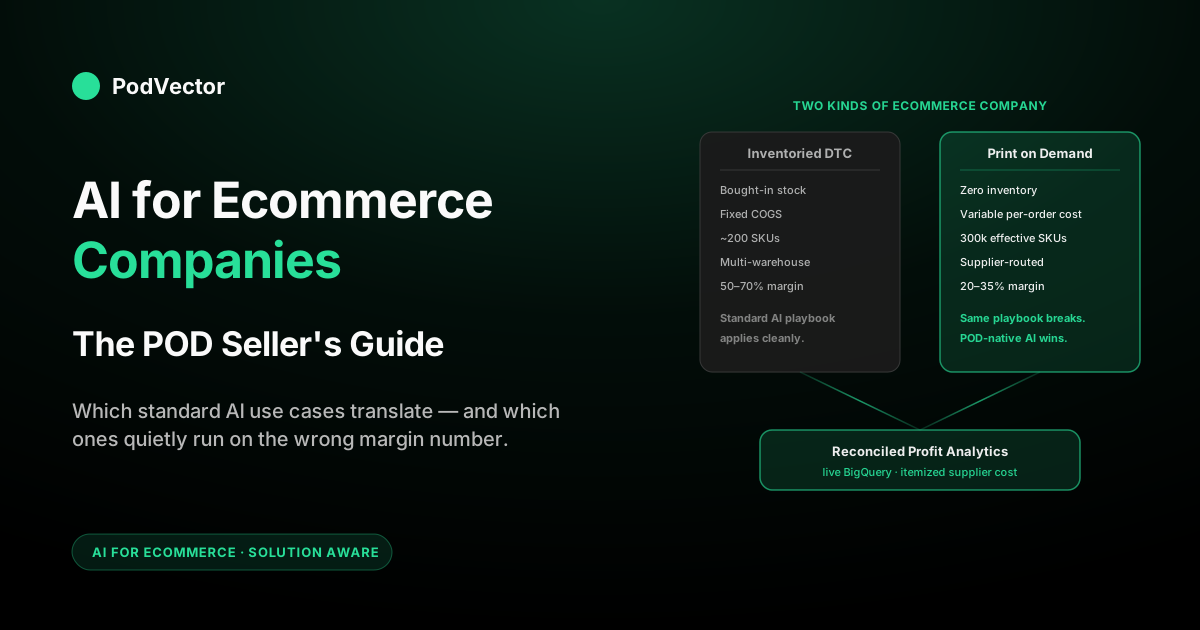
The standard "ecommerce company" template a typical AI vendor builds for is a brand with bought-in inventory, fixed unit cost, a few hundred SKUs, a handful of warehouses, and gross margins significantly higher than what POD can achieve. POD inverts almost all of those assumptions. The economic shape of the business is different enough that AI tools optimized for the standard template generate plausible-looking outputs against the wrong inputs.
Zero inventory means inventory AI is dead weight
The headline use case in every general guide — AI demand forecasting, AI inventory optimization, AI replenishment — does not exist for POD. You don't hold stock. You don't reorder. You don't allocate across warehouses.
Tools sold on those use cases are pricing in value you can't capture, and dashboards leading with "stock-out risk" are showing a metric that's structurally always zero. The equivalent POD problem isn't "do I have enough inventory" — it's "which designs are about to trend, and can I launch them before competitors catch the same signal."
Variable per-order supplier cost, not fixed COGS
An inventoried brand sets COGS once. A POD seller's cost varies by product type, print method, supplier, fulfillment region, and shipping destination — the same hoodie might cost different amounts depending on which Printify or Printful provider takes the order and where it ships.
Generic AI dashboards default to a single COGS column, so the ROAS, margin, and "profitable campaign" labels they generate for a POD store are approximate at best and meaningfully wrong at worst. AI built on the wrong margin number quietly automates against the wrong target.
Design-as-SKU catalogue scale
An inventoried brand might run a few hundred SKUs. A POD operation can run thousands of designs across dozens of product types — producing an enormous number of effective SKUs from an attribution and personalization standpoint.
Off-the-shelf personalization engines that segment on "previous purchase" and "category interest" hit a long-tail wall fast. The personalization that actually works for POD has to operate at the design family, niche, and aesthetic level — a layer most generic engines weren't built for. As Vaybel notes, most AI tools weren't built for POD sellers' specific catalogue dynamics.
Tighter margins that punish small mistakes
Inventoried DTC brands often run significantly higher gross margins than POD operations, which typically earn thinner margins after supplier cost, payment fees, and shipping. A pricing or attribution error that an inventoried brand can absorb can turn a profitable POD design unprofitable. AI tooling that's "directionally right" is fine for a brand with margin to spare and lethal for a brand that doesn't. This is why understanding contribution margin is foundational before layering in any AI automation.
Niche-affinity moats that generic AI quietly erodes
POD brands win on niche affinity — the buyer recognizes the voice, the aesthetic, the inside reference. Generative AI that produces SEO-shaped sludge erases the very thing the brand is supposed to monetize. The discipline isn't "should we use AI for content"; it's "how do we use AI to scale the existing brand voice rather than replace it." Companies that miss this distinction adopt AI fast and lose niche conversion rate slowly.
9 AI use cases for ecommerce companies, translated for POD
The general guides converge on the same core use cases. Each one translates differently — or not at all — for a POD operation. Here's the honest map. (Fraud detection, the tenth use case most guides now list, is largely handled by Shopify Payments and your payment processor for POD — it's real but not a tool you buy separately, so it's not broken out below.)
1. Personalized recommendations
Standard ecommerce companies use AI to surface "frequently bought together" and "you might also like" based on past behavior. For POD this works for the upper layer (visitors who've browsed the dog-mom hoodie should see the dog-mom mug) but breaks at scale because most designs have too few transactions to power collaborative filtering.
The translation that works: cluster designs by visual similarity and niche tag, recommend within the cluster, and re-rank by margin after itemized supplier cost — not by attributed revenue. Brands that recommend on revenue alone push their lowest-margin SKUs to the top of the cart.
2. AI search and on-site discovery
Standard ecommerce search AI handles synonyms, typos, semantic intent. For POD with thousands of designs, the bigger lift is letting buyers search by aesthetic ("vintage rust botanical line art") rather than exact keyword.
AI-powered visual and semantic search is the use case POD ecommerce companies most consistently underinvest in — and the one Etsy and Redbubble have already raised buyer expectations on. We cover the search side in detail in the POD seller's guide to AI search for ecommerce.
3. Customer support automation
Standard ecommerce chatbots resolve "where's my order" and FAQ-style tickets. POD support is structurally different: the most common ticket isn't a generic shipping question — it's "where's my order, the supplier shows shipped but tracking is silent, can you check?" That requires a chatbot that reads supplier-side data alongside Shopify orders.
Generic chatbots miss this and escalate; POD-aware ones resolve it cleanly. According to Triple Whale, among brands already using conversational AI, 96% deploy it for customer support — making it the most widely adopted AI function in ecommerce. We compare the available options in Best AI Chatbot for Ecommerce (Compared).
4. Dynamic pricing
Standard dynamic pricing AI raises and lowers SKU prices based on competitor scraping, demand signals, and stock position. For POD the input set is different: you have no stock to defend, but you do have variable supplier cost by provider and product type. The dynamic-pricing job for POD is closer to "set product-type price floors that always clear minimum margin given today's Printify/Printful pricing" than to "react to competitor moves." Many POD ecommerce companies skip this layer and end up with hoodies underpriced relative to current supplier cost — a slow leak that compounds. Victor's ability to reprice a product to a target margin (with your approval) addresses exactly this gap. See also our breakdown of Printify t-shirt cost and profit and Printify sweatshirt cost and profit to understand the floor you're pricing against.
5. Ad and PPC optimization
Standard AI ad optimizers bid on platform-reported ROAS. For POD the danger is structural: Meta and Google report ROAS based on attributed revenue, not on margin after supplier cost and fees.
POD operators routinely find that a meaningful share of what their ad platform calls "profitable" is actually break-even or worse once itemized supplier costs and payment fees are included. AI bid optimization layered on platform-reported ROAS scales loss. The translation that works: feed the optimizer a margin-after-COGS signal, not a raw revenue signal. Our guide to AI for ecommerce marketing walks through the loop in more detail. And if you're scaling spend, watch for ad frequency and ad fatigue — two signals that erode ROAS before the platform's AI catches them.
6. Inventory and demand forecasting
Standard ecommerce companies use AI here for replenishment, allocation, and stock-out prediction. For POD this entire category is a non-use-case — there is no inventory.
The closest functional equivalent is design-trend forecasting: predicting which design themes are about to spike using TikTok hashtag growth, Reddit subreddit velocity, Etsy search trend data, and Pinterest pin acceleration. POD ecommerce companies that wire this in launch in days rather than weeks; the ones that don't end up arriving at trends after the margin has been competed away.
7. Sales forecasting, retention, and lifetime value
Standard ecommerce companies use AI here for month-over-month revenue projection plus the retention side the current guides increasingly lead with — churn prediction, lifetime-value scoring, and win-back triggers. For POD the more useful application is forecasting at the design-family and niche level — which clusters are growing, which are decaying, which are about to require fresh creative to keep the cohort active. POD revenue forecasting at the SKU level is statistically meaningless because the SKU count is too high; at the design family or niche level it produces signals you can actually plan against.
Retention and LTV translate the same way: a POD buyer rarely rebuys the exact SKU, so churn and repeat-purchase signals live at the niche and aesthetic level, not the product level. The operator question is "which niche cohorts are cooling, and which need fresh designs to stay active" — and the answer is only trustworthy if the underlying LTV is computed on margin after itemized supplier cost, not on attributed revenue. According to Stord's 2026 State of AI report, brands that successfully integrate AI across the value chain see a 30% increase in Customer Lifetime Value — but that number only holds when the data underneath it is accurate.
8. Generative content (copy, images, design variants)
Standard generative AI is used for product descriptions, ad copy, email subject lines, and lifestyle imagery. For POD this is the use case most operators reach for first because of the obvious time savings.
The trap: generic generative AI produces generic listings, and generic listings on Etsy or Shopify don't rank because every other store is shipping the same template. Brands that train AI on their existing brand voice and edit the output ruthlessly get the speed gain without the niche-erosion cost. We cover the trade-offs in the POD seller's guide to generative AI for ecommerce.
9. Agentic commerce and agentic checkout
The newest category — and the one with the most analyst noise. According to Elogic's 2026 market analysis, AI and agents influenced $262 billion of global online holiday spend, with AI-referred visits converting 31% more often than non-AI traffic. Retailers running their own branded shopper agents grew holiday sales 59% faster than those without, per the same Elogic report.
For POD ecommerce companies the immediate question isn't "will agentic checkout disrupt me" — it's "is my product feed structured well enough that an AI agent can read it?" Agents shop schemas. Stores with clean structured data show up in agent results; stores without it don't. This is the discipline the general guides now call Generative Engine Optimization (GEO) — optimizing your product data to be cited and recommended by AI assistants instead of ranked by keyword. The infrastructure is the same infrastructure that powers AI Overviews and ChatGPT shopping — get it right once, win the next several traffic shifts.
Agentic AI: the shift no ecommerce company can wave off
Every general guide for AI for ecommerce companies in 2026 leads with agentic AI for a reason. The shift from feature-AI (you click a button, it generates an output) to agent-AI (it reads live data, takes action against goals you've set) is the structural change that decides which ecommerce companies get leverage from AI and which ones get a folder of unused subscriptions.
According to Elogic, agentic commerce has bifurcated into two competing open standards — ACP (backed by Stripe and OpenAI) and UCP (backed by Shopify and Google) — and most merchants will need to support both. That two-protocol split means the infrastructure decisions POD operators make now have compounding implications.
For POD ecommerce companies the agentic shift looks like this: an AI employee that watches your live Shopify, Printify, Printful, and ad-account data, surfaces margin questions in plain English, and — with your explicit approval — takes action on your Shopify store when conditions you've set are met. Today most "agentic" ecommerce AI is answers-tier (you ask, it answers from your data). The next tier is actions-tier (it acts within guardrails, with your approval). Brands that wire up the answers tier first end up with the data foundation the actions tier requires.
Skip it and the actions tier has nothing reliable to act on. Our agentic AI for ecommerce guide walks through the curve, and our AI agents for ecommerce explainer covers what each tier actually does for a POD operation.
Victor sits at this layer for POD ecommerce companies. Today: ask a profit, ROAS, supplier-cost, or design-family question in English and get an answer reconciled to live warehouse-backed data, with itemized Printify and Printful supplier costs already subtracted. Victor also executes approved Shopify-side actions — repricing a product to a target margin, bulk repricing across your store, setting up discounts, creating collections, or reverting a price change — all under explicit human approval. On the roadmap: broader write automation as more surfaces open up.
What AI actually buys a POD ecommerce company
The general guides quote eye-catching numbers. According to Stord's 2026 State of AI report, early adopters leading in AI-driven personalization generate 40% higher revenue compared to non-adopters. According to Ringly.io, AI content drafting delivers 3.2x ROI and personalization engines deliver 2.7x ROI for retailers who get the data foundation right. For POD ecommerce companies the more honest payoff sits in four buckets.
Margin clarity that wasn't possible at month-end
The biggest unlock for most POD operators isn't a flashy new feature — it's knowing today, not in six weeks, what their actual margin is by campaign, design family, and supplier route, with itemized Printify or Printful costs already netted out. That clarity changes which campaigns you scale, which designs you reorder mockups for, and which suppliers you keep using. AI is what makes that clarity continuous instead of monthly. Understanding your contribution margin at the design and campaign level is the unlock that makes every other AI investment work correctly.
Operator hours back on the calendar
POD operations are heavy on repeated work — writing variant descriptions, generating mockups, replying to "where's my order" tickets, segmenting email lists, drafting ad creative. AI compresses the time per task significantly on the right surfaces. The hours don't disappear; they get redirected to the judgment calls AI can't make — niche identity, brand voice, partnership decisions, big creative bets.
Launch-cycle compression on niche trends
The POD margin window on a viral niche is days, not weeks. AI design generation paired with trend signal scraping closes the design-to-listed gap dramatically for brands that get the loop right. As Mydesigns.io notes, the real bottleneck in POD is not generating one image — it's getting dozens of product-ready listings built and published fast. The brands that solve this arrive at trends before the easy margin has been competed away.
A data foundation that compounds
Every dollar spent on the right AI analytics layer keeps paying off, because every other AI tool in the stack — ad optimizer, email engine, support bot, recommendation system — runs better when the underlying data is reconciled and live. Skip the analytics foundation and every upper-stack AI investment runs against approximate margin and produces approximate gains. We covered this trade-off pattern in our complete guide to AI analytics for print-on-demand. It also affects downstream decisions like whether to pursue Shopify Capital — lenders and algorithms both reward stores with clean, consistent profit data.
A right-sized AI stack for a POD ecommerce company
A reasonable AI stack for a POD ecommerce company in 2026 is narrower than the dashboard sprawl most operators end up with by accident. According to Elogic's 2026 market analysis, only 7% of companies have fully scaled AI while 62% remain stuck in experimentation — the gap is almost always a sequencing and integration problem, not a tools problem. The categories that actually pull weight for POD, in priority order:
- Reconciled profit analytics with itemized supplier cost. Foundation. Without it, every other AI runs against the wrong margin number. (Victor sits here for POD-specific operations — he reads your Shopify, Meta Ads, Google Ads, Printify, and Printful data together so he can show you true profit. With your approval, he can also make changes in Shopify, Google Ads, Meta Ads, and Klaviyo, not just Shopify.)
- AI design generation tied to niche trend signals. The launch-speed unlock. Midjourney, Adobe Firefly, Ideogram, Canva Magic — paired with a trend-scraping loop.
- Listing and mockup automation across product types. Compresses the per-design operator-time cost from hours to minutes.
- Ad creative iteration tied to live margin (not platform ROAS). The optimization loop that scales spend against the right number. Pair it with active monitoring of ad frequency to know when creative is exhausted before your ROAS collapses.
- POD-aware customer support automation. A chatbot that reads your supplier API alongside Shopify orders.
- Lifecycle email and SMS segmented on design family / niche. Personalization engines tuned for POD's long tail.
- AI search and visual discovery on-site. The search bar your buyers expect after using Etsy and Redbubble.
Notice what's not on the list: dynamic inventory tools, fulfillment routing AI, multi-warehouse stock optimization. Skip those. They're built for a different kind of ecommerce company. Our guide to AI solutions for ecommerce goes deeper on which categories translate and which ones don't.
A 60-day AI rollout sequence for a POD operation
Most ecommerce companies adopt AI in the wrong order — flashiest tools first, foundation last — and end up with a beautiful surface running on quietly broken numbers. According to Elogic, one of the most common AI mistakes is buying AI features before fixing data architecture and integration gaps. The sequence that works for POD looks like this.
Days 1–14: Wire up the analytics foundation
Connect Shopify, Printify or Printful, and your ad accounts into one reconciled view with itemized supplier costs feeding into per-order margin. This is the unglamorous step every general guide skips and every successful POD operator does first.
You can build it (a warehouse + connectors + dashboards), buy a POD-specific tool that ships with it, or duct-tape a spreadsheet. The decision is which of those three; the question is never whether to do it. Getting your checkout conversion rate baseline established at this stage also ensures your ad-to-revenue attribution starts clean.
Days 15–28: Add the highest-leverage upper-stack tool
Pick one — usually AI design generation or ad creative iteration. Run it for two weeks, measure the time saved and the margin moved, and decide whether to keep it. If you can't measure either, the foundation isn't reading correctly yet — go back to days 1–14.
Days 29–45: Add a second tool, validate it doesn't conflict with the first
Common second pick: POD-aware support automation or lifecycle email. Watch for tool-fragmentation cost: six AI tools that don't talk to each other are usually worse than three that share a data foundation. The integration pattern matters as much as the individual tool quality.
Days 46–60: Stand up agentic answers, scope agentic actions
By day 46 the analytics foundation has six-plus weeks of reconciled data and the upper-stack tools have shown what they're worth. Stand up an agentic AI layer — Victor or equivalent — that reads the live data and answers margin questions in English.
Begin scoping which Shopify-side actions you'd let it take under guardrails over the next 90 days. The brands that finish the 60-day sequence here are positioned for the agentic shift; the brands still untangling their analytics foundation are positioned to be told what to do by their tools.
Common mistakes POD ecommerce companies make with AI
Buying upper-stack tools before fixing the analytics foundation
Pattern: ad creative AI before reconciled margin, support AI before clean order data, personalization AI before a single source of truth. The visible tools are easier to evaluate so they get bought first, then they run beautifully against numbers that are quietly wrong. Reverse the order.
Treating "AI for ecommerce" tools as POD-ready by default
The AI tool category is dominated by inventoried-DTC assumptions. Vendors will happily take POD revenue and quietly produce wrong outputs. As Vaybel's 2026 POD tool guide notes, most AI tools weren't built for POD sellers.
Ask any vendor: does this tool handle variable per-order supplier cost, or does it default to a fixed COGS column? If they don't have a clean answer, the tool is built for a different kind of ecommerce company.
Trusting platform-reported ROAS without subtracting supplier cost and fees
Meta and Google report attributed revenue. That's not your margin. POD operators consistently find that a meaningful share of "profitable" campaigns are break-even or losing once itemized supplier cost and payment fees are included. AI optimizers built on this signal scale the loss faster than humans could. Watching ad fatigue signals alongside true margin numbers keeps you from doubling down on campaigns that look good on the platform but bleed margin once you see the real numbers.
Generic AI content that erodes niche identity
POD brands win on niche affinity. AI-generated copy and creative that reads like every other listing on Etsy breaks that affinity for everyone who knows what your store is supposed to feel like. Train AI on your existing voice, edit ruthlessly, accept that "less content with personality" beats "infinite content without it." Note that according to Gartner (via Elogic), 50% of US consumers already prefer brands that don't use GenAI in customer-facing messages — a signal that undifferentiated AI output is being noticed.
Adding tools instead of integrating data
Six AI tools that don't talk to each other are usually worse than two tools that share a data foundation. Platform fragmentation is the biggest drag on AI ROI in 2026 across ecommerce — as Elogic's report flags, expecting AI to solve fragmented systems on its own is a top implementation mistake. The right question isn't "what new AI tool should I add?" — it's "what's my data foundation, and what reads from it?"
Ignoring the agentic shift because it feels early
Some POD ecommerce companies wave off agentic AI as too early. According to Elogic, retailers running their own branded shopper agents grew holiday sales 59% faster than those without. The brands waving it off in 2026 will be the brands buying the same traffic and AI-agent shelf space at premium rates in 2027. Cheap-positioning windows close.
FAQs
What's the difference between AI for ecommerce companies and AI for POD specifically?
The general category — AI for ecommerce companies — assumes inventoried economics: bought-in stock, fixed COGS, multi-warehouse fulfillment, and high gross margins. POD inverts most of that: zero inventory, variable per-order supplier cost, third-party fulfillment, and thinner gross margins.
The upper-stack AI categories (content, support, ads, personalization) translate with adjustments. The lower-stack categories (inventory forecasting, dynamic stock allocation, warehouse routing) don't translate at all and are dead weight for a POD operation.
Which AI use case has the highest ROI for a POD ecommerce company under $500K ARR?
Reconciled profit analytics with itemized supplier costs across Shopify, Printify or Printful, Stripe, and ad accounts. Without it, every other AI tool runs against the wrong margin number. The visible automations — ad creative, email, support — are higher in the stack and easier to add later. The analytics foundation is the precondition for all of them being right.
Can POD brands use generic ecommerce AI tools?
Mostly yes for the upper-stack categories (email, ad creative, support, content), with caveats around training and segmentation. Mostly no for the lower-stack categories (inventory, fulfillment, dynamic stock pricing) — those are dead weight for POD. The analytics layer is the one place where POD-specific tools meaningfully outperform generic ones, because variable per-order supplier cost isn't something generic dashboards model correctly.
How much should a POD ecommerce company spend on AI?
For a POD brand under $1M ARR, keeping AI spend to a small percentage of revenue across the stack is reasonable, with the analytics layer as the biggest single line item. Brands spending significantly without measurable margin or operator-time gains are usually compensating for a missing analytics foundation by buying more upper-stack tools. If you're evaluating growth capital to fund your AI stack, see our guide to how to get Shopify Capital and whether Shopify Capital checks credit.
Will agentic AI replace ecommerce operators?
It shifts what humans do. The repeated decisions — drafting copy, segmenting audiences, generating creative variants, replying to standard tickets, adjusting prices to hit margin targets — become AI-handled with human approval gates.
The judgment calls — niche identity, brand voice, partnership decisions, big creative bets, picking which trends are real — stay with humans. Ecommerce companies that try to AI-out everything tend to lose niche identity and decline; companies that AI-out the repeated work free up humans for the judgment calls and grow.
What's the difference between AI for ecommerce companies and ecommerce AI tools?
"AI for ecommerce companies" describes the broader operating layer — strategy, integration pattern, where AI fits in the org. "Ecommerce AI tools" is the narrower category of specific products you buy. The first question (what's our AI strategy?) determines the second (which tools fit it?). Most POD brands skip the first question and buy tools, then can't explain why their AI investment isn't producing results.
How do I know if an AI tool is actually working for my POD store?
Two questions, both 60-day: did it produce a measurable margin or CAC gain you can point at, and did it free up operator time you can point at? If both answers are no, it's a sunk cost — cancel it. POD brands that prune their AI stack quarterly end up with a sharper, smaller toolkit than brands that hoard everything they've ever subscribed to.
What about agentic checkout — will buyer-side AI agents change what POD ecommerce companies need to do?
Yes, but the action item is simpler than the noise suggests: make sure your product feed is structured cleanly. Agents shop schemas. Stores with clean structured data show up in agent shopping results; stores without it don't. The same infrastructure powers AI Overviews and ChatGPT shopping — get it right once, win the next several traffic shifts. We compare the broader landscape in Best AI for Ecommerce (Compared).
Run AI on the right margin number, from day one
Victor reads your live Shopify, Printify or Printful, Meta Ads, and Google Ads data and answers profit questions in plain English — true ROAS after itemized supplier costs, margin by design family, which campaigns and providers actually pay for themselves. He also executes approved Shopify-side actions like repricing to a target margin, setting up discounts, and organizing collections — all under your explicit approval. The analytics foundation every other AI investment in your POD stack quietly depends on. And start with the layer that decides whether the rest of your AI ecommerce stack tells you the truth.
Try Victor free