
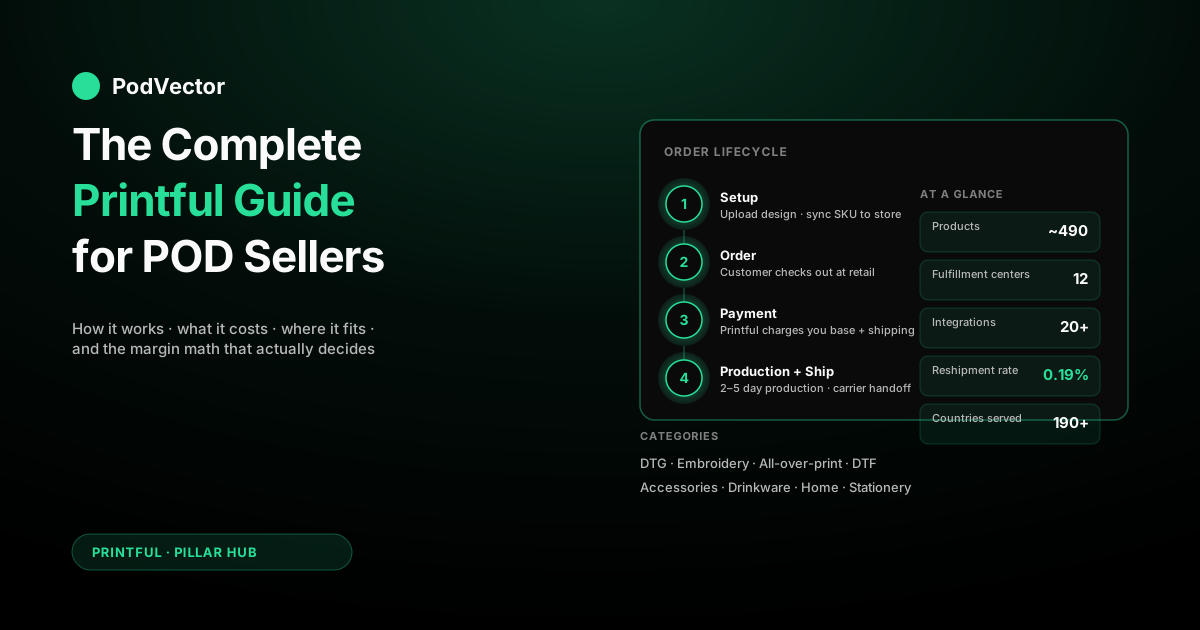
Quick Answer: Printful is a print-on-demand fulfillment company that prints, packs, and ships custom products under your brand whenever a customer orders — no inventory, no minimums. In 2026, its catalog covers ~490 products across DTG apparel, embroidery, all-over-print, accessories, and home goods, with 12 fulfillment centers spanning North America, Europe, Australia, and Japan.
It's free to use (you pay per order), plugs into Shopify, Etsy, Amazon, TikTok Shop, WooCommerce, Squarespace, Wix, eBay, and Walmart via native integrations, and offers a paid Growth tier at $24.99/month that takes 20–33% off base costs — worth it above roughly 10 monthly orders or any embroidery volume. Printful's edge is branding (inside labels, hang tags, custom packaging, white-label packing slips) and production quality; its weakness is base pricing, which runs ~15–35% above Printify and Gelato on most SKUs.
Whether Printful is actually profitable for you is a margin question — not a platform question — and it gets answered at the SKU and channel level, not the platform level. This guide covers how Printful works, what it costs end-to-end, what to sell, how to connect it, where it fits in your stack, who it's best for, and the operator-level decisions that determine whether you make money on it.
What Printful is (and isn't)
Printful is a print-on-demand and fulfillment partner. You upload designs, connect a store, list products.
When a customer orders, Printful charges your card for production plus shipping, prints the item in one of its fulfillment centers, packs it under your branding, and ships it to the customer. You keep the difference between retail and the wholesale-plus-shipping cost. No inventory, no upfront production runs, no warehouse, no minimums.
The confusion most new sellers have is where Printful sits in the ecosystem. Three quick clarifications:
Printful is not a marketplace. You don't sell on Printful the way you sell on Etsy. Printful is a back-end fulfillment layer that connects to wherever you actually sell — your Shopify store, your Etsy shop, your TikTok Shop, your Amazon listings. Traffic and customers are your job. Printing and shipping are Printful's.
Printful is not dropshipping in the AliExpress sense. Dropshipping typically means reselling third-party inventory as-is. Print-on-demand means selling custom goods manufactured on order. Printful produces every item in-house at its own facilities using DTG printers, embroidery machines, DTF equipment, and sublimation lines. The product doesn't exist until someone buys it.
Printful is not the cheapest. If you compared raw base costs across Printful alternatives, Printful would usually be in the middle-to-high half of the range. It's priced for sellers who value branding, print quality, and US/EU fulfillment over saving $2 per shirt. For margin-first sellers, that's either a deal-breaker or a non-issue depending on your retail price and channel.
Founded in 2013 and headquartered in Charlotte, North Carolina with a significant Latvia operation, Printful has fulfilled more than 90 million items for over two million merchants. That scale shows up in two places: reliability (0.2% reshipment rate, public fulfillment SLAs) and product breadth (rare in the POD space). Both are the reason a lot of brands that start on a cheaper platform migrate to Printful once they hit ~$5K–10K/month in sales and margin math gets serious.
How Printful actually works, order by order
A single Printful order moves through the same five stages regardless of product, channel, or seller volume. Understanding these stages matters because every seller problem — missed deadline, wrong variant, chargeback, failed fulfillment — lives at the seam between two of them.
Stage 1: Product setup (happens once per SKU). You pick a blank (e.g. Bella+Canvas 3001 unisex tee), upload your design, position it with the Design Maker, choose colors and sizes, set retail price, and either sync to your store or list as a Printful Quick Store product. Printful auto-generates mockups you can use as product images.
Stage 2: Customer orders on your store. A buyer on Shopify, Etsy, TikTok, Amazon, eBay, or wherever completes checkout at your retail price. The storefront collects payment, tax, and shipping from the customer. Printful isn't involved yet.
Stage 3: Order is pushed to Printful. The integration (webhook or scheduled sync) forwards the line items and customer address to Printful. Printful charges your payment method on file — not the customer's — for base cost plus shipping plus any taxes it's legally required to collect. The customer has already paid you; you're now paying Printful to manufacture and deliver.
Stage 4: Production and packing. The order goes to the fulfillment center closest to the destination (Printful has 12 active centers as of 2026: Charlotte, Los Angeles, Dallas, Toronto, Tijuana, Birmingham UK, Riga Latvia, Barcelona, Sydney, Melbourne, Auckland, Tokyo). Production is typically 2–5 business days. The item is printed, quality-checked, and packed with your branding (inside labels, hang tags, packing slips) if you've set them up.
Stage 5: Shipping and tracking. The packaged order hands off to a carrier (USPS, UPS, FedEx, DHL, DPD, Canada Post, local EU carriers, Japan Post, etc.). A tracking number flows back through the integration to the storefront, which pushes a tracking email to the customer. Delivery typically lands 3–8 business days after production depending on zone.
Where does this go wrong? Almost always at Stage 3.
The seller's payment method fails, and the order sits un-fulfilled until the seller notices (often via an angry customer email). Second-most common: Stage 1 — the design file was low-resolution or the print area was mispositioned, so the product is technically shipping but with quality issues.
Both are seller-side problems that discipline fixes. A full walkthrough with screenshots lives in how to make money with Printful: the complete POD profit playbook.
What you can sell on Printful in 2026
Printful's catalog spans roughly 490 products as of April 2026, organized into eight rough buckets. The exact number drifts as Printful adds and retires products — the categories are the stable part.
| Category | Example products | Print method | Where it shines |
|---|---|---|---|
| DTG apparel | T-shirts, hoodies, sweatshirts, tanks, long sleeves | Direct-to-garment | Core category; best quality on Bella+Canvas 3001, Gildan 64000, Comfort Colors 1717 |
| Embroidered apparel | Hats, dad caps, trucker caps, polos, beanies, jackets | Embroidery machine | Printful's highest-margin category; strong quality advantage over competitors |
| All-over-print (AOP) | AOP tees, hoodies, leggings, joggers, swimsuits, skirts | Sublimation cut-and-sew | Niche apparel, maximalist design; longer production times (5–7 days) |
| DTF apparel | Select tees, crewnecks with bold or dark designs | Direct-to-film transfer | Better color on dark fabrics than DTG; durable through washes |
| Accessories | Tote bags, backpacks, fanny packs, phone cases, stickers, hats (non-embroidered) | Sublimation / DTG / print-and-cut | Low-price gateway products, high attach rate as add-ons |
| Home & living | Mugs, posters, canvas prints, blankets, throw pillows, doormats, towels | Sublimation / inkjet | Giftable; seasonal spikes (Mother's Day, Christmas) |
| Drinkware | Mugs, travel mugs, water bottles, beer steins | Sublimation | Consistent year-round sellers; good for corporate / bulk orders |
| Paper & stationery | Stickers, greeting cards, notebooks, posters, calendars | Print-and-cut / offset-like | Low ticket, fast fulfillment; good for Etsy-first stores |
The category you pick matters more than the specific product, because cost, margin, production time, and customer expectations cluster by category. DTG apparel is the default because it has the biggest catalog, the most integration presets, and the most predictable margins.
Embroidery is where margin-sophisticated sellers go — base cost is higher, but so is retail, and repeat purchase rates on hats are consistently higher than on tees in our aggregated customer data. All-over-print looks impressive in mockups but suffers from longer production times and more color-match complaints.
For a deeper breakdown of what to avoid, what to double down on, and how to read Printful's product pages for the real information (GSM weight, print area dimensions, fit notes), the Printful quality angle is covered in more depth in the upcoming complete Printful review: quality, fulfillment, and profitability.
What Printful costs, end to end
Printful's pricing is free to enter and layered in practice. There are five cost components that show up on an order, and understanding all five is what separates "I tried Printful and the margins were bad" from sellers who run 40% net margin on the same catalog.
1. Base product cost. This is what Printful charges you to produce one unit.
For a Bella+Canvas 3001 tee it's roughly $12.95 on Free tier. For a Gildan hoodie it's $24.50.
For an embroidered 6-panel cap it's $14.50. Base costs vary by product, with color-matched ink, size upcharges (2XL+ usually adds $2–4), and region (US vs EU fulfillment differ slightly).
2. Shipping cost. Charged per order based on product category, destination, and speed.
Standard US shipping on one tee is around $4.99 with each additional tee at $1.50. International shipping is higher and more variable. Importantly, Printful charges you for shipping separately from production; you in turn charge your customer whatever you want — the difference can help or hurt margin depending on what you set.
3. Branding fees. Optional but structural. Inside labels add $2.49/item (or $1.89 on Growth).
Outside labels are similar. Custom packaging sleeves, branded hang tags, pack-in cards, and custom packing slips range from $0.50 to $4.50 per item. Sellers chasing DTC margin typically skip branding; sellers building a brand turn most of it on and raise retail by $5–10 to absorb it.
4. Membership fee. $0 on Free, $24.99/month on Growth, negotiated on Business. This is covered in depth below, but the short answer is Growth pays for itself above ~10 monthly orders.
5. Taxes. Printful collects sales tax on your order in states where it has nexus (most US states). That tax flows to the tax authority, not Printful's margin — but it shows up on your invoice and can surprise first-time sellers who assumed their Shopify tax collection covered everything.
The complete per-order math — worked out for DTG, embroidery, AOP, mugs, and posters with exact numbers pulled from Printful's current pricing page — is in the complete guide to Printful costs and fees for POD sellers. That piece also covers the hidden costs most sellers miss (re-print SLA, failed-order handling, refunds, sample orders for listing photography) which compound into a 3–6% drag on net margin if you don't account for them.
Printful's memberships and when each makes sense
As of January 15, 2026, Printful consolidated its membership tiers. The lineup is now:
- Free — $0/month. Full product catalog, all integrations, Design Maker access, 20% off samples. Use this to start.
- Growth — $24.99/month. Up to 20% off DTG base costs, up to 33% off other categories, 7–9% branding discount, 25% off samples, free embroidery digitization. Becomes free once your trailing-12-month Printful sales cross $12,000.
- Business — negotiated enterprise tier. 22% DTG, 33%+ other, higher branding discount, priority fulfillment, dedicated account manager. Becomes free at $60K trailing-12-month sales. Activated via support, not self-serve.
The old names — Plus, Pro, Premium — don't exist as products anymore. They map to Growth and Business. Full translation history, break-even math per product category, and the decision matrix are in the complete guide to Printful Premium, Plus, and Pro memberships.
The headline math: Growth's break-even is 5–10 orders/month depending on product mix. If you're running embroidery, Growth pays for itself at 5 orders.
If you're running DTG apparel with branding, it pays for itself at 7. If you're under 10 monthly orders with no branding and no embroidery, stay on Free — the subscription is a drag on already-thin margins.
Integrations and where they matter most
Printful connects to 20+ ecommerce platforms natively and covers the long tail via its API and Zapier. The integrations that actually matter for 95% of POD sellers are smaller than that list suggests.
| Platform | Why sellers pick it | Printful support level |
|---|---|---|
| Shopify | Full brand control, best app ecosystem, your-own-domain | Deepest native integration; instant sync, variant control |
| Etsy | Built-in traffic, niche audiences, gift market | Native integration; some variant quirks around sizes |
| TikTok Shop | Virality-driven sales, live-shopping | Native since 2024; growing fastest by volume |
| Amazon | Massive discovery, trust-at-checkout | Native integration, strict listing quality requirements |
| WooCommerce | WordPress-native, no monthly fee | Full plugin, mature |
| Squarespace / Wix | Design-first sellers, portfolio-style stores | Native integration, fewer variant options than Shopify |
| eBay / Walmart | Marketplace arbitrage, older-demographic reach | Native integration, less commonly used |
| Printful API | Custom storefronts, headless commerce, B2B bulk | Available on every tier including Free |
Shopify is the default for brand-building. Etsy is the default for getting free discovery while you build. TikTok Shop is the fastest-growing channel for new sellers in 2026 and is where the next two years of new POD brands will be born — the integration is solid but product approval can be slow.
The integration decision matters more than most new sellers realize because it determines how your margin data flows back into whatever system you use to track profitability. Shopify + Printful produces clean order records with complete cost visibility.
Etsy + Printful is messier because Etsy's fees, listing costs, and promoted-listings ad spend are separate line items you have to stitch in manually. For the full matrix of what each integration exposes to your analytics, see the complete guide to Printful integrations for POD sellers.
Shipping, fulfillment, and production times
Shipping is where expectations and reality diverge for new Printful sellers. The platform advertises "2–5 business days production" and that is the average — but it's the average after the order clears payment, is routed to the right facility, and isn't held up by a stockout on the blank or a design file issue. End-to-end delivery time (customer order to delivery) in practice looks like this:
| Destination zone | Production time | Transit time | Typical total |
|---|---|---|---|
| US domestic (fulfilled from NC, LA, TX) | 2–5 business days | 3–5 business days | 5–10 business days |
| Canada (fulfilled from Toronto or Tijuana) | 2–5 business days | 4–7 business days | 6–12 business days |
| EU (fulfilled from Barcelona, Riga, UK) | 2–5 business days | 3–5 business days | 5–10 business days |
| UK (fulfilled from Birmingham) | 2–5 business days | 2–4 business days | 4–9 business days |
| Australia / NZ (fulfilled from Sydney, Melbourne, Auckland) | 2–5 business days | 3–6 business days | 5–11 business days |
| Japan (fulfilled from Tokyo — select products) | 2–5 business days | 3–5 business days | 5–10 business days |
| Rest of world (cross-border shipping) | 2–5 business days | 7–20 business days | 9–25 business days |
Peak season (late October through early January) adds 2–5 days to production across the network. The biggest lever you have is product choice: DTG apparel and mugs fulfill fastest, all-over-print and embroidered backpacks slowest.
Setting expectations correctly in your product description ("ships in 5–10 business days") prevents 80% of shipping-related chargebacks. The full shipping breakdown with rate tables, carrier choices, and the known tradeoffs per zone is in the upcoming complete guide to Printful shipping: rates, times, and zones.
Printful quality and what trips sellers up
Printful's print quality is consistently in the top third of POD platforms in blind tests. The company publishes a 0.19% reshipment rate, which is low for this category and has been roughly stable for three years. That said, "quality" varies by print method and garment choice, and the sellers who complain about Printful quality are usually picking the wrong combination for their design.
DTG quality is best on Bella+Canvas 3001, 3413, Next Level 3600, and Comfort Colors 1717. These garments have tight weaves that hold ink cleanly. Cheaper Gildan 5000 prints fine but the fabric itself feels less premium, which shows up in unboxing videos and reviews. If you sell at $30+ retail, the upcharge to Bella+Canvas is invisible to margin but visible to the customer.
DTG struggles on dark garments with heavy ink coverage. Physics: DTG ink sits on top of the fabric rather than penetrating it like screen print, so dark colors under a white underbase can crack faster on high-wash items (hoodies, sweats). If your design is heavy on white ink over black fabric, consider DTF instead.
Embroidery quality is Printful's standout. Thread density, stitch count, and color matching are consistently called out as better than Printify's roughly-equivalent-priced embroidery. The tradeoff is digitization — Printful handles it free on Growth/Business but charges $2.95–$6.50 per design on Free.
All-over-print has the highest variance. Color matching on AOP can drift 10–15% from what you see in the mockup generator, especially on neon and fluorescent colors. Order a sample before listing.
Mug and accessory printing is solid, with the caveat that sublimation on white ceramic sometimes shows mottling on gradients. Solid-color designs fare much better than photographic designs on mugs.
The seller-side move that prevents most quality complaints: sample every new product before listing. Use the 20% sample discount (25% on Growth). A $15 sample cost once per SKU is cheaper than a $30 chargeback plus reshipment plus a negative review. Sellers who skip samples and then complain about quality on forums are usually looking at a preventable problem.
Printful vs Printify, Gelato, and the rest
Printful's closest competitors in 2026 are Printify, Gelato, CustomCat, Gooten, and a growing bench of specialist providers (SPOD, Teelaunch, Apliiq for premium apparel, Contrado for luxury). The decision doesn't come down to "which is best" in the abstract — it comes down to which matches your retail price, product mix, and fulfillment region.
| Dimension | Printful | Printify | Gelato |
|---|---|---|---|
| Base cost (Bella+Canvas 3001 tee, US) | ~$12.95 | ~$10.50 (varies by provider) | ~$11.80 |
| Fulfillment model | In-house at own facilities | Network of third-party print providers | In-house + partner network |
| Product catalog size | ~490 | ~900 (wider but variable quality) | ~600 |
| Branding options | Strongest (labels, tags, inserts, custom packaging) | Limited, varies by provider | Mid-tier, global coverage |
| Quality consistency | High (single-provider) | Variable (depends on provider) | High |
| Geographic coverage | 12 centers across 6 regions | Largest via provider network | Largest (30+ print partners worldwide) |
| Best for | Brand-focused DTC; $25+ retail | Margin-focused; testing new niches | Global reach; sustainability focus |
The simplification most experienced sellers converge on: Printful when branding and quality matter more than $2/unit. Printify when $2/unit matters more than branding. Gelato when you sell globally and want local fulfillment in markets Printful doesn't cover well. Use all three if your catalog is diverse — there's no rule against it, and the integrations don't conflict.
The full apples-to-apples breakdown, including specific blanks, shipping cost deltas by zone, and margin math on the same design produced on each platform, is in Printful vs Printify: which is best for POD sellers.
Who Printful is best for (and worst for)
Printful is best for:
- Sellers building a brand (as opposed to flipping designs) who will use labels, hang tags, and packaging
- Stores with retail prices above $25 — the base-cost premium becomes irrelevant
- Embroidery-heavy catalogs (hats, polos, backpacks) where Printful's quality advantage is real
- Stores targeting US, EU, UK, or Australian customers with domestic fulfillment expectations
- Anyone who's been burned by a multi-provider platform's inconsistency and wants production-quality lock-in
- Higher-volume sellers — $12K/year trailing revenue makes Growth free; $60K unlocks Business
Printful is worst for:
- Sellers with retail prices under $20 — base cost eats margin immediately
- Pure-arbitrage sellers optimizing for maximum orders per dollar of ad spend
- Stores targeting regions Printful doesn't serve well (Latin America, Southeast Asia, Africa)
- Niche product needs not in Printful's catalog (skateboards, watches, heavily bespoke items)
- Sellers who absolutely need 1–2 day production and will pay for it — consider specialist express providers
If you don't fit neatly into either side: the right move is usually Printful plus Printify or Printful plus Gelato. Use Printful for your flagship branded SKUs and a cheaper provider for test designs or commodity items.
How to get started with Printful, step by step
The first-90-days playbook for Printful is short. It looks like this:
Step 1: Create a free Printful account at printful.com. No credit card required to sign up. Complete your profile, add a billing method (you'll need one before you can fulfill orders). Takes 10 minutes.
Step 2: Decide where you're going to sell first. For most new sellers in 2026, the answer is Etsy (free traffic, harder margins) or Shopify ($29/month, full control). Skip this if you already have a store — just connect it.
Step 3: Connect your store via Printful's native integration. From your Printful dashboard: Stores → Add Store → pick your platform → authorize. This takes 2 minutes on Shopify, 3–5 on Etsy (some extra verification).
Step 4: Pick one product to start. Not ten. One. Bella+Canvas 3001 tee is the default because it has the biggest audience and best print quality-to-cost ratio. Upload your design, position it, set retail price (aim for 2.5–3x base cost to leave room for ads), and publish to your store.
Step 5: Order a sample. Use the 20% sample discount. Wear it. Photograph it on a real human. Use those photos as your product listing images. Stock-mockup photos convert 40–60% worse than real product photography across every test we've seen.
Step 6: Get your first three orders before you worry about anything else. Post on your personal social, share with friends and family, offer a launch discount. The first three orders are the only thing that matters — they prove the fulfillment flow works end-to-end, they give you real feedback, and they fund your first ad test.
Step 7: Only after you have three real orders should you start thinking about memberships, branding add-ons, additional products, paid ads, or anything else. Most new sellers bankrupt their time (and often their ad budget) by optimizing the back-end before the front-end has traction.
For a much deeper version of this playbook, including the ad-budget math, the pricing formula, and the specific Etsy/Shopify conversion tactics that compound, read how to make money with Printful: the complete POD profit playbook. For general POD-business foundations that apply regardless of platform, see how to start a print-on-demand business step by step.
The real question: is Printful profitable for your catalog?
Here's where most Printful guides end, and where the actual operator problem begins. The decision "should I use Printful" is a tiny fraction of the work. The decision "is Printful paying me" gets answered every day, order by order, SKU by SKU — and almost no new seller has the tracking infrastructure to answer it.
The math looks simple on paper:
| Line | Example (branded Bella+Canvas tee, Shopify) |
|---|---|
| Retail price | $29.99 |
| Printful base cost | ($12.95) |
| Inside label + hang tag | ($4.00) |
| Shipping charged to customer | $4.99 |
| Shipping Printful charges you | ($4.99) |
| Shopify + payment fees (~3.4%) | ($1.19) |
| Ad spend attributed (blended) | ($6.00) |
| Net profit per order | $5.85 |
That number changes every time the customer picks a different size (2XL upcharge), a different product mix, a different shipping zone, or when you run a promo. It changes when you raise your ad spend.
It changes when you add a second channel. The average across your store tells you very little; the per-SKU, per-channel number tells you everything.
Most sellers track this in a spreadsheet once a month, or not at all. That's the gap — and it's the gap PodVector AI's AI agent Victor was built to close.
Victor connects your Printful account, your Shopify sales, and your ad spend (Meta, Google), then answers margin questions against live data. Not "what did I make last month" but "which specific SKU is paying my ads, at which specific size tier, this week." That's the question that determines whether you scale a product or kill it.
For the adjacent question of whether POD as a category is still worth entering in 2026, the honest answer is in is print-on-demand profitable in 2025: truths and myths. For the profit-calculation methodology that works across any POD platform, see how to calculate POD profits step by step.
FAQs
Is Printful free to use?
Yes. Printful has no signup fee, no monthly fee on its Free tier, and no order minimums. You pay per order when a customer buys: base product cost plus shipping plus any branding add-ons you've enabled. The $24.99/month Growth tier is optional and saves money at roughly 10+ orders/month.
Does Printful charge you or the customer?
Printful charges you, the seller. The customer pays your store (Shopify, Etsy, TikTok, etc.) at retail. Printful then charges your payment method on file for production and shipping. You pocket the difference.
How long does Printful take to ship?
Production takes 2–5 business days on average. Shipping adds 3–8 business days depending on destination. End-to-end for US domestic orders is typically 5–10 business days. Peak season (late October to early January) adds 2–5 days. For the full zone-by-zone table, see the complete guide to Printful shipping.
Does Printful do dropshipping?
Printful is technically a print-on-demand fulfillment partner, not a dropshipper in the classic AliExpress sense. It produces the product on order using its own in-house equipment; it doesn't resell third-party inventory. The fulfillment flow looks like dropshipping (customer orders, supplier ships direct), but the products are custom-manufactured, not pulled from a warehouse.
What's the difference between Printful and Printify?
Printful is a single in-house manufacturer — consistent quality, strong branding, higher base costs. Printify is a network of third-party print providers — cheaper base costs, wider catalog, more variable quality. Printful wins for brand-building; Printify wins for margin-first sellers. Full comparison: Printful vs Printify.
Can I use Printful on Etsy?
Yes. Printful has a native Etsy integration that syncs products, pulls orders, and sends tracking back. Some Etsy-specific quirks — size variant structures, image aspect ratios — require extra setup, but it's a mature integration used by tens of thousands of Etsy sellers.
Can I use Printful on Amazon?
Yes, Printful has a native Amazon integration. Amazon's listing quality requirements are strict (image specs, product titles, category approvals), so setup takes longer than Shopify or Etsy, but the integration itself is solid.
How much can you make with Printful?
Wide range. New sellers typically make $0–$500/month in the first 90 days.
Consistent sellers clear $1,000–$5,000/month by month 6. Top Printful stores clear $10K–$100K+/month, and a small number clear seven figures annually.
The variable is not the platform — it's your niche, design, retail price, and ad discipline. Margin is what matters, not revenue.
Is Printful good for beginners?
Yes, with one caveat. The product setup, design uploading, and integration side is as beginner-friendly as POD gets.
What's not beginner-friendly is the margin discipline — new sellers frequently underprice, skip samples, spend on ads without attribution, and end up with revenue that looks good and net margins that are negative. Printful is a good platform; the business skills are what new sellers underestimate.
Can I sell on multiple stores with one Printful account?
Yes. A single Printful account can host unlimited connected stores. Most multi-channel sellers run one Printful account with Shopify, Etsy, TikTok Shop, and Amazon all connected to it. Product catalogs are managed per-store; the account roll-up gives you unified billing and analytics.
Does Printful ship internationally?
Yes, to 190+ countries. Fulfillment routes through the closest facility to the destination when possible. International shipping costs are higher than domestic and delivery times longer; rest-of-world shipping (outside US/EU/UK/AU/NZ/JP) can take 9–25 business days.
Can I cancel Printful anytime?
Yes. Free tier has nothing to cancel. Growth is month-to-month and can be canceled anytime; you keep Growth benefits through the end of the paid period. Your products, integrations, and design files stay in your account even if you cancel.
How does Printful compare to starting your own print shop?
Printful is dramatically cheaper in capital terms ($0 vs $30K–$150K for a screen-print setup). The tradeoff is margin per unit — in-house printing can clear 60–70% gross margin while Printful typically delivers 30–50%.
For most sellers under $500K/year revenue, Printful wins on capital efficiency and risk. Above that threshold, some brands move fulfillment in-house.
Know which Printful SKUs are actually paying you.
The guide you just read is the easy part. The hard part is tracking which products, on which channels, at which sizes, on which ad campaigns, are profitable this week — not just this quarter. PodVector AI's AI agent Victor plugs into your Printful account, your Shopify store, and your Meta and Google ad platforms, then answers live margin questions against your real data. Ask "which Printful SKU was most profitable this week" and get an answer, not another dashboard.
Try Victor free