
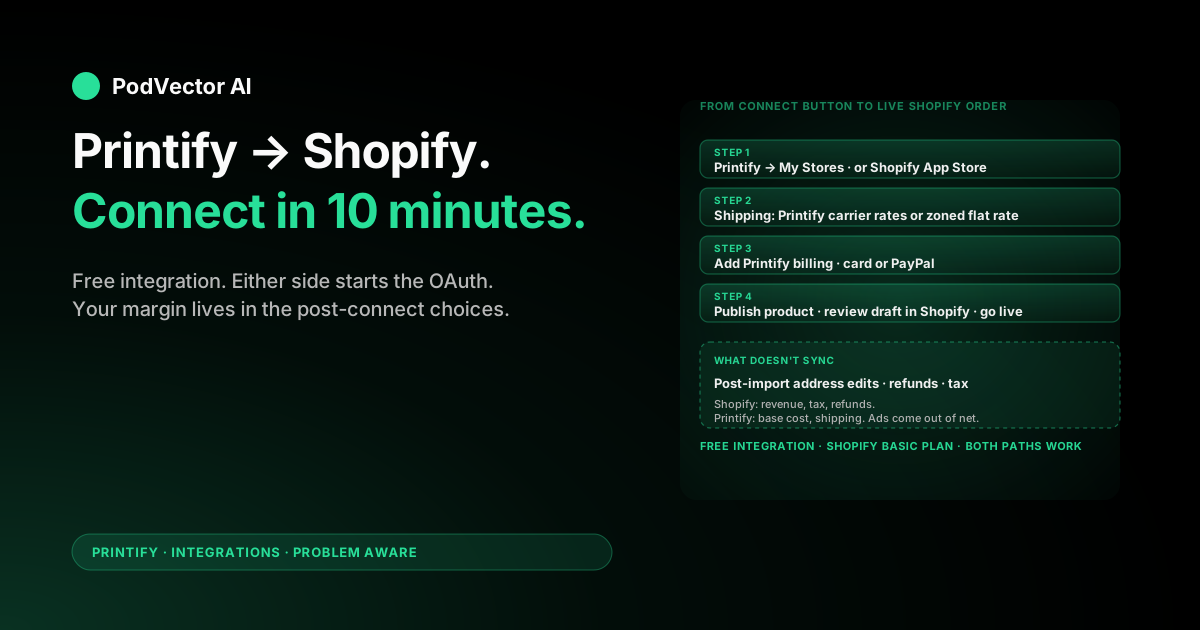
Quick Answer: Connecting Printify to Shopify takes about 3–10 minutes. You can start either from the Printify dashboard (My Account → My Stores → Add new store → Shopify) or from the Shopify App Store (search "Printify" → Add app → authorize), then map the Printify store profile to your Shopify store.
Plan on another 20–40 minutes after the connect to set shipping, add a billing method in Printify, and publish your first product. After that, paid Shopify orders push to Printify for fulfillment automatically.
The integration itself is free. Costs come from your Shopify plan ($39/month and up), Shopify's payment processing, and Printify's per-order base + shipping.
Before You Connect: Prerequisites
The Printify–Shopify integration is free on both sides, but there are four things you need in place before the connect flow will actually work end-to-end.
1. An active Shopify plan. Shopify discontinued its Starter and Basic-Lite tiers for full storefront use; you need at least the Basic plan ($39/month at current US pricing) to accept payments and use the Shopify Admin for product management.
2. A Printify account. Free is fine to start. Printify Premium ($29.99/month) shaves roughly 20% off base product costs and tends to pay for itself once you're consistently doing 30–40+ orders per month, but you don't need it on day one.
3. A payment method on Shopify. Either Shopify Payments or a third-party processor configured in Settings → Payments. Without this, orders can't actually be paid, and Printify won't see them.
4. A billing method ready for Printify. Shopify takes payment from your customer; Printify charges you base cost + shipping when an order is sent to production. Without a card or PayPal on Printify, every Shopify order will stall in "payment required" status.
If you've used Printify with another sales channel before — Etsy, Wix, eBay — the model is similar, but the OAuth handshake and the post-connect setup differ. See our Etsy to Printify walkthrough, the Shopify connection step-by-step, and selling on Etsy using Printify for context. Shopify is the closest analog to Wix in that the storefront is fully yours rather than a marketplace.
Method 1: Connect from Printify (Dashboard route)
This is the route most POD sellers actually use, especially if Printify is already where you spend most of your design time.
Step 1. Log in to your Printify account at printify.com.
Step 2. Click your profile icon in the top right and choose My Account.
Step 3. In the left sidebar, click My Stores.
Step 4. Click Add new store.
Step 5. Find Shopify in the sales-channel list and click Connect.
Step 6. Enter your Shopify store URL (the your-store.myshopify.com version, not the custom domain — Printify uses this for the OAuth handshake).
Step 7. You'll be redirected to Shopify to log in and approve permissions. Read the prompt: Printify is asking to read products, orders, customers (for shipping), and write back order fulfillment status.
Step 8. Click Install app. Shopify drops you back on the Printify dashboard with the Shopify store now listed under My Stores.
You're connected. Any product you push from Printify will land in Shopify's Products tab as a draft, and any paid Shopify order will push to Printify for fulfillment automatically.
Method 2: Connect from Shopify (App Store route)
Start here if your Shopify store already exists and you're adding Printify alongside other fulfillment apps, or if you simply prefer the Shopify-Admin-first workflow.
Step 1. Log in to your Shopify Admin.
Step 2. In the left sidebar, click Apps, then Apps and sales channels.
Step 3. Click Shopify App Store.
Step 4. Search "Printify" and make sure you click the official Printify app (it's the one with the "Built for Shopify" badge and millions of installs — there are a few unofficial wrappers).
Step 5. Click Install.
Step 6. Approve the permissions prompt — Printify needs read access to orders/products and write access to fulfillment.
Step 7. You'll be redirected to Printify. Log in to your existing Printify account. Do not create a new Printify account during this flow if you already have one — this is the most common setup mistake, and it leaves your design library stranded on the old account.
Step 8. Pick which Printify store profile to map to this Shopify store. First-timers will see "My new store" by default — rename it to match your brand so it's not confusing later.
Same end state as Method 1: a two-way live connection between one Printify store profile and one Shopify store.
Which Method Should You Use?
Functionally identical end state. The choice matters for one reason: which account flow do you trust yourself to handle without creating a duplicate.
Method 1 (Printify-first) is safer if you already have a Printify account with designs in it. The flow forces you to log in to that exact account before connecting, so you can't accidentally create a duplicate.
Method 2 (Shopify-first) is more convenient if you live in the Shopify Admin daily. The risk is the "create or log in to Printify" step at the end — clicking Create new account when you meant Log in is how sellers end up with two Printify accounts and a support ticket.
If in doubt, use Method 1.
After Connecting: Set Up Shipping
Shipping is where Printify–Shopify sellers most often lose money. Shopify charges your customer at checkout; Printify charges you at production. If those two numbers aren't aligned, every order eats your margin.
You have three reasonable approaches:
Option A: Publish Printify's flat rates directly into Shopify. Printify can push its shipping table into Shopify as carrier rates, so the customer pays approximately what you'll pay Printify. Quickest to set up; minimal margin risk. The downside is the rates look "high" to customers used to flat $5 shipping from big retailers, which can soften conversion.
Option B: Zone-based flat rates you set manually. Group destinations into 3–5 zones (US domestic, Canada, EU, UK, Rest of World) and pick a flat per-order or per-item rate per zone using Printify's published shipping table as your floor. More setup work, but you control the customer-facing price.
Option C: "Free shipping" priced into the product. Raise the listed price by your average shipping cost and advertise free shipping site-wide. Conversion usually goes up. The discipline this demands: don't run free shipping on heavy items (hoodies, blankets, multi-item bundles) — Printify's per-pound math will eat you alive on those.
To configure: in Shopify Admin go to Settings → Shipping and delivery → General shipping rates → Manage rates. Add zones, set the rate per zone, save. Then test by adding a product to cart with shipping addresses in different countries — you should see the rates you expect at checkout.
For the underlying cost math that should inform whichever option you pick, see our breakdown of Printify's cost per shirt and the broader Printify cost stack. The shipping line item is the second biggest one after base product cost, and the only one Shopify won't surface for you.
After Connecting: Add a Billing Method in Printify
Shopify takes payment from your customer at checkout. Printify takes payment from you the moment the order is sent to print. If Printify has no card on file, every paid Shopify order will sit in "Action required: payment" status in Printify and never fulfill.
Step 1. In Printify, go to My Account → Payments.
Step 2. Add a credit card or link a PayPal account.
Step 3. Decide whether to enable automatic order approval. With it on, paid Shopify orders push straight to production. With it off, you review each order in Printify before it ships — worth the friction for the first 20–30 orders so you can catch design errors and address typos before they hit a print run.
One detail that bites new sellers: Printify charges per order, not per shipment. A single Shopify order with three items pulls three base costs + the combined shipping at production time. Your card needs available credit for that — Printify treats declined charges as a hard stop and pauses the order until you fix the payment method.
Publish Your First Printify Product on Shopify
Flow: design in Printify → push to Shopify → Shopify imports as a draft → you review and publish.
Step 1. In Printify, click Catalog and pick a product to test with. T-shirts and mugs are the lowest-risk starting points — short production time, broad fit, easy reprints if there's a defect.
Step 2. Click Start designing. Upload your artwork or use Printify's built-in design tool.
Step 3. Pick your print provider. This is the single biggest cost-and-quality decision in the Printify catalog: providers vary on base price, ship time, available colors and sizes, and print quality. Order a sample from any provider before you commit volume — the base price difference between providers can be 20–40% on the same product.
Step 4. Set the retail price. Printify shows you the base cost on the same screen. Aim for at least 2.5x base for sustainable margin after Shopify's payment processing fee, your shipping subsidy, and ad costs.
Step 5. Click Save product, then Publish to Shopify.
Step 6. Open Shopify Admin → Products. The new product appears as a draft. Review the description, add lifestyle photos if you have them (mockups alone underperform), set the product's collection, and click Make active to push it live on the storefront.
That's the full loop: design → publish → live on Shopify → orderable.
What the Integration Syncs (and What It Doesn't)
The integration is two-way for some things and strictly one-way for others. Knowing which is which prevents most "why didn't this update?" support tickets.
Synced Printify → Shopify:
- Product title, description, images, variants, and pricing — when you push or update from Printify
- Inventory status (in stock / out of stock) when Printify or the print provider discontinues a variant
- Order status updates (in production, shipped) and tracking numbers
Synced Shopify → Printify:
- New paid orders, automatically pushed to Printify for fulfillment
- Order cancellations made before Printify sends the order to print
Not synced (this is where sellers get burned):
- Edits to a Shopify order after it's been imported to Printify. Change the shipping address in Shopify after import, and Printify will not see the update — you have to edit it in Printify directly.
- Discount codes and free-shipping promos. If a customer gets free shipping in Shopify, that does not affect what Printify charges you.
- Sales tax. Shopify collects tax from the customer; Printify does not handle that line item.
- Refunds. A refund issued in Shopify does not automatically cancel the Printify order. If the order has already gone to production, you're paying for it regardless of the refund.
Costs to Expect Once You're Live
There's no integration fee. The full cost stack of running a Printify + Shopify store has four recurring layers:
1. Shopify plan fee. Basic plan is $39/month, Shopify plan is $105/month, Advanced is $399/month (current US pricing, annual billing slightly cheaper). Fixed and unavoidable for accepting card payments on a Shopify storefront.
2. Shopify payment processing. 2.9% + $0.30 per online transaction on the Basic plan through Shopify Payments. Slightly lower on higher plans, slightly higher if you use a third-party processor (Shopify also adds a 2% "third-party processor" fee on Basic if you don't use Shopify Payments).
3. Printify per-order cost. Base product cost + shipping, charged at production time. This varies wildly by product and print provider — a basic Bella+Canvas 3001 t-shirt is roughly $9–11 base, while a sublimated all-over-print hoodie can be $30+ before shipping.
4. Optional Printify Premium. $29.99/month for roughly 20% off base prices on most products. The break-even point for Premium tends to land around 30–40 orders/month, depending on your product mix.
Quick example: a small Printify–Shopify store doing 30 orders/month at $30 average is grossing $900. Shopify takes roughly $36 in processing fees + $39 in the plan fee. Printify takes roughly $450 in combined base + shipping. That leaves about $375 net before any ad spend — and ad spend is where the margin actually disappears at this scale.
Troubleshooting Common Issues
The handful of problems that account for most Printify–Shopify support tickets:
"Product won't publish to Shopify." Almost always one of three issues: (1) the Printify product is missing a required field (price, variant, or product image), (2) you've hit Shopify's variant cap (100 variants per product on most plans), or (3) the integration token expired after a Shopify password change or plan-tier swap. For the last one, disconnect and reconnect under Printify → My Stores.
"Shopify order didn't sync to Printify." Check that the order is actually paid in Shopify, not just "Pending." Unpaid, draft, and "Payment authorized but not captured" orders do not push to Printify. If it's paid and still missing after 5–10 minutes, disconnect and reconnect the integration — the connection drops occasionally after Shopify auth changes.
"Printify charged my card for an order I refunded in Shopify." Expected. Refunds in Shopify are between you and the customer. To stop Printify from charging you, you must cancel the order in Printify before it leaves the "On hold" status, which is usually within the first few hours of import. Past that, production has started and you're paying.
"Tracking numbers aren't showing up in Shopify." Tracking syncs from Printify to Shopify only after the print provider marks the order as shipped, typically 3–7 business days after import. If 10+ days have passed and there's no tracking yet, open the order in Printify — there may be a production hold (out-of-stock variant, art-quality flag) you need to resolve.
"International shipping is killing my margin." Re-check your Shopify shipping zones. The default Shopify shipping setup often charges the same rate worldwide, while Printify's international rates can be 3–4x domestic. Either publish Printify's carrier rates directly or set explicit zones for the regions you actually sell into.
"I created a duplicate Printify account during the Shopify App Store install." If your design library is on the original account, contact Printify support — they can merge accounts, but it's a manual process. The faster fix going forward: disconnect the new account from Shopify, reconnect using your original Printify credentials, and delete the duplicate.
What to Track After You Go Live
Most Printify–Shopify sellers track gross revenue and call it a day. That's enough to confirm the business exists. It isn't enough to know what to do next. Five numbers actually drive decisions:
True per-order margin. Revenue minus Shopify processing fee minus Printify base cost minus Printify shipping minus the ad spend allocated to that order. Shopify shows you revenue. Printify shows you cost. Nothing puts them in the same view by default — you have to reconcile manually.
Margin by product, not just average. A 30% blended margin can hide three products earning 50% and two earning 10%. The 10% products eat ad budget and operator time; the 50% products are where you should be doubling down on creative.
Margin by print provider. Printify routes the same design to different providers based on availability and your default routing rule. The cheapest provider isn't always the best net margin once defect/reprint rate is factored in.
Lead time by product. If a hoodie averages 9 days from order to ship and a t-shirt averages 4, your November ad strategy should weight the t-shirt heavier — gift-season cutoffs are unforgiving.
Repeat-customer rate by first product purchased. Shopify tracks repeat customers, but few sellers segment by "what did this person buy first?" The "gateway" product that drives repeat purchases is rarely your top-grossing SKU — it's usually the one with the best print quality at the lowest price point.
For a wider view of how this fits into a full POD ops stack, see the cluster hub at Printify integrations and the topic hub at Printify for POD sellers. The official Printify help article on Shopify is worth bookmarking for the connect-flow specifics, which Printify updates more often than third-party blogs catch.
FAQs
Is the Printify–Shopify integration free?
Yes. Neither side charges for the integration itself. You'll pay for your Shopify plan, Shopify's payment processing, and Printify's per-order base + shipping, but the connection itself has no extra fee.
Do I need a paid Shopify plan?
Yes. Shopify Basic at $39/month is the minimum to accept payments and manage products through the Shopify Admin. The 3-day free trial works for testing the connect flow but won't process real orders.
How long does setup take?
The connect step takes 3–10 minutes. Add another 20–40 minutes for shipping configuration, adding a Printify billing method, and publishing your first product. Plan on roughly one hour total for a clean setup.
Can I connect more than one Shopify store to one Printify account?
Yes. Under Printify → My Account → My Stores you can add multiple stores, including multiple Shopify stores. Each Shopify store maps to its own Printify store profile, so you can run separate brand catalogs without mixing them.
Can I sell on Shopify and Etsy with the same Printify catalog?
Yes, but each sales channel is a separate Printify store profile, and product changes don't automatically replicate across them. If you update a design in one channel, push the same update to the other channels separately.
What happens if Shopify and Printify show different inventory?
Shopify is the source of truth for what's visible to customers. Printify is the source of truth for what can actually be produced. If a variant goes out of stock at the print provider, Printify marks it unavailable and the integration updates the Shopify listing — but there can be a 1–2 hour lag, during which a customer might still be able to order the unavailable variant.
Does Printify handle taxes on Shopify orders?
No. Tax collection from the customer is handled by Shopify (and Shopify Tax or your configured tax processor). Printify charges you sales tax on the base cost in some US states where Printify has nexus, separately from anything you've collected from the customer.
What if a customer changes their shipping address after ordering?
If Printify hasn't yet sent the order to production, edit the address inside Printify directly. Once production has started, the address is locked. Changes made in Shopify after the order imported do not sync to Printify, so the Printify side is always the place to update.
Can I cancel a Shopify order and have it cancel automatically in Printify?
Only if the cancellation happens before Printify accepts the order for production — usually within a few hours of import. After that, you've already paid Printify for the production run.
Does the integration support Shopify Markets and multi-currency?
Yes. The integration respects Shopify Markets settings, so a customer in the UK sees GBP and a customer in the US sees USD. Printify still charges you in USD on the back end, so margin per market depends on currency conversion at the moment of sale.
Hand off the "why is my margin actually off?" question
Once Shopify and Printify are connected, your revenue lives in Shopify, your production cost lives in Printify, and your ad spend lives somewhere else again. Stitching all three together every Sunday to figure out true per-order margin gets old fast.
Victor is an AI employee for POD sellers. He pulls Shopify, Printify, Meta, and Google into a single live data warehouse, then runs your ads and surfaces decisions in plain English — "the ‘Mountain Sunset’ hoodie is netting $4.20 after Printify and Meta, propose pausing" — and waits for your approval before acting. And put your POD ops on autopilot with approval gates.
Try Victor free