
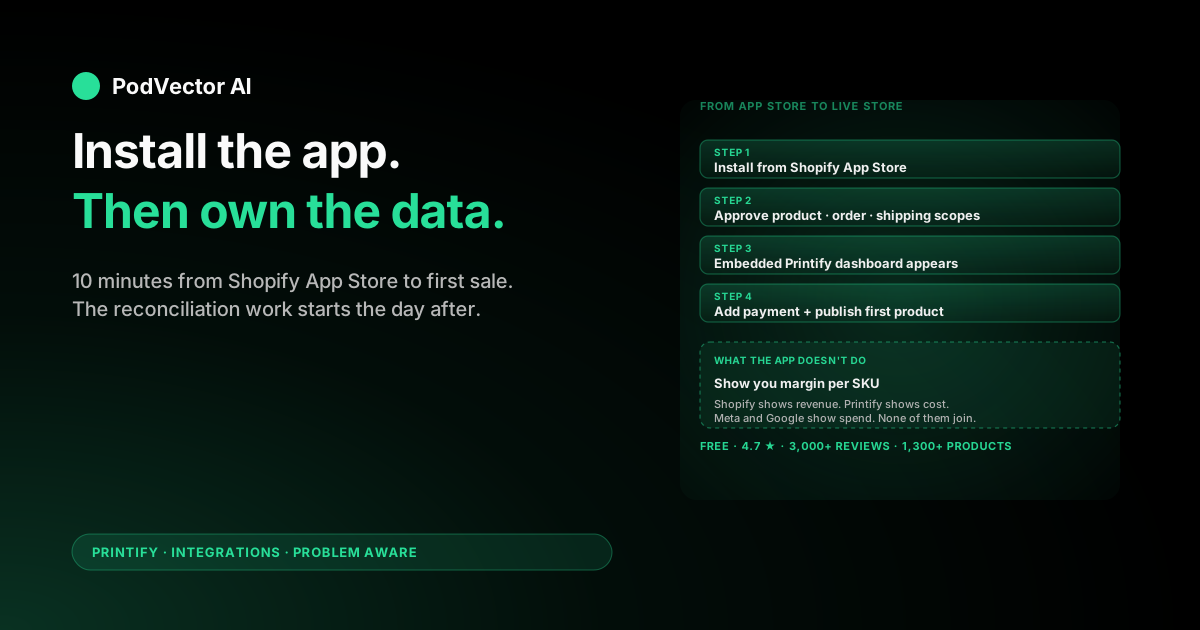
Quick Answer: The Printify app on the Shopify App Store is free, takes about 10 minutes to install, and embeds the Printify dashboard inside your Shopify admin. After install you can design products in Printify and push them straight into your Shopify catalog.
The install is the easy part. The harder question is what to do once it's live — your product data sits in Shopify, your cost data sits in Printify, and your ad data sits in Meta and Google. This guide covers both halves.
What the Printify Shopify app actually does
The Printify app is the official bridge between your Shopify store and Printify's print-on-demand network. Once installed, it embeds the Printify dashboard inside your Shopify admin — you don't have to bounce between two tabs to design and publish products.
Functionally, the app does three things. It syncs products you build in Printify into your Shopify catalog. It listens for new Shopify orders and routes them to Printify for production. And it sends tracking information back from Printify to Shopify so your customer sees a normal Shopify order status page.
Everything else — payment collection, customer accounts, storefront design, taxes — stays with Shopify. Printify never touches the customer-facing side of your store. A step-by-step walkthrough of the linking flow is here.
The app at a glance
Before you install, the basics:
- Price: free to install. You pay Printify per order for production and shipping, separate from your customer's Shopify checkout.
- Rating: 4.7 / 5 on the Shopify App Store with over 3,000 reviews as of 2026.
- Catalog size: 1,300+ blank product types across 90+ print providers.
- Stores per Printify account: 5 on the free plan, 10 on Premium.
- Order automation: fully automatic with a configurable 1–24 hour holding window before production.
- Support: 24/7 chat from Printify, separate from Shopify support.
You don't need Printify Premium ($14.99/month) to use the app. Premium gets you a 20% discount on production costs and a couple of extra store slots, but the app itself works on the free plan from day one. Whether Premium pays back depends on your monthly order volume.
Permissions the app requests
On install, Shopify asks you to approve a permissions list. None of it is unusual for a fulfillment app, but it's worth knowing what you're handing over:
- Products: read and write. Required so Printify can publish products into your catalog and update variants when you re-publish.
- Orders: read and write. Required so Printify can pull new orders, update fulfillment status, and post tracking numbers.
- Inventory: read and write. Required so Printify can mark POD items as in-stock (POD is technically always in-stock, but Shopify needs the flag).
- Customers: read only. Required so Printify can pull the shipping address from the order.
- Shipping: read only. Required so Printify can match Shopify shipping zones to its own provider coverage.
You're not granting Printify access to financials, gift cards, or themes. If a permission outside this list shows up on the install screen, you're on a fake app — back out and search again.
Installing the app from the Shopify App Store
The full install takes about 10 minutes if you have a Printify account ready. About 15 if you're creating one along the way.
- Open the Printify listing on the Shopify App Store. Confirm the publisher is "Printify Inc." with a verified badge — there are knockoff listings.
- Click Install. Shopify will prompt you to confirm which store the app should be installed on.
- Review the permissions screen and click Install app. This is where you accept the scopes listed above.
- Shopify hands you off to Printify. Sign in to your existing Printify account, or click Sign up with Shopify to create one in a single click using your Shopify email.
- Printify shows a connection-success screen and embeds its dashboard inside your Shopify admin under Apps → Printify.
- Add a saved payment method in Printify (My profile → Payments). Printify charges this card per order for production and shipping. Without it, orders queue and don't go to production.
If the install hangs on the permissions screen, you're probably logged in as a Shopify staff account without app-install permissions. Switch to the store owner account and retry.
If you're on a Shopify trial, you can install the app but you can't sell products in some regions until you upgrade to a paid plan. The connection itself still works for testing.
Your first product publish
Installation alone doesn't move any products. The app is a pipe — you still have to design each item in Printify and click publish.
1. Pick a blank and a print provider
Open the Printify catalog from inside your Shopify admin. Pick a blank (t-shirt, mug, hoodie, poster) and a print provider. Provider choice matters: the same blank can vary by $3 in production cost and 2–9 days in shipping speed between providers. Sort by cost and shipping time for your top-selling region, not by mockup quality.
2. Upload your design
Use Printify's design tool to upload artwork. The tool auto-generates mockups for every color and size variant. PNG with a transparent background is the safe default — 300 DPI minimum for print quality.
3. Set retail price
Printify shows production cost per variant. You set the retail price; Printify calculates margin live. Default markup is 40–60% above production, but POD margins are thin once you add ad spend and Shopify fees. Price-test before committing to a default markup across your catalog.
4. Edit the listing details
Set the title, description, tags, and which variants appear. Anything you fill in here lands in Shopify on first publish. After publish, Shopify is the source of truth — edits in Printify won't push back unless you re-publish.
5. Click "Publish to store"
The button is in the top-right of the product editor. Publish usually takes 30–90 seconds. The product lands as a draft by default; toggle Make products visible in Printify's publish settings if you want it live immediately.
Check the product in Shopify under Products → all products. You should see the new SKU with all variants and mockup images. If it's missing, see the troubleshooting section below.
What the app does behind the scenes
Once products are published and the app is live, here's the order pipeline:
- Customer checks out on Shopify. Shopify takes the payment.
- Shopify fires an order webhook to Printify within seconds.
- Printify validates the SKU and shipping address, then holds the order in a 24-hour window by default (configurable).
- After the holding window, Printify charges your saved card for production + shipping and queues the order with the selected print provider.
- Print provider produces and ships. Tracking is pushed back to Shopify, which emails the customer.
The 24-hour holding window is the most useful default Printify ships with. It gives you time to catch fraud orders, fix shipping-address typos, or accept customer-requested changes before you pay for production. Shorten it to 1 hour for higher-volume stores or extend it if you want extra review time.
App vs. direct Printify connection — which to use
There are two ways to connect Printify to Shopify: the app (this guide) or starting from your Printify dashboard and selecting Shopify as a sales channel. Both end at the same connected state, but the experience differs.
The app is better if you're Shopify-first. You stay inside Shopify admin, the Printify dashboard appears as an embedded view, and the install is one click.
The direct flow is better if you already have multiple Printify products designed and you're adding Shopify as a second sales channel. You start in Printify, click "Add new store," select Shopify, and Printify generates the App Store install link. Same destination, opposite direction.
Most new POD sellers use the app. Established sellers who already sell on Etsy via Printify usually add Shopify from the Printify side. Etsy linking has a parallel flow worth knowing.
Running the business after install
Top SERP guides stop here — your store is connected, your products are live, congrats. That's the easy half.
The hard half is that the app gives you two systems with no shared view of margin. Shopify shows revenue. Printify shows cost. Neither shows what you actually made on an order, by SKU, or by ad campaign. To run the business well, you have to reconcile them.
Five things to track from week one:
1. True margin per order
Shopify's "net sales" is gross of Printify production cost, Printify shipping, Shopify transaction fees, and refunds. A $25 t-shirt with Shopify "profit" of $18 might actually be $4 once everything settles. Export Printify's order costs from My Orders → CSV and join to Shopify's order export on order ID.
2. Ad spend recovered per SKU
If you're running Meta or Google ads, blended ROAS hides which SKUs pay back. Tag each campaign in Shopify's order with UTMs, then attribute the order's gross margin to the campaign spend. Half your catalog usually loses on paid; the other half subsidizes it.
3. Print provider performance on your SKUs
Printify shows average production time per provider, but the number that matters is your production time on your SKUs. Track production-start-to-shipped duration per order, grouped by provider. A provider that's 1.2 days slower than average will quietly drag your repeat-purchase rate.
4. Refund rate by SKU and by provider
Some blanks have a 2% defect rate; some have 8%. Shopify shows refunds, but you need them grouped by Printify SKU and print provider to know whether the blank is bad or the provider is. Filter Shopify refunds to "print quality" and pivot.
5. LTV by acquisition source
POD customers buy once and disappear on average. The 15% who return are where the business lives. Tag every order with first-touch UTM at the customer level, then compute 90-day LTV by source. Channels that look bad on first order often clear $25+ LTV over a quarter.
All five live across Shopify, Printify, Meta Ads, Google Ads, and often your email tool. None surface natively in either dashboard. You either build a weekly CSV reconciliation in Sheets, or you hand the join off to a tool that reads every source into one live data warehouse. The same reconciliation problem applies if you add Etsy alongside Shopify.
Uninstalling and reinstalling
If you need to disconnect, uninstall from Shopify, not Printify. The order matters.
- In Shopify admin, go to Settings → Apps and sales channels.
- Find Printify in the list and click Uninstall.
- Confirm. Shopify revokes the OAuth token and the embedded Printify dashboard disappears.
Important: uninstalling does not remove already-published products from your Shopify catalog. Those stay as Shopify products. If you want them gone, delete them in Shopify before uninstalling. Uninstalling also doesn't cancel in-flight Printify orders — those continue to production and ship as normal.
To reinstall, follow the install flow above. Reconnecting the same Printify account refreshes the OAuth token (which expires every 12 months and is the most common cause of mysterious sync failures on long-running stores).
Troubleshooting
Products won't publish
Almost always a missing required field. Shopify requires a product title, at least one variant, and a non-empty description on first publish. Re-open the product in Printify, fill in every field, and republish. If it still fails, disconnect and reconnect — this refreshes the OAuth token.
Orders not flowing to Printify
Three causes, in order of likelihood: (1) the app didn't get all required permissions on install, (2) the order's product was added to Shopify manually instead of published from Printify, (3) your Printify payment method failed and orders are queued. Check My Orders → Action required in Printify first.
Embedded dashboard shows a blank screen
Usually a browser issue — Shopify's app frame conflicts with some ad blockers and tracking-protection extensions. Whitelist printify.com and shopify.com in your blocker, or test in a clean browser profile.
Wrong shipping rate at checkout
Shopify is showing your custom rate, not Printify's. Either upgrade to Shopify Advanced+ for carrier-calculated shipping (Printify exposes live rates to Shopify on that plan), or align your Shopify flat rates to Printify's actual costs by region. Recheck whenever you change print providers — they ship from different countries.
"Variant unavailable" errors
Printify occasionally retires blanks. When a customer orders one, the order fails in Printify with this error. Manually swap the variant for the closest equivalent or contact the customer for size/color confirmation. Watch Printify's deprecation notifications if it happens more than once.
FAQs
Is the Printify Shopify app free?
Yes. The app itself is free to install. You pay per order for production and shipping — that goes to Printify, separate from your customer's Shopify checkout. Printify Premium ($14.99/month) is optional and only changes per-product cost, not your access to the app. Premium's benefits and break-even math is here.
How long does the install take?
About 10 minutes if you already have a Printify account. Add 5 minutes if you're signing up during install. Publishing your first 1–3 products takes another 15–30 minutes. A full catalog launch is typically a half-day of work.
Can I connect more than one Shopify store?
Yes. The free Printify plan supports 5 stores per account; Premium supports 10. Each store appears in Manage my stores with its own product list and order feed. Useful for multi-brand POD operators running niche stores.
Does the app handle taxes?
No. Shopify handles all tax collection and remittance. Printify only charges you for production and shipping. If you're selling cross-border, configure Shopify's tax settings before launch — Printify is invisible to that side of the flow.
What happens if my Printify payment method fails?
Orders pause in Printify's "Action required" queue and don't go to production until you fix the card. The Shopify order remains in "unfulfilled" status. Add a backup payment method in Printify to avoid silent outages — this is the single most common cause of fulfillment delays for stores past their first 100 orders.
Can I edit a published Printify product directly in Shopify?
Yes, but be careful. Once you edit a field (title, description, images) in Shopify, Printify won't overwrite that field on future publishes. Pricing and variants stay editable from either side. Most sellers manage edits from Shopify once products are live to avoid sync confusion.
Does the app work with Shopify B2B / wholesale?
Partially. Basic order flow works with Shopify B2B, but wholesale pricing tiers don't push from Printify — you set the wholesale price manually in Shopify after publish. Functional for small B2B catalogs, rough for serious wholesale operations.
How do I update the app when Printify ships a new version?
Automatically. Shopify-installed apps update in the background. You don't have to do anything. If Printify rolls out a feature that needs an additional permission, Shopify will prompt you on next admin login to re-authorize.
Related reading
For more on the Printify ecosystem, see our Printify integrations hub and the broader Printify topic page. The official Printify listing on the Shopify App Store is also worth bookmarking for current pricing, reviews, and the install link.
Hand off the operations to Victor
You installed the app. You published your first products. Now you have product data in Shopify, cost data in Printify, ad data in Meta and Google, and no shared view of which SKUs actually make money.
Victor is an AI employee built for POD sellers. He reads every source into one live data warehouse, answers questions in plain English ("which SKUs lost money last week?"), and — with your approval — reallocates ad spend, pauses unprofitable campaigns, and updates Shopify listings. You stay in control; Victor does the busywork.
Stop reconciling CSVs every Sunday.
Try Victor free