
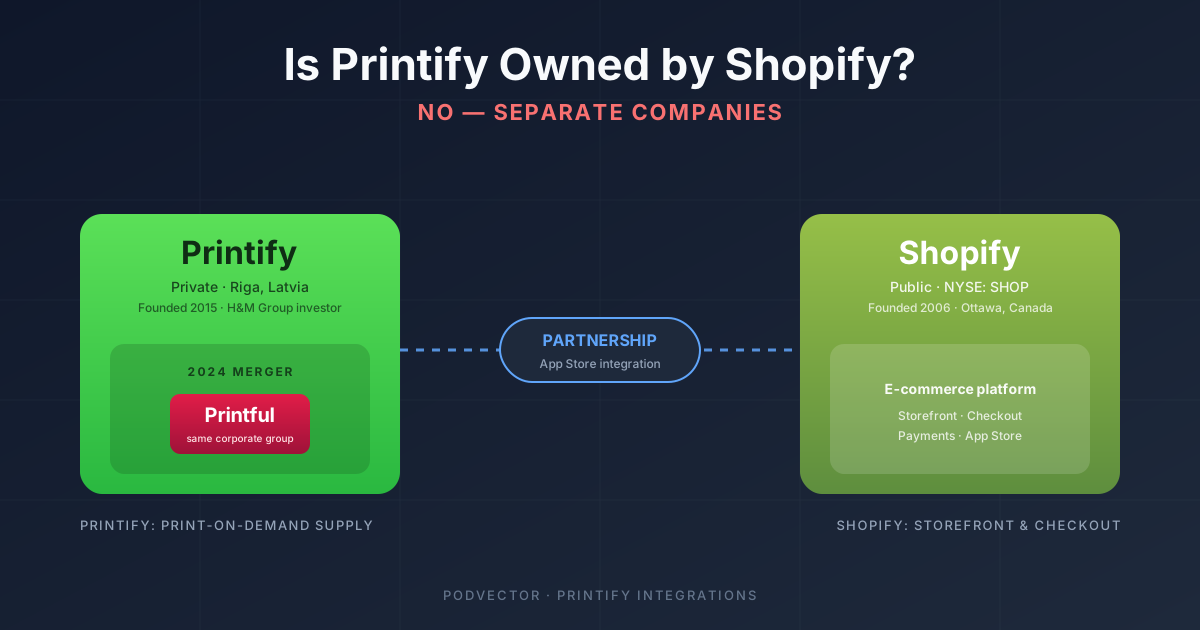
Quick Answer: No, Printify is not owned by Shopify. They are two separate companies — Shopify is a Canadian e-commerce platform listed on the NYSE and TSX, and Printify is a privately held print-on-demand company headquartered in Riga, Latvia.
The two integrate tightly via the official Printify app in the Shopify App Store, which is why a lot of sellers assume they're one business. They aren't. It's a partnership, not a parent-subsidiary relationship.
The bigger structural change worth knowing about happened on the Printify side: in 2024, Printify and Printful merged — the two largest independent POD platforms became one corporate group. Shopify wasn't part of that deal either.
The short answer
No. Shopify does not own Printify. Printify does not own Shopify. Neither company is a subsidiary, division, or shell of the other.
They are two independent businesses that play complementary roles in the print-on-demand stack. Shopify provides the storefront — the checkout, the product pages, the customer database. Printify provides the supply side — the catalog of blank products, the network of print providers, and the order-to-fulfillment pipeline.
When you connect them through the Printify app on the Shopify App Store, you're authorizing one independent company to push products and read orders inside another independent company's platform. That's an integration. It's the same kind of arrangement Printify has with Etsy, eBay, WooCommerce, Wix, TikTok Shop, and a dozen other sales channels.
Who actually owns Printify
Printify is a privately held company. It was incorporated in the United States and is headquartered in Riga, Latvia, with a secondary office in San Francisco.
It was founded in 2015 by three people: Artis Kehris, Gatis Dukurs, and Jānis James Berdigans. Until 2024 it operated as an independent print-on-demand platform. After the merger with Printful (more on that below), it sits inside a combined corporate group.
On the funding side, the company raised in stages. A $1 million round in 2018, then $3 million in 2019, then a $45 million Series A in October 2021. That Series A is the most relevant one for the "is Printify owned by anyone famous?" question — the round was led with participation from H&M Group, the Swedish fashion retailer.
So if you want to be precise: Printify has institutional investors (including H&M), founders who still hold equity, and a post-merger relationship with Printful. None of those parties is Shopify.
Current leadership: Alex Saltonstall is CEO, and Anastasija Oleinika is President and Head of Platform.
Who actually owns Shopify
Shopify is a public company. Ticker symbol SHOP, dual-listed on the Toronto Stock Exchange and the New York Stock Exchange. It's headquartered in Ottawa, Canada, and was founded in 2006 by Tobias Lütke, Daniel Weinand, and Scott Lake.
"Who owns Shopify" in the literal sense is "the public shareholders who own SHOP stock," with the largest individual holder being founder and CEO Tobi Lütke. Institutional investors — Vanguard, BlackRock, the usual large-cap holders — own meaningful chunks of the float.
Shopify's product is the e-commerce platform itself: hosting, checkout, payments (Shopify Payments), shipping (Shopify Shipping), the admin dashboard, the theme system, and the app ecosystem. It does not operate a print-on-demand fulfillment network. It does not print or ship physical merchandise.
That's the structural reason Shopify and Printify can't be the same company even if you squint. Their business models don't overlap — they layer.
Why people think they're the same company
The confusion is reasonable. Three things contribute to it.
The integration is tight. When you install the Printify app on Shopify, products you design in Printify appear as Shopify listings inside your store. Orders flow back automatically. Tracking syncs both ways. From a daily-workflow standpoint, you barely notice you're using two systems.
Both names contain hint-of-Shopify branding. "Printify" rhymes with "Shopify." That's not a coincidence — Printify chose a name that signals "the print version of a familiar e-commerce platform" — but it's marketing, not ownership.
Shopify recommends Printify in its own content. Shopify publishes guides comparing Printful vs. Printify, lists Printify as a featured app, and ranks Printify highly in the "Print on Demand" category on the App Store. That endorsement makes Printify look like an official Shopify product. It's not — it's a third-party app that Shopify happens to promote because the integration is mature and the merchant outcomes are good.
The corporate reality: Shopify takes its standard App Store revenue share when you transact through Printify on a Shopify store, but it does not own any of the upstream Printify business.
What the Printify Shopify app actually is
Worth being concrete about, because this is where the ownership confusion usually lives.
The Printify Shopify app is a piece of software that Printify built and submitted to the Shopify App Store. It uses Shopify's public APIs — the same APIs any developer can use — to read your products, write new listings, receive order webhooks, and update tracking numbers.
Shopify reviews apps for security and policy compliance before they're listed. That review does not make Shopify the owner. Every app in the Shopify App Store — Klaviyo for email, Recharge for subscriptions, Yotpo for reviews — works the same way. Independent companies, building on top of Shopify's platform, listed in Shopify's directory.
If Shopify decided tomorrow to ban Printify from the App Store, Printify would still exist as a company. Sellers would lose the in-Shopify install path, but the underlying API integration could be rebuilt as a custom app, and Printify would continue to operate through Etsy, eBay, WooCommerce, and its other channels.
That dependency is one-directional. Shopify doesn't need Printify. Printify benefits hugely from being inside Shopify's ecosystem.
If you're still working out the connection on your own store, the Printify-to-Shopify connection walkthrough covers the actual click path.
The 2024 Printify-Printful merger
This is the corporate event most "is Printify owned by Shopify" articles miss, and it's the one that actually changes things.
In 2024, Printify and Printful — the two largest independent print-on-demand platforms — merged. Both companies are Latvia-based, both raised meaningful venture capital, and both were direct competitors for over a decade. The merger consolidated them into a single corporate group.
Operationally, the two brands continue to run separately. Printify still operates its catalog and print-provider network. Printful still operates its in-house production facilities. Sellers who used both kept using both. The change is at the ownership and strategic level, not the product level.
Why this matters for the ownership question: it means the answer "Printify is independent" is now slightly more complicated than it was before 2024. Printify is independent of Shopify, yes. But it is no longer independent of Printful — they share a parent structure.
If you're trying to diversify across print-on-demand providers as a risk-management strategy, "Printify plus Printful" is no longer the diversification it used to be. They're the same corporate group now. True diversification means adding a Gelato, a Gooten, or a CustomCat into the mix.
What this means for POD sellers
Three practical implications.
You're managing a stack of independent vendors. Shopify (storefront), Printify (POD supply), your payment processor, your ads platforms. Each is a separate company with separate billing, separate dashboards, and separate failure modes. When something breaks — an order doesn't sync, a tracking number doesn't update — you have to know which vendor owns the problem before you can fix it.
Concentration risk is real but not where you'd think. Shopify and Printify being separate companies means you can keep your Shopify store and switch your POD provider tomorrow without rebuilding your storefront. That's the upside. The risk has shifted: with the Printful merger, picking "Printify or Printful" no longer hedges against a single provider's outage or pricing change.
Pricing and fee changes are independent. Shopify can raise its plan prices. Printify can raise its subscription tiers or change its product markups. Neither needs the other's permission, and neither warns the other's customers. You have to track both.
The operational ask on you, as a seller, is the same regardless of who owns what: keep an eye on margin across the full stack, not just one platform's dashboard. Shopify shows you revenue net of Shopify fees. Printify shows you cost of goods. Neither shows you the combined margin after ads, transaction fees, and refunds. That number lives in the spreadsheet you build yourself — or in a tool designed to unify it.
If ownership matters to you: alternatives
If the Printify-Printful merger nudges you toward diversifying, the realistic alternatives split into two groups.
Independent POD platforms not part of the Printify group:
- Gelato — Norway-based, large global production network, strong international shipping economics.
- Gooten — US-based, focused on operational reliability and a slightly more curated catalog.
- CustomCat — US-based, lower base prices on common SKUs, smaller catalog breadth.
- Teelaunch — US-based, focused on Shopify-native workflows, narrow but reliable catalog.
Storefront alternatives not Shopify-owned:
- WooCommerce — open-source WordPress plugin, owned by Automattic. Different cost structure, more self-hosting overhead.
- BigCommerce — public US company, similar feature set to Shopify, smaller app ecosystem.
- Wix Stores — public Israeli company, lighter-weight, weaker for high-volume POD operations.
- Squarespace — public US company, design-first, smaller commerce feature set.
You don't need to switch any of this just because of corporate ownership. The point is that "Shopify and Printify are separate" gives you the freedom to mix and match. That's the structural feature worth keeping in mind.
For more on how the Printify side of the equation works across platforms, the Amazon + Printify setup guide and Printify-to-Etsy connection guide walk through the same integration pattern on two other major channels. The full Printify integrations cluster covers the rest, and the Printify topic hub is the index for everything.
Worth noting: if you're trying to figure out whether Printify's pricing tiers are worth it after all this, the Printify subscription coupon breakdown walks through the math.
For the canonical corporate facts, the Printify Wikipedia page is kept current with funding rounds and the Printful merger. The original direct-answer write-up at WebsiteBuilderInsider covers similar ground, and the longer Printify vs Shopify comparison at Style Factory is useful if you want a side-by-side breakdown of what each platform actually does.
FAQs
Did Shopify ever try to buy Printify?
There has been no publicly disclosed acquisition offer. The two companies have a partnership through the Shopify App Store and joint marketing materials, but no public M&A activity. Shopify has historically made strategic acquisitions in logistics (Deliverr in 2022, later divested) and POS, not in print-on-demand fulfillment.
Who is Printify's biggest investor?
The most prominent named investor from the 2021 Series A is H&M Group. The full cap table is not public because Printify is a privately held company. Post-2024, the merged Printify-Printful corporate group has additional combined shareholders that have not been individually disclosed.
Is Printful owned by Shopify?
No. Printful is in the same corporate group as Printify (post-2024 merger), neither of which is owned by Shopify. Like Printify, Printful integrates with Shopify via the Shopify App Store as an independent app.
If Printify isn't owned by Shopify, why does Shopify recommend it?
Shopify recommends apps that work well on its platform because successful merchants are successful Shopify customers. App recommendations are based on app performance, merchant reviews, and category coverage — not corporate ownership. Klaviyo, Recharge, and many other top apps are also independent companies that Shopify promotes.
Can I trust an integration that's between two separate companies?
Yes — that's how essentially every e-commerce stack works. Your Shopify store is already pulling from Stripe (payments), Cloudflare (CDN), and a dozen apps from independent vendors. Printify is one more API integration among many. The risk to monitor is the same one you'd monitor for any vendor: pricing changes, API stability, support responsiveness.
Is the Printify Shopify app safe to install?
It goes through Shopify's standard app review process and has been on the App Store since 2015. From a security perspective it requests the same scopes as any product-sync app (read/write products, read orders, update fulfillment). Standard caution applies — review the scopes before authorizing, as you would with any third-party install.
If they're separate companies, why does my Shopify customer service mention Printify orders?
They probably can't help you with Printify-specific issues. Shopify support handles your Shopify store; Printify support handles production, shipping, and fulfillment issues on Printify orders. The dividing line is roughly "anything before checkout" (Shopify) vs "anything after checkout that involves making a physical product" (Printify).
Does the 2024 merger affect my existing Printify or Shopify connection?
No. Existing integrations, account credentials, product syncs, and order flows continue to work as before. The merger affected corporate ownership, not the day-to-day product. If anything changes downstream — pricing tier consolidation, catalog merging — it will be communicated through Printify's normal account channels.
Let Victor run your Printify-plus-Shopify ops with your approval
Knowing Printify and Shopify are separate is the easy part. Running a POD business on top of them — reconciling Shopify revenue against Printify production costs, allocating ad spend by SKU margin, catching listing mismatches before they refund — is the part that eats your week.
Victor is an AI employee built for that. He runs your Meta and Google ads, manages your Shopify catalog, and handles Printify/Printful operations across both brands of the merged group — pausing losing creative, reallocating budget to winning SKUs, updating listings, and routing fulfillment. Every material action waits for your approval before it ships.
Try Victor free