
Quick Answer: According to Printify's own January 2026 comparison page, Printify's lowest-cost t-shirt runs around $7 versus $8.17 at Printful, and its most popular tee plus shipping costs $15.39 versus $16.19 at Printful. On the Bella+Canvas 3001 specifically, chayaani.com's March 2026 real-pricing analysis found a gap of roughly $1.33 per shirt between the two platforms at base. On commodity blanks like the Gildan 64000, inkandpxl.com's April 2026 breakdown — citing Merch Titans' test data — puts Printify's base at approximately $8 and Printful's at approximately $12.
The base cost is only one of five lines that determine real per-shirt profit. Shipping, sample orders, returns, and provider variation move the math by $2–$5 per unit — which is why two stores running the same blueprint can land several margin points apart.
One new factor every POD seller needs to know for 2026: Printful and Printify announced a merger in November 2024. As of mid-2026, both platforms still operate as completely separate brands with separate catalogs, pricing, and dashboards — but the competitive landscape is shifting.
This breakdown covers the actual 2026 numbers per blank, why Printify's marketplace model produces lower base costs, the merger's implications for sellers, and where POD stores leak margin even after they pick the "cheaper" platform.
2026 update: the Printful–Printify merger
Before comparing costs, POD sellers need to know the biggest structural shift of 2026: Printful and Printify announced their merger in November 2024, with regulatory approval and shareholder backing already in place at announcement. According to Printful's official merger announcement, the two companies joined forces as equal partners, with both platforms to continue operating as separate brands for the foreseeable future.
As of mid-2026, designmusketeer.com's June 2026 seller guide confirms that both platforms still run as completely separate brands — separate accounts, separate catalogs, separate pricing, separate dashboards — and existing stores keep working exactly as before. The combined entity now operates under a new parent brand. According to Printful's merger announcement, the combined business gives sellers access to both Printful's in-house production facilities and Printify's network of more than 85 third-party production partners.
For cost comparison purposes, nothing has changed yet at the product or pricing level. But sellers building long-term platform strategy should watch for consolidation changes — particularly on provider networks and catalog overlap — as the merged entity matures.
Side-by-side: Printful vs Printify t-shirt base costs in 2026
The base cost is what each fulfillment partner charges you per blank shirt, before shipping and before any subscription discount. Here are the headline figures drawn from 2026 pricing sources.
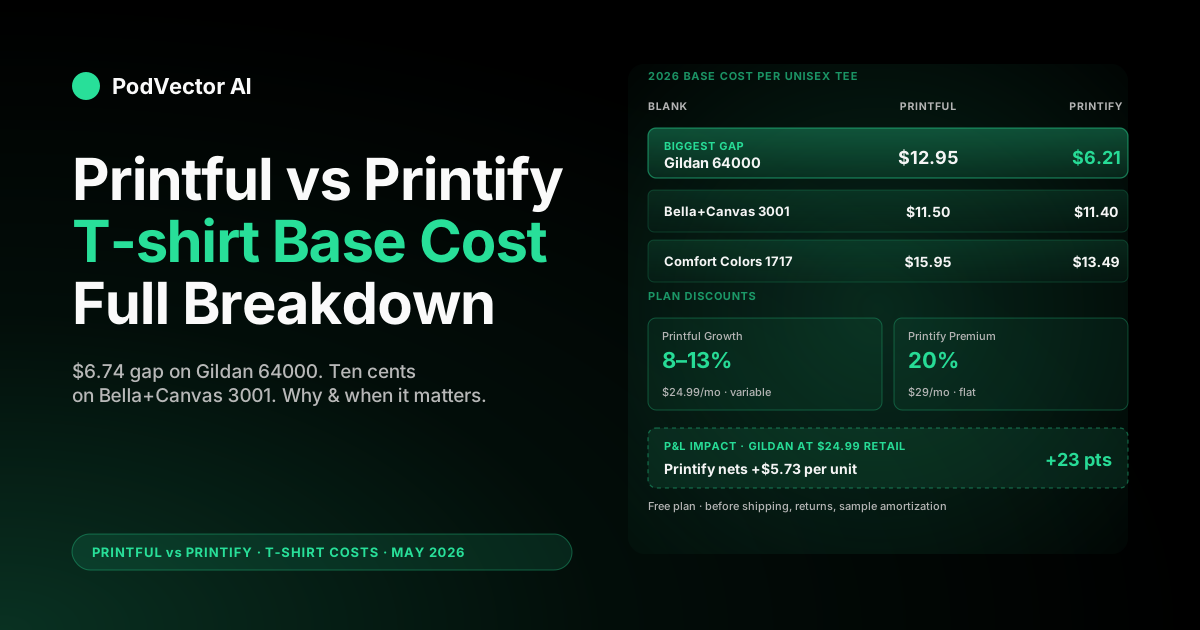
According to Printify's own January 2026 comparison, Printify's lowest-cost t-shirt runs around $7 and Printful's runs around $8.17. For the most popular tee including shipping, Printify comes to $15.39 versus Printful's $16.19. On the Bella+Canvas 3001 specifically, chayaani.com's March 2026 real-data comparison found a gap of approximately $1.33 per shirt at base. On the Gildan 64000, inkandpxl.com's April 2026 analysis — drawing on Merch Titans' April 2026 test orders — puts Printify's base at roughly $8 and Printful's at roughly $12.
| Blank | Printful base (approx.) | Printify base (approx., Free plan) | Printify base (approx., Premium) | Source |
|---|---|---|---|---|
| Gildan 64000 (unisex) | ~$12 | ~$8 | Lower with 20% off | inkandpxl.com / Merch Titans, Apr 2026 |
| Bella+Canvas 3001 | ~$11.69 | ~$10.36 | ~20% off base | chayaani.com, Jun 2026 |
| Generic unisex cotton tee | ~$12 | ~$10 (can drop to ~$8 on Premium) | ~$8 | printondemandbusiness.com, 2026 |
| Lowest-cost tee (any blank) | ~$8.17 | ~$7.00 | Lower with 20% off | Printify comparison page, Jan 2026 |
Note: POD catalog prices shift frequently. Always verify current prices directly on each platform's product page before building a pricing model, since individual provider selection on Printify produces a range rather than a single fixed number.
Two things stand out. The Gildan-class commodity blank gap is real and meaningful. The Bella+Canvas 3001 gap is smaller — chayaani.com's June 2026 three-way comparison puts the Bella+Canvas 3001 at approximately $10.36 on Printify versus $11.69 on Printful, a difference of $1.33. Print providers compete hardest on the high-volume budget end of the catalog. The blanks where the gap collapses are the premium triblends and ringspun cotton tees.
Why Printify is structurally cheaper
Printful owns its factories. It employs the printers, runs its own DTG presses, manages its own inventory of blanks, and ships from its own facilities. That's a vertically integrated model with consistency upside and structural cost downside.
Printify is a marketplace. According to chayaani.com's 2026 comparison, Printify connects sellers to third-party print providers — so your actual cost depends on which provider you choose. Each provider runs their own pricing, blank inventory, and quality standards, competing against the others on the platform.
According to inkandpxl.com's April 2026 analysis, because Printify aggregates more than 80 competing print providers, supplier competition drives prices below what a single vertically integrated operation can match. The base-cost difference between the two platforms is mostly the cost of vertical integration — Printful's pricing absorbs facility overhead, payroll, and equipment; Printify's pricing reflects the spot rate of whichever provider you picked, plus Printify's platform margin.
This is also why the gap varies so much by blank. On commodity tees, dozens of US providers compete and the spot price compresses. On a Bella+Canvas 3001 with a specific color and decoration method, fewer providers handle it and the price firms up closer to what Printful's owned facility charges.
Bella+Canvas 3001: the comparison everyone runs
The Bella+Canvas 3001 is the unofficial benchmark blank for POD comparisons. It's the shirt most apparel-focused stores actually sell, because customers know the cut and the fabric weight.
According to chayaani.com's June 2026 three-way comparison of Gelato, Printful, and Printify, the Bella+Canvas 3001 runs approximately $10.36 base on Printify versus approximately $11.69 on Printful — a gap of roughly $1.33 per shirt. The exact Printify number varies by provider; Drive Fulfillment, Swift Pro, and Monster Digital all carry it at slightly different prices.
According to chayaani.com's March 2026 real-pricing data, at 100 sales per month that $1.33 difference produces roughly $133 more in gross margin on Printify, or about $1,596 per year. That's meaningful, but it's not in the same league as the gap on commodity blanks.
The gap on this shirt is small enough that the platform choice should be driven by something other than price alone. Print quality, fulfillment speed, return policy, and provider consistency all matter. As ecommerceceo.com's March 2026 Printful review notes, Printful handles manufacturing in-house rather than routing orders to third-party print providers, which produces more consistent quality — important when building a brand rather than just selling shirts.
Sellers who pick Printify on the assumption that it's universally cheaper end up surprised when their Bella+Canvas-heavy catalog produces nearly identical fulfillment costs to Printful, minus the consistency Printful offers.
Gildan 64000: where the gap is biggest
The Gildan 64000 is the cheapest mainstream unisex tee on both platforms. It's also where the cost spread between Printful and Printify is the largest — and where the "Printify is significantly cheaper" claim actually holds up.
According to inkandpxl.com's April 2026 analysis (drawing on Merch Titans' April 2026 test data), on a standard Gildan 64000, Printify's base cost sits at approximately $8 and Printful's at approximately $12. That roughly $4 gap at 100 monthly orders produces approximately $400 more in gross margin before platform fees, ad spend, and return costs — and at 500 monthly orders, the difference approaches $2,000, according to inkandpxl.com.
The catch: Printful's higher base cost includes its own facility's quality control, and consistency on commodity blanks is typically better than Printify's variable-provider experience. Some POD operators print Gildans through Printify and premium blanks through Printful for exactly this reason. The Merch Titans 2026 comparison reaches a similar split-the-catalog conclusion after running test orders on both.
Hidden lines that move real per-shirt cost
The base cost is the headline number, but it's not the number that hits your P&L. Several other lines change the actual per-shirt cost on a fulfilled order.
| Line | What it adds | Typical range per unit (2026) |
|---|---|---|
| Shipping (first unit, US) | Carrier fee from facility to customer | Printful ~$4.69 / Printify ~$4.75 (chayaani.com, Mar 2026) |
| Shipping (each additional unit) | Discounted add-on rate | Printful ~$2.20 / Printify ~$2.40 (chayaani.com, Mar 2026) |
| Additional print placements | Back print, sleeve print, etc. | ~$2.49–$5.25 (ecommerceceo.com, Mar 2026) |
| Inside labels | Branded neck label | ~$0.99 (ecommerceceo.com, Mar 2026) |
| Sample order amortization | Your test prints, spread across real orders | Varies by volume |
| Returns & reprints absorbed | POD doesn't refund — you eat damaged/wrong orders | Higher on Printify due to provider variability |
| Branding extras | Packaging inserts, hang tags | Varies by provider and product |
According to chayaani.com's March 2026 real-pricing data, Printful wins on first-unit US shipping by about $0.06 and on each additional item by about $0.20. These are small differences per order, but they compound at volume and partially offset the base-cost gap.
The returns line is where Printify's marketplace model gets quietly expensive. POD platforms don't refund customers — you do. When a wrong shirt or a misprint goes out, you cover the reprint. According to chayaani.com's 2026 quality analysis, Printify's quality varies by provider — some providers like Monster Digital are excellent, others average — and provider variability drives reprint rates higher than Printful's owned facilities typically produce.
According to ecommerceceo.com's March 2026 Printful pricing review, Printful also rolled out a targeted price increase in February 2026 affecting Cotton Heritage products (hoodies, heavyweight tees, sweatshirts, sweatpants) and shipping rates on select accessories — worth checking if your catalog leans on those blanks.
If you're already tight on these costs, see how Printful's holiday shipping deadlines and costs compound when peak season arrives.
Print provider variation: Printify's quiet tax
Printify's lower base cost has a structural side effect: the same SKU in your catalog can ship from different providers depending on which one has stock and the live routing. According to chayaani.com's 2026 comparison, Printify's quality varies by provider — some (like Monster Digital and SwiftPOD) are excellent, others are average — and that inconsistency is a real business risk.
According to Merch Titans' April 2026 comparison, Printify shipping depends entirely on which provider fills the order. Some ship in two days; others take 8–12 days. This inconsistency is Printify's biggest weakness for customer experience, especially for stores that have trained customers to expect fast delivery.
This shows up two ways on your P&L. First, the "base cost" on your dashboard is actually a weighted average across whichever providers Printify routed your orders to. Second, the customer experience varies — your Monster Digital orders look slightly different from your Swift Pro orders.
The cost side of this is what most blogs miss. If you don't lock a specific provider in your Printify product setup, you'll see base-cost drift across the month as routing changes. That's a real number that shows up only when you reconcile actual order data against catalog list prices.
Printful doesn't have this problem. The blank is the blank, the price is the price, and the facility is the facility. According to ecommerceceo.com's March 2026 review, because Printful handles manufacturing in-house, print quality and consistency is noticeably better — which matters when you're building a brand. The trade-off is a higher headline base cost in exchange for a single source of truth on what you actually paid.
Merch Titans' April 2026 comparison recommends ordering the same design from multiple Printify providers and one Printful shirt to compare side by side — a test that can surface quality and cost differences before they become customer complaints.
Plan discounts: when Growth or Premium pays back
Both platforms offer paid plans that discount the base cost. The break-even math is different for each.
Printful Growth ($24.99/month) offers up to 33% off select product costs, according to chayaani.com's March 2026 analysis. According to ecommerceceo.com's March 2026 Printful pricing review, the Growth plan pays for itself after roughly 10–15 orders. Importantly, the Growth plan becomes free once a store hits $12,000 in annual sales ($1,000/month), per ecommerceceo.com — a structurally unusual incentive tied to sales performance rather than a fixed billing cycle.
Printify Premium ($39/month) gives a flat 20% off base costs across the catalog, according to chayaani.com's March 2026 data. The flat-rate discount makes the math simpler than Printful's category-variable discounts. Note: always verify current Printify Premium pricing directly on Printify's site, as plan pricing has changed in recent years.
The Printful Growth math is messier because the discount varies by SKU type — apparel gets one rate, hats another, embroidery yet another. The Printify Premium math is simpler and the 20% applies flat across every blank.
For a deeper walkthrough of Printful's plan tiers and the exact discount structure, see the Printful premium membership price and benefits breakdown, the August 2024 premium pricing update, and the full Printful premium price and benefits guide.
Real per-order P&L at $24.99 retail
Headline base cost is one number. The full P&L is what matters. The table below illustrates how costs stack on each platform for a Gildan-class tee at $24.99 retail, using the 2026 figures sourced above. Use this as a framework — plug in the exact current prices from each platform's catalog when you run your own model.
| Line | Printify (paid plan) | Printful (Growth) |
|---|---|---|
| Retail price | $24.99 | $24.99 |
| Base cost (Gildan-class, approx.) | ~$8 before plan discount (inkandpxl.com / Merch Titans, Apr 2026) | ~$12 (inkandpxl.com / Merch Titans, Apr 2026) |
| Shipping (first US unit) | ~$4.75 (chayaani.com, Mar 2026) | ~$4.69 (chayaani.com, Mar 2026) |
| Returns/reprint reserve | Higher (provider variability) | Lower (in-house QC) |
| Shopify transaction fees | Varies by plan | Varies by plan |
| Gross profit per unit (pre-ad-spend) | Higher on commodity blanks | Lower on commodity blanks |
According to inkandpxl.com's April 2026 breakdown, on a Gildan-class blank at roughly $4 cost difference per unit, 100 monthly orders produce approximately $400 more in gross margin on Printify, and 500 monthly orders bring the difference close to $2,000 — before ad spend, returns, and other variable costs are applied.
The math shifts significantly on Bella+Canvas 3001. According to chayaani.com's March 2026 data, at 100 sales per month the $1.33 per-unit Bella+Canvas gap produces roughly $133 more per month on Printify. At that level, the choice should be driven by quality, consistency, and brand fit rather than cost alone.
If you don't model this per-SKU, you'll make the wrong platform choice. A store running mostly commodity Gildans saves meaningful money on Printify. A store running mostly Bella+Canvas saves modest money on Printify and may be giving up Printful's consistency in exchange.
When "cheaper base cost" is actually more expensive
There are three scenarios where Printify's lower base cost loses to Printful's higher base cost on real profit.
High-return categories. Sizing-sensitive items (joggers, hoodies, fitted tees) and color-critical designs both tend to return at higher rates on Printify due to provider variability. According to chayaani.com's 2026 quality analysis, Printify's quality varies meaningfully by provider, and the reprint exposure that comes with variability can erode a base-cost advantage quickly.
Brand-consistency businesses. If your store sells multiple items in a "set" and customers expect uniform print quality across the bundle, Printify's provider variability becomes a brand problem. The base-cost saving can cost you the repeat customer who received a slightly off-color shirt. According to ecommerceceo.com's March 2026 review, Printful's in-house quality control means print colors are consistent across orders — a meaningful advantage when brand identity is the product.
International fulfillment. According to Merch Titans' April 2026 comparison, Printful operates fulfillment centers in the US, Canada, Mexico, Europe, and Australia, shipping most US orders in 2–5 business days from their own facilities. Printify routing internationally can result in longer transit times and higher per-unit carrier fees for non-US orders. If you have a sizable EU customer base, model the international shipping side carefully — see how Printful's international shipping (India) stacks up as one example.
None of this means Printify is the wrong choice — only that the comparison isn't "lower base cost wins." It's a per-SKU, per-customer-base decision.
Gelato as a third option: when it matters
Current top SERP results now routinely compare three platforms, not two. Gelato is the third name that appears alongside Printful and Printify in 2026 coverage, and it's worth knowing when it's relevant to your cost model.
According to chayaani.com's June 2026 three-way comparison, Gelato's t-shirt base cost runs $9.80–$11.50 depending on region — sitting between Printify and Printful on the Bella+Canvas 3001. Where Gelato differentiates is on European fulfillment: it produces locally in the EU, which means a UK seller ships to UK customers in 2–4 days rather than 7–12 days from a US partner, according to chayaani.com. For US-centric stores, Gelato's cost advantage is limited. For sellers with substantial EU traffic, local EU production can reduce both shipping cost per unit and customer service overhead from delayed deliveries.
If your Shopify store's customer base is primarily US-based and your catalog is Gildan or Bella+Canvas heavy, Gelato rarely changes the calculus. But if you're seeing meaningful EU order volume, it's worth pulling a Gelato quote alongside your Printify and Printful comparisons.
Tracking real per-SKU margin across both
The hardest part of running both platforms — or even deciding between them — is reconciling what you actually paid against what the dashboards say you paid. Printify shows you a list price. Printful shows you a list price. Shopify shows you a sale price. None of these match the line items on your fulfillment invoices once provider routing, shipping uplifts, returns, and sample orders factor in.
This is the gap where margin leaks. Most POD stores discover it only quarterly, when they reconcile statements and notice the gross margin on their P&L is several points below what their dashboards predicted. By then, the unprofitable SKUs have been running for months.
This is exactly the problem PodVector's AI employee, Victor, is built to surface. Victor reads your Shopify orders, your Printify and Printful fulfillment line items, and your Meta and Google Ads spend into a single live data warehouse, then flags SKUs whose actual margin drifts from your modeled margin. When you ask "which SKUs dropped below my target margin after fulfillment last month," Victor reads the actual order-side cost data — not the catalog list price — and answers with the specific products.
Victor also proposes corrective actions: a price increase on a leaky SKU, a discount restructure on a high-return blank. You approve or reject. Every action is logged. The combination — POD-native cost modeling against live fulfillment data, plus the ability to execute Shopify-side changes on your approval — turns the platform comparison from a one-time spreadsheet exercise into a continuously monitored system. For sellers running both Printify and Printful simultaneously, that matters: you'll have two sets of fulfillment invoices hitting one Shopify sales feed, and the routing complexity means manual reconciliation misses things Victor catches automatically.
For the broader cost structure on the platform that runs higher base costs but tighter consistency, see the full Printful costs & charges breakdown. For all the Printful coverage including shipping and integrations, see the Printful topic hub.
FAQs
Is Printify always cheaper than Printful on t-shirts?
No. According to Printify's own January 2026 comparison data, Printify's lowest-cost tee runs around $7 versus Printful's $8.17 — a real but modest gap on the cheapest blanks. On commodity Gildan-class tees, the gap can be roughly $4 per unit according to inkandpxl.com's April 2026 analysis. On Bella+Canvas 3001, chayaani.com's March 2026 data puts the gap at just $1.33 per shirt. The platform you pick should depend on your blank mix, not on a blanket "Printify is cheaper" assumption.
What happened with the Printful and Printify merger?
Printful and Printify announced their merger in November 2024 as equal partners, with regulatory approval already in place at announcement. According to designmusketeer.com's June 2026 seller guide, as of mid-2026 both platforms still run as completely separate brands — separate accounts, separate catalogs, separate pricing, separate dashboards. Existing stores keep working exactly as before, though the long-term competitive landscape will shift as the merged entity matures.
What's the cheapest t-shirt to print on demand in 2026?
According to Printify's January 2026 comparison page, Printify's lowest-cost t-shirt runs around $7 at base. On the paid Premium plan, the 20% discount reduces that further. Printful's lowest-cost tee runs around $8.17 at base per that same source, before any Growth plan discount applies.
Does the Bella+Canvas 3001 cost the same on both platforms?
Nearly. According to chayaani.com's June 2026 three-way comparison, Printify lists the Bella+Canvas 3001 at approximately $10.36 and Printful at approximately $11.69 — a gap of about $1.33. The gap is small enough that other factors — fulfillment consistency, return rate, brand fit — should drive your choice.
How much do shipping costs add to a t-shirt base?
According to chayaani.com's March 2026 real-pricing data, US first-unit shipping runs approximately $4.69 on Printful and approximately $4.75 on Printify. Each additional unit in the same order adds approximately $2.20 on Printful and $2.40 on Printify. International shipping varies widely by destination and provider.
Are Printify Premium and Printful Growth worth the monthly fee?
According to ecommerceceo.com's March 2026 Printful pricing review, the Printful Growth plan ($24.99/month) pays for itself after roughly 10–15 orders, and becomes free once a store reaches $12,000 in annual sales. Printify Premium offers a flat 20% off base costs per chayaani.com's March 2026 data. Both plans pay back quickly for stores doing any real volume — the key difference is that Printful's discount varies by product category while Printify's is flat across the catalog.
Why does my actual per-shirt cost differ from the catalog list price?
Three reasons. Printify routes orders across multiple providers, so the actual base cost is a weighted average rather than the list price. Shipping is rarely a flat number across all orders. Returns and reprints — which POD platforms don't refund on your behalf — get absorbed by you and inflate effective cost. Reconciling actual fulfillment invoices against catalog list prices typically surfaces a meaningful gap that only shows up in monthly statement reconciliation.
Can I run both Printful and Printify in the same Shopify store?
Yes. Many POD operators do exactly this: Printify for commodity blanks where the base-cost saving is largest, Printful for premium tees and products where brand consistency matters most. The complexity is on the cost-tracking side — you'll have two sets of fulfillment invoices to reconcile against one sales feed, and provider routing on the Printify side adds another variable to track.
Is Gelato worth considering alongside Printful and Printify?
For EU-focused stores, yes. According to chayaani.com's June 2026 three-way comparison, Gelato's t-shirt base cost runs $9.80–$11.50 depending on region, and its local EU production means a UK seller ships to UK customers in 2–4 days rather than 7–12 days from a US-based Printify partner. For US-centric POD stores, Gelato's cost advantage over the two main platforms is limited and the catalog is narrower.
Stop guessing which platform actually has the better margin
Catalog list prices don't match invoice line items. Provider routing on Printify drifts. Returns, shipping uplift, and the February 2026 Printful price increases on Cotton Heritage products all hit your P&L but never your dashboard.
Victor connects to your Shopify, Printful, and Printify accounts, reads actual fulfillment order data into a live data warehouse, and tells you per SKU which platform is winning — not in theory, in your last 30 days of orders. He proposes the price and routing changes that fix the leaks, and executes them on your approval.
Try Victor free