
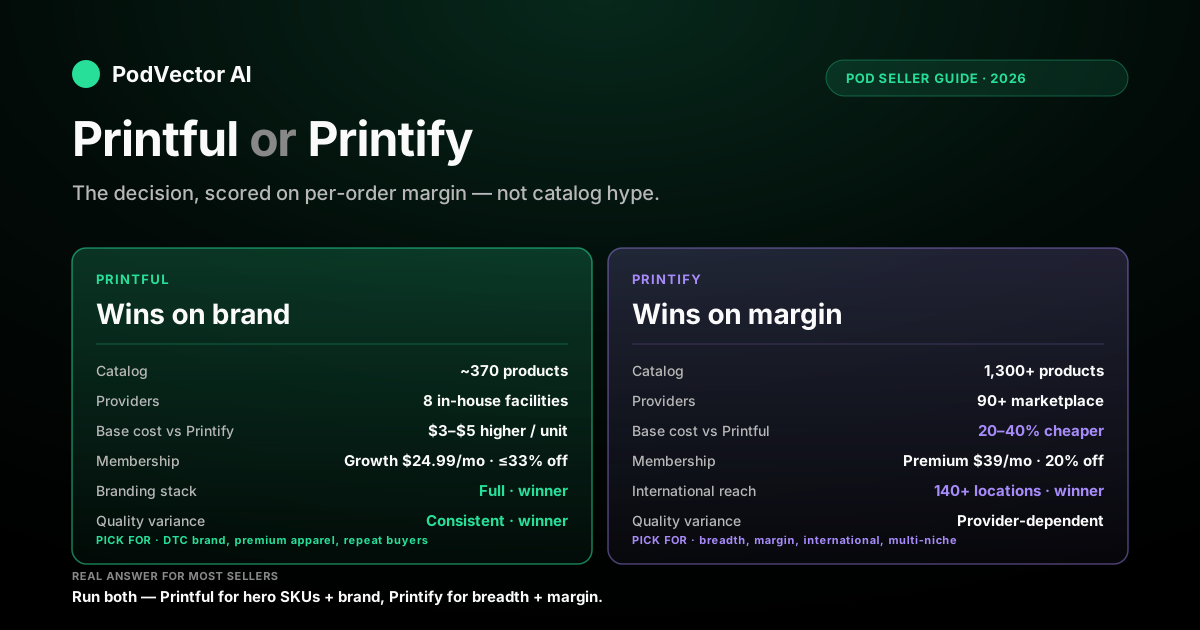
Quick Answer: Printify is cheaper per unit (20–40% lower base costs, 1,300+ products across 90+ providers). Printful costs more but delivers consistent quality, a full branding stack, and a slightly more polished Shopify integration. Both connect to Shopify for free in minutes — the question is which one nets you more money per order after you factor in what your product can actually sell for.
Pick Printful when brand experience is part of the product — custom labels, packaging, premium DTC apparel on Shopify. Pick Printify when margin is the binding constraint, you sell across categories, or your customers are international.
Most sellers above hobby volume run both. The 2025 merger announcement does not change that math — both platforms still operate independently as of July 2026.
The Printful-or-Printify decision in 30 seconds
If you sell on your own DTC Shopify site, your customer will hold the package, and the unboxing matters — start with Printful. The branding stack and quality consistency are worth the per-unit cost premium.
If you sell on Etsy, eBay, or any marketplace where the customer doesn't see your "brand," and you're price-sensitive — start with Printify. The margin headroom is real and the quality is fine when you pick the right provider.
If you're past 50 orders a month, you'll likely end up running both. That's not a fence-sit — it's the dominant pattern for sellers above hobby volume because each platform genuinely wins different SKUs.
| Criterion | Printful | Printify |
|---|---|---|
| Catalog size | 514+ products | 1,300+ products |
| Print providers | In-house (own facilities) | 90+ marketplace providers |
| Average base cost | 20–40% higher | 20–40% lower |
| Quality variance | Consistent | Provider-dependent |
| Membership | Growth $24.99/mo (up to 33% off) | Premium $39/mo (20% off) |
| Branding stack | Full (labels, packaging, inserts) | Limited and provider-dependent |
| International reach | Own facilities in multiple countries | 140+ printing locations worldwide |
| Shopify integration | Free app, auto product sync | Free app, embedded in Shopify admin |
| Best fit | Brand, premium SKUs, DTC | Margin, breadth, marketplaces |
Shopify integration: how each platform connects
Both Printful and Printify integrate with Shopify through free apps in the Shopify App Store — no upfront fees, no minimum orders, and no inventory to hold. The mechanics differ slightly, and it's worth knowing both before you commit.
Connecting Printful to Shopify
Search for "Printful" in the Shopify App Store, install the app, and follow the on-screen prompts. Printful auto-syncs product mockups to your Shopify listings and handles fulfillment routing automatically once a payment captures. Key setup checks:
- Auto-fulfillment: Go to Printful → Settings → Order Fulfillment and confirm automatic fulfillment is on. Printful will not pick up an order if Shopify has only authorized — not captured — payment.
- Shipping rates: Printful supports live carrier-calculated rates on Shopify Basic and above. If you're on a legacy plan, flat-rate shipping profiles are the fallback.
- Mockup sync: After creating a product, mockups push to Shopify automatically but can take a few minutes. If they're missing after ten minutes, regenerate them inside Printful.
For a deeper walkthrough of the Printful–Shopify connection and how to layer in AI-driven store operations on top of it, see our guide to print-on-demand Shopify apps.
Connecting Printify to Shopify
Install the Printify app from the Shopify App Store, then log in to your Printify account directly from the Shopify admin — the Printify dashboard embeds inside Shopify so you never have to leave your admin panel. Shipping rates are assigned to products automatically on publish.
One limitation to note: a single Shopify store can only be connected to one Printify account at a time. If you ever see a "store already connected" error, it means the store is linked to a different Printify account you've used previously — disconnect it from that account first.
For the full step-by-step Printify–Shopify setup including variant mapping and order routing, our dedicated Printify Shopify integration guide covers every configuration detail.
Running both simultaneously
Shopify supports connecting multiple POD apps at the same time. Printful and Printify can both be installed and active on the same store — different products simply route to whichever platform you assigned them to. Customers see one unified product catalog; the fulfillment split is invisible on the storefront. We cover the dual-stack pattern in detail below.
Why this is a margin question, not a quality question
Most "Printful or Printify" comparisons get tangled in print quality. They shouldn't. In 2026 the top Printify providers — Monster Digital, Swiftpod, Drive Fulfillment — print at or above Printful quality on the SKUs they specialize in. The quality gap that existed several years ago has narrowed enough that "Printful is better quality" is no longer a useful generalization.
What hasn't narrowed: the per-unit base cost gap. Printful runs its own facilities and absorbs that overhead in the unit price. Printify routes orders to independent providers and keeps a thin software margin. The result is a structural 20–40% difference in what each platform costs you per shirt, hoodie, mug, or hat.
So the actual question is: does the per-unit cost premium you pay Printful buy you something — branding, predictability, simplicity — that more than makes up for the margin you lose? For some sellers yes, for some sellers no, and the answer depends on what you sell and to whom.
Where Printful's in-house model pays off
Printful owns its print operation end to end — its own facilities across multiple countries including the US, Latvia, Spain, Mexico, Brazil, and Australia. Same printers, same operators, same QC procedures, same packing standards. When you place an order with Printful, one company handles it from artwork upload to dock door.
The practical payoff for the seller:
Predictable quality on reorders. If you sell a hero SKU that customers buy more than once, the second order will look like the first. Color, placement, fabric hand — all standardized. Printify can match this if you stay with one provider, but Printful does it by default.
One support relationship. When something goes wrong — misprint, lost-in-transit, customer complaint — you talk to Printful, Printful fixes it. With Printify a quality issue routes to the specific provider, who routes it back through Printify's support, who routes it to you. The chain is longer.
Full branding stack in one place. Custom inside labels, outside hem labels, packing slips, inserts, packaging — all ordered through one Printful interface and applied consistently to every order. We'll cover this in detail below.
Catalog breadth has grown. Printful now lists 514+ products in its catalog — a meaningful expansion from earlier years — covering apparel, accessories, home goods, and more, all fulfilled in-house.
The cost: every product on Printful sits 20–40% above the equivalent Printify SKU on base price. For a $24.99 t-shirt that's $3–5 of margin you don't get back unless your branding or pricing earns it.
Where Printify's marketplace model pays off
Printify is software, not facilities. They built the catalog interface, the order routing, the integrations, and the membership program. The actual printing happens at one of 90+ independent providers (called "print providers" inside Printify's marketplace).
The payoff:
Lower base costs across the catalog. Providers compete on price inside Printify's marketplace. The cost savings flow through to you on most SKUs, with the largest gaps on apparel and the smallest gaps on accessories.
Catalog breadth Printful can't match. Printify offers 1,300+ products including shoes, pet products, niche home goods, sequined apparel, jewelry, and dozens of variants of mugs, water bottles, and seasonal items. If you sell outside core apparel, Printify often has the only POD version of the product.
International printing locations. 140+ provider locations means a customer in Australia can be printed and shipped from Australia. The same order routed through Printful would print at one of Printful's own facilities and potentially ship internationally — slower and more expensive.
Shopify admin embedding. Printify's app embeds its full dashboard directly inside your Shopify admin, so you manage products, orders, and provider selection without leaving Shopify.
The cost: variance. The quality of any given Printify order depends on the provider you picked for that SKU. Pick well and Printify matches Printful. Pick poorly and you get the kind of inconsistency that drives the "Printify is bad quality" reviews. Provider selection is a Printify-specific skill — order samples from 2–3 candidate providers per product before committing.
The real cost gap on a hoodie order
Let's run actual numbers. Most comparisons stop at "Printify is cheaper." We'll show by how much, on a SKU sellers actually move.
Take a Gildan 18500 hoodie — one of the most-sold POD blanks, available on both platforms. List it for $44.99 on Shopify. US customer, standard shipping, single-side print.
| Line item | Printful | Printify (Monster Digital) |
|---|---|---|
| Sale price | $44.99 | $44.99 |
| Base product cost | $28.50 | $22.95 |
| Print cost (single side) | included | included |
| Domestic shipping | $6.99 | $7.25 |
| Payment processing (~3%) | $1.35 | $1.35 |
| Net per order | $8.15 | $13.44 |
Printify nets more per hoodie at the same sale price. Across 100 orders that gap compounds significantly. Across 1,000 it's a meaningful difference in annual take-home margin.
That looks decisive — and on a marketplace SKU sold without branded packaging, it is. Printify wins clean.
Now change one variable: add a Printful custom inside label and a branded packing slip. The Printful net drops. But if the branded experience supports a $54.99 sale price — a premium that Shopify DTC apparel routinely sustains — Printful's net climbs back ahead. The branded experience earned its cost.
This is the actual decision framework. It is not "which platform is cheaper." It is "which platform's per-order net is larger after you factor in what you can charge for the finished product." For an Etsy seller competing on price, Printify wins. For a Shopify DTC brand selling premium apparel, Printful often wins despite the higher base cost.
A good rule of thumb from a retail pricing standpoint: according to libautech.com, a t-shirt with a $13 base cost and $4 estimated shipping should retail for at least $28–$32 to hit a healthy margin — undershooting that range is one of the most common POD pricing mistakes.
For the deeper revenue-and-cost-stack walkthrough on the Printful side, our complete Printful profit playbook covers pricing, niche selection, and the margin levers that move the needle.
Print quality: comparable when you pick well
The honest 2026 summary: Printful's floor is high and consistent. Printify's ceiling is competitive at the top providers and meaningfully lower at the bottom.
Printful prints across its own facilities under one set of QC procedures. Color calibration, ink density, print placement, garment handling — all standardized. You can place 100 orders of the same SKU and the 100th will match the first within a tight tolerance.
Printify's quality depends on which provider you chose for the SKU. Top-tier providers in 2026:
- Monster Digital (DTG): Routinely matches Printful on Bella+Canvas and Gildan apparel
- Swiftpod (DTG, all-over print): Strong on premium apparel and AOP
- Drive Fulfillment: The go-to for embroidery on Printify
- Marco Fine Arts: For posters, canvas, and wall art
Pick one of those for the SKU and Printify quality is not the differentiator. Pick a low-cost no-name provider and the savings buy you exactly what you'd expect — uneven prints, color drift, and the occasional shrunk-in-wash review.
The Printify quality skill is provider selection. The Printful equivalent is "place the order and trust the system." Both work; one requires more upfront learning.
For a head-to-head verdict on the quality-vs-cost question, our is Printful or Printify better guide walks the trade-off in more depth, and the is Printify or Printful better guide takes the same question from the opposite angle.
Branding: the only category Printful clearly wins
This is where Printful runs away with it.
Printful's branding stack: inside neck labels (printed or woven), outside hem labels, custom packing slips, branded packaging, branded stickers, embroidered branding on apparel, and (on premium tiers) custom packaging boxes. Everything is ordered through one interface and applies consistently to every order routed through Printful.
Printify's branding options are narrower and provider-dependent. Some providers offer custom labels (different formats per provider), fewer offer custom packing slips, very few offer custom packaging, and almost none offer the full packaged-experience kit. If "the package opens like a real brand" is part of your customer experience, Printful is the platform that supports it end to end.
For DTC apparel brands building toward repeat purchase or a Shopify Plus storefront, this is often the deciding factor — even at higher base costs. The branded unboxing is a margin lever, not a cost.
For comparison-shopping marketplace sellers (Etsy, eBay), branding matters less. The customer found you through the marketplace, not through your brand, and the unbox doesn't change repurchase rate the way it does on DTC. Printify's plain-shipper default is fine.
Membership math: which tier earns back faster
Both platforms offer a paid membership that pays back in product discounts. The math has different shapes.
Printful Free: $0/month, full catalog, branding services à la carte at full price, no per-product discount.
Printful Growth: $24.99/month, up to 33% off select products, 9% off branding services, 25% off samples. Pays back fastest on premium apparel and embroidered SKUs — roughly 5–10 orders/month at premium price points covers the fee. Note: at $12,000 in trailing 12-month sales (about $1,000/month), the Printful Growth fee is waived automatically.
Printify Free: $0/month, full catalog and provider list, no per-product discount.
Printify Premium: $39/month, 20% off all products across all providers. Pays back at roughly $200/month in product spend. Unlike Printful Growth, there is no automatic free-flip at a sales threshold — you keep paying $39/month regardless of volume.
Both platforms also have higher tiers for higher-volume operations. For most sellers under $10K/month in revenue, the entry-level Growth or Premium tier is the right call.
For the full Printful-tier-by-tier scoring, our complete guide to Printful Premium, Plus, and Pro memberships walks every benefit at every level.
International: the shipping reality check
If your customers are mostly US-based, the international story is a footnote. If you sell to Europe, the UK, or Australia, this is one of the biggest reasons sellers lean Printify.
Printful runs its own facilities across several countries and routes orders by closest facility — which sometimes still means cross-border shipping depending on product availability and routing logic.
Printify's 140+ provider locations include local print providers in most major markets. A customer in Australia can be matched to an Australian provider — domestic shipping rate, faster delivery. Same for Germany, the UK, Canada, and most of Europe.
The payoff for international sellers is large. Printful's international shipping for a single hoodie can run substantially higher with longer delivery windows. Printify's domestic-equivalent shipping for the same hoodie sourced from a local provider costs less and arrives faster — both of which reduce cart abandonment when the shipping cost line appears at checkout.
For the full Printful international shipping breakdown — costs, zones, and delivery times — our Printful shipping calculator step-by-step guide walks through how Printful prices each route.
Etsy vs Shopify: which platform fits which channel
The channel you sell on changes the answer.
Etsy: Printify is the more common choice. Etsy fees compress margins (transaction fees, payment processing, offsite ads on top of listing fees), and Printify's lower base costs leave more room. Etsy customers also rarely see your "brand" — they found you through Etsy search, the package arrives in a plain shipper, and the next purchase is just as likely from a competitor's listing.
Shopify (DTC): Printful's branding stack and Shopify integration polish are real advantages. Customers on your Shopify store opted into your brand specifically, the unbox affects repurchase rate, and the higher base cost is offset by the higher prices DTC apparel commands. That said, Printify's embedded Shopify dashboard is also clean and well-reviewed — it's a genuine choice, not a default.
Marketplaces (eBay, Walmart, TikTok Shop): Printify's margin leeway usually wins. The marketplace owns the customer relationship, the brand experience matters less, and the price-competitive model favors the lower base cost.
Multi-channel: Both. Run Printful for your Shopify SKUs and Printify for your marketplace SKUs from the same store. We cover the dual-stack pattern below.
For a broader look at how AI-driven automation can help you manage product pricing and discounts across a multi-channel Shopify store, see our guide to AI Shopify automation for print-on-demand sellers.
Running both on the same Shopify store
One of the most common questions from sellers considering both platforms: can they actually coexist in the same Shopify store without tech conflict? Yes — and the setup is straightforward.
Shopify allows multiple POD apps to be installed and active simultaneously. Install both the Printful app and the Printify app from the Shopify App Store. Each product you create is assigned to whichever platform you built it in. When an order comes in, Shopify routes fulfillment to the correct platform based on which app "owns" that product variant.
The customer experience is seamless — one checkout, one order confirmation, one brand. The routing is invisible on the storefront. What the seller sees: two separate fulfillment dashboards, two sets of shipping confirmations, and two sets of cost data to reconcile.
That last point — reconciling cost data across two POD platforms plus Shopify — is where most dual-stack operators hit friction. It's covered in the tracking section below.
For a step-by-step look at how Printify's Shopify integration works as part of a multi-app setup, our Printify Shopify integration guide covers the configuration in full detail.
2026 merger context, briefly
Printful and Printify announced an intent to merge in late 2025. As of July 2026, both platforms still operate independently — separate accounts, separate catalogs, separate pricing, separate support, separate integrations.
For day-to-day decisions, the merger changes nothing yet. Pick the platform that fits your current economics and treat the merger announcement as a multi-month timeline with regulatory and integration uncertainty along the way.
For the full timeline and what's actually happening behind the announcement, our Printful-Printify merger guide walks through the public filings and what to expect.
Decision tree: when each one is right
Pick Printful if any of these describe you:
- You sell on your own DTC site (Shopify, custom, or BigCommerce)
- You sell premium apparel where customers will return for a second order
- Custom labels, branded packaging, or branded inserts are part of your customer experience
- You need predictable quality across reorders for the same SKU
- You have one or two hero products that have to be perfect every time
- You sell at premium price points where the base cost gap is absorbed by pricing power
- You value operational simplicity over the lowest possible per-unit cost
Pick Printify if any of these describe you:
- You're price-sensitive and margin is the binding constraint on growth
- You sell across multiple product categories or test new ones often
- Your customers are international, especially outside North America
- You sell on Etsy, eBay, Walmart, or marketplaces where the customer doesn't see your "brand"
- You're early in a niche and need to validate before committing to premium fulfillment
- You sell products outside core apparel — home goods, accessories, niche specialty items
- You're willing to invest the time to pick the right Printify provider per SKU
Running both — the most common end state
Most POD sellers above ~50 orders a month run both platforms in parallel. It is the dominant pattern, and it works because each platform genuinely wins different SKUs.
The structure looks like this:
Printful for the hero line. The 3–10 SKUs that drive 60–80% of revenue. Custom-labeled, custom-packaged, premium-priced. Predictable quality on the products that build repeat customers.
Printify for the long tail. Mugs, stickers, accessories, seasonal SKUs, anything you're testing. Lower base costs, more catalog options, faster experimentation.
Both feed the same Shopify or Etsy store. Customers don't see the routing — the Shopify product page is the same whether the SKU fulfills through Printful or Printify. You get Printful's brand experience on the products that matter for retention and Printify's margin on the breadth that drives discovery.
The cost: two integrations, two dashboards, two sets of order alerts, two sets of fulfillment delays to monitor, and double the work to track unified margin. That last one — unified margin across two POD platforms plus your sales channels — is the real friction, and it's the reason most sellers postpone the dual-stack longer than they should.
For a look at how other POD sellers handle multi-provider Shopify operations, including automation tools that reduce the dual-stack overhead, see our guide to the best all-in-one AI automation platforms for Shopify POD stores.
Tracking margin across both platforms
Once you're on two POD platforms plus Shopify (or Etsy, or both), the margin question becomes structurally hard to answer in spreadsheets.
Each platform reports differently. Printful's order export shows base cost, branding fees, and shipping per order. Printify's export shows the same fields but with provider-specific breakdowns and different cost categorization. Shopify shows revenue, payment fees, and shipping income — net of discounts and refunds. Etsy adds listing fees, transaction fees, offsite ads, and a different sales tax model.
To answer "what's my actual net margin per SKU across both fulfillment platforms" you have to join all four data sources and reconcile them line by line. Most sellers either don't do this or only do it once a quarter — which means pricing decisions, ad budgets, and SKU prioritization happen on stale or partial numbers.
This is the gap Victor closes. Victor — PodVector's AI employee — sits on top of your Printful, Printify, Shopify, Meta Ads, and Google Ads data in a live data warehouse, applies the right fee logic per platform, and gives you per-SKU margin across the whole stack. When the numbers surface an opportunity — a product to reprice, a discount to create, a shipping threshold to adjust — Victor proposes the action and executes it on Shopify after you approve. Whether you run Printful, Printify, or both, the question "is this product actually making money" stops being a Sunday-night reconciliation job.
For a deeper read on what each Printful product actually costs to make once branding, shipping, and fees are in, our complete Printful review covering quality, fulfillment, and profitability walks through the numbers SKU by SKU.
For the broader Printful coverage, our Printful platform hub indexes every angle, and the Printful topic hub covers fees, integrations, and operations end to end.
If you want to see how intelligent Shopify automation fits into a POD operation running both providers, our guides to intelligent Shopify automation tools and the best comprehensive AI automation platform for Shopify go deeper on what's possible when your store data is unified.
For external context, the Merch Titans Printful vs Printify breakdown covers the same trade-offs from a more product-comparison angle.
FAQs
Printful or Printify — which is cheaper?
Printify is cheaper on per-unit base cost by 20–40% across most product categories. The exact gap depends on which Printify provider you pick. Printful's higher base cost is offset by tighter quality control and full branding services, so "cheaper" isn't always the same as "more profitable" for your business.
Is Printful quality really better than Printify?
It depends on the Printify provider. Top-tier Printify providers like Monster Digital and Swiftpod match or beat Printful on most apparel SKUs. Mid- and lower-tier Printify providers do not. Printful's advantage is consistency across all orders by default — Printify can match it but only if you do the provider-selection work upfront.
Can I use Printful and Printify together on the same Shopify store?
Yes, and most sellers above ~50 orders/month do. Shopify allows multiple POD apps active simultaneously — both the Printful app and Printify app can be installed at the same time, with each product routing to whichever platform you built it in. The customer sees one unified store; the fulfillment split is invisible on the storefront. The common pattern is Printful for hero/branded SKUs and Printify for the long tail and price-sensitive products.
How do I connect Printful to Shopify?
Search for "Printful" in the Shopify App Store, install the app, and follow the on-screen prompts. Printful auto-syncs mockups to your listings. Make sure automatic order fulfillment is enabled in Printful's settings and that your Shopify payment is set to capture (not just authorize) before orders are sent to Printful for production.
How do I connect Printify to Shopify?
Install the Printify app from the Shopify App Store. The Printify dashboard embeds directly inside your Shopify admin — you log in to Printify from within Shopify and manage products without leaving your admin panel. Shipping rates are automatically assigned when you publish a product. Note: one Shopify store can only be connected to one Printify account at a time.
Did Printful and Printify merge?
The two companies announced an intent to merge in late 2025, but as of July 2026 they still operate as separate platforms with separate accounts, catalogs, pricing, and support. Day-to-day decisions should treat them as independent vendors.
Which is better for Etsy — Printful or Printify?
Printify is the more common Etsy choice because Etsy's fees compress margins and Printify's lower base costs leave more room. Printful works fine on Etsy too, especially for branded apparel sellers who can charge premium prices and care about consistency.
Which is better for Shopify — Printful or Printify?
Printful's branding stack pairs well with DTC Shopify brands, and its Shopify integration handles automatic fulfillment and live shipping rates cleanly. Printify also works well on Shopify — its embedded dashboard is well-reviewed — and is preferred by sellers prioritizing margin or selling outside core apparel. Running both on the same Shopify store is common and technically straightforward.
Do I need to pay for Printful Growth or Printify Premium right away?
No. Both platforms have free tiers that let you test the catalog and run real orders. Upgrade once your monthly volume is high enough that the discount more than covers the fee — typically around 5–10 orders/month for Printful Growth and 15–20 orders/month for Printify Premium, depending on product mix. Printful Growth is also waived automatically once you hit $12,000 in trailing 12-month sales.
Which has more products — Printful or Printify?
Printify, by a wide margin. Printify offers 1,300+ products across 90+ providers; Printful offers 514+ in-house. If you sell outside apparel or test multiple categories, Printify's catalog breadth is one of its biggest advantages.
Which has faster shipping — Printful or Printify?
For US orders, the two are comparable — both produce in 2–5 business days plus standard shipping. For international orders, Printify is faster on average because of its 140+ provider locations: a UK or Australian customer often gets a domestic-printing-and-shipping route on Printify, while Printful routes from one of its own facilities which may be farther away.
Does Printify's Shopify app embed inside the admin?
Yes. After installing the Printify app, the full Printify dashboard is embedded inside your Shopify admin panel. You can create products, manage orders, and select print providers without leaving Shopify. Printful's app also integrates with Shopify but operates slightly differently — product creation happens inside the Printful interface, and mockups sync back to Shopify automatically.
Pick the right platform — then know what it's actually making you.
Printful or Printify is mostly a margin question. You can answer it with a spreadsheet for one product. You can't answer it across a 30-SKU catalog running two POD platforms without merging four data sources.
Victor — PodVector's AI employee — pulls your Printful, Printify, Shopify, Meta Ads, and Google Ads data into a live data warehouse and gives you per-SKU margin across the whole stack. When the numbers point to an action — a price update, a discount, a shipping threshold change — Victor proposes it and executes on Shopify after you approve. The choice between platforms (or running both) gets made on real numbers, not estimates.
Try Victor free