
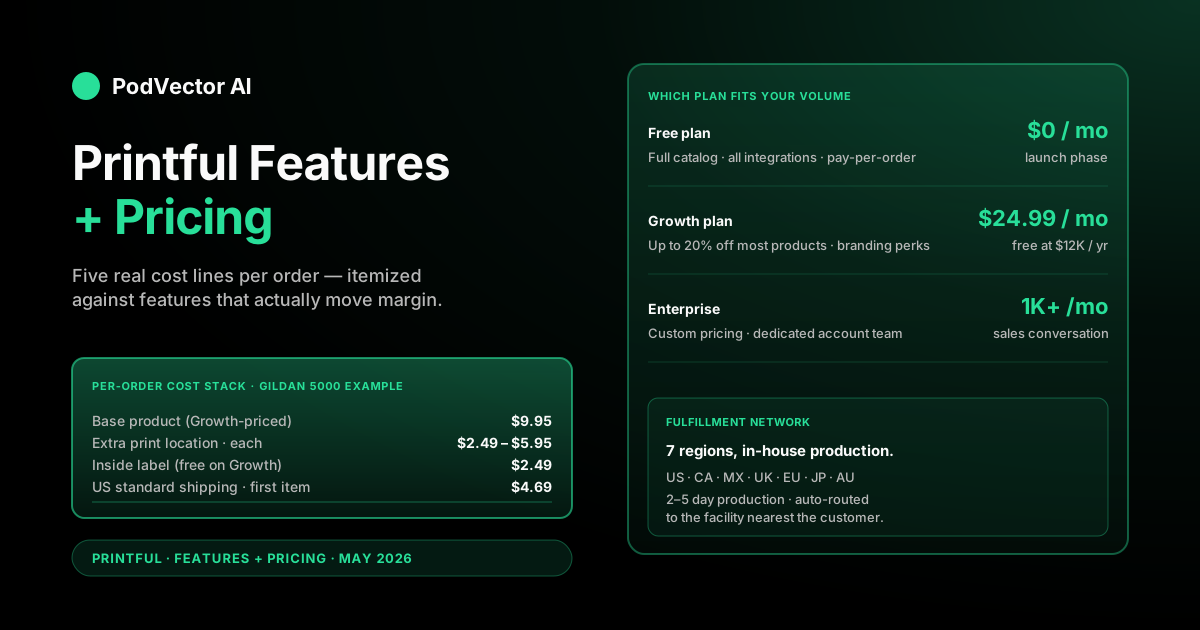
Quick Answer: Printful has two paid tiers — a Free plan with no monthly fee and a Growth plan at $24.99/month (auto-comped once a store crosses $12K/year in fulfilled sales). You pay per order: base product cost, print location add-ons, optional branding, and shipping.
The features that move your margin most are the 340+ curated catalog, the in-house fulfillment network across seven regions, the up-to-20% Growth discount on most products, and the 20+ native storefront integrations. The features that look free but quietly cost you are extra print locations ($2.49–$5.95 per location), inside-label branding ($2.49/item), and reserve costs for returns and FX.
This article itemizes every fee, maps each feature to its margin impact, and shows where the real cost stack sits for an operator running 500–5,000 orders a month.
Printful plans at a glance
Printful runs on a freemium model. The Free plan covers everything most sellers need to start. The Growth plan is the upgrade you flip on when volume justifies the discounts.
The Free plan has no monthly fee. You get the full 340+ product catalog, unlimited designs and mockups, all 20+ native integrations, and access to in-house fulfillment in every region. You only pay when an order ships.
The Growth plan costs $24.99/month if billed monthly, or $19.99/month billed annually. It unlocks up to 20% off most products (the exact percentage varies by SKU and is shown in the catalog when you hover a product). It also stacks branding perks: free large prints on selected items, an extra discount on sample orders, and priority customer support.
Growth becomes free once your store generates $12,000 in annual sales fulfilled through Printful. That's $1,000/month in fulfilled volume — roughly 25–50 mid-priced orders. Most operators hit that threshold within a quarter or two of consistent traffic.
Printful also operates an Enterprise tier for high-volume merchants (typically 1,000+ orders/month) with custom pricing, dedicated account management, and direct production-line scoping. There's no public price; it's a sales conversation.
What you actually pay per order
Every Printful order has five cost lines. Knowing all five is the difference between "looks profitable in the dashboard" and "actually profitable on the P&L."
Base product cost. The catalog price for the blank. A Gildan 5000 unisex tee starts around $9.50–$10.50 depending on size. An all-over-print hoodie runs $34–$42. A 11oz ceramic mug is $7.95–$11.95.
Print location surcharge. One front print is included in the base. Each additional print location adds $2.49–$5.95 depending on placement and method. A four-location tee (front, back, left sleeve, right sleeve) lands $7.50–$15 above the base.
Branding add-ons. Inside neck label printing is $2.49 per item. Custom packaging inserts run $0.50–$1.20. Branded packing slips and pack-in promo cards are free on Growth, $1.95–$3.95 on Free.
Shipping. Calculated at checkout by destination, weight, and carrier choice. US-to-US apparel shipping starts at $4.69 for the first item and $1.25 for each additional item in the same package. Same-region EU shipping is broadly similar. Cross-region (US to EU, or vice versa) adds $4–$10.
Reserve costs. Returns, FX losses on non-USD payouts, customs duties on international orders, and the occasional reprint for printing defects. Budget 2–5% of revenue here. Sellers who skip this line are the ones who run "profitable" stores that quietly bleed cash on quarterly reconciliation.
The sum of those five lines is your true unit cost. Anything less is wishful thinking.
Product catalog: 340+ items and how the curation affects pricing
Printful's catalog is intentionally smaller than Printify's 950+. The trade-off is curation. Every blank in Printful's catalog has been tested through their own production lines, which is why their per-item base cost tends to be 10–25% higher than Printify's equivalent SKU.
What you're paying for in that delta is consistency. Color calibration is held within tighter tolerances. Blank-supplier swaps don't happen mid-quarter without warning. And — this matters for margin — fulfillment fees stay stable. A Gildan 5000 that costs $9.95 in January is $9.95 in April unless Printful publishes a price change in advance.
The catalog itself breaks into roughly seven categories: men's apparel, women's apparel, kids and baby, accessories (hats, bags, socks), home and living (mugs, towels, posters, blankets), wall art (canvases, framed prints), and a small but growing line of branded packaging extras.
For most POD operators, 80% of revenue comes from 20% of catalog choices. The big four are unisex tees, hoodies, mugs, and posters. Pricing on those four is where the margin math lives — everything else is breadth for niche stores.
Fulfillment network: in-house facilities across seven regions
Printful operates owned facilities in the United States (multiple locations), Canada, Mexico, the United Kingdom, the European Union (Latvia, Spain), Japan, and Australia. Orders auto-route to the facility nearest the destination address.
The pricing impact of that network is twofold. Shipping costs drop because parcels travel shorter distances. And production-time variance drops because every facility runs the same SOP, the same color calibration, and the same QC checklist.
Average production time is 2–5 business days after the order clears payment and clears any design-file checks. That's measured from the moment your order hits the production queue, not from when your customer clicked "buy." Add 1–3 days for shipping in-region, 5–14 days cross-region.
Two things you should know about the network that don't show up in marketing pages. First, not every product is stocked at every facility — apparel is broadly available, but some all-over-print and embroidery work routes to specific regional hubs, which extends shipping time. Second, "in-house fulfillment" doesn't extend to every category: certain home and living items (canvases, some posters) are produced by vetted partners under Printful's QC umbrella, not in Printful's own facilities.
Branding and customization features (and what they cost)
The branding stack is where Printful out-features most of the budget POD competitors. It's also where line items quietly accumulate if you're not watching.
Inside neck label printing. Replace the manufacturer's label with your own brand text. $2.49 per item. Free on Growth for selected products.
Outside hem and sleeve prints. Move your logo to the hem or sleeve instead of (or in addition to) a chest print. Treated as a second print location: $2.49–$3.95.
Custom packaging inserts. A branded card slipped into the polybag. $0.50 per card on Free, free on Growth.
Branded packing slip. Your logo on the slip the customer sees first. Free on both tiers, but designs upload on Growth only.
Pack-in promo cards. Discount codes, thank-you notes, QR codes for repeat purchase. $1.95–$3.95 each on Free, free on Growth (limited quantity per order).
Custom hangtags and stickers. Available through Printful's warehousing service. You produce them externally, ship them to a Printful warehouse, and Printful adds them to outgoing orders. Warehousing fees apply separately.
Branding is the lever that lets you charge a premium without changing the blank. A $24 generic tee is a hard sell. A $34 tee in a branded mailer with a thank-you card and a discount code for a second purchase feels intentional. The branding stack costs $3–$6 in fees. If it lifts your AOV by $10, the math works.
Integrations: 20+ native connectors
Printful has more native storefront connections than any other POD platform. The integrations split into four buckets.
Storefront builders: Shopify, Wix, Squarespace, BigCommerce, Webflow, Ecwid, PrestaShop, Magento. Plug-in install, pull catalog, sync products. No engineering required.
Open-source and self-hosted: WooCommerce, WordPress. Plugin-based with the same one-click setup.
Marketplaces: Etsy, Amazon, eBay, TikTok Shop, Wayfair, Storenvy. Native connectors with marketplace-specific quirks (Etsy has a shop-listing limit, Amazon has tighter content rules).
No-code Quick Stores: Printful's own hosted storefront for sellers who don't want to run a Shopify or Wix site at all. Free, ad-supported on the storefront itself, with a faster path to first sale.
The pricing impact of integrations is mostly hidden but significant. A native connector that handles inventory, mockup sync, and order pass-through cleanly saves you 10–20 hours/month of manual order management at any meaningful volume. That time is real money — either yours or a VA's.
Where Printful's integration story gets thinner is multi-channel selling. If you sell on Shopify, Etsy, and TikTok Shop simultaneously and want one unified view of margin across all three, Printful's dashboards won't give it to you. That's the gap a unified data warehouse fills.
Growth Plan: when the $24.99/month pays for itself
The Growth plan's pitch is "up to 20% off most products plus branding perks for $24.99/month." Whether that math works depends on your volume and your product mix.
The break-even is easy. If you fulfill more than $125/month in Printful product costs and your discount rate is 20%, the discount alone saves $25 and the plan pays for itself. For a typical $12 base cost per tee, that's about 10–11 orders/month.
Most operators clear that bar within their first month of consistent traffic. The plan is rarely a bad deal once you're past the launch phase. And the auto-comp at $12K/year means even seasonal stores stop paying once they've moved real volume.
Where Growth doesn't pay for itself: very-low-volume hobby stores (under 5 orders/month), stores selling exclusively products outside the discount list (some warehousing-only items, some premium specialty products), and stores in their very first weeks before any sales have closed.
For everyone else, treat Growth as a baseline cost of doing business on Printful, not a luxury upgrade.
A real margin example on a Gildan 5000 tee
Worked example. Single front print, US to US, retail $24.99, Growth plan active.
- Base product: $9.95 (Growth-discounted from $11.25)
- Print location: $0 (one front print included)
- Inside label: $0 (free on Growth)
- Packing slip with logo: $0 (free on Growth)
- Shipping (US standard): $4.69
- Reserve at 3% of revenue: $0.75
- Payment processing (2.9% + $0.30): $1.02
Total cost: $16.41. Retail $24.99 minus $16.41 = $8.58 contribution per unit, or 34.3% margin before ad spend.
Add a second print location on the back ($3.95) and the margin drops to $4.63 per unit, or 18.5%. Add a custom pack-in card on Free ($1.95 — but free on Growth) and you've eaten the margin entirely if you're not on Growth.
This is why operators who run profitable POD stores almost universally track cost-per-SKU at the line-item level, not blended. The blended view says "I make 30% margin." The line-item view says "this two-color back-print SKU loses money on every sale."
Costs that look free but aren't
Three categories of cost don't show up in Printful's pricing page but show up on your bank statement.
FX conversion loss. If your store sells in USD but you're paid in EUR or GBP, every payout converts at Printful's rate, which trails the interbank rate by 1–2%. On $10,000 of monthly fulfillment, that's $100–$200 of invisible loss.
Returns and reprints. Printful's policy covers production defects but not customer-driven returns (wrong size ordered, didn't like the color). A 3–5% return rate on apparel is normal. Build it into your unit economics or it eats your margin in Q1 every year.
Catalog price changes. Printful updates fulfillment prices on a rolling basis with advance notice. Sellers who set retail prices once and never revisit them watch a 35% margin slowly decay to 22% over 18 months as base costs creep up. A live margin watch — every SKU repriced or flagged when its fulfillment cost moves — fixes this.
None of these are scams. They're standard industry economics. The trap is treating them as edge cases instead of baseline cost-of-doing-business lines.
How to reduce your Printful cost stack
Six concrete levers, ranked by impact.
1. Activate Growth above $125/month in product spend. The 20% discount on most products plus free branding is the single biggest lever. Stop running on Free past the launch phase.
2. Consolidate to one print location per SKU. Front-only designs use the included print. Every additional location is a $2.49–$5.95 line. For most of your catalog, a single bold front design outperforms a multi-location design on both margin and customer comprehension.
3. Price products in shipping-friendly bundles. Two tees in one order share most of the shipping cost (first item $4.69, additional $1.25). Bundles, sets, and AOV-builder products pay for themselves twice — once in margin, once in shipping efficiency.
4. Concentrate on regional fulfillment. A US-focused brand routing 90% of orders to US facilities pays significantly less in shipping than a globally-targeted brand routing 30% cross-region. Your ad targeting should match your fulfillment footprint.
5. Buy bulk samples with the Growth sample discount. Sampling is non-negotiable for any product you're going to put real ad spend behind. Growth gives you a deeper sample discount that pays back the subscription if you're testing more than 3–4 products a quarter.
6. Reprice on a calendar, not on instinct. Pull base costs from Printful, match against retail prices on your store, and reset any SKU that's fallen under your floor margin. Doing this monthly is the difference between operators who hold 30%+ margin year-over-year and operators who quietly slide into the teens.
Printful pricing vs the alternatives
Printful is not the cheapest POD provider. It's positioned as the premium option, and the pricing reflects that. Three comparisons that matter most.
Printify. Lower base costs (a Gildan 5000 starts around $7.95 vs Printful's $9.95). Wider catalog. But variable quality because Printify routes through 100+ third-party print providers rather than owned facilities. Margin per unit is higher; reprint and return rates are also higher. The deeper trade-offs are covered in the is-Printful-better-than-Printify comparison and the related Printful or Printify decision walkthrough.
Gelato. Local fulfillment in 30+ countries. Strong for global brands. Pricing on apparel sits between Printful and Printify; pricing on wall art often beats both.
CustomCat. Lowest base costs in the category but a smaller catalog and weaker integration story. Best for sellers running tight margins on a narrow product mix.
The right choice usually isn't "which is cheapest" but "which pricing structure matches my volume, return tolerance, and brand positioning." Printful wins when consistency and branding matter. Printify wins when raw margin matters. The real cost difference between them often disappears once you factor in return rates and customer support hours.
FAQs
Is Printful actually free to use?
Yes, the Free plan has no monthly fee. You only pay when an order ships — product cost, print add-ons, shipping. The Growth plan ($24.99/month) is optional and unlocks volume discounts.
How much does the average Printful order cost the seller?
For a single-print US-to-US tee, expect $14–$18 in total seller cost (base + shipping + processing). Hoodies run $30–$42. Mugs $11–$15. Retail prices typically 1.8–2.5x the cost to hold healthy margin.
Does the Growth Plan pay for itself?
For most active stores, yes. The $24.99/month is recovered once you fulfill more than ~$125/month in discounted product. Most stores clear that within their first month of consistent traffic. The plan also auto-comps once you reach $12K/year in fulfilled sales.
What's the cheapest Printful product to start with?
Posters and stickers have the lowest base costs ($3.95–$9.95) and the highest margins relative to retail. Tees are the bestseller volume-wise but margin per unit is tighter. Mugs strike a middle balance.
How do Printful's costs compare to Printify?
Printful's base costs run 10–25% higher than Printify's equivalent SKUs. The premium pays for consistency, in-house fulfillment, and tighter QC. Operators with strong brand positioning and lower return tolerance generally come out ahead on Printful; volume sellers chasing raw margin often prefer Printify. For a deeper comparison, see the breakdown on Printful t-shirt costs by SKU and the 2025 base cost breakdown.
What features come with the Growth Plan but not Free?
Up to 20% off most products, free inside-label printing on selected items, free pack-in cards (limited quantity), deeper sample discounts, large-front-print upgrades on selected products, and priority customer support. The full subscription breakdown itemizes which products qualify.
Can I switch between Free and Growth?
Yes. Upgrade or downgrade at any time from your dashboard. Discounts apply immediately on Growth activation. If you downgrade, the discount drops on your next order.
Where can I see the full pricing list?
Each product page on Printful's catalog shows tiered pricing — Free price and Growth price side by side. There's no public master pricing page; pricing is shown per-SKU because variants (size, color, print method) affect cost individually. For a deeper look at how each cost layer stacks for your specific cluster of products, browse the full Printful costs and charges hub or the broader Printful guide hub. For independent industry context on plan economics, Bootstrapping Ecommerce publishes a regularly updated pricing guide.
Printful gives you the price list. You still need an analyst to read it against your store.
The fees in this article are public. Mapping every fee against every SKU on your store, every day, against shifting base costs and shipping rates — that's where most operators lose the margin they thought they were earning.
Victor connects to your Printful account, pulls itemized fulfillment costs into your data warehouse, and answers questions like "which SKUs dropped below margin after the last fulfillment price update?" in plain English. It's an AI employee that already knows your numbers, not a static dashboard you have to interpret.
Try Victor free