
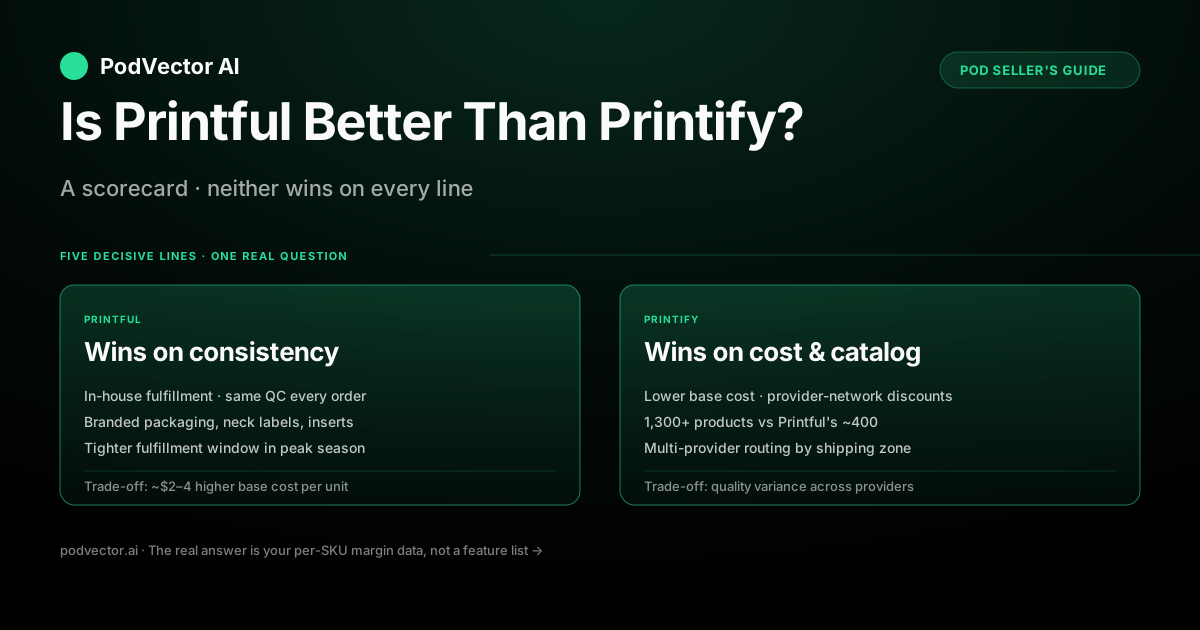
Quick Answer: No — neither platform is strictly "better." Printful wins on consistency, in-house quality control, and branding. Printify wins on base cost, catalog breadth, and supplier flexibility.
For most POD sellers in 2026, the right answer is "it depends on the SKU." Premium apparel and branded merch tend to perform better on Printful. Cost-sensitive products and niche items tend to win on Printify.
The honest verdict requires your own data: per-SKU margin after shipping, refund rate by provider, and fulfillment-time impact on review scores. Comparing feature lists is a starting point, not the answer.
The 30-second verdict
"Is Printful better than Printify?" is the wrong shape of question. It assumes one POD platform is objectively superior to the other across all sellers and all products. That isn't how the market actually splits.
Printful and Printify both operate under the same parent company now (FYUL, launched late 2025), but the two apps still run as separate products with separate catalogs and separate fulfillment networks. The choice between them is still a real choice.
Here is the honest split, based on how the two platforms actually perform for POD sellers in 2026:
- Printful is better if your brand depends on consistent print quality, premium feel, custom packaging, and you can absorb a higher base cost.
- Printify is better if you compete on price, sell a wide variety of products, or you need supplier flexibility to dodge stockouts and shipping-zone issues.
For sellers running both stores side by side, the "winner" tends to be different for every product line. We'll unpack why, and then close with the one question your own data should answer for you.
Pricing and per-SKU margin
This is where most comparisons start, and for good reason. A few dollars of cost difference per shirt compounds across thousands of orders.
Printful base costs. Printful charges roughly $11–13 for a standard DTG (direct-to-garment) t-shirt, plus shipping. The in-house fulfillment model means pricing is consistent — you know what your cost will be when you list the product.
Printify base costs. Printify routes the same kind of shirt through a network of print providers, with base costs typically running $7–10 for the cheapest provider. Sellers who pay for Printify Premium ($29/month) get an additional ~20% discount on most products.
On paper, Printify wins by a few dollars per unit. That gap is real, and it matters most for products with thin margins or sellers who compete on price.
But the comparison gets messier when you account for the variables a base price doesn't show:
- Shipping cost varies by provider on Printify. A Monster Digital order shipped to the West Coast costs differently than the same shirt from a partner in Europe.
- Refund rate eats margin. If one provider has a 4% defect rate and another has 1.5%, the "cheaper" provider is often not cheaper at all.
- Volume discounts on Printful kick in via the Printful Growth and Business plans, narrowing the per-unit gap for high-volume sellers.
Bottom line: Printify almost always has a lower headline price. Whether it has a lower true cost depends on which provider you pick and how reliable they are for your specific SKU.
For a deeper line-by-line cost breakdown, see our full Printful or Printify POD seller's guide.
Print quality and consistency
Quality is where the comparison stops being symmetric.
Printful's quality model. Printful owns its print facilities. The same equipment, the same inks, and the same QC process run every order. The output is consistent across regions and across time.
This matters more than POD sellers usually admit. If your Etsy reviews depend on the third shirt looking like the first, in-house fulfillment is doing real work for your brand.
Printify's quality model. Printify is a marketplace of print providers, each with its own equipment, ink, and process. The platform publishes performance scores per provider so sellers can pick the better ones.
The variance is real. Two providers can fulfill the same product file and produce noticeably different output. Sellers who use Printify well learn to test 2–3 providers per SKU before committing.
If you're shipping premium products and consistency is the brand promise, Printful's model is structurally safer. If you're shipping volume across a wide catalog and you have the patience to vet providers, Printify's model can match Printful's quality on the SKUs that matter.
Product catalog and variety
This is where Printify pulls ahead — and the gap is large.
Printful's catalog runs around 380–400 products. It's curated: apparel, accessories, home and living, plus a handful of newer categories like jewelry and stationery. Most of what Printful offers is what they can fulfill consistently in-house or via close partners.
Printify's catalog runs over 1,300 products, because each new print provider that joins the network can list new SKUs. You'll find product categories on Printify that Printful simply doesn't offer — embroidered patches, certain technical fabrics, specialty home goods, niche drinkware.
For sellers who want to test product-market fit across categories, Printify's catalog depth is a meaningful advantage. For sellers who already know they're an apparel-and-mugs brand, Printful's narrower catalog isn't a constraint.
Fulfillment speed and reliability
Both platforms quote similar fulfillment windows on paper. Reality is more nuanced.
Printful typically fulfills DTG apparel in 2–5 business days, with most orders moving on day 2 or 3. Because the work happens in Printful's own facilities, the spread is tight and predictable.
Printify fulfillment depends entirely on the provider. The best providers (Monster Digital, SwiftPOD, Dimona) match Printful's pace. Lower-tier providers can drift to 5–7 business days during peak season.
Reliability matters more than speed. A 4-day fulfillment that hits 4 days every time beats a 2-day fulfillment that misses every fourth order. Printful's in-house model wins on reliability by structure. Printify's variability rewards sellers who actively manage their provider selection.
The fulfillment question becomes especially load-bearing during Q4. If you've never shipped 500+ orders/day in late November, both platforms will surprise you. Our breakdown of the broader Printify-or-Printful question goes deeper on peak-season behavior.
Shipping rates and zones
Shipping is the silent margin killer, and both platforms handle it differently.
Printful's shipping is calculated by destination and product weight, with the same logic for every order. International shipping is supported broadly, with fulfillment centers in North America and Europe to keep zones short.
Printify's shipping rate depends on which provider fulfills the order. Two providers fulfilling the same product can charge different shipping to the same address. Sellers who use the multi-provider feature can route by zone — a US customer goes to a US provider, a UK customer goes to a UK provider.
For sellers with a heavily international customer base, Printify's multi-provider routing can produce real savings. For sellers whose customers are concentrated in one region, the shipping math usually favors whichever platform has fulfillment in that region.
Branding and customization
This is Printful's strongest single advantage.
Printful offers branded packing slips, custom packaging inserts, neck labels on apparel, hang tags, branded packaging itself, and other touches that make a fulfilled order feel like it came from your brand instead of a generic POD warehouse.
Printify offers some branding features — branded inserts and packing slips, depending on the provider — but the depth and consistency are below Printful's. Not every Printify provider supports every branding option.
For brands where the unboxing matters (premium apparel, gift-driven categories, Instagram-led DTC plays), Printful's branding stack is a structural advantage. For sellers whose customers buy on price and don't care about the packing slip, it's mostly irrelevant.
Sales channel integrations
Both platforms cover the major sales channels — Shopify, Etsy, Amazon, eBay, WooCommerce, TikTok Shop. The integration quality is roughly comparable on the channels that matter most for POD sellers.
The small differences:
- Etsy integration is mature on both platforms. Printful's connector handles tax and shipping profiles slightly more cleanly out of the box.
- Shopify integration is similar. Both publish the same kind of product variants and sync inventory automatically.
- Amazon integration on Printful tends to be more reliable for sellers operating under stricter Amazon SLA expectations, because the in-house fulfillment makes shipping windows more predictable.
For most sellers, integration quality is not the deciding factor between Printful and Printify in 2026. Both work.
Customer support
Printful has historically been faster to respond on support tickets, with live chat available during business hours and email turnaround typically inside 24 hours.
Printify support is improving but is still uneven — quality depends on the issue type. Order-specific issues that route to the print provider can take longer to resolve than issues handled by Printify directly.
For sellers running high volume, support latency becomes a real operating cost. A defective-print issue that takes 3 days to resolve is 3 days of unresolved customer email.
Which platform for which seller
The honest segmentation, based on how the two platforms actually deliver for different POD seller profiles:
Printful is the better fit if:
- You sell premium apparel where consistency is the brand promise.
- Custom packaging, neck labels, or inserts are part of your customer experience.
- You sell into Amazon or other channels with strict fulfillment SLAs.
- Your margins are thick enough that the $2–4 per-unit premium doesn't matter.
- You'd rather pay more for predictability than save money on variance.
Printify is the better fit if:
- You compete on price and need every dollar of base cost margin.
- You sell across a wide catalog and need product depth Printful doesn't have.
- You sell to a globally distributed customer base and want multi-provider routing.
- You're willing to vet and test providers to manage quality variance.
- You're scaling fast and don't want to be locked into one fulfillment network.
Both is the right answer for many sellers. Plenty of stores run premium SKUs on Printful and high-volume basics on Printify, with the connector logic decided product by product. The two platforms' parent company doesn't seem to mind — see our guide to the Printful Printify merger for what FYUL's strategy means for sellers using both apps.
For a structured pros-and-cons table, see Printful vs Printify: pros and cons, which is best for POD sellers and the alternate phrasing in our parallel pros/cons comparison.
The one question your data should answer
Every comparison article (including this one) is forced to generalize. Your store isn't generalized. It has specific SKUs, specific customer geography, and a specific refund history.
The real question isn't "is Printful better than Printify?" — it's:
For each of my SKUs, which provider produces a higher margin after shipping, refunds, and the ad spend it takes to acquire the customer?
That question requires combining several data sources: your Shopify revenue data, your Printful and Printify cost data, your shipping data, your ad spend data, and your refund logs. Most POD sellers don't have this combined view, which is why they default to a feature comparison instead of a data answer.
This is the gap an AI employee layer is designed to close. A unified data warehouse that pulls Shopify, Printful, and Printify cost and order data into one place — and an AI employee that can answer "which provider should I use for SKU X next quarter?" and act on the answer with your approval without forcing you to write SQL — turns the Printful vs Printify question from a feature debate into a number.
For a wider look at the topic and the cluster of related comparisons, the Printful cluster hub and the Printful topic hub are the right entry points.
FAQs
Is Printful or Printify cheaper?
Printify is almost always cheaper on the headline base price — typically $2–4 per unit on standard DTG apparel. Whether it's cheaper in true cost depends on shipping, refund rate, and the specific provider you select.
Is Printful's quality better than Printify's?
Printful's quality is more consistent because the work is in-house. Printify's quality varies by provider — the best providers match Printful, the worst providers don't. The right framing is "more consistent," not "objectively better."
Did Printful and Printify merge?
Yes, under a parent company called FYUL (launched November 2025). But the two apps still operate as separate products with separate catalogs, separate APIs, and separate fulfillment networks. Sellers don't have to migrate, and most don't.
Should I use both Printful and Printify?
For sellers above a certain volume, yes — using both is common. Premium SKUs go to Printful for consistency and branding; high-volume basics and niche products go to Printify for cost and catalog breadth. The split is decided product by product.
Which is better for Etsy?
Both work well on Etsy. Printful's branding and consistency tend to support higher review scores; Printify's lower cost gives more room to compete on Etsy's price-sensitive listings. Many Etsy sellers run both.
Which is better for Shopify?
Both integrate cleanly with Shopify. The Shopify-specific factor is usually shipping zone and customer concentration — if your Shopify customers are globally distributed, Printify's multi-provider routing tends to lower shipping cost.
Is Printful worth the higher price?
For brand-led sellers, yes — Printful's consistency and branding are worth the premium. For price-led sellers, no — the per-unit savings on Printify compound faster than Printful's quality premium converts to higher reviews.
Answer it with your data, not with a feature comparison
Feature comparisons are educated guesses. Your Shopify orders, Printful and Printify cost data, refund logs, and ad spend already contain the real answer — for each of your SKUs, with each of your providers, in each of your shipping zones.
Victor is the AI employee that unifies your POD and ecommerce data and answers the questions you'd otherwise need a data team for. Margin by SKU. Refund rate by provider. Real CAC by channel.
and stop guessing which platform is better.
Try Victor free