
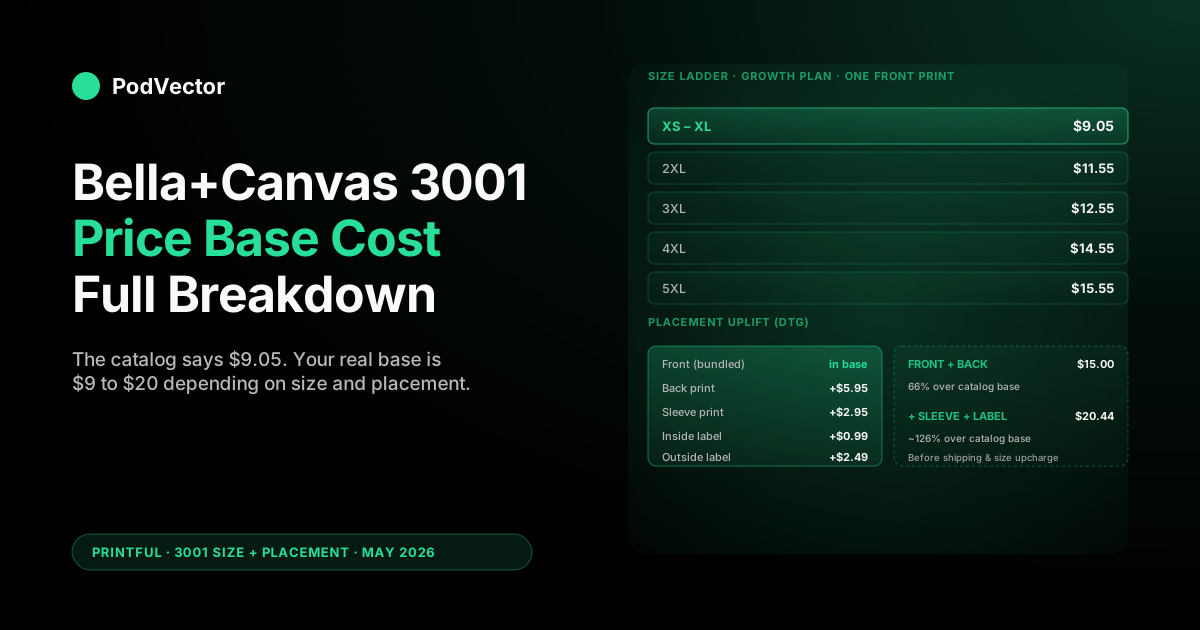
Quick Answer: The Printful Bella+Canvas 3001 base price is $9.05 on Growth (~30% off Free) and $8.45 on Business (~35% off Free), for sizes S–XL, US fulfillment, one front DTG print, May 2026 catalog. Free plan: $12.95.
That is the catalog base — the headline number on the 3001 product page. It is not what hits your Printful invoice.
This guide walks the size ladder (XS through 5XL), the print-placement uplift (back, sleeve, label), and the gap between the catalog base and your real per-unit cost when an order ships.
Catalog base by plan
Printful runs three subscription tiers, and each one prices the 3001 differently. Same SKU, same warehouse, same blank — three different "base costs."
| Plan | Monthly fee | 3001 base (S–XL) | Discount vs Free |
|---|---|---|---|
| Free | $0 | $12.95 | — |
| Growth | $24.99 (waived at $12k annual) | $9.05 | ~30% |
| Business | $49.99 (waived at $150k annual) | $8.45 | ~35% |
The Free-to-Business spread on a single 3001 is $4.50 per unit. On 200 shirts a month, that gap is $900 — almost three times the Business plan fee.
Most stores pencil the math wrong here. They compare a Free-plan landed cost to a Growth-plan retail benchmark from a competitor blog post, then wonder why their margin is half what the post promised. Your tier on shipment day is the only base that matters.
For the full breakdown of how each tier reshapes unit economics, see our Printful cost guide.
The 3001 size ladder: XS to 5XL
The catalog base price is for sizes S, M, L, and XL. Every size outside that band carries an upcharge that Printful itemizes on the invoice — not on the catalog page you used to set your retail price.
| Size | Free base | Growth base | Business base |
|---|---|---|---|
| XS – XL | $12.95 | $9.05 | $8.45 |
| 2XL | $15.45 | $11.55 | $10.95 |
| 3XL | $16.45 | $12.55 | $11.95 |
| 4XL | $18.45 | $14.55 | $13.95 |
| 5XL | $19.45 | $15.55 | $14.95 |
The 5XL is $6.50 above the S–XL price on Free and Growth. If you list a single retail price across the whole size range, every 5XL sale is a $6.50 margin hit you didn't budget for.
The stores that get this right do one of two things. Either they tier their retail price (size-priced variants in Shopify), or they cap the size range at 2XL and lose the long-tail orders on purpose.
Neither answer is wrong. Both require knowing what fraction of your unit volume sits in the 2XL+ band — which is the second number most POD sellers don't have on hand.
Print placement uplift (back, sleeves, labels)
The base price includes one print location: front, up to roughly 12" × 16". Everything else is a line item.
| Add-on | Per-unit charge |
|---|---|
| Back print (DTG) | +$5.95 |
| Left or right sleeve print | +$2.95 |
| Inside neck label print | +$0.99 |
| Outside hem label print | +$2.49 |
A front-and-back design on a single 3001 isn't $9.05 on Growth. It's $9.05 + $5.95 = $15.00 before shipping. Add a sleeve, and you're at $17.95.
That's a 99% bump on what the catalog labeled "base." Two-sided designs are not optional in some niches (sports apparel, band merch, oversized streetwear all assume back prints) — so the "base" on those niches is structurally higher than the catalog page suggests.
The label charges are smaller, but they stack on every unit. If you're using outside hem labels for brand recognition, that's $2.49 per shirt bundled into every order forever — about $498 a year on 200 units a month.
Real "base" for the size mix you sell
The "real" base cost for your store is a weighted average across the size and placement mix you actually ship. Here's the math for three common scenarios on the Growth plan.
| Scenario | Composition | Weighted base |
|---|---|---|
| Front-only, S–XL dominant | 85% S–XL, 12% 2XL, 3% 3XL | $9.43 |
| Front + back, S–XL dominant | 85% S–XL, 12% 2XL, 3% 3XL · all 2-sided | $15.38 |
| Front + back + outside label | Same mix · 2-sided · outside label | $17.87 |
The same 3001, same plan, same warehouse — $9.43 to $17.87 in real per-unit base, depending on what you're actually putting on the shirt. Almost a 90% spread.
If your retail price assumes the $9.05 catalog number, the second and third scenarios produce negative margin at common $24.95 list prices. That's the gap stores discover three months in, when the invoice math finally gets reconciled.
The per-shirt landed cost breakdown walks the same exercise with shipping and platform fees layered on top.
DTG vs embroidery on the 3001
The catalog base assumes direct-to-garment (DTG) printing, which is the default decoration method for the 3001. Embroidery on the same blank is a different price ladder entirely.
| Decoration | Growth base (S–XL) | Notes |
|---|---|---|
| DTG, one front print | $9.05 | Catalog default |
| Embroidery, one front (small) | $11.75 | + $6.50 one-time digitization |
| Embroidery, one front (large) | $13.75 | + $6.50 one-time digitization |
Embroidered 3001s carry roughly a $3–$5 premium over DTG before the one-time digitization charge. The digitization fee is per-design, not per-unit, so it amortizes fast across volume — but it shows up on your first invoice as a single line item.
The reason embroidery numbers matter on a base-cost guide: many sellers cross-list the same 3001 in DTG and embroidery variants. The "base cost" for the embroidery variant is a different number from the DTG variant, and Shopify won't bridge that gap for you.
For deeper detail on Printful's print pricing across decoration methods, see the canvas print pricing breakdown.
The anchor-size trap
Printful displays the 3001 catalog price using size M as the anchor. Glance at the product page and your eye lands on "$9.05" — clean, round, easy to plug into a retail calculator.
The trap: M is the cheapest size in the entire range. Every other size is at-or-above that anchor. The 2XL is +$2.50, the 5XL is +$6.50, the 4XL is in between.
If your size distribution skews unisex-adult (which 3001 buyers usually do), your median shipped size is probably L or XL — both still at the $9.05 base. But your tail orders (2XL through 5XL) carry uncapped upside risk on the cost side.
One 5XL order at $9.05 retail-anchored math is a $6.50 margin destruction event. Three or four of those a month wipes out the profit on twenty S–M sales.
The fix is not to refuse plus sizes. It's to size-tier your Shopify variants. Front-load the cost knowledge so the retail price tiers up alongside the catalog price tiers up.
Break-even retail by plan
Pulling the size, placement, and shipping numbers together, here's the break-even retail price for a front-only, S–XL Bella+Canvas 3001 with US domestic shipping ($3.99 first-tee Growth rate).
| Plan | Base | Shipping | Landed cost | Retail for 50% margin |
|---|---|---|---|---|
| Free | $12.95 | $5.49 | $18.44 | $36.88 |
| Growth | $9.05 | $3.99 | $13.04 | $26.08 |
| Business | $8.45 | $3.99 | $12.44 | $24.88 |
Same 3001, same design, same customer — the Free plan needs $36.88 retail to clear 50% margin; Business clears it at $24.88. That $12 spread is what the subscription fee is buying.
This is before any platform fees. Etsy adds 6.5% transaction + 3% payment processing + $0.20 listing — call it $2.85 on a $25 sale. Shopify with PayPal adds about 2.9% + $0.30 — closer to $1.05 on a $25 sale. The retail floor shifts up another dollar or two depending on where you sell.
For the cross-plan economics including the Growth membership math and the membership comparison, the break-even point on Growth is roughly 130 units a month at typical 3001 retail prices.
Where the 3001 sits vs other blanks
The 3001 is a "premium staple" in Printful's catalog. It's not the cheapest tee, and it's not the most expensive.
| Blank | Growth base (S–XL, front DTG) | Position vs 3001 |
|---|---|---|
| Gildan 5000 unisex heavy | $7.95 | ~$1.10 cheaper |
| Gildan 64000 unisex softstyle | $8.45 | ~$0.60 cheaper |
| Bella+Canvas 3001 | $9.05 | — |
| Next Level 3600 men's | $11.75 | ~$2.70 more |
| Bella+Canvas 3001CVC (heather) | $9.95 | ~$0.90 more |
The 3001 lives in a $1–$3 band around the popular blanks. The case for paying the premium over a Gildan 5000 is fit, fabric weight (4.2 oz vs 5.3 oz), and the 54-color range — practical reasons for streetwear and graphic-tee niches.
If your niche is workwear, gift items, or low-AOV gag designs, the $1.10 Gildan 5000 saving compounds to real money fast. If your niche is fashion-adjacent or competitive streetwear, the 3001's fit advantage usually clears the price gap on conversion alone.
The decision isn't always "3001 because everyone uses it." It's "3001 if the niche pays for it; Gildan otherwise."
Tracking 3001 base cost across the catalog
Printful changes blank pricing without announcement. The 3001 has had at least three price adjustments since 2022 — usually small, occasionally meaningful. The catalog page updates silently; old orders ship at old prices; new orders ship at new prices.
The practical problem: you set a retail price three months ago against a $9.05 catalog base. The catalog base is now $9.45. Your invoice line items reflect the new price; your Shopify retail still reflects the old assumption. You've lost 40 cents per unit and didn't notice.
The way around this is to read the catalog base back from invoice lines, not from the product page. Printful invoices itemize "Product (Unisex Staple T-Shirt | Bella + Canvas 3001) — $9.05" per unit. That's the ground truth.
POD operators tracking margin by SKU usually pull invoice line items into a spreadsheet weekly. The faster path is a live data warehouse — pull Printful invoice rows into a unified data layer, join against Shopify orders by order ID, and watch margin per SKU as a continuous number rather than a quarterly reconciliation. Tools like Victor built on that approach surface margin shifts the day they happen, not the month after.
For a broader view of Printful's cost components, see the Printful costs and charges hub or our Printful coverage hub.
FAQs
What is the base price of a Printful Bella+Canvas 3001?
$9.05 on the Growth plan for sizes S–XL with one front DTG print (May 2026 catalog). Free is $12.95, Business is $8.45. Sizes 2XL through 5XL carry $2.50–$6.50 upcharges.
Is the base price the only cost I'll pay?
No. The base covers the blank, one front print, and handling. Shipping, size upcharges, additional placements (back, sleeves), and label prints are itemized separately on the invoice. Real per-unit cost runs $13–$18 depending on your size mix and placements.
How much does a back print add?
+$5.95 per unit for DTG back print. That's a 66% bump on the Growth-plan base ($9.05 → $15.00). Sleeve prints are +$2.95 each.
What size is the catalog "base" price for?
Sizes XS through XL. The 2XL is $2.50 more, the 5XL is $6.50 more. If you list a single retail price across all sizes, every 2XL+ sale eats unbudgeted cost.
Does the price change when I'm on Growth vs Free?
Yes. The 3001 is $9.05 on Growth and $12.95 on Free — a $3.90 per-unit savings. At ~130 units a month, the Growth subscription pays for itself.
How often does Printful change the 3001 base price?
Roughly once a year, often without notice. The catalog page silently updates; orders shipped after the change use the new price. Track invoice lines, not the product page, for ground-truth cost.
Is the 3001 cheaper than the Gildan 5000?
No. The Gildan 5000 is roughly $1.10 cheaper at $7.95 Growth-plan base. The 3001 premium pays for lighter fabric, slimmer fit, and a 54-color range — usually worth it for streetwear and fashion-graphic niches; rarely worth it for workwear or gift-item niches.
Does the base cost include shipping?
No. US domestic shipping is $3.99 first-tee on Growth, $5.49 on Free. International shipping is materially more — sometimes more than the shirt itself.
What's the break-even retail price for a 3001 at 50% margin?
$26.08 on Growth, $24.88 on Business, $36.88 on Free — front-only S–XL, US shipping, no platform fees. Add $1–$3 for Etsy or Shopify fees depending on where you sell.
What's the difference between the 3001 and the 3001CVC?
The 3001CVC is the heather/melange version of the 3001, made from a cotton-polyester blend instead of 100% combed ring-spun cotton. It runs ~$0.90 more on Growth. The base 3001 covers solid colors.
Watch 3001 margin shift in real time
The catalog base is one number. Your real per-unit cost — across size mix, placement mix, and Printful's silent price updates — is twelve. Most POD sellers reconcile quarterly. The shifts they miss are the margin they leave on the table.
Victor reads your Printful invoices and Shopify orders live, joins them in your data warehouse, and flags margin drift the day it starts — not the quarter after.
Try Victor free