
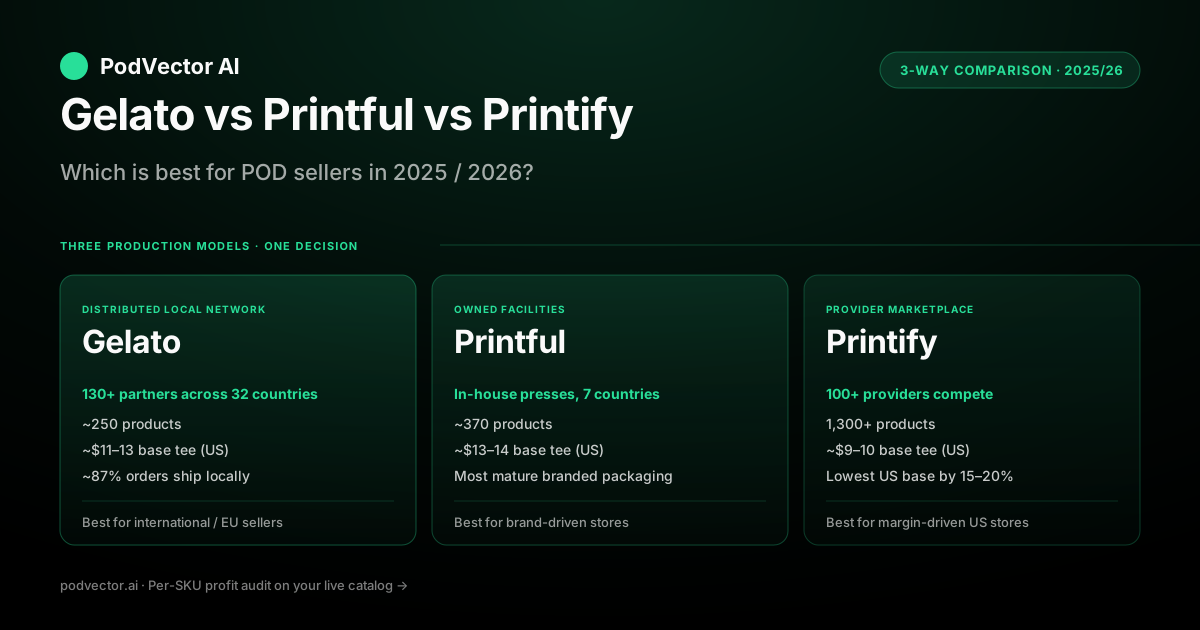
Quick Answer: Pick Printify if you sell mostly in the US and base cost decides your margin — top providers price a Bella+Canvas 3001 tee around $9, the lowest of the three. Pick Printful if branded packaging and consistent quality matter more than $3–4 of base cost — owned facilities in 7 countries produce the most uniform output.
Pick Gelato if more than 30% of your orders ship outside the US — its 130+ local print partners across 32 countries kill customs friction and cut delivery from 10+ days down to 2–4.
The 2025-to-2026 picture barely shifted on base cost. What did move is subscriptions — Gelato+ rose to $29.99/month and Printify Premium to $39/month in 2026 — plus integration depth, branded-packaging maturity, and how operators stack two of the three to cover regions one platform misses.
The 3-way decision in 60 seconds
Most "Gelato vs Printful vs Printify" articles compare the three as if they're interchangeable. They're not. Each one optimized for a different bottleneck in the POD operator's P&L.
Printify optimized for base cost. It runs a marketplace of 100+ independent print providers who bid for the same SKU, which drives US base prices 15–20% below the other two on most apparel categories.
Printful optimized for consistency and brand. It owns its facilities, hires its own print operators, and ships from its own warehouses — so the same SKU printed in March looks like the same SKU printed in November.
Gelato optimized for geography. It routes orders to a network of 130+ vetted local print partners in 32 countries, so a German buyer's poster prints in Germany, a Japanese buyer's hoodie prints in Japan, and almost nothing crosses customs.
Pick the platform whose optimization matches the bottleneck in your business — not the one that wins generic feature comparisons.
Side-by-side snapshot table
This is the orientation. The rest of the article unpacks where each row leaks nuance.
| Dimension | Gelato | Printful | Printify |
|---|---|---|---|
| Production model | 130+ partners, 32 countries | Owned facilities, 7 countries | 100+ third-party providers |
| Catalog size | ~250 products | ~370 products | 1,300+ products |
| Local production rate | ~87% of orders | Region-dependent | Provider-dependent |
| Free tier | Yes | Yes | Yes |
| Mid-tier subscription | Gelato+ $29.99/mo | Growth $24.99/mo | Premium $39/mo |
| Base cost (Bella+Canvas 3001 tee, US) | ~$11–13 | ~$13–14 | ~$9–10 (top providers) |
| EU local production | Yes (8+ countries) | Latvia, Spain | Limited, provider-dependent |
| APAC local production | Australia, Japan, Singapore | Australia only | Limited |
| Branded packaging | Gelato+ and above | Most mature suite | Provider-dependent |
| Best fit | International / EU sellers | Brand-driven US/EU stores | Margin-driven US Etsy stores |
The three production models
The single most important fact about these three platforms is that they run fundamentally different production models. Once you understand the model, every pricing and quality difference downstream falls out of it.
Gelato — software orchestrating local partners
Gelato doesn't own presses. It runs a software layer that signs up local commercial print shops, certifies their equipment and output, then routes incoming orders to whichever certified partner is closest to the buyer.
A buyer in Berlin orders a t-shirt at 9am. Gelato's router sends the file to a vetted printer in Germany. The order prints that day, ships domestically, and arrives in 2–3 days at German domestic postage rates. No customs. No international tracking.
The trade-off is consistency across regions. The Berlin printer and the Sydney printer follow the same Gelato spec, but they're different humans on different machines. A poster printed in Germany may feel slightly different from the same poster printed in the US.
Printful — owned facilities, single operator
Printful runs its own print facilities in the US (North Carolina, California), Canada, Mexico, Latvia, Spain, the UK, and Australia. Files go to a Printful press. Printful staff print them. Printful QA reviews them. Printful warehouses ship them.
That single-operator chain is why the same SKU looks the same every time. The trade-off is geographic reach — buyers outside the 7 facility countries pay international shipping and wait longer.
Printify — marketplace of independent providers
Printify is a software layer sitting on top of 100+ independent print shops. When you add a product to your store, you pick which provider prints it. Different providers carry different blanks, use different print methods, ship from different warehouses, and charge different base costs.
The marketplace dynamic is where Printify's pricing edge comes from — providers compete for your orders, which pushes base costs down. It's also where the quality variance comes from. A $9 t-shirt from a provider you've never sample-tested can land beautifully or land badly.
Gelato — distributed local network
Gelato is the platform built for "I sell internationally." Around 87% of its orders ship from a print partner inside the destination region. That single number drives most of its other advantages.
Where Gelato wins
- EU and UK coverage: local print partners in Germany, France, Spain, the Netherlands, the UK, Italy, Poland, and Scandinavia. EU buyers pay EU shipping rates and skip customs entirely.
- APAC reach: local production in Australia, Japan, and Singapore — geographies where Printful and Printify still ship internationally from the US.
- Wall art and prints: posters, framed prints, canvas, and large-format wall decor are Gelato's strongest category, often 10–20% cheaper than competitors when produced locally because shipping wall-format goods cross-border is brutal.
- VAT and customs: handled cleanly because most orders don't cross borders. EU buyers see EU VAT, no surprise customs fees on delivery.
- Carbon math: shorter shipping distances mean lower emissions per order, which some brands use as a marketing angle.
Where Gelato loses
- Catalog size: around 250 products, focused on items that print globally with consistent results. If your niche needs a specific blank Gelato doesn't carry, you're stuck.
- Less provider control: the routing engine picks the partner. You can't say "always print this SKU at Provider X."
- Cross-region consistency: same SKU may print slightly differently in different countries. Not a problem if your buyers stay in their own region — a real problem if your brand identity depends on uniform output.
- Apparel pricing: a Bella+Canvas 3001 tee runs $11–13 on Gelato versus $9–10 on top Printify providers. For US-only apparel stores, Printify wins on cost.
Pricing notes
Gelato's free tier covers solo sellers. Gelato+ ($29.99/month, or $19.99/month billed annually) and Gelato+ Gold ($119/month) unlock branded packaging, premium catalog items, and discounted base costs. The subscription pays back at roughly $250/month in product spend for Gelato+.
Printful — owned facilities
Printful is the platform built for "consistency and brand are worth the premium." Buyers receive an identical product every time, in branded packaging Printful's competitors still can't fully match.
Where Printful wins
- Brand consistency: single team, single QA process, single source of blanks per facility. Critical for stores selling premium apparel where customer trust depends on uniform output.
- Branded packaging: the most mature suite in POD — neck labels, inside labels, packing slips, custom boxes, branded tissue, inserts. None of the three competitors match the depth.
- Premium products: embroidered apparel, all-over-print, custom hats, premium fleece — Printful's in-house operation is hard to beat on these.
- Integration depth: 20+ ecommerce platforms including Shopify, Etsy, WooCommerce, Wix, BigCommerce, Squarespace, Amazon, eBay, TikTok Shop — with deeper SKU-level controls than newer integrations.
- Returns workflow: standardized across all facilities. One process, one support team.
Where Printful loses
- Highest base costs of the three: typically $13–14 on a Bella+Canvas 3001 t-shirt versus $9–10 on Printify's top providers and $11–13 on Gelato.
- Geographic gaps: 7 facility countries leave Asia, South America, and most of Africa shipping internationally. Buyers outside the 7 countries wait longer and pay more.
- Catalog size: around 370 products versus Printify's 1,300+. If you need a specific blank or product type, the catalog may not cover it.
- Margin pressure on commodity SKUs: in competitive price-sensitive niches (basic tees in the US under $20 retail), Printful's base cost squeezes margin past where Printify can still print profitably.
Pricing notes
Free tier covers everything except branded extras. Growth ($24.99/month) adds branded inserts, custom packing slips, and bulk discounts. The Growth tier pays back at roughly $300–500/month in product spend, depending on category mix.
Printify — provider marketplace
Printify is the platform built for "base cost decides whether I make money." Its marketplace dynamic pushes US base costs 15–20% below Printful and Gelato on most apparel categories.
Where Printify wins
- Lowest US base costs: Bella+Canvas 3001 starts around $9 on top providers like SwiftPOD or Monster Digital. The cheapest base cost of the three by a wide margin.
- Broadest catalog: 1,300+ products across the marketplace. Almost every blank type, every print method, every fulfillment region has at least one provider option.
- Etsy popularity: Printify is the default among high-volume Etsy sellers chasing the lowest US base. Ecosystem knowledge — provider rankings, sample reviews, hidden-gem providers — is deepest on Printify.
- Premium subscription math: Premium rose to $39/month in 2026 for 20% off products, which now clears at around $195/month in product spend — still worth it for any store doing real volume, just a higher break-even than the old $29 tier.
- Provider redundancy: if a provider goes out of stock or shuts down, you switch to a different provider for the same product without rebuilding the listing.
Where Printify loses
- Quality variance: picking the right provider per SKU is real operational work. A bad provider creates refunds you don't see until orders ship.
- Branding gaps: inserts and neck labels are inconsistent across providers. If branded packaging is part of your unboxing, Printify is a weak spot.
- Geography: many top providers are US-only. EU and APAC orders ship internationally with customs friction. Gelato beats Printify outside the US by a wide margin.
- Support complexity: production issues sometimes route through the underlying provider, which adds resolution time. Printful's owned-facility support resolves issues faster on average.
Pricing notes
Free tier supports unlimited orders. Premium ($39/month, or $299/year) gives 20% off products and unlocks high-volume features. Enterprise tier is custom-priced for stores doing $25K+/month. The deeper pricing math sits in the Printful vs Printify pricing comparison.
Pricing and base cost comparison
On a Bella+Canvas 3001 unisex tee — the most commonly compared SKU in POD — 2026 base costs land in this range:
| Platform | Base cost (S–XL, US) | With sub discount | Typical US shipping (1st item) |
|---|---|---|---|
| Printify (SwiftPOD) | ~$8.99 | ~$7.19 (Premium) | $3.99 |
| Printify (Monster Digital) | ~$9.50 | ~$7.60 (Premium) | $4.50 |
| Gelato (US partner) | ~$11.95 | ~$10.16 (Gelato+) | $5.95 |
| Printful (US facility) | ~$13.50 | ~$12.15 (Growth) | $4.79 |
The headline gap is roughly $4–5 between cheapest Printify and Printful at base. But on a $25 retail tee, that gap is the difference between 36% gross margin and 60% gross margin. On a competitive Etsy listing where retail can't move much, $4 of base cost is the difference between profitable and unprofitable.
Subscription discounts compress the gap. Premium Printify hits $7.19 on the cheapest SKUs. Growth Printful hits $12.15. The relative gap stays roughly 40% even after subscriptions.
Why the gap exists
Printify's marketplace forces providers to compete on price. A provider that prices too high loses orders to the next provider in the same SKU listing. Printful and Gelato don't have that dynamic — Printful sets its own prices, and Gelato negotiates with each partner individually rather than running an open auction.
The cost of the gap is what we've been listing as "where Printify loses" — variance, branding inconsistency, support complexity. The savings are real. So are the trade-offs.
Shipping speed and geography
Shipping is where Gelato's distributed model pays back. Below are typical delivery windows from each platform to common buyer geographies in 2026.
| Buyer location | Gelato | Printful | Printify (top US providers) |
|---|---|---|---|
| US (any state) | 3–6 days | 3–7 days | 3–8 days |
| Germany / France | 2–5 days (local) | 4–8 days (from Latvia/Spain) | 8–14 days (from US) |
| UK | 2–4 days (local) | 3–7 days (from UK facility) | 8–14 days (from US) |
| Australia | 2–5 days (local) | 3–7 days (from AU facility) | 10–18 days (from US) |
| Japan | 3–6 days (local) | 10–18 days (from US/EU) | 10–18 days (from US) |
| Canada | 3–6 days (local + US) | 3–7 days (from CA facility) | 5–10 days (from US) |
If more than 30% of your orders ship outside the US, Gelato's geography advantage usually outweighs Printify's base cost advantage. The math: a Printify tee at $9 base shipping internationally costs $9 + $14 shipping = $23 landed. A Gelato tee at $12 base shipping locally costs $12 + $5 shipping = $17 landed.
For US-only stores, the Printify base cost advantage stands on its own. International routing is moot.
Integration mechanics
All three platforms integrate with the major store builders. The differences are in the depth of the integration and what you can automate from inside your store backend.
Shopify integration
Printful's Shopify integration is the deepest. Native variant sync, inventory location handling, fulfillment status webhooks, refund flow, and SKU-level mockup generation. Gelato and Printify both have solid Shopify apps but lack some of the deeper variant-level controls Printful exposes.
Etsy integration
Printify dominates Etsy. The ecosystem is built around Printify — Etsy seller forums, YouTube tutorials, listing templates, mockup tools. Printful's Etsy integration works but the community knowledge base is thinner. Gelato's Etsy integration is functional but newer.
WooCommerce, Wix, Squarespace, BigCommerce
Printful covers all four with native plugins. Printify covers WooCommerce, Wix, and Squarespace. Gelato covers Shopify, Etsy, WooCommerce, and Wix.
API access
All three expose REST APIs for custom integrations. Printful's API is the most mature and best documented. Printify's API improved significantly in 2024–2025. Gelato's API is solid but the smaller catalog limits what you can build against it.
Design and mockup tools
All three ship a free in-browser design editor and mockup generator, but they're not equal. Printful's mockup library is the largest and renders the most photorealistic lifestyle shots — the cleanest path to listing-ready images for Shopify and Etsy without leaving the platform. Gelato's editor is strongest on wall art and multi-product layouts, with built-in (paid) Shutterstock access. Printify's editor is the most basic — most high-volume Printify sellers design in Canva or Photoshop and upload finished print files. If you want photoreal mockups straight from the platform, Printful leads; if you live in your own design tool anyway, the difference barely registers.
Branded packaging and unboxing
If your brand identity depends on the customer's first impression when they open the box, this section is more decisive than any of the pricing math.
Printful has the most mature branded-packaging suite: inside labels, outside labels, neck labels, custom packing slips, branded tissue, custom boxes, inserts, and gift messages. All integrated in one workflow. Growth tier ($24.99/month) unlocks most extras.
Gelato+ ($29.99/month) and above offers branded inserts and packing slip customization, with broader options on Gelato+ Gold. Less depth than Printful but functional for most brands. Quality of execution depends on the local print partner.
Printify branded packaging is provider-dependent. Some top providers (SwiftPOD, Duplium) offer neck labels and inserts. Others don't. Consistency across providers is the bigger issue — a buyer ordering two SKUs from your store might receive two different unboxing experiences if the SKUs route to different providers.
For brand-led stores, Printful's consistency advantage on packaging usually matters more than the $3–5 base cost premium.
Pick X if Y — by store profile
Pick Gelato if
- More than 30% of your orders ship outside the US
- You sell wall art, posters, or large-format prints where international shipping kills margin
- Your brand is EU-based or you're expanding into EU/UK
- Sustainability or "shipped locally" is a marketing angle for your customers
- Customs friction has cost you sales or refunds in the past
Pick Printful if
- Your brand identity depends on consistent unboxing across every order
- You sell at a premium price point where $3–5 of base cost is absorbable
- You sell embroidered, all-over-print, or premium apparel where in-house quality matters
- You're building a long-term brand on Shopify with full custom packaging
- Your buyers concentrate in the US, EU, UK, Canada, or Australia (the 7 facility countries)
Pick Printify if
- Base cost decides whether each order is profitable in your niche
- You sell on Etsy and need to compete with other Etsy POD sellers on retail price
- You sell across a wide product catalog where the 1,300+ SKU breadth matters
- You're willing to do provider selection work — sample testing, refund-rate tracking, second-source mapping
- Your buyers concentrate in the US
Stacking two of the three
Operators above $5K/month often run two of the three together, assigning a fulfillment partner per SKU or per region. The customer sees one store with one checkout — the routing happens in your Shopify or Etsy backend.
Common stacks:
- Printify + Gelato: Printify for US orders where base cost wins, Gelato for international orders where shipping speed and customs win. The most common high-volume stack.
- Printful + Gelato: Printful for US-centric branded apparel, Gelato for international and wall art. Sacrifices the lowest US base cost in exchange for unboxing consistency.
- Printful + Printify: Printful for premium SKUs where consistency matters, Printify for volume SKUs where base cost dominates. See the Printful vs Printify print-on-demand comparison for the per-SKU breakdown logic.
Stacking adds operational overhead — three sets of supplier dashboards, three sets of invoices, three sets of refund SLAs to track. The payoff is that you stop forcing one platform to win in geographies and product categories it wasn't built for.
The profit comparison nobody runs
Every "Gelato vs Printful vs Printify" article — including this one up to this point — compares the three on base cost, shipping, integrations, and branding. None of them compare what actually matters: profit per order net of all costs across your catalog.
A Printify tee at $9 base looks cheaper than a Printful tee at $13. But if Printify's refund rate on that SKU runs 4% versus Printful's 1.5%, and shipping is $1 higher on Printify because the provider you picked is in a different state from your average buyer, the Printful tee is more profitable per order on net.
The same logic plays out for Gelato versus Printify on international orders. Gelato's local production is cheaper in landed cost but pricier on base for some SKUs. The right answer depends on which products you sell, where your buyers live, and which refund and replacement rates each supplier actually delivers in your catalog — not the generic numbers in this article.
Most operators skip that analysis because pulling Shopify orders, Printify invoices, Printful invoices, and Gelato invoices into one P&L is real work. The platforms don't volunteer that data in a comparable format. So operators default to "Printify is cheap" or "Printful is consistent" and ride the heuristic, leaving real margin on the table.
This is where an AI employee earns its place. Victor connects to your live store, supplier invoices, and ad accounts, works out which supplier nets you the most per order on each SKU you actually sell — then acts on it: reassigning a SKU's fulfillment to the cheaper-landed provider, repricing the listing, or shifting ad spend toward the products that clear margin, with your approval on every move. Not a dashboard that hands you a number and leaves the work to you — an operator that makes the change once you sign off. That's the comparison this article can't make for you, because it depends on your unit economics and your store — and that's exactly where the platforms' marketing pages stop.
FAQs
Which is cheapest in 2026 — Gelato, Printful, or Printify?
On US base cost for apparel, Printify is cheapest by 15–20% on top providers (SwiftPOD, Monster Digital). Gelato sits in the middle. Printful is highest. For international orders, Gelato is often cheapest on landed cost because local production kills international shipping fees and customs.
Is the 2025 picture different from 2026?
Base costs shifted by a few percent across the year, not by tiers. Subscriptions did move: Gelato+ rose to $29.99/month and Printify Premium to $39/month ($299/year) in 2026, while Printful Growth held at $24.99/month. The other 2025-to-2026 changes were Gelato adding APAC partners, Printful expanding its UK and Australia facility capacity, and Printify deepening its premium provider tier. If you read a 2025 comparison, the structural conclusions still hold; only the subscription prices and specific dollar figures need a refresh.
Can I use Gelato, Printful, and Printify together in one store?
Yes, and many operators above $10K/month do. You assign a fulfillment partner per SKU or per product in your Shopify or Etsy backend. The customer sees one store with one checkout. The complexity sits in your operations — tracking three sets of supplier costs, refund SLAs, and quality baselines — not in the customer experience.
Which is best for Etsy sellers in 2026?
Printify, in most cases. Etsy's competitive pricing dynamic rewards the lowest US base cost, and Printify's ecosystem knowledge — provider rankings, sample reviews, listing templates — is deepest. Printful and Gelato both work on Etsy, but the average Etsy seller leans Printify because base cost dominates Etsy retail dynamics.
Which is best for Shopify sellers in 2026?
It depends on your brand position. Premium brands on Shopify usually pick Printful for unboxing consistency. Cost-led Shopify stores pick Printify. International or wall-art Shopify stores pick Gelato. Shopify's flexibility lets you run any of the three or a stack of two — Etsy doesn't reward stacking the same way.
Does any of these handle international VAT and customs cleanly?
Gelato handles it best — local production avoids customs for most international orders. Printful handles DDP (delivered duty paid — duties prepaid by the merchant, no surprise fee for the buyer) on most EU routes from its Latvia and Spain facilities. Printify's customs handling varies by provider; some include DDP, some don't, which means surprise customs fees on delivery are possible for international Printify orders.
Which has the best customer support for sellers?
Printful, by most measures. Its owned-facility model means production issues route to a single support team that controls the entire chain. Gelato's support is good for the routed-network model. Printify's support quality depends on the underlying provider — top-tier providers (SwiftPOD, Monster Digital, Duplium) are responsive; lower-tier providers can be slower.
Can I switch between Gelato, Printful, and Printify mid-business?
Yes — none of the three lock you in. You can move SKUs between platforms by updating the fulfillment partner in your store backend. The friction is mostly in re-uploading mockups, re-confirming print files render correctly on the new platform, and sample-testing before sending real orders. Plan a week per platform switch.
Is there a 2026 reason to add a fourth platform like Gooten or Apliiq?
Mostly for specific product categories or regional gaps the big three don't cover well. Gooten still has competitive base costs on certain home goods. Apliiq specializes in branded apparel where Printful's catalog doesn't cover the specific blank. Most operators stay on a one or two-platform stack; adding a third creates operational overhead that rarely pays back unless you're chasing a specific niche.
Related comparisons
For the broader Printful comparison surface, see the full Printful comparison cluster for head-to-head matchups against every major POD platform. For Printful's role within its broader topic surface, the Printful topic hub aggregates costs, integrations, and supplier guides.
Pricing-specific questions on Printful sit in how much does Printful cost and how much does Printful cost per month. For the head-to-head pricing dynamics that drive the Printful versus Printify gap, see the Printful vs Printify pricing comparison. The Print On Demand Business 3-way comparison covers similar ground from an EU seller's angle.
Stop comparing platforms. Let an AI employee run the one that pays you most.
Base cost is one input. Refund rate, shipping zone, branded-packaging upcharge, and ad cost stack on top — and together they decide which supplier actually pays you more per order. Victor is an AI employee that runs your Meta and Google ads, Shopify catalog, and Printify/Printful fulfillment — and routes each SKU to the supplier that nets you the most, asking for your approval before every move.
Try Victor free