
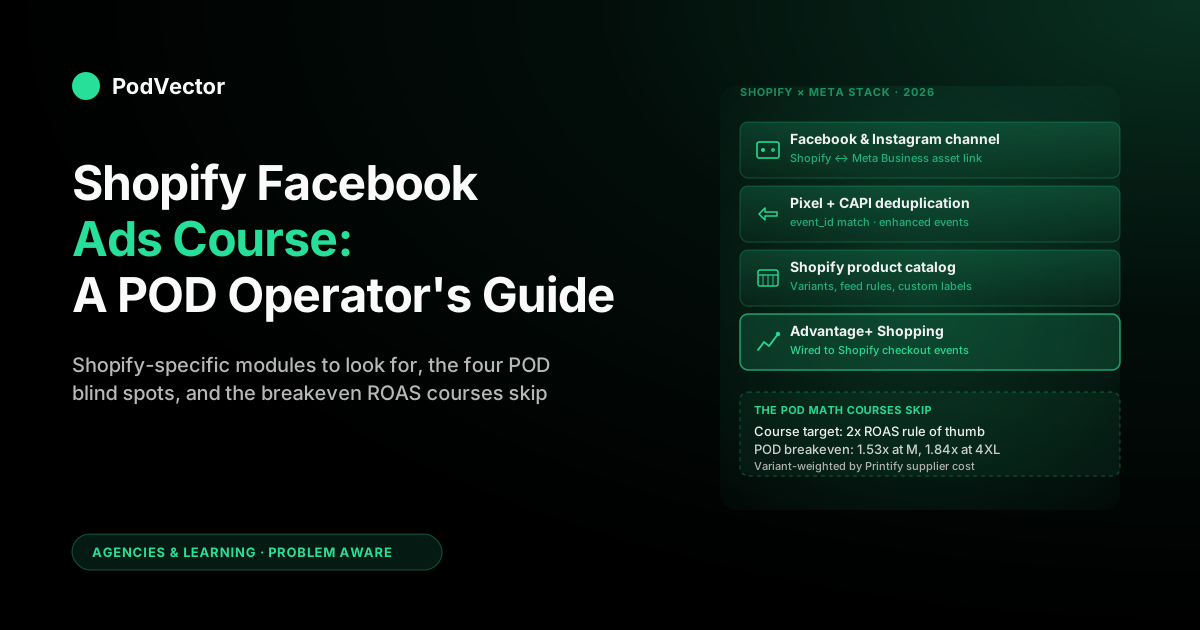
Quick Answer: A Shopify Facebook Ads course is a structured training built around the Shopify-specific Meta stack — the Facebook & Instagram sales channel, Shop Pay-aware Pixel and Conversions API tracking, Shopify product feed catalog ads, and Advantage+ Shopping campaigns wired to Shopify checkout events. Pricing in 2026 ranges from free YouTube playlists to $1,500 cohort programs, with the $400–$700 mid-tier (Foxwell Founders Hub, Common Thread Collective, Ecommerce Empire Builders) producing the best return for most Shopify operators between $5K and $50K MRR.
The catch for print-on-demand sellers is that the curriculum is built around fixed cost of goods, so the bid strategies, scaling rules, and Advantage+ structure they teach quietly stop working once Printify or Printful per-variant supplier costs hit the math. This guide covers what a Shopify-focused course actually teaches, the four POD-specific blind spots inside even the best curricula, the questions to ask before paying, and the 30/60/90-day plan for finishing one without it gathering dust in a member portal.
What a Shopify Facebook Ads course actually teaches
A Shopify-specific Facebook Ads course is paid acquisition training narrowed to the Meta stack as it integrates with Shopify. That distinction matters more than it sounds.
A generic Facebook Ads course teaches Ads Manager, Pixel basics, and audience targeting in the abstract. A Shopify Facebook Ads course assumes you already have a Shopify store and walks you through the integrations, tracking choices, and campaign structures that actually move revenue inside Shopify reporting — not just inside Meta's dashboard.
The core curriculum across reputable 2026 courses overlaps heavily. You install the Facebook & Instagram sales channel, connect a Meta Business Suite asset, configure the Pixel and Conversions API through Shopify's native integration with deduplication enabled, set up your product catalog through the Commerce Manager so that catalog ads can pull live inventory, and then layer Advantage+ Shopping campaigns on top of that infrastructure with creative and budget tested through a defined methodology. Most courses ship 25–60 video lessons across these topics, downloadable spreadsheet templates for account audits and creative testing logs, and a private community for ongoing questions.
For a Shopify operator who has never run paid social, the structured path is genuinely valuable. A motivated student moving through a $500 mid-tier course can credibly outperform a $3,000/month junior agency account manager within 60 days, because the curriculum is dense and the platform-specific moves (Conversions API, catalog setup, creative cadence) are not things you stumble into accidentally. The pitch — for a fraction of one month of agency retainer, you get a senior practitioner's playbook on demand — is mostly accurate.
The pitch fails predictably for print-on-demand operators because every well-known course was built around a brand that owns its inventory. A Shopify-native curriculum still assumes a $30 t-shirt has a $7 cost of goods that doesn't shift when a customer picks 4XL instead of medium.
POD sellers know that's not true. Printify Premium oversize charges, Printful color upgrades, and Gelato regional shipping multipliers all break the fixed-COGS assumption courses encode in their bid strategies, scaling rules, and "what's a good ROAS" benchmarks. The course is right; the recipe is wrong; the operator is the one paying the difference.
The Shopify-specific modules to look for
A genuinely Shopify-focused course covers the integration layer in depth, not as an afterthought. Generic Facebook Ads courses spend three minutes on "install the Pixel" and move on. A Shopify-specific course should spend an entire module on the integration choices that determine whether your data is clean enough to actually optimize against.
Facebook & Instagram sales channel setup
The Shopify-Meta integration runs through the Facebook & Instagram sales channel app, which connects your store to a Meta Business asset, syncs your product catalog, and enables checkout-event tracking through Shopify's data layer. A serious course covers the difference between the older standalone Facebook channel and the newer unified app, the permission model for Business assets versus pages, and the common errors operators hit during the initial connection (mismatched currency, unverified domain, missing Catalog API permissions). For Shopify Plus operators, it should cover Multipass and headless considerations.
Pixel + Conversions API through Shopify's native integration
Shopify provides a first-party integration that pushes both browser-side Pixel events and server-side Conversions API (CAPI) events from a single configuration. A good course explains why deduplication via the event_id matches between Pixel and CAPI is non-negotiable in 2026, how Shopify's checkout events map to Meta's standard event names (InitiateCheckout, AddPaymentInfo, Purchase), and what enhanced match parameters you need to pass for iOS 14+ measurement to recover. The course should also cover when you'd choose a third-party CAPI provider (Stape, Elevar) over Shopify's native integration — typically when you need GTM-style transformation logic Shopify doesn't expose.
Product catalog and dynamic feed
Shopify auto-generates the product feed for the Meta catalog, but the auto-generated feed is rarely the optimal feed. A serious Shopify course covers attribute mapping (size, color, gender, age group), feed rules for product titles that include keywords without tripping policy review, custom labels for campaign segmentation by margin tier, and the realities of variant-level catalog ads versus parent-product catalog ads. For POD stores with hundreds or thousands of design variants, this module is the difference between a catalog that scales and a catalog that ships disapprovals every Tuesday.
Advantage+ Shopping wired to Shopify checkout
Advantage+ Shopping campaigns (ASC) are Meta's primary commerce campaign type in 2026, and they expect a clean Shopify checkout signal to optimize against. A course should walk through the ASC setup screen with Shopify-specific notes (which event source to select, how Shopify's domain verification interacts with the existing-customer cap, the realities of attribution windows on a Shopify store with subscription products), the difference between ASC and the legacy Manual Sales campaigns, and the structural decision between one ASC running broad and several ASCs separated by audience signal.
Shopify-native reporting reconciliation
The discrepancy between what Meta Ads Manager reports as revenue and what Shopify reports as Meta-attributed revenue is one of the most reliable sources of operator confusion. A serious course teaches you to reconcile the two — UTM parameters Shopify will respect, Meta's modeled conversions versus Shopify's last-click attribution, the role of the Shopify Marketing report, and which number to make decisions from. Generic courses skip this and leave students arguing with their accountant about why Ads Manager says one number and the Shopify dashboard says another.
Free, mid-tier, and premium courses worth evaluating
The Shopify Facebook Ads course market in 2026 stratifies into roughly four price-and-depth bands. Each one targets a different stage of operator, and only two consistently make sense for POD-shaped Shopify stores without supplemental work.
This builds on the broader analysis in our Facebook Ads for ecommerce course guide for POD operators; the bands below are narrower because they exclude generalist Facebook Ads courses and focus only on Shopify-specific curricula. The full landscape of paid options — agencies, freelancers, courses, communities — sits in our Agencies & Learning hub.
Tier 1: Free and freemium ($0–$50)
Shopify's own Learn library, the Meta Blueprint free e-learning courses, the Shopify YouTube channel's paid acquisition playlists, and a long tail of Udemy courses in the $9.99–$49 range. The signal-to-noise ratio is uneven.
Shopify's first-party content is honest but reads like sales collateral for the Facebook & Instagram channel app. Meta Blueprint covers platform mechanics well but never mentions Shopify by name.
Udemy courses range from competent to deeply dated. For an operator who hasn't placed their first Shopify ad yet, a focused weekend in tier 1 gets you to a working Advantage+ Shopping campaign launched against your real catalog. Past that baseline, the time cost of stitching fragmented content together exceeds the price of a paid course.
Tier 2: Mid-tier paid courses ($300–$900)
The sweet spot for the vast majority of Shopify POD operators. Self-paced video curriculum from a single named instructor with five to fifteen years of Shopify-side paid-social experience, lifetime access, periodic updates as Meta and Shopify ship new features, downloadable templates, and usually a private community. Three programs surface repeatedly in 2026 operator forums:
- Foxwell Founders Hub — Andrew Foxwell's $599/year membership; weekly office hours, deep Meta-specific curriculum, strong Shopify integration coverage. Best for operators between $20K and $200K MRR.
- Common Thread Collective Ecommerce Growth — around $497 one-time; CTC runs nine-figure brands so the strategic frame is high; less hand-holding on Shopify mechanics than Foxwell.
- Ecommerce Empire Builders — $497–$997 depending on package; Shopify-heavy with strong dropshipping crossover relevant to POD.
POD operators get 80–85% of the value out of any of these and need to layer their own supplier-cost adjustments on the remaining 15%.
Tier 3: Premium / cohort-based ($1,500–$5,000)
Live cohort programs (8–12 weeks), small group masterminds, certificate programs from formal institutes, and higher-touch packages that bundle one-on-one coaching calls. Cohort programs from established Shopify-focused agencies typically land between $1,997 and $3,997.
The pitch is accountability and real-time feedback. For POD operators above $30K MRR with specific strategy questions and the cash flow to absorb the price, tier 3 occasionally makes sense. For operators below that level, the same dollars spent on a vetted freelancer's hours produce better outcomes because the freelancer can actually look inside your Shopify and Ads Manager accounts.
Tier 4: Niche or POD-operator-built courses ($200–$1,200)
The smallest band of the market and the most worth seeking out for POD readers. Courses built by operators who specifically run Shopify + Printify or Shopify + Printful stacks and teach Meta paid acquisition through that lens.
They cover variable supplier cost, design-pipeline-driven creative testing, niche audience signals, and the trademark exposure realities of POD on Meta's policy review. The best of them outperform any tier 2 generalist course per dollar.
The hard part is sourcing them; they don't always rank for the head term "Shopify Facebook Ads course" because the search volume is too small. Operator forums, seven-figure POD networks, and private Slack groups are the highest-signal path. If you've been on Shopify and Printify for a year and haven't found one yet, Foxwell + your own POD-specific layer is more reliable than a tier 4 course you can't verify.
Where Shopify courses miss for print-on-demand
Even the best Shopify-focused courses are built around brands that own their inventory and ship from one warehouse. POD breaks four assumptions inside that frame, and the breakages compound the longer you scale.
Variable supplier cost reconciliation
A $30 hoodie is not a $30 hoodie. A medium black hoodie on Printify might cost $11.42; the same SKU in a 4XL might cost $16.18; switching the supplier from Printify Choice to Printify Premium might add another $2.50 per unit; routing it through a Gelato region might trim $1.30.
Generic Shopify courses report ROAS as if the cost of goods were a single number for a SKU. POD courses don't exist at scale, so no curriculum currently teaches contribution-margin reporting that ingests the per-variant supplier cost feed and reconciles it against Meta-attributed revenue. Operators have to build that reconciliation themselves — typically in a spreadsheet that goes stale within two weeks.
Trademark and IP exposure on POD catalogs
POD stores experience disapproval and policy-review velocity that brand-owned stores never see. A $35 anime-inspired tee with even adjacent IP risk gets pulled mid-flight; the ad account picks up a violation; the Pixel learning data takes a hit.
No major Shopify Facebook Ads course in 2026 covers the prophylactic catalog hygiene that POD stores actually need — variant-level IP review queues, trademark watchlist scrapers, the playbook for a pre-emptive pause when a design starts going viral and is about to attract a takedown. The curriculum assumes your catalog is mostly safe.
Design-pipeline-driven creative rotation
Brand stores test creative the way courses teach: launch six concepts, identify winners, scale winners. POD stores live on a long tail of fast-fading designs where the "winner" might generate $400 of revenue over four days and never repeat.
Courses teach you to scale; they don't teach you to systematically prune the long tail of creative that defines a POD catalog without losing the niche-audience learning data attached to each variant. The mismatch shows up as wasted spend on the bottom 60% of designs that never warranted a Facebook Ads run in the first place.
Multi-supplier routing economics
A Shopify POD store running both Printify and Printful (or adding Gelato for EU fulfillment) has a routing decision per SKU per region that affects margin by 15–40%. No Shopify-focused Facebook Ads course teaches when to route a SKU through which supplier based on margin, fulfillment time, and ad-attributed demand.
The decision sits in a different layer of the stack — closer to operations than to acquisition — but it materially changes which products are even worth advertising. A course that ignores the routing layer leaves the operator scaling spend on SKUs that should have been re-routed first.
The POD breakeven ROAS calculation courses skip
The single most important calculation a Shopify POD operator needs to do before launching any campaign is the breakeven ROAS — the ROAS at which a campaign neither makes nor loses money once supplier costs, Shopify fees, payment processing, refunds, and shipping are subtracted. Generic Shopify courses give you a rule of thumb (something like "shoot for 2x") that misses how supplier-cost variability shifts the number on POD stores.
Concrete example. A Shopify POD store sells a $34.99 t-shirt.
Printify supplier cost averages $9.80 across the variant mix actually selling. Shipping recovered from the customer matches shipping paid to Printify (call it net zero).
Shopify Payments takes 2.9% + $0.30 per transaction, which on $34.99 is roughly $1.31. Refund and reprint rate runs 3% (typical for POD), which absorbs another $1.05 per order in expected loss. Pulling those out:
- Revenue per order: $34.99
- Less supplier cost (variant-weighted): $9.80
- Less payment processing: $1.31
- Less refund/reprint reserve: $1.05
- Contribution margin per order before ads: $22.83
The breakeven Meta ad spend per order is $22.83, which means the breakeven ROAS is $34.99 / $22.83 = 1.53. A "2x ROAS" target your Shopify course recommends doesn't actually leave you with money on this product; you need closer to 1.85 to make a meaningful contribution to overhead and pay yourself. If you scale this product into 4XL territory where supplier cost spikes to $14.40 per unit, the breakeven ROAS climbs to about 1.84 — and the same campaign that was profitable on the medium variant goes underwater on the heavier variants without the operator noticing.
For a deeper treatment of these mechanics, our guide to Meta Ads ROAS and attribution for POD walks through variant-weighted breakeven calculations, the mechanics of Meta's modeled conversions, and how to reconcile Ads Manager against Shopify reporting line by line. Working through that math before paying for a course tells you exactly which modules will be most useful — and which "rule of thumb" claims to discount.
How to decide if a course is the right next step
A course is the right next investment if three things are simultaneously true. First, you have a working Shopify store with at least one product getting non-trivial organic or referral traffic — Meta Ads amplifies an existing buyer signal more reliably than it generates one from cold.
Second, you have $300–$700 of cash flow you can lose without affecting operations, plus 25–40 hours over the next 60 days to actually move through the material. Third, you've already exhausted free content to the point where you can articulate which specific question a course should answer for you (creative testing methodology? CAPI setup? scaling without the algorithm crashing?).
A course is the wrong investment if you're hoping it will give you a customer base. The strategic frame for paid Meta acquisition before any course or agency decision lives in our Meta Ads topic hub, which connects ad-type selection, ROAS math, Shopify integration, and learning paths into one map.
If your Shopify store has zero organic traffic and no email list, the course will teach you to spend $50/day to discover what you could have learned by interviewing five customers. The same is true if your products themselves have a margin or differentiation problem — no course teaches you to fix a product nobody wants.
Finally, a course is the wrong investment if you're past the $50K MRR mark and your bottleneck is hours, not knowledge. A vetted freelancer at $90/hour solves the hours bottleneck more cleanly than a $599 membership that competes with your operations time.
If you're still on the fence, our analysis of when to hire help instead of buying a course — covered in the Meta Ads agencies and courses for POD complete guide — walks through the decision tree by stage and revenue band.
7 questions to vet a Shopify Facebook Ads course
Once you've decided a course is the right next step, the difference between a $499 course that earns its price back in 60 days and a $499 course that gathers dust comes down to a small set of evaluation questions. Apply these before swiping the card.
- Was the curriculum updated within the last six months? Meta ships material platform changes (new ASC features, attribution windows, policy updates) every quarter. A course last updated 18 months ago is teaching workflows that no longer exist. The vendor's update changelog should be visible somewhere on the sales page or in a public community.
- Does the instructor still actively run accounts? Search the instructor's name plus their current agency or client list. Operators who stopped running ads three years ago and now teach full-time tend to drift from current Meta behavior within a year.
- Are the case studies Shopify-based and recent? Generic ecommerce case studies on platforms other than Shopify (BigCommerce, WooCommerce, custom carts) are signal that the curriculum is platform-agnostic and the Shopify lens is marketing rather than substance.
- What's the refund policy? A no-refund or "after lesson 3, no refunds" policy on a $499+ course is a red flag. Reputable mid-tier courses offer 14- or 30-day refunds with a defensible "you tried it" requirement.
- Is the community active? A Slack or Circle community with a few hundred members posting daily is worth $200 of the course price by itself. A dead community where the last post was three weeks ago is a red flag about both the course and the instructor's ongoing engagement.
- Does any module address variable cost of goods? The honest answer for almost every Shopify Facebook Ads course is no, but ask anyway. The way the instructor responds tells you whether they understand POD-shaped problems exist or assume every Shopify store is brand-owned.
- Do you have a specific question the course should answer? If you can't write the question on a sticky note before purchasing, the course will fill the time but not solve a problem. "I need to fix our Conversions API setup so events deduplicate" is a question. "I need to understand Facebook Ads better" is not.
Free playbooks worth pricing against a paid course
Before paying $500 for a course, the honest comparison is against the free path. Meta Blueprint's free e-learning library covers platform mechanics at a level competitive with most paid Tier 1 courses.
Andrew Foxwell's free Twitter/X threads and YouTube appearances cover his core methodology before you ever pay for the membership. Common Thread Collective publishes case studies on their blog that teach roughly half of what their paid course covers. The Shopify Help Center documents the Facebook & Instagram channel integration in a level of detail no third-party course can match because Shopify wrote the integration.
Pulling free content together into a working sequence is the time tax of the free path. A motivated operator can do it in 30–40 hours spread over a few weeks.
The trade-off is real: you save $500 and spend 30 hours stitching versus paying $500 and saving the stitching time. For operators between $5K and $20K MRR, the time tax usually favors the paid course. For operators with deep technical chops or a strong existing analytical practice, the free path produces something more durable because the operator built the mental model rather than borrowing it.
If you want to see how the SERP's free guides hold up, the OptiMonk team's Facebook Ads for Shopify beginner's guide is one of the better free walkthroughs of the Shopify-Meta integration mechanics, and it costs nothing. Reading it before deciding whether to buy a course is worth the hour.
A 30/60/90-day plan for finishing a course
The post-purchase failure mode is universal: the operator pays $500, watches three modules, gets pulled into a busy week, and never returns. The course costs nothing to skip and everything to finish. A pre-committed plan defends against the failure mode.
Days 1–30: Foundations and the first campaign
Block 4–6 hours per week. Move through the foundational modules — account setup, Pixel/CAPI configuration, catalog setup, first ASC campaign — in sequence without skipping.
By day 30, you should have one Advantage+ Shopping campaign running against your live Shopify catalog with deduplicated event data flowing to Meta and a creative testing log started in the course's template. The success metric is not revenue at this stage; it's clean data flowing to a campaign that the algorithm can actually optimize against.
Days 31–60: Iteration and the POD layer
Block 3–4 hours per week. Move through creative testing, audience strategy, and bidding modules.
Crucially, layer your own supplier-cost reconciliation work on top — pull the Printify or Printful supplier-cost feed weekly, calculate the variant-weighted breakeven ROAS for the products you're advertising, and adjust the campaign targets the course recommends to reflect the POD math. By day 60, you should have completed at least three creative test cycles and have a working dashboard (spreadsheet is fine) that shows Meta-attributed revenue net of supplier cost, payment fees, and refund reserve.
Days 61–90: Scale and reconciliation
Block 2–3 hours per week. Move through scaling, attribution, and reporting modules.
This is the phase where the course's "raise budget by 20% per week" rule meets your variant-weighted breakeven ROAS and you discover which products can actually absorb scale and which ones need to be re-routed to a cheaper supplier or pulled. By day 90, you should have a documented decision-making rhythm — weekly creative review, weekly reconciliation against Shopify, monthly P&L close — that doesn't require you to remember everything in your head.
The 30/60/90 plan works because it forces the POD-specific layer in at day 31 instead of day 90. Operators who skip that step finish a course with strong Shopify mechanics and the same supplier-cost blind spot they started with.
FAQs
Is a Shopify Facebook Ads course worth it for a POD operator?
For most operators between $5K and $50K MRR, yes — a $400–$700 mid-tier course returns its cost within 60–90 days if you actually finish it and layer the POD-specific math (variant-weighted breakeven ROAS, multi-supplier routing) on top. Below $5K MRR, free content plus a focused playbook usually beats the course because the bottleneck is product-market fit, not paid-acquisition skill. Above $50K MRR, a vetted freelancer at $90/hour usually beats the course because the bottleneck is hours, not knowledge.
What's the best Shopify Facebook Ads course in 2026?
Foxwell Founders Hub at $599/year is the most consistently recommended membership for Shopify operators in the $20K–$200K MRR range. Common Thread Collective's Ecommerce Growth course around $497 is the best one-time-purchase option. Neither one is built for POD specifically, but both teach the Shopify-native mechanics well enough that the supplier-cost layer can be added on top by the operator.
Can I learn Shopify Facebook Ads for free?
Yes. Meta Blueprint's free e-learning, Shopify's Help Center documentation, and the YouTube libraries of operators like Andrew Foxwell and Common Thread Collective cover roughly 70% of what a paid Tier 2 course covers.
The trade-off is the 30–40 hours of stitching required to assemble fragmented content into a working sequence. Operators with strong analytical chops often prefer the free path; operators between $5K and $20K MRR usually prefer the time savings of a paid course.
How long does it take to finish a Shopify Facebook Ads course?
A well-structured Tier 2 course (25–60 video lessons) takes 25–40 hours to move through deliberately. With the POD-specific reconciliation layer added on top, plan 60 hours over 90 days to fully internalize the material and have a working campaign with reconciled reporting. Operators who try to binge a course in a weekend retain almost none of it.
Should I take a course or hire a Facebook Ads agency for my Shopify store?
Below $30K MRR, the course almost always wins. Agency retainers start around $2,500/month, and the course pays for itself many times over at a fraction of one month's retainer.
Above $50K MRR, the math flips — your hours become the constraint, and a vetted agency or freelancer is worth the spend. The middle band ($30K–$50K MRR) is the legitimate gray zone; our comparison of the best Facebook Ads agencies for ecommerce walks through the agency-side decision in detail.
Do Shopify Facebook Ads courses cover Conversions API?
Reputable 2026 courses cover CAPI setup through Shopify's native integration, including event deduplication via event_id matching, enhanced parameters for iOS 14+ measurement recovery, and verification through Meta's Test Events tool. Courses last updated more than a year ago may still be teaching browser-only Pixel setups, which materially under-report on iOS traffic. Verify the update date before purchasing.
What's the difference between a generic Facebook Ads course and a Shopify-specific one?
Generic Facebook Ads courses teach Ads Manager mechanics, audience targeting, and creative testing in the abstract. Shopify-specific courses additionally cover the Facebook & Instagram sales channel app, Shopify-Meta integration choices for Pixel/CAPI, the Shopify-generated product feed and how to optimize it for catalog ads, Advantage+ Shopping campaigns wired to Shopify checkout events, and the reconciliation between Ads Manager reporting and Shopify reporting. For a Shopify operator, the integration depth in a Shopify-specific course is worth more than the generic platform mechanics.
Will the course teach me POD-specific tactics?
Almost certainly not. No major Shopify Facebook Ads course in 2026 was built around print-on-demand.
You'll get the platform mechanics for free, but the variable supplier cost reconciliation, trademark exposure handling, design-pipeline creative rotation, and multi-supplier routing decisions are layers you'll need to build yourself or pull from POD-specific resources. Our complete Meta Ads playbook for print-on-demand sellers covers the POD layer that courses skip.
Skip the supplier-cost spreadsheet
Every Shopify Facebook Ads course leaves you to build your own variant-weighted breakeven ROAS reconciliation against Printify or Printful supplier costs. Victor reads your a live data feed of Meta spend, Shopify orders, and per-variant supplier cost and answers the question your course doesn't — which products can actually absorb more spend right now, and which ones need to be re-routed or paused. And ask the questions a $599 course leaves on your plate.
Try Victor free