
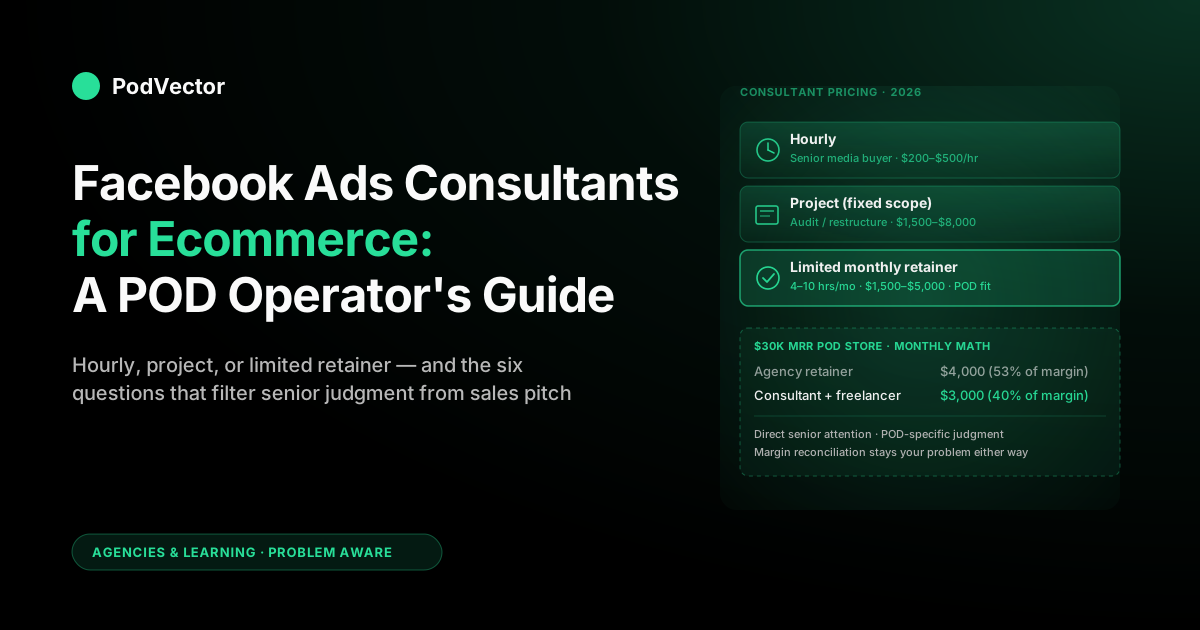
Quick Answer: A Facebook ads consultant for ecommerce is a single senior practitioner you hire for hourly advice ($200–$500/hour), a fixed-scope audit ($1,500–$3,500), or a part-time monthly engagement ($1,500–$5,000) — without the team, retainer, or creative production a full agency bundles. For most print-on-demand operators between $10K and $50K MRR, a consultant is the right answer when an agency is premature: they cost a third of an agency retainer, give you direct senior attention, and don't push you into Advantage+ Shopping configurations that quietly destroy POD margins.
The trade-off is that a consultant doesn't ship creative, doesn't run the account day-to-day, and doesn't reconcile Pixel-reported ROAS against your Printify or Printful supplier costs — that gap is yours to close. This guide covers what consultants actually do, the realistic 2026 cost ranges, the POD-specific filters that separate the senior buyer who's run hoodies-on-Shopify from the generalist who'll waste your retainer, and the engagement structures that work for small POD stores.
What a Facebook ads consultant for ecommerce actually does
A Facebook ads consultant is a single senior media buyer you hire for thinking, not for execution. The consultant audits your existing Meta account, identifies the structural problems in campaigns, audiences, creative, or measurement, builds a 30-to-90-day plan you (or someone you pay separately) will execute, and stays on retainer or available hourly to review the work as it ships.
The consultant does not click around in Ads Manager every day. They do not produce static creative or short-form video.
They do not maintain Conversions API once it's wired up. They do not respond to Meta disapprovals at 11pm on a Saturday. What you're paying for is calibrated judgment — the difference between a structurally healthy account and one that looks fine on the dashboard but compounds bad decisions for six months.
The model sits between two cheaper options and one more expensive one. Below the consultant is the freelancer ($1,000–$3,000/month) — usually a mid-level media buyer running the account day-to-day, less senior, more hands-on.
Above the consultant is the agency ($4,000–$15,000+/month) — a team running execution, creative, and analytics across multiple practitioners. Adjacent to the consultant is the course ($297–$1,500 one-time) — a structured learning product where you become your own buyer. A consultant is what you hire when you've outgrown self-education but the account isn't large enough to absorb agency overhead, or when you have an agency and want a senior outside perspective on whether they're delivering.
For ecommerce specifically — and especially for print-on-demand stores running Shopify with Printify or Printful in the supply chain — the consultant role compresses to one job: telling you, with brutal honesty, whether the way your Meta account is currently configured can produce profit at your unit economics. That answer is rarely flattering, and it's rarely available from anyone billing you a retainer to keep the account running.
Consultant vs. agency vs. freelancer: the real differences
The three roles are routinely conflated in vendor marketing. They are not interchangeable.
Consultant
One senior person, usually 8–15 years in paid social, frequently a former agency lead or in-house growth director who went independent. Bills hourly ($200–$500), by project ($1,500–$5,000 fixed scope), or by limited monthly retainer ($1,500–$4,000 for a few hours weekly).
Deliverables are documents, decks, audits, and live calls — not ad accounts they manage end-to-end. Tenure with you tends to be 30 days to 6 months, then either upgrades to ongoing advisory or ends cleanly with a handoff. Best for diagnostics, structural redesign, and second opinions.
Freelancer
One mid-to-senior practitioner who runs the account day-to-day, usually 3–8 years of experience, billing $1,000–$3,000/month for ongoing management. Will be inside Ads Manager weekly, will tweak audiences and creative test cadence, may produce light creative iterations from existing assets.
Will not ship net-new UGC video, will not handle CAPI engineering, will not meaningfully challenge your strategy from week to week — they execute the strategy you (or a consultant) have set. Best when you have a clear plan and need someone to run it.
Agency
A team of 3–50+ people splitting media buying, account management, creative production, and analytics across roles. Bills $2,000–$15,000+/month on retainer with project fees layered on top for CAPI, catalog work, or net-new video.
Will run the account, ship creative, handle Meta support, and produce reporting. The trade-off is that the senior strategist visible in the sales call is rarely the day-to-day executor — your account is one of fifteen in a junior buyer's book — and the retainer math doesn't pencil out below roughly $30K MRR for POD operators. Our deep dive on Facebook ads agencies for ecommerce walks through the four agency tiers and where POD fits in each.
The question is not "consultant or agency" in the abstract. It's "which role solves the problem I actually have right now," and for most POD operators in the early-to-mid scaling phase, the answer is "consultant for diagnostics, freelancer for execution, agency only when both retainer math and creative cadence demand it."
What consultants charge in 2026 (hourly, project, monthly)
Three pricing structures dominate the consultant market for ecommerce Meta work, and the choice of structure matters as much as the rate.
Hourly: $200–$500
The most flexible structure and the one that aligns incentives best for small operators. You pay only for the time you use, you get senior attention on demand, and you can scale up or down quarter to quarter.
Realistic 2026 rates: $200–$300/hour for solid mid-senior practitioners with 5–8 years of paid social experience, $300–$450/hour for senior consultants with named-brand portfolio cases, and $450–$650/hour for the small set of practitioners with public reputation, books, or a recognized agency exit. For a POD operator wanting structural review, three to six hours a month at $300/hour ($900–$1,800) frequently produces more useful output than a $4,000/month agency retainer's first ninety days.
Project (fixed scope): $1,500–$8,000
Common project deliverables and 2026 fee ranges: a Meta account audit ($1,500–$3,500), a 90-day testing roadmap ($2,500–$5,000), a full account restructure with documentation ($4,000–$8,000), a Conversions API and server-side tracking implementation review ($2,000–$5,000), or an attribution model evaluation against your supplier-cost reality ($3,500–$7,500). Project pricing is best when the deliverable is well-defined, the scope is bounded, and you don't need ongoing access — pay once, get the deliverable, execute it yourself or hand to a freelancer.
Monthly retainer (limited hours): $1,500–$5,000
A consultant on a small retainer is essentially "agency-quality strategic input without agency overhead." Typical scope: 4–10 hours per month of senior attention, biweekly or weekly office hours, a monthly strategy review, and Slack or email access between sessions. The senior practitioner is not running your account — your in-house buyer or freelancer is — but they're reviewing decisions, sanity-checking testing plans, and pushing back on choices that look good on Meta's dashboard but compress contribution margin. For POD operators between $30K and $80K MRR who are not yet ready for an agency but have outgrown self-management, this is the highest-ROI structure on the market.
The rates above apply to ecommerce-fluent generalists. Consultants with explicit POD experience — Printify, Printful, Shopify catalog work, and supplier-cost reconciliation — typically charge a 20–40% premium and are worth it. The consultant who has lived through the iOS 14 attribution gap on a 200-SKU Printify catalog will save you that premium back in the first month.
Three engagement models that work for POD
Different POD scaling stages benefit from different consultant engagement structures. The three that consistently produce ROI:
Model 1: One-time diagnostic audit ($2,000–$3,500)
Best for: POD stores at $5K–$25K MRR running Meta themselves and sensing the account is "off" but not knowing why. The consultant spends 6–10 hours reviewing the account, your tracking setup, your creative library, your unit economics, and your reporting.
Output: a written audit (10–25 pages) with prioritized findings, plus a 90-minute review call. You execute the recommendations yourself or hand them to a freelancer.
No ongoing relationship. The audit pays for itself if even one major finding (broken event, mis-structured campaign, misaligned audience) is fixed.
Model 2: Quarterly strategic check-in ($1,500–$2,500/quarter)
Best for: POD stores at $25K–$60K MRR with a freelancer running daily execution and an operator who wants senior strategy input without paying for it weekly. Structure: one 90-minute session at the start of each quarter to set priorities, one 60-minute mid-quarter review, one written end-of-quarter summary with next-quarter recommendations, plus async question access (Slack or email, capped). The consultant is not in the account daily — they're the strategic counterweight to the freelancer's tactical view, plus an ongoing relationship that compounds across quarters.
Model 3: Limited monthly retainer ($2,500–$4,000/month)
Best for: POD stores at $50K–$120K MRR not yet ready for an agency but running enough volume that monthly senior attention pays back. Structure: weekly 30-minute calls, written weekly note on what to test next, asynchronous review of any major decision before it ships, monthly account snapshot.
The consultant operates as a fractional head-of-paid-acquisition while you execute through a freelancer or in-house buyer. Crosses the agency-retainer breakeven only above $80K MRR with disciplined execution underneath.
The shape of these models is intentionally lighter-weight than agency engagements. A consultant running a small monthly retainer is high-leverage at the strategy layer and intentionally absent from execution, which is what makes the math work for POD.
Why a consultant often beats an agency for POD operators
This is the part of the consultant-vs-agency conversation that nobody else covering this query writes honestly, and it's the single most important section for a POD reader.
The retainer math doesn't lie
A POD store doing $30K MRR at a 25% gross margin has $7,500 in monthly contribution to cover all operating costs — agency retainer, creative production, software, taxes, and the operator's own time. A $4,000/month Meta agency retainer alone is 53% of monthly contribution.
A consultant at 6 hours/month at $300/hour is $1,800 — 24% of contribution, with the same senior-thinking input, and the operator (or a $1,500/month freelancer) handles execution. The total cost of "consultant + freelancer + UGC creator on per-asset fee" frequently lands at $3,000–$3,500 a month — 30% cheaper than an agency, with substantially more direct senior attention. We break the retainer math down with concrete examples in our complete Meta ads agencies and courses guide for POD.
Consultants don't push you into Advantage+ Shopping by default
Most generalist ecommerce agencies migrate new clients to Advantage+ Shopping Campaigns (ASC) within the first 30 days because it's the path of least friction and reports well on the platform. For POD operators with variable per-SKU supplier costs, ASC routinely pushes spend toward the highest-revenue SKUs, which are systematically the worst-margin ones — oversized hoodies at $26+ supplier cost, all-over-print sublimation at $22+.
A senior consultant whose pay isn't tied to keeping a retainer alive is far more willing to recommend a margin-aware manual structure that an agency would resist because it's harder to scale across multiple clients. Consultants give you the right answer; agencies give you the scalable answer.
Consultants will say "no" more often
An agency on a 12-month retainer has a structural incentive to find work to bill against. A consultant on an hourly engagement has the opposite incentive — finishing fast preserves the relationship for the next project.
That asymmetry shows up in recommendations: consultants are far more likely to tell you that your creative isn't the problem and you should fix your unit economics first, that you should pause Meta entirely for 30 days while you fix your supplier mix, or that hiring them for ongoing work would be a waste of your money. Agencies almost never say any of those three things.
The supplier-cost reconciliation gap stays your problem either way
Neither consultants nor agencies typically reconcile Pixel-reported ROAS against your actual Printify or Printful per-order supplier cost. The difference is that a consultant will name the gap in their first audit and recommend a tooling or reporting fix, while an agency will quietly optimize against the wrong baseline. We cover the full reconciliation problem in the complete guide to Meta ads ROAS and attribution for POD.
When hiring a Facebook ads consultant makes sense
Five concrete triggers, in order of clarity. Any one of them is sufficient to justify a consultant engagement; none of them require an ongoing relationship.
- Your Pixel-reported ROAS looks fine but your bank account doesn't. The single most common reason POD operators hire a consultant. The audit usually surfaces a measurement gap (broken CAPI events, supplier cost not netted, refunds not modeled), an attribution gap (iOS conversion modeling overstating), or a structural campaign gap (ASC pushing spend at thin-margin SKUs). All three are diagnosable in a 6–10 hour audit.
- You're spending $5K+/month on Meta and you can't articulate the testing plan. If your last four creative tests don't have a documented hypothesis or a defined success threshold, you're spending budget on hope. A consultant can build the testing plan in a single project engagement and hand it off for execution.
- You're considering an agency and want a second opinion before signing. The single highest-ROI consultant engagement: pay $1,500–$2,500 for a consultant to audit the agency's proposal, sit on a sales call with you, and pressure-test the SOW. Consultants who've worked agency-side spot retainer-padding language fast.
- You've inherited a Meta account from a prior agency or freelancer and the account history is opaque. A 6–10 hour audit converts the inherited mess into a documented map of what's working, what's residual, and what to dismantle. Worth the project fee for clarity alone.
- You're scaling past $50K MRR and your unit economics are tightening, not loosening. Margin compression at scale means the optimization choices that worked at $20K MRR are no longer the right choices. A senior consultant can walk you through which campaign structures, audience definitions, and creative themes scale into thinner-margin territory and which don't.
And two situations where a consultant is the wrong call: when you don't yet have $5K/month of consistent Meta spend (the optimization surface is too small to justify senior attention — finish a structured ecommerce-focused course first, see our Facebook ads for ecommerce course guide), and when your product-market fit is still unproven (the consultant will optimize against numbers that won't reflect tomorrow's product mix).
The 6-question POD-specific consultant vetting framework
The vetting questions for a consultant differ from the agency vetting framework — you're hiring one person's judgment, not a team's process. The six questions below separate the senior buyer who can serve a POD operator from the generalist whose advice would cost you contribution margin.
- "Have you personally run a Shopify-Printify or Shopify-Printful account, and what did you learn about supplier-cost reconciliation that you wouldn't have learned on a fixed-COGS DTC brand?" POD-fluent consultants have a specific answer here — usually a story about a campaign that looked great in Ads Manager and was actually losing money once supplier costs were netted. Consultants without POD experience either deflect or generalize.
- "What's the first signal in a Meta account that tells you the unit economics underneath aren't healthy enough to scale?" The right answers are concrete and operator-tested: rising CPC paired with falling AOV, frequency creep without contribution margin response, ASC spend concentrating in SKUs with documented thin margins. Vague answers about "audience saturation" without a measurement framework signal a consultant who pattern-matches DTC playbooks.
- "How would you structure my first 30 days if my Meta account looks healthy on the dashboard but my P&L doesn't?" POD-aware answers start with measurement and tracking validation, not with creative or audience changes. The consultant who reaches for creative ideas in the first 30 days hasn't internalized that POD's defining problem is reporting truth, not media buying skill.
- "Will you put the deliverables and timeline of this engagement in writing, scoped to specific outputs rather than hours?" Senior consultants are comfortable scoping by deliverable; consultants billing on hourly time without a scope hedge their accountability. "I'll work for 10 hours and we'll see what we find" is a yellow flag at the senior tier — it's a signal of either inexperience or a willingness to pad.
- "What's the engagement structure you'd recommend for someone in my exact spend range, and why?" The right answer for a $15K MRR POD operator is "a one-time audit for $2,500, then revisit in six months" — not "a $3,500/month retainer." A consultant who recommends the heaviest engagement for every prospect is selling, not consulting.
- "What's the last engagement you walked away from, and what did you tell the prospective client?" Senior consultants have walked away from prospects whose unit economics weren't fixable through paid social. The willingness to share the example is a signal of integrity. Consultants who claim they've never turned a prospect down are either junior or overstating.
If a consultant scores well on at least four of these six, the engagement is worth the project fee. Anyone scoring below four is a generalist; the rate may be fair, but the POD-specific value isn't there. For comparison-shopping the broader consultant landscape, the HawkSEM roundup of seven Facebook ads consultants lays out the generalist ecommerce consultant market well — useful as a baseline of who's available, less useful as a POD-fit filter.
Where to actually find ecommerce-fluent consultants
The high-signal sources, ranked roughly by quality of leads:
- POD operator communities and Discord servers. Stores in the $50K+ MRR range have hired and fired enough consultants to know who's actually delivered. Direct operator referrals are the highest-signal source available, full stop. Look for communities organized around Printify or Printful specifically rather than generic ecommerce.
- LinkedIn search with specific filters. Search "Facebook ads consultant" plus "Shopify" or "Printify" and filter for 10+ years of experience and "Open to work" or "Available for projects." You'll surface a smaller, more senior pool than generic ecommerce searches.
- Twitter/X performance marketing community. A meaningful portion of the senior independent paid-social practitioners are active on Twitter. The signal is who they reply to, who quotes their case studies, and who they share war stories with — not their follower count.
- Former agency leads who went independent. Strong filter: search agency case studies for the senior strategist named on a successful POD or apparel ecommerce account, then check if they've left for independent work. This is how a meaningful share of the best consultants are sourced.
- Specialist consultant marketplaces. Platforms like Credo, GrowthCollective, or MayPlePro vet consultants and surface a curated subset. Useful as a starting filter; the platforms take a margin so rates run 10–25% higher than direct hire.
- Operator referrals from your existing tooling vendors. Higher-tier ecommerce tooling (analytics, attribution, CAPI infrastructure) often have informal lists of consultants their customers have hired and stayed with. Worth asking your vendor success team.
The two sources to discount: cold inbound from consultants pitching you (the senior practitioners are referral-driven, not outbound), and Fiverr or Upwork at the low end (the sub-$100/hour tier is rarely senior enough to deliver POD-specific value, regardless of profile claims).
What to prepare before the first call
Consultants charge for time. Walking into the discovery call with the materials below converts the first hour into substantive work rather than information-gathering.
- The last 90 days of Meta account performance. Spend, ROAS as Meta reports it, conversion volume, frequency by campaign, AOV, broken out by campaign type if possible.
- Your true contribution margin per order. Revenue per order minus supplier cost (Printify or Printful), shipping, processing fees, and any platform fees. Even an approximate number ($X.XX per order across the catalog) lets the consultant pressure-test against reality from minute one.
- Your top 10 SKUs by units sold and by revenue. The mix matters. A consultant looking at your top 10 by units versus top 10 by revenue can immediately spot whether ASC is pushing spend toward the worst-margin half of your catalog.
- Your Conversions API status. Is server-side tracking live? Are events deduplicating with the Pixel? Is Advanced Matching configured? Yes/no/unsure — even "unsure" is useful information.
- Your stated goal for the next 90 days. Hold MRR while improving margin, scale to $50K MRR, recover from a Meta account restriction, prep for Q4 — different goals require different recommendations. Know which yours is before the call.
- Your competing options. If you're also evaluating an agency, a freelancer, or a course, say so. Senior consultants will tell you when one of those is a better fit for your stage; that honesty is the signal you want.
Red flags and green flags during the engagement
The first 30 days of a consultant engagement reliably surface fit. The patterns that predict outcomes:
Red flags
- Recommendations that mirror agency playbooks without POD adjustments. "Migrate to Advantage+ Shopping, consolidate audiences under Advantage+ Audiences, ship 8 creative iterations a month" is a generic ecommerce playbook. Without margin-aware filtering, it's the wrong playbook for POD.
- No questions about supplier cost during discovery. Disqualifying. If the consultant doesn't ask, they don't know POD.
- Heavy upsell into ongoing retainer at the end of the audit. Senior consultants have honest opinions about whether ongoing work is justified. Consultants who turn every audit into a retainer pitch are revenue-driven, not value-driven.
- Deliverables that read like agency case study templates. The audit should be specific to your account: your campaign names, your SKU mix, your conversion event configuration. Generic frameworks dressed up with your numbers are low-effort outputs.
- Pressure to delay starting the audit until after a "discovery" call costing $500+. Discovery calls should be free at the consultant tier. Paid discovery is a sales structure, not a value structure.
Green flags
- The first audit deliverable surfaces something you genuinely didn't know. A broken event, a mis-categorized SKU, an attribution model assumption that's drifted, an audience overlap eating budget. The consultant earning the fee shows you something specific about your account.
- Recommendations include things you should stop doing, not just start doing. Pause this campaign, defund this audience, kill this creative theme. Consultants who only add work are pattern-matchers; the ones who subtract are operators.
- Honesty about the limits of paid social as a lever. "Your unit economics need a supplier negotiation before any of this matters" is a sentence senior consultants will say. Junior or sales-driven consultants won't.
- Concrete handoff plan if you're not retaining ongoing. A senior consultant scoping a one-time audit should hand you a written summary, a 90-day plan in document form, and a recommendation on whether you need a freelancer or can execute it yourself. Clean exits are a quality signal.
- Push-back on at least one of your assumptions. If the consultant agrees with everything in the first call, they're being agreeable rather than useful. The best engagements include "I disagree with your read on what's happening here" in the first hour.
For comparing the named ecommerce Meta agencies that compete in this space, see our comparison of the best Facebook ads agencies for ecommerce. For the broader landscape of agency, consultant, freelancer, and course options, the Meta ads agencies and learning hub covers them all, and the broader topic context is in the Meta ads for POD topic hub.
FAQs
How much does a Facebook ads consultant cost in 2026?
Realistic 2026 ranges: hourly $200–$500 (with $300–$450 the typical mid-senior rate), project-based $1,500–$8,000 (audit at the low end, full restructure at the high end), and limited monthly retainer $1,500–$5,000 for 4–10 hours of senior attention per month. Consultants with explicit POD experience charge a 20–40% premium over generalist ecommerce consultants and are usually worth the difference for Printify or Printful catalogs.
Is a Facebook ads consultant worth it for a POD store doing under $30K MRR?
Often yes, in the project format — a $2,000–$3,500 one-time audit at $20K MRR pays back faster than a $4,000/month agency retainer at the same MRR, because the audit identifies fixable structural problems (measurement gaps, mis-configured ASC, attribution drift) that compound across every future month. Ongoing consultant retainers below $30K MRR are usually overkill; one-time audits and quarterly check-ins are the right cadence.
What's the difference between a Facebook ads consultant and a Facebook ads agency?
A consultant is a single senior practitioner you hire for thinking — audits, strategy, second opinions — billing hourly or by project at $200–$500/hour or $1,500–$8,000 per engagement. An agency is a team of 3–50+ people running daily execution, creative production, and account management for a $2,000–$15,000+/month retainer.
Consultants give you direct senior attention with no creative throughput; agencies give you team-based execution with creative production but indirect senior attention. For most POD operators below $50K MRR, a consultant plus a freelancer plus a UGC creator on per-asset fees outperforms an agency on cost and on POD-specific judgment.
How do I know if a Facebook ads consultant understands print-on-demand?
Three tests. First, ask them to describe a campaign that looked good on the Meta dashboard and was actually losing money — POD-fluent consultants have a specific story about supplier cost compressing reported ROAS. Second, ask how they'd structure ASC for a 200-SKU catalog with 15 design niches; the right answer segments the feed by margin tier, the wrong answer is "one ASC campaign with everything." Third, ask whether they'd recommend the engagement structure they typically sell for someone at your stage; if they recommend the heaviest option for every prospect, they're selling, not consulting.
Should I pay a Facebook ads consultant hourly or by project?
For a single deliverable with a clear scope (audit, restructure, CAPI review), pay by project — the fixed scope aligns incentives toward finishing well rather than billing more hours. For ongoing strategic input where the work scope changes month to month, pay by limited monthly retainer (4–10 hours). Pure hourly is best for ad-hoc questions and second opinions where the volume of work is genuinely unpredictable.
How long does a typical Facebook ads consulting engagement last?
Project engagements run 2–6 weeks from kickoff to final deliverable. Quarterly check-in engagements last as long as the operator wants the strategic input, usually 2–4 quarters before either evolving into a heavier retainer or concluding cleanly. Monthly retainer engagements at the consultant tier rarely run past 12 months — at that point either the operator has internalized the strategic thinking and the consultant role is done, or the volume of work has grown enough that an agency is the right next step.
Can a Facebook ads consultant replace an agency for a growing POD store?
Up to a point — usually around $80K MRR with disciplined daily execution underneath. Below that threshold, a senior consultant on a small retainer plus a freelancer on daily execution plus a UGC creator on per-asset fees outperforms an agency on cost, on direct senior attention, and on POD-specific judgment. Above that threshold, the creative throughput an agency provides starts compounding faster than a consultant-plus-freelancer combination can match, and the retainer math finally pencils out.
What should I expect from a Facebook ads consultant audit?
A documented review (10–25 pages typical) covering: account structure and campaign hierarchy, audience configuration and overlap, creative library health and fatigue patterns, conversion event setup and Conversions API status, attribution model assumptions, and reconciliation against your unit economics. The deliverable should include prioritized findings (rank-ordered by expected revenue impact) and a 30-to-90-day execution roadmap.
Plus a 60-to-90-minute review call to walk through findings live. Audits that don't include all six areas above are scoped too thin to be worth $2,000+.
What's the role of AI tooling in 2026 consultant engagements?
Senior consultants now lean on AI-assisted analytics tooling to compress what used to be days of manual data reconciliation into hours — particularly for the supplier-cost-against-Pixel-revenue reconciliation that defines whether a POD account is actually profitable. The honest framing: AI tooling lets a single consultant deliver in 6 hours what an agency analyst delivered in a week three years ago.
The consultant's value is now disproportionately in interpretation and judgment rather than data assembly. Operators who can run their own reconciliation through analytics tooling get more leverage from each consultant hour, because the consultant can spend the engagement on the strategic layer rather than the plumbing.
Bring your real numbers to every consultant call
The single biggest difference between a consultant engagement that pays for itself and one that doesn't is whether you walk in with your true contribution margin in hand — not Pixel-reported ROAS, but revenue net of Printify or Printful supplier cost, shipping, fees, and refunds. Most POD operators don't have that number on demand, which means the first three hours of every consultant engagement are spent assembling it. PodVector AI's AI agent, Victor, runs live data warehouse across your Shopify, Printify, Printful, and Meta Ads data and answers questions like "what was my true ROAS by campaign last month after every cost" in plain English — the kind of reconciled view that makes consultant time count from minute one. And walk into your next consultant call with the numbers that actually matter.
Try Victor free