
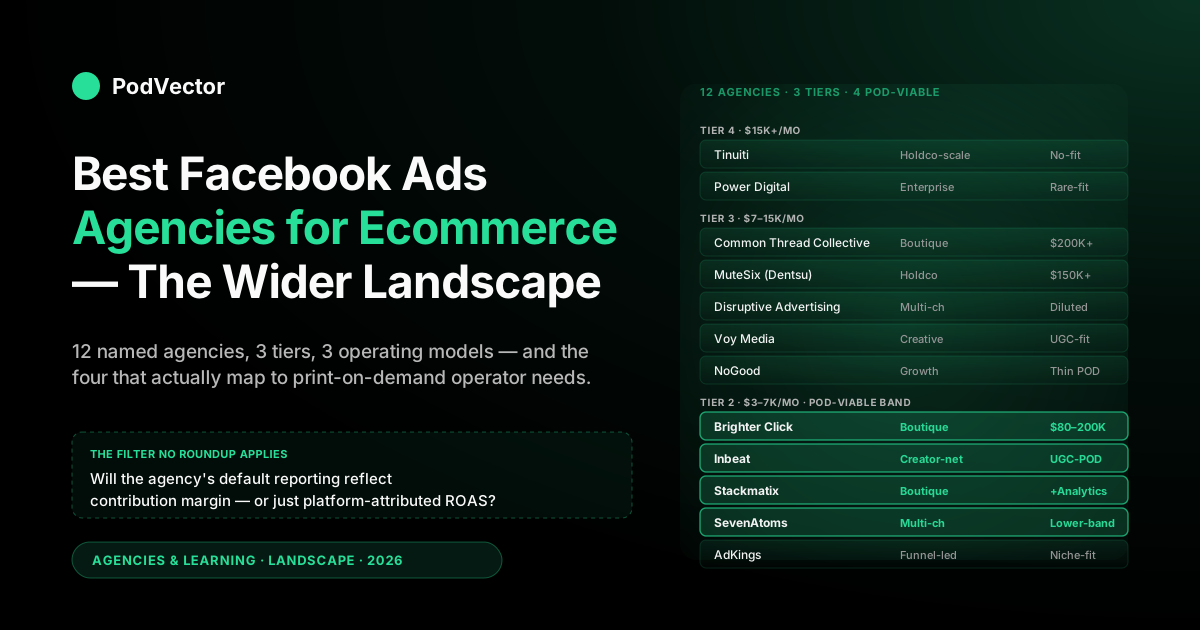
Quick Answer: The 2026 list of "best Facebook ads agencies for ecommerce" is bigger than the four or five names that get repeated in every roundup. Across the major shortlists you'll see twelve agencies surface again and again — Tinuiti, Power Digital, Common Thread Collective, MuteSix, Disruptive Advertising, Voy Media, NoGood, Brighter Click, Inbeat, Stackmatix, SevenAtoms, and AdKings — split across three tiers and three operating models (holdco, boutique-strategist, creative-shop).
For DTC brands with stable cost-of-goods, picking inside that list is mostly a question of budget and chemistry. For print-on-demand operators with variable Printify or Printful supplier costs, only four of the twelve are realistically a fit — and even those four require a contractual reconciliation clause that turns Pixel-reported ROAS into actual per-order contribution margin. This comparison maps the wider landscape: every agency mapped, the four POD-viable ones flagged, and a decision framework for the most common case (the agency that beats every option on this list is the one you don't hire).
2026 shift to know: according to AI Advantage Agency's 2026 guide, Advantage+ Shopping Campaigns are now the default ecommerce campaign type on Meta, and agencies still defaulting to manual structures without testing ASC are behind the curve. Ask any agency on this list how they use ASC before you sign.
Why this list is wider than the typical "top 5"
Most ecommerce-Facebook-ads roundups in 2026 — including the well-circulated Mayple "10 Best eCommerce Facebook Ads Agencies" list and the longer Stackmatix "15 Best Facebook Ads Agencies" compilation — surface roughly the same names but in different order and with very different framing. Some emphasize creative production, some emphasize attribution maturity, some emphasize roster prestige. None of them filter for the question that actually matters to a print-on-demand operator: does this agency understand variable supplier cost, and does its default reporting reflect contribution margin or platform-attributed ROAS?
This comparison takes the union of the agencies that appear most consistently across the major 2026 shortlists, holds each one against a uniform set of POD-aware criteria, and produces a single landscape view. It's intentionally wider than our companion opinionated 8-agency shortlist — that piece picks winners; this piece maps the field.
If you already know your budget band and want a recommended pick, start with the shortlist. If you're earlier in the buying cycle and want to see every name you'll keep encountering, this is the article.
How we filtered the long list down to twelve
There are easily 40+ agencies that claim Facebook-ads-for-ecommerce as a service line in 2026. To compare them meaningfully we filtered to twelve using four criteria, and we've left the cuts visible so you can disagree if your situation differs.
- Surfaces in at least three of the major 2026 roundups. An agency that only appears on its own website and one paid listicle isn't a serious candidate for an external buyer.
- Has at least one named ecommerce case study you can verify. "Trusted by 200+ brands" without naming any of them gets cut.
- Discloses pricing, retainer band, or minimum-spend threshold. Agencies that hide pricing entirely until a sales call self-select out — for a comparison article they're not comparable.
- Operates in English-language markets and accepts US/CA/UK/AU clients. The intent of "best Facebook ads agencies for ecommerce" is overwhelmingly North America-led, so we filtered to that geography.
That leaves twelve agencies, which we then mapped to three tiers (Tier 2: lower-mid retainer, Tier 3: mid retainer, Tier 4: enterprise retainer) and three operating models (holdco-owned, independent boutique, creative-led shop). The mix is intentional: it reflects the real distribution of agency types you'll encounter in a procurement cycle, not just the names that pay for the highest placement on listicle sites.
What's changed in 2026: three shifts reshaping agency performance
The Facebook ads landscape for ecommerce has shifted materially since 2024. According to AI Advantage Agency's 2026 ecommerce guide, three changes are now reshaping how the best agencies run campaigns on Meta — and any agency you're evaluating should have a clear answer on all three.
- Advantage+ Shopping Campaigns (ASC) are the new default. Meta's AI-driven ASC consistently outperforms manual campaign structures for ecommerce accounts with established purchase history. Agencies still defaulting to manual structures without testing ASC are behind the curve; the right approach is testing both and allocating budget to what performs.
- Creative volume and velocity now drive algorithm performance. Meta's algorithm in 2026 rewards accounts that feed it a high volume of creative variants to test. Agencies running only a small handful of ad creatives per campaign cycle are underfeeding the algorithm compared to brands running many more variants. Any agency you hire needs a creative production process that keeps the algorithm fed, not a monthly refresh cycle.
- First-party data is now a competitive advantage. Email lists, customer purchase data, and subscriber lists fed into Meta as Custom Audiences — and used to build Lookalikes — give ecommerce brands a targeting edge that cold interest targeting cannot match. Agencies that aren't actively building and refreshing Custom Audiences from your owned data are leaving performance on the table.
For POD operators, point three connects directly to your Klaviyo flows. If you're not feeding post-purchase and abandoned-cart lists into Meta, you're losing the first-party advantage. See the CRO guide for how to structure your funnel to maximise the data you're sending back to Meta.
The full comparison table (12 agencies)
Pricing bands are 2026 ranges based on disclosed retainers and trade-press reporting. Treat these as orientation: every agency negotiates and most will adjust scope to hit a target retainer.
| Agency | Tier & retainer | Operating model | Best fit MRR | POD verdict |
|---|---|---|---|---|
| Tinuiti | Tier 4 — enterprise retainer | Independent (PE-backed) | Very high MRR only | Mismatched scale; not a POD candidate. |
| Power Digital | Tier 4 — enterprise retainer | Independent | High MRR only | Enterprise scope; rarely viable for POD. |
| Common Thread Collective | Tier 3 — premium retainer | Independent boutique | Substantial MRR required | Premium fit only with a CFO-grade reconciliation layer. |
| MuteSix (Dentsu) | Tier 3 — premium retainer | Holdco-owned | Substantial MRR required | Strong creative; default reporting is platform ROAS. |
| Disruptive Advertising | Tier 2/3 — mid retainer | Independent (multi-channel) | Mid-market MRR | Multi-channel scope dilutes Meta-specific attention. |
| Voy Media | Tier 2/3 — mid retainer | Creative-led independent | Mid-market MRR | Excellent video; supplier-cost reconciliation is out of scope. |
| NoGood | Tier 2/3 — mid retainer | Independent (growth-marketing) | Mid-market MRR | SaaS/D2C fluency; POD experience is thin. |
| Brighter Click | Tier 2 — lower retainer | Boutique strategist | Lower-mid MRR band | POD-viable if you contract reconciliation. |
| Inbeat | Tier 2 — lower retainer | Creator-network shop | Lower-mid MRR band | POD-viable for UGC-heavy POD niches (apparel, novelty). |
| Stackmatix | Tier 2 — lower retainer | Independent boutique | Lower-mid MRR band | POD-viable with explicit margin tracking add-on. |
| SevenAtoms | Tier 2 — entry retainer | Independent (multi-channel) | Entry MRR band | POD-viable at the lower retainer band; ask about variable COGS workflow. |
| AdKings | Tier 2 — entry retainer | Funnel-led independent | Entry MRR band | Funnel scope works for info-products; less so for catalog POD. |
The twelve agencies, each in 150 words
For depth on any one of these, the cluster hub on agencies and courses goes deeper on the eight we recommend, and the opinionated shortlist walks each top pick through criteria, weaknesses, and the contractual asks. The summaries below are calibrated for triage — enough to keep or cut from your shortlist in 60 seconds.
1. Tinuiti
The largest independent performance agency in North America, with a substantial staff across paid social, search, marketplace, and creative. According to Stackmatix's 2026 agency rankings, Tinuiti is best for enterprise and marketplace brands scaling across Meta and beyond. Named clients include Etsy, eBay, and Reformation.
Retainers are enterprise-tier; minimum spend thresholds are high and the cost structure assumes a brand large enough to amortize a holdco-style team. For POD, the answer is almost always no — the economics don't pencil out at the scale most POD operators are at.
The exception is a POD aggregator or licensed-IP storefront at very high monthly revenue, where Tinuiti's measurement and incrementality work becomes worth the retainer. For everyone else on the POD spectrum, Tinuiti's name on a roundup is informational, not actionable.
2. Power Digital
Independent full-funnel growth agency known for a proprietary measurement product called Nova that runs marketing-mix modeling at the account level. Strong reputation among mid-market and enterprise DTC brands; case studies named on the site span apparel, beauty, supplements, and consumer electronics.
Retainers are enterprise-tier. For POD, Power Digital is a structural mismatch at typical POD revenue levels — the operating cost of running their stack against a thin-margin POD account doesn't pencil out for either side.
At higher revenue thresholds, Nova's modeling is genuinely interesting because it can accommodate variable COGS if you provide the data feed. But you'd be the one engineering that feed; Power Digital's default workflow assumes fixed margins and Shopify-native cost reporting.
3. Common Thread Collective
The most-cited boutique in the DTC ecosystem. Built on a "Statistical Forecasting" methodology that ties media decisions to contribution-margin targets — which is exactly the framework a POD operator needs, in principle.
The reality: CTC's frameworks assume the brand maintains its own contribution-margin source of truth and pipes it into the planning process. They are not going to be the team that reconciles Printify supplier cost line by line on your behalf; they expect you to bring that data.
At higher MRR with internal finance discipline, this is a premium fit. Below that threshold, the retainer-to-revenue ratio is hostile and the agency's frameworks outpace what your data infrastructure can support.
4. MuteSix (Dentsu)
Holdco-owned (Dentsu acquired in 2019) but operates with substantial autonomy. According to ClicksGeek's 2026 agency guide, MuteSix works best for established ecommerce brands with significant advertising budgets who need an agency capable of managing complex, multi-platform campaigns at scale. Strongest creative engine in the wider Dentsu network for paid social specifically — UGC at scale, video editing capacity, and a reliable static-iteration cadence.
Default measurement is platform-attributed and consolidated-dashboard reporting, not P&L reconciliation. For mid-market DTC scaling on Meta plus TikTok, MuteSix is a defensible pick.
For POD, the creative side fits well but the measurement side requires you to layer your own contribution-margin reporting on top of whatever the agency reports. If you can do that, MuteSix becomes viable at substantial MRR. If you can't, you'll be making campaign decisions on metrics that misrepresent your unit economics.
5. Disruptive Advertising
Independent multi-channel agency with a long history in PPC and a more recent build-out on Meta. According to Stackmatix's rankings, Disruptive Advertising is best for ad spend audit and optimization on larger budgets. Strengths are cross-channel attribution discipline and a transparent reporting cadence; the weakness for an ecommerce-Meta-specific buyer is exactly that breadth — Meta isn't the agency's center of gravity, it's one of several practices.
POD experience is uneven; some pods of Disruptive have run apparel-POD accounts, others have not, and it's worth asking which strategist would handle yours during the sales conversation. Multi-channel scope can dilute Meta-specific attention if your priority is purely Facebook and Instagram paid social.
6. Voy Media
Creative-led independent. According to Stackmatix's "15 Best Facebook Ads Agencies" list, Voy Media has managed over $500 million in ad spend for direct-to-consumer brands, with a creative-first approach emphasizing video content and UGC. The standard scope reflects that emphasis.
According to ClicksGeek's 2026 guide, Voy Media is ideal for ecommerce and DTC brands with monthly ad budgets of $30,000 or more. For POD, the creative side is a strong fit, especially for niches where UGC drives intent (apparel, novelty, drinkware).
The measurement side defaults to Pixel-reported ROAS, with no built-in supplier-cost reconciliation. If you treat Voy as a creative engine and run your own contribution-margin reporting against their output, the relationship works. If you expect them to make pacing decisions based on your true margin, that conversation needs to happen contractually before you sign.
7. NoGood
Independent growth-marketing agency originally rooted in B2B SaaS, now with a meaningful ecommerce practice. Particularly strong on creator partnerships and on the analytical side — cohort analysis, LTV modeling, retention work — which sits well alongside Meta paid social. POD experience is thinner than the agency's SaaS or D2C apparel work; in our reading of the public case studies, no print-on-demand brand is named at the time of writing.
NoGood is a credible candidate if your POD storefront is closer to a brand than a generic catalog (i.e., you have repeat customers and an LTV story), and a worse candidate if you're running a high-velocity, single-purchase POD model.
8. Brighter Click
Boutique strategist-led shop. According to Data Ally's 2026 agency guide, Brighter Click is a creative-led Facebook Ads agency that specializes in UGC production, influencer sourcing, and paid media management — differentiating itself by helping leadership teams understand how paid media connects to real business outcomes. Smaller team than the names above, which means the senior strategist actually runs the account rather than handing it to a junior.
POD-viable in the lower-to-mid MRR band, especially if you contractually require reporting that includes per-order contribution margin. The constraint is capacity — boutiques have hard ceilings on how many accounts they take, so availability fluctuates.
9. Inbeat
Creator-network shop that combines UGC creator sourcing with paid-media management. Strong fit for ecommerce categories where authentic-looking video is the primary creative lever — apparel, novelty, accessories, beauty.
POD-viable for the right niches: a POD apparel brand running TikTok-style ads on Meta benefits more from Inbeat's creator pipeline than from a more traditional agency's in-house production.
The caveat is that Inbeat's measurement scope is narrower than full-funnel agencies; you'll need to handle attribution and margin reporting on your end. For solo POD operators, this is one of the more interesting agency models because it scales creative without scaling the retainer.
10. Stackmatix
Independent boutique with a focus on ecommerce paid social and search. They offer explicit add-ons for analytics builds and dashboard work — which matters here, because their analytics add-on is the mechanism through which they'll layer in margin tracking if you ask for it.
POD-viable explicitly with that add-on attached. Without it, they default to platform-ROAS reporting like everyone else in the tier. Stackmatix is one of a handful of agencies that will engage on the analytics-build conversation as a paid scope item rather than waving it off as "you handle that side." For POD operators who can't or don't want to build margin reporting in-house, this is structurally one of the better matches on the list.
11. SevenAtoms
Long-standing independent multi-channel agency (Meta, Google, LinkedIn, HubSpot). Entry-tier pricing and a willingness to engage with smaller accounts than most of the names above.
POD-viable at the lower retainer band, but the multi-channel breadth means you're paying partly for capabilities you don't need if Meta is your sole channel. Worth asking explicitly during the sales conversation: who runs the Meta-specific work, what's their POD or variable-COGS experience, and how does reporting handle supplier cost?
If the answers are vague, the engagement will likely run on platform ROAS by default. If the answers are specific, this becomes one of the more affordable POD-viable options.
12. AdKings
Funnel-led independent with strong roots in info-product and lead-generation funnels, now extending into ecommerce. The funnel-design DNA is genuinely valuable for some POD models — high-AOV niches, bundle-driven offers, upsell flows — and less valuable for catalog POD where the user lands on a product page and either buys or doesn't.
POD verdict is conditional: if your storefront has any funnel structure (quiz, bundle, upsell), AdKings is worth a conversation. If you're running a pure catalog model with hundreds of SKUs, the funnel methodology is a poor fit and there are better picks at the same price point.
Three operating models — and which one fits POD
The twelve agencies sort into three distinct shapes. Knowing which shape you're buying matters more than picking the right name within the shape.
Holdco-owned (MuteSix)
Owned by a global advertising holding company (Dentsu, in MuteSix's case). Pros: deep creative bench, formal measurement infrastructure, enterprise-grade Meta partnerships. Cons: senior strategists rotate, account loads run high, default reporting reflects the parent's standardized methodology rather than your specific margin structure. POD fit: only at substantial MRR with internal finance support.
Independent boutique (CTC, Brighter Click, Stackmatix, Inbeat, etc.)
Owner-operator-led, smaller teams, narrower service scope. Pros: senior attention, willingness to customize reporting, lower minimums, faster onboarding.
Cons: capacity ceilings, single-strategist key-person risk, less infrastructure. POD fit: this is where the four POD-viable agencies on the list cluster. The boutique model is structurally compatible with variable COGS because boutiques negotiate scope per client rather than running a standardized playbook.
Creative-led shop (Voy Media, Inbeat partially)
Built around in-house or networked creative production. Pros: video and UGC at scale, fast iteration cadence, strong fit for visual-first niches.
Cons: measurement is downstream of creative, contribution-margin work is rarely native to scope. POD fit: works as a creative engine if you handle reporting and pacing decisions internally; doesn't work if you expect the agency to optimize toward your true margin.
The four POD-viable agencies on this list
Of the twelve, four cleanly map to print-on-demand operator needs without requiring you to retrofit their reporting framework after the fact: Brighter Click, Inbeat, Stackmatix, and SevenAtoms. The reasons differ.
- Brighter Click — boutique strategist attention, willingness to add contribution-margin reporting as a contractual ask, capacity constraints that screen for a serious match.
- Inbeat — creator-network model that scales creative without scaling retainer, ideal for UGC-heavy POD niches.
- Stackmatix — explicit analytics add-on as a paid scope item, which is the mechanism for layering supplier-cost tracking into reporting.
- SevenAtoms — lowest retainer band on the POD-viable list, with a willingness to engage on smaller accounts; trade-off is that you'll need to verify Meta-specific staffing during sales.
None of the four are POD-native — there is, as of 2026, no agency at scale that exclusively serves Printify and Printful operators. Each requires you to bring the variable-COGS conversation into the sales process and confirm in writing that reporting will reflect contribution margin, not platform ROAS.
The three roundups we cited at the top of this article all skip that step. Skipping it is how POD operators end up six months into a retainer with great-looking dashboards and worse margins than they had before.
If you want the deeper case for each of these picks, the 8-agency opinionated shortlist walks through each top recommendation with weakness analysis and the contractual asks. The closely-related "What POD Operators Should Know" piece covers the contract-language side of the conversation in more detail.
Before you finalize any agency decision, also check your hook rate benchmarks — if your creative isn't stopping the scroll, no agency can fix that with budget alone. And if your reach has been low, read why your reach is low before assuming the agency's campaign structure is the problem.
When the right answer is to hire none of them
For most solo POD operators in 2026, the honest answer is that no agency on this list is the right answer right now. Three patterns repeat in real conversations with POD operators who hired one of the twelve and exited the engagement inside six months.
- Sub-threshold MRR. The math doesn't work. Even entry-tier retainers can consume a significant share of revenue at low scale, before ad spend. A capable freelancer at a fraction of that cost plus your own tooling outperforms any agency on cost-per-result.
- Highly seasonal POD niches (holiday-driven apparel, event-driven novelty). Twelve-month retainers don't fit four-month revenue cycles. Project-based work plus self-managed pacing is a better shape.
- Operators with strong analytics fluency. If you can read your own data, the agency adds creative production and a second set of eyes — both of which are unbundlable. UGC creators on retainer plus a peer review group plus your own reporting beats a full-stack agency on every metric except convenience.
The structural problem for solo POD operators isn't that agencies are bad — it's that agencies are priced for brands with infrastructure and headcount that solo operators don't have. The economically rational alternative is to run your own analytics, which historically meant hiring an analyst or learning SQL.
Neither is realistic for a one-person shop pushing 50 designs a week to Printify. The practical workaround in 2026 is conversational analytics that read your live warehouse export — Victor is built for exactly this case: ask questions in plain English ("which Printify products have the worst contribution margin this week, after factoring in supplier cost and ad spend?"), get answers in seconds, no SQL, no dashboard maintenance, no retainer.
That doesn't replace an agency for the work an agency uniquely does (creative production, account management at scale, formal incrementality testing). It does replace the analytics half of what a mid-tier boutique would spend their hours on, which is enough to push the agency-or-not decision rightward by many months for most POD operators. For the broader strategy view, the Complete Meta Ads Playbook for POD Sellers covers how to structure self-managed campaigns when you're operating without an agency, and the Meta Ads ROAS & Attribution guide covers the measurement side that's the actual bottleneck for most operators in this band.
If you're also running or considering Google Ads alongside Meta, see the relevance score guide for how to diagnose quality signals, and the data-driven attribution guide for Google Ads for how attribution differences between Meta and Google affect your read on true performance. Victor reads your Google Ads data alongside Meta and Shopify, so you can ask cross-channel margin questions in plain English without stitching dashboards together manually.
FAQs
Which is the single best Facebook ads agency for ecommerce in 2026?
There isn't one. According to Stackmatix's 2026 rankings, the best Facebook ad agency matches your budget, vertical, and growth stage — there is no single winner for every business. The honest answer depends on your MRR band, niche, and whether you can do reconciliation reporting in-house.
At very high monthly revenue where you can pay for the layer, Common Thread Collective. In the boutique band, Brighter Click. With a UGC focus, Inbeat. With heavy analytics needs, Stackmatix with the analytics add-on. Anybody who tells you a single name without asking your numbers is making a sales pitch, not a recommendation.
How are Tier 2, Tier 3, and Tier 4 agencies actually different?
Tier 2 (lower retainer) is owner-operator and boutique work with senior attention but limited infrastructure. Tier 3 (mid retainer) is mid-sized independent shops with formal teams, dedicated strategists, and standardized reporting.
Tier 4 (enterprise retainer) is enterprise: holdco-owned or PE-backed, formal measurement infrastructure, named-client rosters, but rotating personnel and high account loads. The right tier for POD is almost always Tier 2 because the economics of Tier 3 and Tier 4 require revenue scales most POD storefronts don't reach.
Do any of the twelve agencies on this list specialize in print-on-demand?
No. As of 2026 there is no agency at scale whose primary book of business is Printify and Printful operators. The four POD-viable picks above are agencies that will accommodate POD specifics on request, not agencies that lead with POD as a vertical. This is genuinely a gap in the market — and the reason most POD operators end up either hiring a freelancer who happens to know POD, or running ads themselves with conversational analytics.
What should I ask in the sales call to filter out non-POD-fit agencies?
One question: "How does your standard reporting handle a per-order supplier cost that varies by product, like Printify or Printful?" The good answers acknowledge that Pixel-attributed ROAS doesn't reflect contribution margin, and either propose a reconciliation workflow or quote you a paid analytics add-on. The bad answers wave it off as "we'd just include cost in your reporting setup" without explaining how. Two follow-ups: "Have you run a Printify or Printful storefront before, and which client?" and "Will you contractually report contribution margin alongside ROAS?" Three questions, and you've eliminated the majority of agencies that would otherwise waste your time.
What 2026 Meta features should I ask any agency about before signing?
According to AI Advantage Agency's 2026 guide, ask specifically about Advantage+ Shopping Campaigns (ASC) — Meta's AI-driven campaign type that automatically optimizes across your product catalog for purchase conversions. Any agency that can't articulate how they test ASC against manual structures, how they maintain creative volume and velocity, and how they use first-party Custom Audiences is likely operating on outdated playbooks.
Should I pay percentage-of-spend or flat retainer to an ecommerce Facebook ads agency?
Flat retainer if you can negotiate it. According to Stackmatix's agency guide, pricing usually follows a flat retainer, percentage of spend, or a hybrid — and percentage-of-spend creates a structural incentive to push budget up, which for POD with thin margins is the opposite of what you want.
The exception is genuinely scaling brands where the agency's bonus on incremental spend is small relative to the contribution margin generated. For most POD operators, that exception doesn't apply.
How do I tell if an agency on this list will still exist in 12 months?
Holdco-owned agencies (MuteSix) and PE-backed independents (Tinuiti) carry restructuring risk — when the parent reshuffles, your account team can disappear. Owner-operator boutiques (Brighter Click, Inbeat, Stackmatix) carry key-person risk but rarely just fold.
The middle layer — independent mid-sized shops without owner-operator presence — is the most volatile. Ask in the sales call when the founder last engaged with a client account and how account-team retention has trended over 24 months.
Is there a Meta Business Partner badge worth filtering on?
It's a positive signal but a low filter. Most agencies on this list are Meta Business Partners; not being one is the disqualifier, being one is table stakes. The badge says nothing about ecommerce-specific competence or POD experience. Filter on those, then check that the badge is also there.
If I'm at low MRR, what's the right alternative to hiring any of these?
A capable freelancer for media management, plus your own creative production (or UGC creators on a one-off basis), plus self-serve analytics that surface contribution margin without you having to build dashboards. Victor is built specifically for the analytics half of that stack — ask questions about your live POD data in plain English, get answers in seconds, replace the dashboard layer entirely. The freelancer plus tooling beats every agency on this list at low MRR for cost-per-result. See the POD seller's guide to AI for ecommerce for how to think about where AI tooling fits alongside (or instead of) paid media agencies.
Get the analytics half of an agency without the retainer
Most POD operators are paying agencies for two things: campaign execution and analytics. Victor handles the analytics half — ask questions about your live POD data in plain English, get back contribution margin, supplier cost, ad-spend reconciliation, and per-product P&L in seconds. No SQL, no dashboard maintenance, no retainer. Pair it with a freelancer for execution and you've replicated the substantive value of a boutique agency at a fraction of the cost.
Try Victor free