
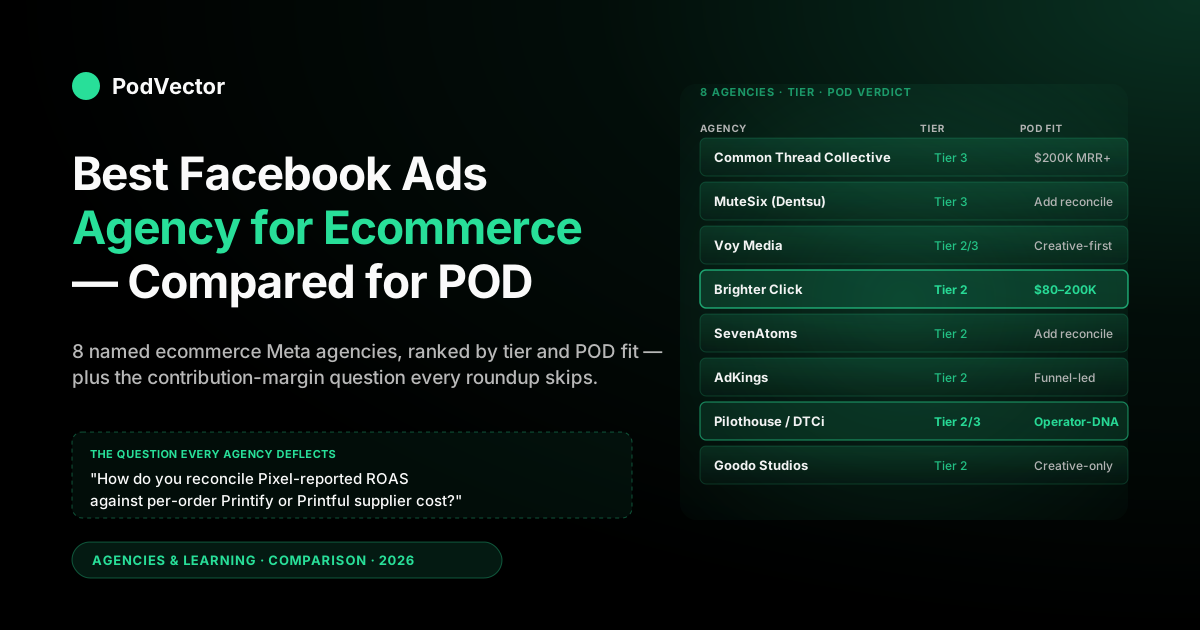
Quick Answer: The best Facebook ads agency for ecommerce in 2026 depends on what you sell, how big you are, and how stable your unit economics are. For DTC brands, names that consistently surface in current roundups include Common Thread Collective, MuteSix, Voy Media, and Brighter Click — with Brighter Click ranking as the overall best for scaling DTC brands in the Data Ally 2026 roundup.
For print-on-demand operators with variable Printify or Printful supplier costs, that list is misleading — most ecommerce agencies optimize toward Pixel-reported ROAS that ignores per-order supplier cost, which can flip a "winning" account into a margin-negative one without anybody noticing. Below a low-to-mid four-figure monthly revenue floor a freelancer plus your own data tooling beats any agency on cost-per-result; boutique POD-aware shops earn their retainer in the mid range; larger agencies become viable only if you contractually require supplier-cost reconciliation. This comparison ranks 8 named agencies on services, pricing, ideal client profile, and POD-specific verdict — and tells you when none of them are the right answer.
Why this list looks different from generic ecommerce roundups
Most "best Facebook ads agency for ecommerce" articles in 2026 — including the Data Ally top-6 list and the Web Tonic 43-agency roundup — rank agencies by team size, named clients, and the agency's own self-reported ROAS case studies. That works fine for DTC brands with stable cost-of-goods. It fails for print-on-demand operators because every metric in the case studies has a hidden assumption: that the brand's COGS is fixed and known to the agency.
POD breaks that assumption. A Printify hoodie has a different supplier cost than a Printify mug, which is different again from a Printful all-over-print sublimation tee.
A strong ROAS reported on a Pixel dashboard can represent healthy contribution for a fixed-COGS brand and near-zero contribution for a typical POD store. Same ROAS number, completely different P&L outcome. A roundup that doesn't account for this is recommending agencies based on a metric that doesn't exist for the reader's business.
This comparison ranks the same agencies that surface in those generic roundups, but adds a POD-specific verdict to each: would this agency, in their default mode of operation, optimize toward a metric that reflects a print-on-demand operator's actual contribution margin? In most cases the honest answer is no. That doesn't mean the agency is bad — it means the buying decision needs an additional layer of contractual specificity that the generic roundups skip.
How we evaluated each agency
Eight criteria, weighted toward what matters for a POD operator rather than a DTC brand. Generic roundups tend to weight the first three; we weight all eight.
- Ecommerce-Meta specialization — does the agency focus on Meta paid social for ecommerce, or is Meta one of many channels in a broader retainer? Specialists generally outperform generalists on Meta-specific work.
- Creative production capacity — UGC creator network, in-house video editing, static iteration cadence. Meta consumes creative faster than any other channel; agencies without production capacity struggle past month four.
- Measurement maturity — Conversions API setup, server-side tracking, incrementality testing. iOS attribution gaps are not residual error for thin-margin POD businesses.
- POD or variable-COGS experience — has the agency run a Printify, Printful, or similar supplier-driven catalog before? If yes, that's a meaningful signal; if no, expect to pay for the learning curve.
- Pricing transparency — published retainer ranges, scope clarity, audit-before-retainer options. Opaque pricing usually correlates with opaque scope.
- Reporting honesty — does the agency report on Pixel-attributed metrics only, or does it offer reconciliation against the client's own P&L? The latter is rare and valuable.
- Account-load discipline — number of concurrent accounts per strategist. High account loads per strategist make daily attention impossible.
- Contract flexibility — minimum commitment length, exit clauses, willingness to start with a paid audit. Long auto-renewing lockups are an outdated standard that no longer reflects how operators want to buy.
Quick comparison table
Pricing tiers reflect 2026 market ranges drawn from current agency roundups; named agencies move within these bands depending on scope. Treat these as orientation, not as quotes — every agency negotiates and most will adjust scope to hit a target retainer.
| Agency | Tier & retainer range | Best for | POD verdict |
|---|---|---|---|
| Common Thread Collective | Tier 3 — from ~$8,000/mo (per Web Tonic) | High-revenue DTC brands | Premium fit only at the top revenue tier with a CFO-grade reconciliation layer in-house. |
| MuteSix (Dentsu) | Tier 3 — ~15% of spend or $10K+/mo (per Web Tonic) | Mid-market DTC scaling on Meta + TikTok | Strong creative engine; default scope reports on platform ROAS, not POD contribution. |
| Voy Media | Tier 2/3 — custom pricing (per Web Tonic) | DTC brands prioritizing UGC video | Excellent video output; supplier-cost reconciliation is not part of standard scope. |
| Brighter Click | Tier 2 — boutique retainer | Scaling DTC & SaaS; overall best in Data Ally 2026 | Boutique attention is the right shape for mid-revenue POD if you contract reconciliation. |
| SevenAtoms | Tier 2 — mid-range retainer | Long-tenure ecommerce accounts | Solid platform fluency; needs explicit contracted POD reconciliation to be a fit. |
| AdKings | Tier 2 — mid-range retainer | Creative + funnel-driven DTC | Funnel discipline is real; default measurement still anchors on Pixel ROAS. |
| Pilothouse / DTCi | Tier 2/3 — wider range depending on scope | Scaling DTC brands inside a portfolio model | Operator-DNA is closest to POD; expect to negotiate scope-fit for variable COGS. |
| Goodo Studios | Tier 2 — production-weighted retainer (listed in Data Ally 2026) | DTC creative-first launches | Creative is the strength; measurement and POD reconciliation are not the offer. |
The 8 ecommerce Facebook ads agencies, compared
1. Common Thread Collective
Profile: One of the most-cited names in DTC ecommerce paid social. Profit-first methodology, strong financial-modeling pedigree, and a reputation for talking about contribution margin in a way most ecommerce agencies don't. Headcount in the 100+ range, multi-channel scope (Meta, Google, TikTok, email). According to the Web Tonic 2026 roundup, Common Thread Collective is positioned as a "DTC brand building + performance" specialist.
Pricing & scope: According to the Web Tonic 2026 roundup, retainers start from around $8,000/month. Full-funnel programs that include Google paid search, lifecycle, and creative production push well above that floor. Multi-month minimums are standard.
Best for: High-revenue DTC brands that already have stable unit economics and want a partner who'll talk about contribution rather than top-line ROAS.
POD verdict: The cultural fit is closer than most agencies — CTC publicly emphasizes contribution-margin thinking, which is the right frame. The economic fit only exists at the upper end of the POD revenue spectrum, where the retainer math actually works. Operators who land here should still contract for explicit Printify- or Printful-supplier reconciliation rather than assuming the agency's profit-first language extends to per-order supplier cost.
2. MuteSix (Dentsu)
Profile: One of the original D2C-focused Meta agencies, acquired by Dentsu and now operating as part of a global holding-company structure. Heavy investment in creative production — UGC creator networks, in-house video, performance-creative iteration cycles. Strong positioning in mid-market DTC. The Web Tonic 2026 roundup positions MuteSix as a "DTC creative production" specialist serving fashion, beauty, and wellness brands.
Pricing & scope: According to the Web Tonic 2026 roundup, MuteSix operates on roughly 15% of spend or a flat fee starting around $10,000/month. Holding-company economics push toward fewer, larger clients with multi-month commitments.
Best for: DTC brands with high monthly revenue that need creative velocity above all else and have unit economics stable enough to absorb the retainer.
POD verdict: Creative throughput is real and useful for any operator who can absorb the spend. The standard reporting cadence anchors on Pixel-reported ROAS and platform-attributed conversions, which means you'd need to layer your own POD-aware reconciliation on top. For most POD operators, the retainer plus the missing reconciliation layer puts MuteSix in the wrong tier — but for the rare high-revenue POD shop with a competent in-house analyst, the creative engine can pay for itself.
3. Voy Media
Profile: Direct-response ecommerce agency with a UGC-video-first thesis. Public case studies emphasize ad-spend management at scale and creative-led growth. Strong on Meta and Instagram, with TikTok as a secondary channel. According to the NinjaPromo 2026 roundup, Voy Media holds official Facebook Marketing Partner status.
Pricing & scope: Custom pricing depending on scope, per the Web Tonic 2026 roundup. Creative production is usually included in the retainer up to a defined output count, with per-asset fees beyond that.
Best for: DTC brands that need UGC video at scale and have a brand strong enough to support multiple creative concepts in flight at once.
POD verdict: The creative engine is a real strength and translates well to POD apparel and accessory niches that respond to UGC. The measurement and supplier-cost reconciliation layer is not part of the standard offer, which means the same caveat applies: you'll need to bring your own contribution-margin reporting and contract explicitly for reconciliation if you want the agency's optimization to track to your actual P&L.
4. Brighter Click
Profile: According to the NinjaPromo 2026 roundup, Brighter Click is "a Facebook ads agency specializing in creative strategy and UGC production, integrated with paid media management, for eCommerce, SaaS, FinTech, and healthcare brands." The Data Ally 2026 roundup ranks them first overall for "scaling DTC brands & SaaS companies," with performance ad creative and UGC as the primary strength. Also listed among highly reviewed agencies by Clutch.
Pricing & scope: Boutique retainer pricing; smaller account loads per strategist than holding-company agencies, which generally translates to more daily attention per dollar of retainer.
Best for: Mid-to-upper-revenue ecommerce operators who want senior attention, a smaller agency footprint, and a clear creative-led ROAS focus.
POD verdict: The shape of the agency is right for POD — boutique-tier attention, UGC-led creative, and pricing that matches the spend bands most POD operators occupy. The fit becomes real if (and only if) you contract for supplier-cost reconciliation as a deliverable rather than assuming "ROAS focus" includes it. POD operators who walk in with their contribution-margin data and require the agency to optimize against it have the strongest case for hiring Brighter Click or a peer agency at this tier.
5. SevenAtoms
Profile: Long-tenured ecommerce paid social agency with a decade-plus of Facebook ads management, multi-channel scope (Meta, Google, content), and a focus on ecommerce verticals. Bay Area-based, mid-sized team.
Pricing & scope: Mid-range retainer. Standard inclusion of static and short-form video creative iterations, with separate scope for landing-page work or lifecycle.
Best for: Ecommerce operators in a solid revenue band looking for a stable, multi-year relationship rather than a creative-experimentation engine.
POD verdict: Platform fluency is real; the reporting cadence is the standard ecommerce-agency pattern of Pixel-reported ROAS plus monthly review. POD-specific contracting (per-order supplier cost feed, contribution margin as a primary KPI) is unusual but not impossible to negotiate. SevenAtoms-class agencies fit POD operators who are willing to push for additional scope rather than accepting the default.
6. AdKings
Profile: Performance-marketing and creative agency with a funnel-optimization emphasis. Public positioning is "creative + media + funnel" rather than purely paid social. Frequently profiled in performance-marketing roundups.
Pricing & scope: Mid-range Tier 2 retainer. Stronger-than-average creative production, with funnel-stage testing baked into the standard process.
Best for: DTC brands with a funnel-aware founder who wants the agency to coordinate creative, paid social, and post-click conversion as one motion.
POD verdict: Funnel discipline is genuinely useful for POD because it forces attention to the post-click economics, not just the impression-and-click side. The default measurement still anchors on Pixel ROAS rather than supplier-adjusted contribution, so the same caveat applies: contract for reconciliation explicitly, or you'll be optimizing a metric that doesn't reflect your bank balance.
7. Pilothouse / DTCi (The DTC Group)
Profile: Operator-led portfolio agency that grew out of running its own DTC brands rather than from a traditional agency model. Strong creative engine, willingness to experiment with offers and funnels, and a culture that's closer to a DTC operating company than to a service firm.
Pricing & scope: Retainers vary widely by scope. Narrow-scope engagements sit at the lower end of the Tier 2 range; full-portfolio engagements including creative, media, and offer development reach Tier 3 territory.
Best for: DTC operators at a meaningful revenue scale who want a partner that thinks like an operator rather than a vendor.
POD verdict: The operator-DNA culture is the closest match for POD on this list. Pilothouse-class agencies are the most likely to engage seriously with per-order supplier cost, attribution gaps, and contribution-margin frames if asked. The negotiation leverage is in scope-fitting; the agency is more flexible than holding-company peers on what's included in the retainer. For a POD operator with the attention to manage the relationship actively, this tier is often the best fit on this list.
8. Goodo Studios
Profile: Creative-first agency with a focus on high-end production for DTC brands. According to the Data Ally 2026 roundup, Goodo Studios is best for "production ads" with high-end performance creative as its primary strength. Strong UGC, in-house video, and a positioning that emphasizes creative quality over media optimization volume.
Pricing & scope: Production-weighted retainer pricing. Media buying and measurement are usually scoped narrower than at performance-first agencies.
Best for: DTC brands launching new product lines or rebranding, where creative quality matters more than incremental media optimization.
POD verdict: Creative quality is the offer; measurement is not. POD operators who hire Goodo-class agencies should pair them with a separate measurement layer — either a freelancer for media buying or in-house data tooling for contribution reporting — rather than expecting the creative agency to also reconcile against supplier costs. As a creative partner specifically, the fit can be excellent for POD niches that respond to elevated brand creative.
The POD-specific vetting layer (apply on top of every shortlist)
Every agency on this list is competent at the platform. The differentiator for POD isn't competence — it's whether their default workflow optimizes toward a metric that reflects your contribution margin. Apply this four-question vetting layer on top of the shortlist, regardless of which agency you're talking to:
- "Walk me through how you'd report on an account where supplier costs vary per order." A POD-aware answer describes a concrete process — a tool, a reporting layer, a quarterly reconciliation against your P&L. A generic answer says "we report platform metrics; the rest is internal to you." The second answer is disqualifying for POD work, regardless of agency tier.
- "How would you structure Advantage+ Shopping for a 200-SKU catalog with 15 design niches?" POD-aware answers segment the catalog feed by margin tier or niche before exposing it to ASC, exclude thin-margin SKUs explicitly, and build a manual control structure to keep the lowest-contribution products out of automated bidding. "One ASC campaign, all products" answers indicate the agency hasn't run POD-shaped catalogs.
- "What's your process when Meta flags a trademark or community-standards concern on a SKU?" POD-native answers describe immediate catalog exclusion of disputed SKUs while the appeal works, plus a process for preventing repeat appeals from triggering broader account scrutiny. Generic answers stop at "we'd file an appeal."
- "Can you give me one current POD client reference and one client you've parted ways with in the last six months?" The willingness to share a churned client says more about agency honesty than any case study. "We've never lost a client" is rarely true and usually a signal of either a small client base or convenient framing.
The full eight-criteria vetting framework — including red flags, green flags, and the 30/60/90-day evaluation cadence to apply once you've signed — sits in the companion guide on what POD operators should know about a Facebook ads agency for ecommerce.
When DIY beats every agency on this list
Three scenarios where the right answer is "none of the above." Each is more common among POD operators than the agency rankings would suggest.
Early-stage revenue: a course plus a freelancer beats every retainer
At low ad-spend levels, no agency retainer pencils out. The retainer-to-spend ratio is wrong, and the agency would need to lift your true ROAS substantially to break even on the engagement, which essentially never happens at early stages.
The higher-ROI path is an ecommerce-focused course plus a specialist freelancer — or, increasingly, your own data tooling that gives you live visibility into contribution margin without needing a person to produce reports. This approach also scales well alongside the AOV-lifting strategies that compound agency-side results. The course path specifically is covered in the Facebook ads course for ecommerce guide for POD.
Highly seasonal or holiday-cycle businesses: project-based beats retainer
POD operators with strong Q4 concentration or specific seasonal niches (sports, holidays, event-based merchandise) often pay months of retainer for a fraction of useful work. Project-based engagements per concentrated push frequently outperform a long retainer on cost-per-result, especially if paired with a permanent freelancer for the off-season. Understanding your checkout completion rate benchmarks before signing any retainer helps you set honest performance baselines with agencies.
Operators with strong analytics fluency: tooling beats agencies
For POD operators who are comfortable in Ads Manager and want measurement leverage rather than execution leverage, a per-order data tool that joins Shopify, Printify, Printful, and Meta Ads data — and answers the contribution-margin question directly — replaces the most valuable thing an agency provides (the reconciliation layer) at a fraction of the cost. Knowing your net profit margin benchmarks and running your own CRO techniques gives you the same lift without the retainer overhead. The agency-vs-tooling tradeoff is covered more fully in the complete Meta ads agencies and courses guide for POD.
A decision tree by revenue band
If you take nothing else from this comparison, take this — the right answer for POD operators correlates closely with revenue band, and the named-agency choice is secondary to the band-level decision.
- Early-stage (low MRR): Don't hire any agency on this list. Course + freelancer + your own data tooling. Revisit after doubling revenue twice.
- Growing mid-stage: Boutique POD-aware shop or freelancer-plus-UGC-creator combo. Tier 1 named agencies on this list (Brighter Click-class) become viable toward the upper end of this band if you contract for supplier-cost reconciliation explicitly. Pairing with a Klaviyo browse-abandonment flow compounds paid-traffic ROI significantly at this stage.
- Established mid-stage: Tier 2 named agencies (Brighter Click, SevenAtoms, AdKings, Voy Media) become economically viable. The deciding factor is creative production capacity matched to your niche, plus contractual reconciliation. Pilothouse-class operator agencies are the strongest match for POD culture if you can hit the retainer floor. At this revenue level, understanding what channel diversification does to your attribution picture matters before committing to a single-channel agency.
- High-revenue tier: Tier 3 agencies (Common Thread Collective, MuteSix) become viable, with the explicit caveat that their default measurement is DTC-style ROAS and you'll need a layer of internal reconciliation that the agency does not provide. The biggest variable at this tier is internal data fluency, not agency choice. Operators using an AI employee like Victor from PodVector to read their Shopify, Meta Ads, and Printify/Printful data get the reconciliation layer in-house — reducing dependency on any agency's reporting.
For platform-specific context, the complete Meta ads playbook for print-on-demand sellers covers strategy without the agency overlay. For the broader topic context across every Meta ads question a POD operator faces, the Meta ads for POD topic hub is the entry point, and the agencies and learning cluster hub is the cluster-level index.
FAQs
Which Facebook ads agency is best for ecommerce in 2026?
There is no single best — the answer depends on your revenue band, unit economics, and channel mix. According to the Data Ally 2026 roundup, Brighter Click ranks first overall for scaling DTC brands, with Common Thread Collective and Pilothouse / DTCi surfacing most often for operators who prioritize financial-modeling pedigree.
For mid-market DTC, Brighter Click, SevenAtoms, AdKings, and Voy Media are the most commonly recommended Tier 2 fits, each with different creative emphasis. For POD operators specifically, the named agency matters less than whether you contractually require supplier-cost reconciliation as a reporting deliverable — without that, every agency on this list optimizes against a metric that doesn't reflect your contribution margin.
What does a Facebook ads agency for ecommerce cost in 2026?
According to the Web Tonic 2026 roundup, starting prices in the market range from around $3,000/month for full-service performance agencies up to $15,000+/month for enterprise-tier specialists, with MuteSix operating on approximately 15% of spend. UGC creator output is usually a separate line item per finished video. As a rough ceiling, retainer plus media management overhead should not exceed a meaningful share of monthly contribution margin — an agency that consumes more than it generates is mathematically unable to justify itself even if it performs well.
Can a Facebook ads agency for ecommerce work for print-on-demand?
Yes, but only with explicit contractual modifications to standard scope. The default ecommerce-agency workflow optimizes toward Pixel-reported ROAS, which silently ignores per-order supplier cost — the variable that defines POD profitability.
To make the engagement work, contract for: (1) a per-order supplier-cost feed from Printify/Printful into the agency's reporting, (2) contribution margin (not Pixel ROAS) as the primary KPI, (3) margin-tier segmentation in the catalog before exposing it to Advantage+ Shopping, and (4) quarterly reconciliation against your own P&L. Agencies that resist these modifications are not a fit, regardless of how well they rank in generic roundups.
What's the difference between Tier 2 and Tier 3 ecommerce agencies?
Tier 2 agencies typically run mid-range retainers with named departments, one strategist per reasonable account load, in-house creative production at moderate volume, and standard ecommerce-agency reporting. Tier 3 agencies — like MuteSix starting at roughly $10,000/month per the Web Tonic 2026 roundup — means larger teams with dedicated UGC creator networks, full-funnel video production, separate analytics or CRO arms, and a sales process that feels like enterprise SaaS.
The main differences for the buyer are creative throughput, account-team depth, and price. For POD operators specifically, Tier 2 is almost always the right band; Tier 3 economics rarely work until you're well into a high revenue tier.
Should I pay percentage-of-spend or flat retainer to an ecommerce Facebook ads agency?
Flat retainer for POD, in nearly every case. Percentage-of-spend misaligns incentives — the agency earns more when you spend more, regardless of contribution-margin health.
For POD with thin variable margins, that misalignment is genuinely dangerous. If percentage-of-spend is the only structure offered, cap it at a low percentage with a minimum fee floor and require quarterly reconciliation against your P&L. Most reputable agencies on this list will move to flat retainer if asked.
How long should I commit to a Facebook ads agency?
A short minimum commitment with a rolling notice period thereafter is the right structure. After the first 90 days you should have enough data — performance against the agreed roadmap, creative output count, measurement maturity — to evaluate fit. Long minimums were standard a decade ago; in 2026 they signal an agency that can't retain on results alone. The honest contract is a short minimum with 30-day notice afterward, plus a quarterly review built into the agreement.
How do I know if an agency on this list will actually understand POD?
Three tests, in order of signal strength. First, ask them to walk through how they'd report on an account where supplier costs vary per order — a POD-aware agency answers fluently with a process; a generic ecommerce agency deflects.
Second, ask if they've run a Printify or Printful client account specifically, and request to speak with that client. Third, ask how they'd structure Advantage+ Shopping for a 200-SKU catalog with 15 niches; POD-aware answers segment the feed by margin or niche, generic answers describe one ASC campaign with everything. Failing the first test is disqualifying regardless of how they answer the others.
Are there any POD-native Facebook ads agencies?
A small handful exist, mostly compact shops without strong public-facing marketing, and they don't usually appear in generic ecommerce-agency roundups. Operator referrals from established POD networks are the highest-signal source.
The trade-off: POD-native shops often charge a premium per hour over generalist agencies and earn it quickly in reconciliation accuracy alone. The premium is worth it for operators who want their reporting to track their actual P&L without contractual gymnastics.
What's the role of AI in 2026 ecommerce agency work, and does it change this comparison?
Meta's campaign-side AI (Advantage+ Shopping, Advantage+ Audiences, automated placements, dynamic creative) now handles most tactical optimization. What you're paying an agency for in 2026 has shifted from "audience and bid management" to "creative direction, UGC sourcing, catalog engineering, measurement reconciliation, and exception handling." For POD operators specifically, the biggest available leverage is post-campaign analysis — the layer that reconciles Pixel-reported performance against actual supplier-adjusted profit.
Most agencies have not built this layer yet; operators who have it — whether self-built, with tooling, or via a POD-native agency — consistently make better decisions across the board. An AI employee like Victor from PodVector reads your Shopify, Meta Ads, Google Ads, Printify, Printful, and Klaviyo data and surfaces exactly this reconciliation layer. For context on how AI-driven product and pricing decisions complement paid social, see the POD seller's guide to Shopify AI.
Walk into every agency interview with your real numbers
Every agency on this list will optimize toward whatever baseline metric you accept. For most ecommerce brands the default is Pixel-reported ROAS — a number that, for POD sellers, ignores Printify or Printful supplier cost, the iOS attribution gap, refunds, and platform fees. Operators who walk in with their true contribution margin per campaign get materially better engagements because the agency can no longer optimize toward a metric that doesn't reflect the P&L.
PodVector's AI employee, Victor, reads your live data warehouse across Shopify, Printify, Printful, Meta Ads, Google Ads, and Klaviyo — and answers questions like "what did my Facebook campaigns actually make this month after every cost" in plain English. He also executes approved Shopify-side actions (repricing, discount setup, collection creation) so insights convert directly into store changes without a dev ticket. Stop letting agencies define the scoreboard. And bring your own numbers to every conversation.
Try Victor free