
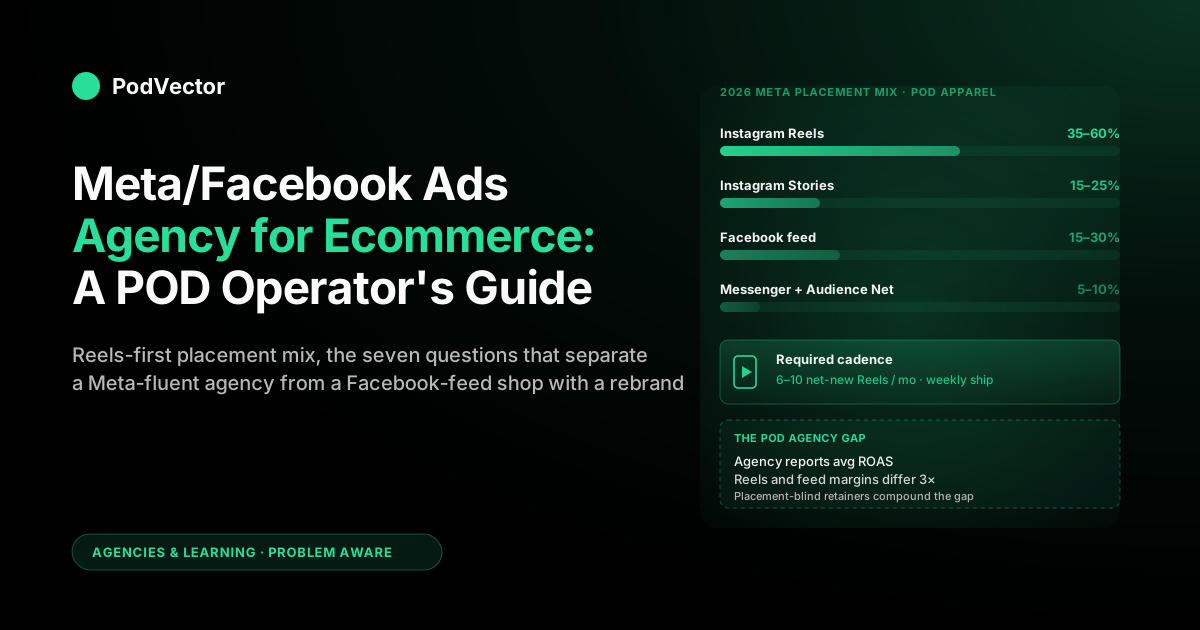
Quick Answer: A Meta/Facebook ads agency for ecommerce manages the full Meta paid-social surface — Facebook feed, Instagram Reels, Stories, Messenger, Audience Network, and increasingly Threads — for a $2,500–$12,000+ monthly retainer plus creative production. The "Meta" half of the label matters: an agency that still pitches itself as "Facebook ads" in 2026 is usually optimizing against a placement mix that hasn't matched real Meta consumption since Reels overtook feed for ecommerce.
For print-on-demand operators, the placement-mix question matters more than the agency-tier question — Instagram Reels and Stories are where POD apparel actually converts in 2026, and an agency configured around Facebook-feed-first creative will quietly underperform on the surfaces that drive your sales. This guide covers what changes when you hire an agency for the entire Meta ecosystem (not just Facebook), the 2026 cost ranges, the placement-and-creative questions that separate a Meta-fluent agency from a Facebook-feed shop with a rebrand, and the POD-specific filters that decide whether the retainer earns out.
What "Meta/Facebook ads agency" actually means in 2026
The slash in the label exists because the platform rebrand never fully landed in operator language. Most agencies still own the URL "facebookadsagency-something.com" and still sell pages titled "Facebook Ads Agency," but in practice they're running the entire Meta paid-social stack — Facebook feed, Instagram feed and Reels, Stories across both apps, Messenger, the Audience Network of partner sites, and the early-2026 Threads inventory. A Meta/Facebook ads agency in 2026 is an agency that pitches the brand-recognized half ("Facebook ads") and delivers across the full Meta surface — the question that matters is whether they're actually delivering across that full surface or whether their creative pipeline and reporting are still anchored on Facebook feed.
The team shape is the same as any ecommerce paid-social agency: a media buyer running Ads Manager, a strategist or account manager owning the relationship, one or two creative producers turning out static and short-form video, and at higher tiers a measurement specialist running Conversions API, server-side tracking, and incrementality work. The pitch is the standard one: you outsource the entire Meta operation, the team takes bid strategy, audience structure, and creative throughput off your plate, and you get back the 15–25 hours a week a competent in-house buyer would consume.
For a DTC apparel brand at $50K+/month ad spend with 65% gross margins, the pitch holds up. For a print-on-demand operator with variable per-SKU supplier costs from Printify or Printful, the pitch holds up only when the agency understands two things at once — POD unit economics, and the 2026 Meta placement mix that drives apparel sales.
For the agency-tier breakdown and where POD sellers fit in each retainer band, our deep dive on Facebook ads agencies for ecommerce walks through the four tiers in detail. This guide focuses on the Meta-platform-breadth question that the Facebook-only framing skips.
Meta agency vs. Facebook agency: the placement gap
A "Facebook ads agency" and a "Meta ads agency" are nominally the same thing in 2026 — the platform rebrand swallowed the distinction at the corporate level four years ago. In practice, the agencies that still treat the work as Facebook-first are running a measurably different placement mix from the ones that treat the work as Meta-first, and the difference shows up in POD performance fast.
The 2026 Meta placement reality
For ecommerce apparel — which is where most POD volume sits — Instagram Reels and Stories together drive a substantial majority of Meta's high-intent ecommerce conversions in 2026. Facebook feed remains a meaningful retargeting and middle-funnel surface, but the prospecting weight has shifted toward Reels-first short-form video for two structural reasons: Meta's ranking model now privileges Reels-style watch-time signals, and Instagram's audience composition (particularly women 25–55, the dominant POD apparel buyer) over-indexes on Reels engagement compared to feed.
An agency that opens its discovery deck with "we'll launch Advantage+ Shopping Campaigns and run image-led carousels in Facebook feed" is describing a 2022 playbook. An agency that opens with "your creative pipeline needs to be Reels-first with Instagram Stories adaptation, Facebook feed as a secondary placement, and a discrete creative testing track for each" is describing what actually drives volume in 2026. Both agencies will charge similar retainers; only one is configured to deliver against where Meta's algorithm actually surfaces ecommerce intent.
The four placement classes that matter for POD
Instagram Reels. Short-form video, 9:16 vertical, sound-on by design. The dominant prospecting placement for POD apparel and accessories.
Creative cadence required: 4–10 net-new Reels per month minimum at any meaningful spend, with an iteration loop on top winners. Agencies without a Reels-native creative pipeline (UGC creator network, in-house editor for short-form, or partner studio relationship) are not configured for 2026 POD volume.
Instagram Stories. Vertical, swipe-up era replaced with sticker-led commerce. Lower individual conversion volume than Reels but high CPM efficiency for retargeting and middle-funnel. Best for warmed traffic and Stories-native creative (not Reels stretched into 9:16). Agencies that "run the Reels and let Meta optimize Stories placement" are leaving CPM efficiency on the table.
Facebook feed. Static and short video, mixed aspect ratios. Still the most efficient retargeting surface for older POD buyer segments (45+) and the strongest placement for catalog-based dynamic product ads. Lower prospecting weight than three years ago; declining as a percentage of any healthy POD account's spend.
Audience Network and Messenger. Marginal contribution to most POD accounts, but worth a placement-level audit. Audience Network occasionally surfaces low-quality clicks at deceptively low CPC; Messenger has its own conversion patterns for first-time buyers in cold prospecting. A Meta-fluent agency has an opinion on whether to include or exclude both, with reasoning grounded in your account's data.
The placement question is not academic. POD apparel that converts on Reels often does not convert on Facebook feed, and the reverse is also true.
An agency optimizing toward "Meta ROAS" without segmenting by placement is reporting an average that obscures both the performing surface and the dragging one. For more on how attribution gaps compound across placements, see our complete guide to Meta ads ROAS and attribution for POD.
What a Meta ads agency costs in 2026 (retainer, creative, platform)
Three cost layers determine the real all-in price of a Meta ads agency for POD. Operators routinely sign retainers without internalizing the full stack, then watch monthly burn outpace the proposal by 40–80%.
The retainer ($2,500–$12,000+/month)
The core management fee. 2026 ranges by tier:
- Boutique / freelancer-led ($2,500–$4,500/month). One senior buyer plus part-time creative help. Best for $20K–$60K MRR POD operators who can absorb the retainer at a margin-conscious cadence. The senior buyer is also the day-to-day executor.
- Mid-market specialist ($4,500–$8,000/month). Three to seven people split across media, strategy, and creative. The pitch deck features the senior strategist; the day-to-day executor is usually a mid-level buyer. Best for $60K–$200K MRR brands.
- Premium / D2C-brand-grade ($8,000–$15,000+/month). Common Thread Collective, Mutesix, and similar firms operating at this tier typically gate at $50K–$100K+/month in Meta spend. The retainer plus performance fee structure assumes the brand has the contribution headroom to absorb the agency layer plus dedicated creative production. Out of scope for almost every POD operator below $200K MRR.
The creative production layer ($1,500–$8,000/month)
The cost most agencies carve out of the retainer and quote separately. A Reels-first 2026 Meta cadence requires 4–10 net-new short-form video assets per month plus 6–15 static iterations. Production options:
- Agency in-house creative ($3,000–$8,000/month). Bundled or unbundled depending on the agency. Highest control, highest cost.
- UGC creator network ($150–$600 per asset). Per-asset pricing through marketplaces or direct creator relationships. Cheapest per unit, requires operator management overhead unless the agency runs the network.
- Hybrid (UGC + in-house edits) ($1,500–$3,500/month). The most common POD-friendly structure: agency manages a UGC roster, edits for placement variants, ships into rotation.
Whether creative is in or out of retainer is the single most negotiated line in a Meta agency contract. Bundle when the agency's creative is genuinely good. Unbundle when their reel of "best creative" is generic ecommerce that wouldn't fit your brand voice.
The platform and tooling layer ($300–$2,000/month)
Frequently passed through to the operator and frequently invisible at signing. Conversions API infrastructure (Stape, RudderStack, or in-house server-side), attribution tooling (Triple Whale, Northbeam, or similar), creative testing automation, and reporting dashboards all add monthly cost. A boutique agency may bring their own light tooling; a mid-market or premium agency typically expects you to fund a Triple-Whale-tier attribution stack at $300–$1,200/month on top of retainer.
Real all-in for a $30K MRR POD store working with a competent boutique agency: roughly $4,000–$6,500/month before any media spend. That's 13–22% of revenue, before paid traffic. The retainer math is the single most undermodeled variable in the agency conversation — most operators don't run it before signing, and most agencies don't surface it.
What's in (and out of) a typical Meta agency retainer
The standard 2026 Meta retainer covers more than it covered three years ago, and less than agency sales decks suggest. The honest scope:
Reliably included
- Account audit at kickoff (sometimes billed separately as a $1,500–$3,500 onboarding fee)
- Campaign structure design (ASC + manual prospecting + retargeting layers)
- Audience setup including Advantage+ Audiences configuration
- Daily-to-weekly bid and budget management
- Monthly reporting and a recurring strategy call
- Light creative iteration on existing assets (resizes, text variants, thumbnail tests)
- Meta Pixel and basic Conversions API setup review
Variably included (always read the contract)
- Net-new Reels production — frequently scoped as N assets per month with overage fees
- Catalog ads and dynamic product ad feed management — sometimes separately billed
- Server-side Conversions API engineering beyond basic setup
- Incrementality testing and lift studies
- Landing page conversion-rate optimization (some agencies; usually scoped out)
- Email and SMS retention integration (cross-channel agencies; pure-Meta agencies skip)
Reliably excluded
- Reconciling Pixel-reported revenue against your true Printify or Printful supplier cost
- Per-SKU contribution margin analysis informing audience and bid decisions
- Shopify backend optimization, app stack management, or platform-level tracking issues
- Brand strategy, positioning, or product roadmap input
- Customer service, fulfillment, or supplier relationship management
The reliably-excluded list is where most POD agency engagements quietly fail. The agency optimizes against Pixel ROAS; the operator's bank account responds to true contribution after supplier cost. The numbers do not match, and the reconciliation gap stays the operator's problem regardless of retainer size.
Why POD placement mix breaks generic ecommerce agency playbooks
Three POD-specific issues compound on top of the standard "good ecommerce agency, wrong fit" failure mode. None of them are obvious to an agency without prior POD experience.
Per-SKU supplier cost defeats average-ROAS optimization
A POD store running 200 SKUs through Printify will see supplier costs that vary from $7 (basic tee) to $26+ (oversized hoodie or all-over-print). Meta's optimization, agency reporting, and Advantage+ Shopping all operate on average ROAS — which means spend will systematically push toward the highest-revenue SKUs (often the highest supplier-cost ones), and reported ROAS at the campaign level will look healthy while contribution margin compresses.
The fix is per-SKU margin tagging at the catalog level and segmented campaign structure by margin tier, which most agencies don't run by default. For the full margin-tagging approach, see our complete Meta ads playbook for print-on-demand sellers.
Reels-first creative requires POD-fluent UGC sourcing
Generic ecommerce UGC creators produce generic ecommerce content — product unboxings, lifestyle shots, "honest review" reads. POD apparel converts on a different creative pattern: niche-affinity content (the dog-mom community, the teacher community, the specific-interest tribe a design speaks to) where the apparel is incidental to a story the viewer already self-identifies with.
Agencies that pitch a "creator marketplace with 5,000 vetted UGC creators" are usually pulling from a roster optimized for skincare and supplements. Sourcing apparel-and-niche-fluent creators is a different muscle, and one most generalist ecommerce agencies haven't built.
Iteration cadence outpaces traditional agency creative cycles
A 2026 Reels-first Meta account on a POD apparel brand burns through creative in days, not weeks. Top-performing Reels often plateau within 14 days of launch.
The required iteration cadence — 4–10 net-new Reels per month plus 8–20 variant edits — outpaces the two-week creative review-and-approval loops most ecommerce agencies still run. Agencies optimized for monthly creative drops will let your account stagnate between drops; agencies optimized for weekly creative shipping plus Friday performance reviews will keep the iteration loop alive.
When hiring a Meta agency makes sense for POD
Five concrete triggers, in rough order of clarity. Any one is sufficient justification; none of them are required.
- You're at $40K+ MRR with confirmed unit economics and you've personally validated true contribution margin. The retainer math pencils above $40K MRR if (and only if) you know your true post-supplier-cost margin and can defend it. Below that threshold, a consultant on a small retainer plus a freelancer on execution outperforms an agency on cost and on POD-specific judgment — see our guide on Facebook ads consultants for ecommerce.
- Your creative throughput is the bottleneck, not your media buying skill. If your bottleneck is "we can't ship enough Reels," an agency with a real UGC pipeline solves the bottleneck faster than a freelancer-plus-creator hybrid. If your bottleneck is "we don't know what to test," a consultant solves it for a third of the price.
- You're spending 15+ hours a week in Ads Manager and your time has higher-leverage uses. The classic agency ROI case. Agencies don't outperform a competent in-house buyer on optimization; they win on freeing your hours back. The trade is honest if your hours have a higher-margin use.
- You're scaling into a Q4 or seasonal peak that requires creative volume you can't ship in-house. Seasonal campaigns benefit from agency creative throughput in a way that steady-state operations don't. A 90-day engagement around a peak is easier to scope and exit than an open-ended retainer.
- You've grown past the point where any one freelancer can keep up. Above $80K MRR, the volume of creative testing, audience iteration, and measurement work usually exceeds what a single freelancer can sustain. The agency model becomes the right structural fit.
And two situations where an agency is the wrong call: when your true contribution margin is unknown or under 20% (no agency can fix unit economics with paid social), and when product-market fit is still being validated (the agency will optimize against numbers that won't reflect tomorrow's product mix). For both situations, see our complete guide to Meta ads agencies and courses for POD for the staged approach.
The 7-question Meta-fluency vetting framework
The vetting questions for a Meta agency in 2026 are different from the 2022 Facebook-agency vetting questions. The seven below separate the Meta-platform-fluent agencies from the Facebook-feed-shop-with-a-rebrand.
- "What percentage of your average POD or apparel client's Meta spend ran on Instagram Reels last quarter, and how do you know?" Meta-fluent agencies can answer with a number (typically 35–60% for apparel in 2026) and a reporting source. Agencies pattern-matching DTC playbooks deflect or quote a generic ecommerce average that doesn't differentiate placement.
- "Walk me through your creative cadence for a $30K/month spend POD apparel client. How many net-new Reels per month, how many static iterations, and what's the review-and-ship loop?" Right answer: 6–10 net-new Reels per month, 12–20 static iterations, weekly review with same-week shipping. Wrong answer: monthly creative drops with biweekly review.
- "How do you handle per-SKU supplier cost variance in optimization decisions when working with a Printify or Printful catalog?" Meta-fluent POD agencies have a margin-tagging or segmented-campaign answer here. Generic ecommerce agencies will offer to "monitor average ROAS more closely," which doesn't address the structural problem.
- "What's your stance on Advantage+ Shopping Campaigns for a POD catalog with 100+ SKUs at variable margin?" POD-aware answers acknowledge ASC's tendency to push spend toward high-revenue (often low-margin) SKUs and propose either margin-segmented ASC structure or a hybrid manual-plus-ASC approach. Reflexive "ASC is the future, ride the algorithm" answers are agency self-interest, not your interest.
- "What's your Conversions API and server-side tracking implementation, and what events are you currently deduplicating against the Pixel?" The right answer references specific events (Purchase, AddToCart, InitiateCheckout) and a deduplication mechanism (event_id matching). Vague "we'll get CAPI set up" answers signal an agency that hasn't engineered measurement at depth.
- "How will you reconcile Pixel-reported ROAS against my true post-supplier-cost contribution margin in your monthly reporting?" Most agencies will admit they don't, and offer to "incorporate the data once you provide it." That answer is honest. The agency claiming they'll do the reconciliation themselves either has a tooling integration (verify it) or is overpromising.
- "What client of yours have you walked away from in the last 12 months, and why?" Senior agency teams have walked away from at least one prospect or current client whose unit economics couldn't support the retainer. The willingness to share the example is a signal of integrity. Agencies that have never declined a client are revenue-driven, not value-driven.
An agency scoring four or more right answers is worth a paid trial month. Anything below four is a generalist ecommerce agency that hasn't internalized the Meta placement reality or the POD margin reality.
For the broader category survey beyond agencies, see our comparison of the best Facebook ads agencies for ecommerce. For external context on the named ecommerce Meta agencies in this space, the Stryde 2026 roundup of top ecommerce Meta ads agencies covers the generalist field well.
Red flags and green flags during the sales process
The first three sales calls reliably surface fit. The patterns that predict outcomes:
Red flags
- The agency's case studies are exclusively skincare, supplements, or fixed-COGS DTC. Generic ecommerce expertise without apparel or POD fluency. Their playbook will not transfer cleanly.
- "We'll launch Advantage+ Shopping in week two and let Meta optimize" with no segmentation discussion. Path-of-least-resistance configuration that systematically defunds margin-aware POD operations.
- No questions about supplier cost, margin variance, or Printify/Printful catalog structure during discovery. Disqualifying. If the agency doesn't ask, they don't know POD.
- The reel of "best creative" looks indistinguishable from every other ecommerce agency's reel. Generic UGC roster, not apparel-and-niche-fluent creators.
- Pressure to sign a 12-month minimum without a 90-day evaluation breakpoint. Senior agencies are comfortable with a 90-day evaluation clause. Hard 12-month locks shift risk entirely onto the operator.
Green flags
- The strategist asks for top 10 SKUs by units sold versus by revenue in the first call. They're checking whether ASC will push spend at the worst-margin half of your catalog before they propose campaign structure.
- The creative reel includes Reels-first short-form, not just Facebook-feed statics dressed up. Their pipeline is 2026-configured, not 2022-residual.
- They volunteer that supplier-cost reconciliation is your problem to close, not theirs. Honesty about scope. The agency claiming they'll close the reconciliation gap is overpromising; the one acknowledging it is operating in good faith.
- The proposal includes a scoped 90-day evaluation milestone with defined success metrics. A senior agency is comfortable being measured against specific outputs at 90 days, not asked to "build trust over the first six months."
- The strategist pushes back on at least one of your assumptions in the first call. "I disagree that creative is your bottleneck — your campaign structure is" is the kind of pushback senior teams offer in discovery. Agreement-on-everything signals a sales call, not a strategy call.
Alternatives to price first
Three structures that consistently outperform an agency for POD operators below $50K MRR. Worth pricing before signing any retainer:
- Senior consultant ($1,800–$5,000/month) plus freelancer ($1,000–$3,000/month) plus UGC creator on per-asset fees. Total $3,500–$9,000/month with substantially more direct senior attention than an agency at the same price. Best for $20K–$80K MRR. Walk through the consultant role in our consultant guide.
- One-time agency audit ($2,500–$5,000) plus self-managed execution. Buy senior agency thinking once, execute it yourself with a freelancer or in-house buyer. Best for operators who've outgrown self-education but aren't ready for a retainer.
- Structured ecommerce-focused course ($297–$1,500) plus operator-led execution. Best for sub-$15K MRR where the optimization surface is too small to absorb senior agency attention. See our guide on Facebook ads for ecommerce courses.
None of these alternatives close the supplier-cost reconciliation gap automatically. That's the constant variable across every engagement structure — the operator owns the reconciliation, regardless of who's running the account. For the cluster-level view of when each option fits, the Meta ads agencies and learning hub covers the full landscape, and the broader topic context lives in the Meta ads for POD topic hub.
FAQs
What's the difference between a Meta ads agency and a Facebook ads agency in 2026?
Nominally none — Meta is the corporate entity that owns Facebook, Instagram, Messenger, and the Audience Network. In practice, the label an agency uses is a signal: agencies still pitching themselves as "Facebook ads" four years after the rebrand are often anchored on Facebook-feed-first creative and reporting, while agencies that have led with "Meta" treat the work as a multi-placement portfolio with Reels, Stories, and feed optimized separately. The placement difference matters for POD because Reels and Stories drive a substantial majority of 2026 ecommerce apparel conversions.
How much does a Meta/Facebook ads agency cost for ecommerce in 2026?
Retainers range from $2,500–$4,500/month at the boutique tier (one senior buyer plus light creative help, best for $20K–$60K MRR), $4,500–$8,000/month at the mid-market tier (3–7 person team, best for $60K–$200K MRR), and $8,000–$15,000+/month at the premium tier (gated at $50K+/month Meta spend, out of scope for most POD below $200K MRR). Add $1,500–$8,000/month for creative production and $300–$2,000/month for tooling and Conversions API infrastructure. All-in for a $30K MRR POD store working with a competent boutique agency is typically $4,000–$6,500/month before media spend.
Should a POD store under $30K MRR hire a Meta ads agency?
Usually no. The retainer plus creative production plus tooling typically consumes 15–25% of revenue at that stage, and most ecommerce agencies optimize against Pixel-reported ROAS rather than true contribution margin after supplier cost.
A consultant on a small retainer plus a freelancer on execution plus a UGC creator on per-asset fees runs $3,500–$6,000/month with more direct senior attention and more POD-specific judgment. Agencies start to make sense above $40K MRR with confirmed unit economics; below that threshold, the alternatives outperform on cost and on fit.
Why do most ecommerce Meta agencies underperform for POD operators?
Three reasons compound. First, agencies optimize against average ROAS while POD has highly variable per-SKU supplier costs, so reported ROAS rises while contribution margin compresses.
Second, generic ecommerce UGC rosters produce skincare-and-supplements creative patterns, while POD apparel converts on niche-affinity content from creators inside specific communities. Third, monthly creative drop cadences are too slow for 2026 Reels-first iteration, where top winners plateau within 14 days. A POD-fluent Meta agency addresses all three; a generic ecommerce agency addresses none.
What's the right placement mix for a POD apparel store on Meta in 2026?
Roughly 35–60% Instagram Reels, 15–25% Instagram Stories, 15–30% Facebook feed (heavier weight in retargeting than prospecting), and 5–10% across Messenger and Audience Network — with the exact split varying by buyer demographic and product category. The dominant pattern: Reels carries prospecting, Stories handles middle-funnel, Facebook feed retargets older buyer segments and runs catalog-based dynamic product ads. Agencies running Facebook feed as the dominant placement in 2026 are leaving meaningful efficient inventory on the table.
How long does it take for a Meta ads agency to deliver POD results?
Realistic timeline: 30 days for measurement and tracking validation, 60 days for campaign restructure to start producing cleaner data, and 90 days for the first iteration cycle of Reels-first creative to compound. Agencies promising "30-day turnaround" on revenue lift are usually pulling from existing creative and account momentum rather than building durable structure. Agencies asking for "six months to build trust" before offering measurable milestones are pacing the relationship to suit retainer continuity, not your timeline.
Can I switch from a Facebook-feed-first agency to a Meta-fluent one without losing data?
Yes, and the switching cost is mostly account history rather than tracking infrastructure. Conversions API setup, Pixel events, and audience definitions stay with your Meta Business Manager regardless of agency.
What you lose: the previous agency's campaign learning phases, accumulated creative library inside their Meta Ads Library access, and any tooling integrations under their account. The switch is worth it when the placement-mix gap is structural — most operators recover the lost learning phases within 60–90 days under a Meta-fluent agency.
What should I expect from the first 30 days of a Meta agency engagement?
A documented account audit covering placement mix, campaign structure, audience configuration, creative library health, and Conversions API status; a kickoff strategy deck with the proposed campaign restructure and creative cadence; weekly performance reviews; and the first 2–4 net-new Reels in production. Agencies that don't deliver all four in the first 30 days are paced for retainer continuity, not for output. Agencies that deliver creative in week one without a measurement validation step are skipping the structural diagnostic the engagement should start with.
What's the role of AI tooling in 2026 Meta agency engagements?
Senior agencies in 2026 use AI-assisted creative ideation, automated reporting reconciliation, and increasingly AI-driven attribution modeling. The honest framing: AI tooling lets a smaller agency team deliver what previously required a larger one, which has compressed the boutique tier's quality without compressing the mid-market tier's price.
From a POD operator's perspective, the implication is that the boutique agency at $4,000/month in 2026 frequently delivers what a $7,000/month agency delivered three years ago — which makes the case for the boutique tier stronger and the case for the mid-market tier (which still charges 2022 prices for largely 2022 outputs) weaker. Operators who can run their own supplier-cost reconciliation through analytics tooling get more leverage from each agency hour, because the agency can spend the engagement on the strategic and creative layers rather than on data assembly.
Walk into your Meta agency call with reconciled numbers
The single biggest difference between a Meta agency engagement that pays for itself and one that doesn't is whether you walk in with your true post-supplier-cost contribution margin in hand — not Pixel-reported ROAS, but revenue net of Printify or Printful supplier cost, shipping, fees, and refunds, segmented by placement and SKU. Most POD operators don't have those numbers on demand, which means the first three months of every agency relationship are spent debating whose ROAS is right. PodVector AI's AI agent, Victor, runs live data warehouse across your Shopify, Printify, Printful, and Meta Ads data and answers questions like "what was my true ROAS by Reels versus feed last month after every supplier cost" in plain English — the kind of reconciled view that makes agency time count from minute one. And walk into your next agency call with the placement-and-margin math nobody on the agency side is going to do for you.
Try Victor free