
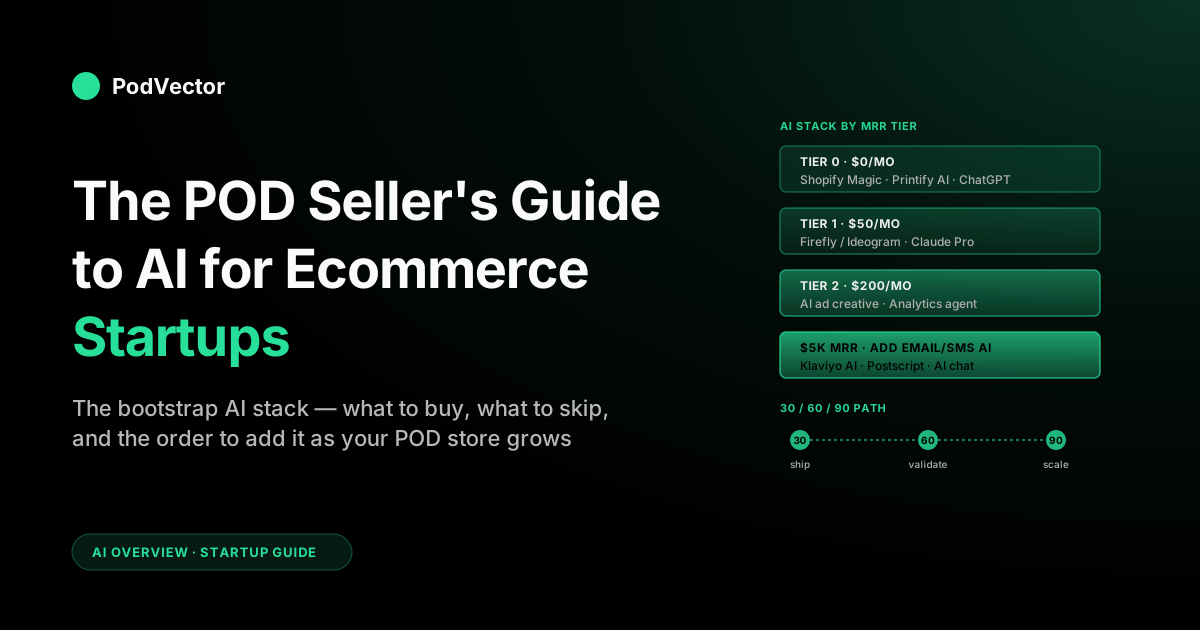
Quick Answer: AI for ecommerce startups in 2026 means five practical capabilities — design and image generation, product copy at scale, AI-assisted ad creative, on-storefront customer service, and analytics that actually answer questions instead of producing dashboards. For a print-on-demand startup specifically, the ROI sequence is different from what a wholesale brand sees: design and copy generation pay back inside a week because they remove the slowest steps in launching a new product, while AI personalization and recommendation engines don't earn their cost until you have catalog scale and traffic volume to feed them.
The right starting AI stack for a bootstrapped POD store is roughly $0–$200/month and answers four questions — how do I get more designs out faster, how do I write good copy without hiring, how do I make ads without a designer, and how do I know what's actually profitable. This guide walks through that stack, the order to buy in, and the trap of over-tooling a store before it has revenue.
What 'AI for ecommerce startups' actually means in 2026
Strip out the vendor noise and "AI for ecommerce startups" in 2026 covers five capability categories that have all crossed the line from interesting to essential: image and design generation, product copy generation, ad creative and video generation, customer-facing chat and support, and operator-facing analytics that you can actually ask questions of. Each was a research demo two years ago, and each is now an undifferentiated commodity available through Shopify's built-in AI suite, Printify's own AI tools, or a $20/month standalone app. The real question for a startup is which to lean on hard, which to defer, and how to avoid the trap of paying for ten of these when only three are doing work.
For a brand-new POD store, the binding constraint is rarely software. It's time, design output, and the small budget of attention a founder has between their day job and the ten other things they need to do this week.
AI tools win here when they remove the slowest manual step (drafting a product description, sourcing a hero image, cutting a 15-second TikTok) — not when they layer optimization on top of a store that doesn't yet have customers to optimize. Ranking the categories by "which one removes the slowest manual step" is the easiest way to sequence the spend.
What changed between 2023 and 2026
Four shifts matter most for a startup operator. First, design generation crossed the quality threshold for printable art around 2024 — the difference between Midjourney v5 and the current generation of Adobe Firefly and Ideogram is the difference between "needs cleanup before printing" and "ready to upload." Second, AI ad creative tools (Pencil, AdCreative.ai, Meta's own Advantage+ creative variants) now produce ad variants at a rate no in-house designer could match, which inverts the old testing math. Third, AI moved from suggesting to acting in narrow contexts — autonomous email recovery, autonomous bid adjustment, autonomous SKU pausing — and that "agentic" frame is the one to watch because it's where the operator's role is genuinely changing. Fourth, shoppers themselves started buying through AI: over half of US consumers have now used an assistant like ChatGPT or Gemini to research or start a purchase, which moves part of product discovery off Google and onto AI answers and makes generative engine optimization (GEO) a real concern even for a brand-new store.
For a POD startup, the practical implication is that the cost of creating a product to test has collapsed. What used to take a week now takes an afternoon.
The bottleneck has migrated from creation to validation: which of the 40 designs you can now generate in a weekend are worth running ads against. That's the question the AI stack at the analytics end of the workflow has to answer, and it's where most starter stacks have a gap.
Why POD startups need a different AI playbook
The standard "ecommerce AI guide" is written for a wholesale brand: defined SKUs, fixed cost basis, a real warehouse, returning customers, and a marketing team. A POD startup breaks every assumption in that mental model, and the gap matters when you're picking tools.
Your unit economics are variable per order
A wholesale brand knows its cost of goods to the cent. A POD startup's cost depends on which Printify or Printful supplier produces the order, which product type the shopper picked, where it shipped, and what the supplier's pricing did this month.
Two converted orders at the same revenue can have margins 15 percentage points apart. AI tools that optimize for "conversion" or "revenue" without seeing per-order contribution margin can push you toward "lifts" that quietly hurt your P&L. This is the single biggest reason generic ecommerce AI advice fails POD operators.
Your catalog is design-heavy, not SKU-heavy
Wholesale brands have 30–80 SKUs with rich content per SKU. A working POD store has hundreds or thousands of designs with thin per-design content.
AI personalization tools assume the first regime and underperform in the second because there isn't enough per-design context for the model to do its best work. That makes content-generation AI (per-design copy, per-design lifestyle imagery) a higher-ROI investment than personalization AI for most POD stores under $50K MRR.
Your traffic is mostly first-touch
Most POD startups acquire customers through paid social where 70%+ of traffic is first-time visitors. AI personalization that needs purchase history or returning-visitor signals has very little to work with on a startup store.
What it can work with is session-level behavior — clicks, scroll depth, search queries, exit timing — and that's where the lift hides for early POD stores. When you evaluate an AI tool, ask explicitly how it handles a first-touch visitor with no prior data; the answer reveals whether the tool was built for wholesale brands or for marketplaces like yours.
You're founder-led, not team-led
Most generic ecommerce AI guides assume an organization with a marketing manager, a designer, a customer-service lead, and an analyst. A POD startup is one person, sometimes two.
AI tools that require setup, training, integration, or a weekly review cadence don't get adopted in that environment — the founder is too busy. The AI tools that actually take root are the ones you can turn on in twenty minutes and ignore. This is a real selection criterion, not a soft one. (For a related deep-dive on what the day-to-day operator stack looks like: the POD seller's guide to AI for ecommerce productivity.)
The five AI categories that move the needle for a POD startup
Within those constraints, five AI categories pull their weight. A startup buying in this order tends to get to first profitable month faster than a startup that buys feature-richness over sequencing.
1. Design and image generation
This is the unlock for POD. The cost of a printable design dropped from $30–$80 (commission a designer) or three hours of your own Illustrator time to a few minutes and effectively no marginal cost.
Tools worth knowing: Adobe Firefly for raster art that's safe for commercial use, Ideogram for text-in-image work (slogans, typography-heavy designs), Midjourney for stylized hero imagery, and Printify's built-in AI image generator for a tighter Printify-to-Shopify loop. The play isn't to use one — it's to know which one performs best for the niche you're in.
Typography-driven niches (cat lovers, nurse humor, niche hobby quotes) reward Ideogram. Stylized illustration niches (vintage, retro-cartoon, watercolor) reward Midjourney. Photoreal product mockups reward Firefly.
2. Product copy generation
The second-slowest manual step in launching a POD product is writing the listing — title, bullet points, description, alt text. AI copy tools (Shopify Magic, Jasper, Copy.ai, ChatGPT with a niche-tuned prompt) collapse this to under a minute per design.
The catch: out-of-the-box AI copy is generic and reads identically to every other store using the same tool, which kills SEO differentiation. The fix is a prompt template that includes your niche, voice, and product-specific keywords — not the default. A 30-minute upfront investment in a good prompt pays back forever.
3. AI ad creative and video
For a POD startup running paid social, ad-creative bottleneck is real. Tools like Pencil, AdCreative.ai, Canva's AI features, and increasingly Meta's own Advantage+ Creative produce static and video variants at a rate one founder can't match by hand. The math changes from "test 3 ads per week" to "test 30," and that's a different game.
The honest caveat: AI-generated ad creative still underperforms human-directed creative for emotional or story-driven niches. It outperforms human creative for product-focused, feature-driven creative where variation matters more than craft.
4. Customer-facing chat and support
AI chat for ecommerce in 2026 reads product attributes, reviews, shipping policies, and order status in real time and handles the long tail of "where's my order," "does this run small," "can I get this in another color." For a POD store the ROI is real — these questions consume a lot of founder time and rarely require human judgment. The right tool depends on stack: Shopify Inbox's built-in AI for Shopify-native stores, Tidio or Gorgias AI for higher-volume stores, or a deferred decision until you have enough chat volume to justify the spend. (More on this specifically: AI chatbot for ecommerce: what it looks like for POD sellers.)
5. Operator-facing analytics
This is the category where most POD startups under-invest, and it's the one with the most leverage past the first 90 days. Generic ecommerce dashboards (Shopify's, Triple Whale's, even ad-platform-native reporting) tell you what happened.
They don't reliably answer the questions that drive POD profit decisions: which Printify product type is netting positive after fees? Which design is converting on which audience at what cost?
Which campaign is up on revenue but down on contribution margin? AI analytics — especially live-data agents that read your store, supplier, and ad data together — answer those questions in plain language. Victor is built for exactly this pattern, and we'll cover the agentic shift in detail below.
The bootstrap AI stack: $0–$200/month, in priority order
If you're at $0 MRR and want a working AI stack tomorrow, here's the honest priority order. Buy in this sequence — don't skip ahead.
Tier 0 — free / already-included
- Shopify Magic (free with Shopify): product description writer, email subject-line generator, image background remover. Use for first-draft copy and basic image cleanup.
- Printify's AI image generator (free with Printify): generate designs directly inside Printify, no round-trip through another tool. Quality is competitive with mid-tier standalone tools as of 2026.
- ChatGPT free tier or Claude.ai free tier: any time you'd Google something, ask the model first. Includes copy templates, niche research, ad-angle brainstorming, and competitive teardown.
- Meta's Advantage+ creative variants (free with paid ads): Meta will auto-generate creative variants of your uploaded asset. Turn it on; the lift over not turning it on is consistently positive.
This is your starting stack. Run it for 30 days before adding anything paid. Most POD startups never need to upgrade beyond it for the first 60 days.
Tier 1 — the first $50/month
- Adobe Firefly or Ideogram subscription ($20–$30/month): when you need higher-resolution, commercial-safe generations than the free tools produce. Pick one based on whether your niche is type-driven (Ideogram) or illustration-driven (Firefly).
- ChatGPT Plus or Claude Pro ($20/month): for the better model, file uploads (paste in supplier price sheets and ask questions), and longer-context work. Worth it the moment you're using the free tier daily.
Tier 2 — the next $150/month
- An AI ad-creative tool ($60–$100/month, depending on plan): once you're spending $30/day or more on ads and the bottleneck is creative production, not budget. AdCreative.ai and Pencil are the two most-used in this category. Skip until creative is the bottleneck.
- An operator-facing analytics agent ($0–$50/month at startup tier): once you have 50+ orders, you need to start asking profit questions across your store, supplier, and ad data. Victor is in this category and is positioned for the POD use case specifically. Other categories of dashboards (Triple Whale, Lifetimely) work too but answer "what" rather than "why."
Notice what's not in the bootstrap stack: AI personalization engines, AI site search, AI loyalty programs, predictive inventory, dynamic pricing tools. Each of those has a place — but not in the first $200/month and not before product-market fit. Adding them early is the most common over-tooling mistake POD founders make.
The growth AI stack: what to add at $5K, $20K, and $50K MRR
The order in which to layer in additional AI capability matters as much as the bootstrap order. Each MRR threshold unlocks a category that didn't have enough data or volume to earn its cost before.
At $5K MRR
Add an AI email and SMS automation tool (Klaviyo with its AI features, or a more focused Postscript SMS setup). At this revenue level you have enough customer data for AI segmentation and abandoned-cart sequences to actually improve over a generic broadcast list.
The lift over a non-segmented list is usually 15–30% on email-attributed revenue. Also worth: an AI chat tool, because customer-service questions are now a real time sink.
At $20K MRR
Add AI for ad-platform optimization — Northbeam, Triple Whale's AI features, or an attribution layer that can tell you what's working past Meta's blended numbers. The reason this comes at $20K and not earlier is that with less than ~$100/day in ad spend, the noise in the data exceeds the signal the AI can extract.
You're buying analysis of randomness if you do it sooner. Also worth at this stage: AI site search, because your catalog is now large enough that browsing isn't enough.
At $50K MRR
This is where personalization and recommendation engines start earning their keep. You finally have repeat-customer data, returning-visitor signals, and enough catalog depth that "you might also like" beats a manually curated rail.
Tools to consider: Nosto, LimeSpot, or Shopify's native AI recommendations (which improved meaningfully through 2025). Also worth at this stage: serious investment in an operator-facing analytics agent, because the sheer volume of data now exceeds what a founder can keep in their head.
(For a deeper look at what the comparison looks like across categories: best AI for ecommerce, compared, and the broader POD seller's guide to AI for ecommerce.)
Where AI fails for POD startups (and why)
Knowing where the tools don't deliver matters as much as knowing where they do. The four most common disappointments:
AI personalization on a cold-traffic store
Personalization engines need behavior signal to perform. A store where 70% of visitors are first-touch from cold paid social doesn't generate enough signal for the engine to outperform a well-designed default browse experience.
The "+10–15% revenue from personalization" benchmarks come from brands with significant returning-visitor traffic — typically over 30% — and they're not your benchmarks at MRR $5K. Defer.
AI-generated ad copy that ignores your brand voice
Generic AI ad copy reads like generic AI ad copy. The lift over no-AI is real on product-feature ads, but the lift inverts on brand-voice or storytelling ads where craft matters.
A small POD store with a distinct niche voice (sarcastic dog moms, niche hobby in-jokes, regional pride) often performs better with a hand-written ad than with AI variants. Use AI copy for variations on a working hand-written original, not for cold first-draft brand work.
AI dashboards that produce charts instead of answers
The dashboard era of analytics has run its course. Most "AI" analytics products in 2026 are still chart-rendering tools with a chat box bolted on, where asking "which campaign was net-profitable last week" returns a Looker-style breakdown rather than an answer.
The tools that actually answer questions read your live store, supplier, and ad data and respond in plain language with the number. That's a different product category and most current dashboards aren't in it.
AI tools that don't see the supplier side
Almost all generic ecommerce AI tools see Shopify but don't see Printify or Printful. For a POD store that's the wrong half.
The interesting profit questions live on the supplier side — which product type is netting after fulfillment cost, which supplier's price changes ate margin this month, which design is profitable on Shopify but unprofitable after the supplier bill. Tools that can't see that data can't answer those questions, regardless of how slick the UI is. (Related: the complete guide to AI analytics for print-on-demand.)
The agentic shift: where AI for ecommerce is headed
The biggest shift between 2024 and 2026 isn't model quality — it's the move from "AI that suggests" to "AI that acts." In a research context the term is agentic AI; in practice for a POD startup it means three things, in order of how soon they'll matter to you.
First, autonomous email recovery: an AI agent that watches abandoned-cart events, decides which channel to recover on, writes the message, and sends it without operator approval. This is shipping in Klaviyo, Postscript, and a handful of standalone tools right now and the lift over rule-based recovery flows is around 20–35% in current studies.
Second, autonomous ad management: an agent that watches campaign performance against a target ROAS or contribution-margin threshold and pauses, restarts, or rebudgets without operator approval. Meta's Advantage+ Shopping Campaigns are an early version of this; standalone agents from companies like Pencil and Madgicx are pushing further. The lift is real but smaller than the email case because Meta's own optimizer is already doing some of this work.
Third, autonomous portfolio management: an agent that watches your store's design portfolio, identifies underperforming designs, and pauses or recommends pulling them — and on the other end, identifies winning designs and recommends scaling production into them. This is the category where Victor sits today on the operator side, and where the employee roadmap goes next: from answering "which designs should I pull" to actually executing the pull. We're not there yet across the industry; it'll be the meaningful product shift of 2026 and 2027.
The practical implication for a POD startup: when you're picking AI tools today, prefer the ones with a credible employee roadmap (taking action on your behalf, not just answering). Tools that will only ever be dashboards or suggestion engines are about to feel small. Tools that can answer questions today and act on them tomorrow are where the leverage is going. (For a fuller treatment: agentic AI for ecommerce: what it looks like for POD sellers.)
The other agentic shift: shoppers buying through AI (and what GEO means for you)
The agentic story most ecommerce coverage now leads with is on the demand side, not the operator side: consumers asking ChatGPT, Gemini, or Perplexity "find me a funny cat-mom t-shirt" and increasingly completing the purchase inside the assistant via agentic checkout. Industry forecasts put agentic commerce on a path to a meaningful slice of US retail revenue by 2030, and over half of US consumers have already used an AI assistant somewhere in a shopping journey. For a brand-new POD store, this doesn't change what you build — it changes who has to be able to read your product.
The practical move is generative engine optimization (GEO): making sure your titles, descriptions, and structured data are clean enough that an AI shopping agent can parse your product, match it to a query, and surface it in an answer. The good news for a startup is that GEO and good old-fashioned listing hygiene overlap almost completely — specific titles, accurate attributes, real descriptions instead of keyword soup. The AI copy generation in category two above is the same lever; you're just now writing for an AI reader as well as a human one. Don't over-invest here at day one, but know that the cold-traffic-from-Meta playbook is no longer the only discovery channel a POD store has to think about.
A 30/60/90 day AI plan for a brand-new POD store
If you're building a POD store from zero this week, here's the AI plan that works without overspending and without skipping the steps that compound later.
Days 1–30: ship designs and listings
The whole goal of the first month is to get designs in front of paid traffic and learn what the niche buys. The AI stack to do that:
- Design generation: Printify's built-in AI plus one paid tool (Ideogram or Firefly, $20/month).
- Listing copy: Shopify Magic for first drafts, plus a niche-tuned ChatGPT prompt you build once.
- Ad creative: hand-written first ads, then Meta Advantage+ creative variants on whatever's working.
- Analytics: Shopify's native dashboard, plus a habit of looking at orders by Printify product type weekly. No paid analytics tool yet.
Goal at day 30: 5–10 designs live, $20–$50/day in ad spend, your first 10–30 orders, a baseline read on which product types are converting at all.
Days 31–60: validate and double down
Now you have data. The questions get sharper, and the AI stack grows to answer them:
- Add an AI ad-creative tool ($60–$100/month) once you're at $30+/day in spend and creative is the bottleneck.
- Add an operator-facing analytics agent that can see your Printify and Shopify data together. This is where Victor fits — the question "which of my orders were net-positive after Printify cost and ad spend" should have an answer in seconds, not a manual spreadsheet.
- Add AI email automation (Klaviyo's free tier first, paid tier when list crosses 250).
Goal at day 60: clear answer on which 2–3 designs are profitable, doubled-down ad spend on the winners, paused or pulled losers, and a working email recovery sequence.
Days 61–90: scale the winners
This is where the AI stack you built starts compounding:
- Use AI design generation specifically to spin up variants of your winning designs (different colors, formats, related sub-niches). The point is iteration on what's known to work, not net-new exploration.
- Use AI ad creative to test 5–10x more variants per winner than you could write by hand.
- Use the analytics agent to watch contribution margin per campaign and per design weekly — and pause anything that doesn't pencil.
- Skip personalization, AI site search, and recommendation engines for now. They earn their cost later.
Goal at day 90: revenue baseline established, profitable cost basis confirmed, you know what to scale and what to kill. This is the foundation a real operating cadence is built on.
FAQs
What's the single most useful AI tool for a brand-new POD store?
An AI image generator that produces commercially-safe printable art — Adobe Firefly, Ideogram, or Printify's built-in tool. Design output is the bottleneck for almost every POD startup, and removing it lets you test more, faster, with less commitment per test. Everything else can wait a few weeks.
How much should a POD startup spend on AI tools per month?
$0 in month one. Up to $50/month in months two and three. $150–$300/month past month three if revenue justifies it. Most POD startups over-spend on tools before they have customers — which adds operational complexity without adding revenue. Spend up the stack only after the previous tier is paying for itself.
Will AI replace POD designers?
Not quite. AI replaces commissioned design work for most niches — typography, common illustration styles, derivative art.
It doesn't replace a designer's eye for what works in a niche, which is the actual bottleneck on a POD store with too many designs and not enough hits. The shift is from "hire a designer to produce" to "use AI to produce, hire a designer (or curator) to choose." For most startups that means starting with AI-only and bringing in human design judgment when you can afford it.
What's the difference between AI ecommerce tools for startups and for established brands?
Established brands have data — purchase history, returning customers, multi-touch attribution — that lets sophisticated AI tools (personalization, recommendation engines, dynamic pricing) do their best work. Startups don't have that data and need AI tools that work on session-level signals or on cold-traffic patterns.
The mismatch is real: a tool optimized for established brands will routinely underperform on a startup store, and vice versa. Read the case studies on any tool you evaluate and ask whether the customers profiled look like you.
Should a POD startup use Shopify's built-in AI features or a third-party app?
Shopify's built-in AI is free and reasonably good, and for the first 90 days it's almost always enough. Third-party apps earn their cost when (a) you've hit the limits of the built-in tool on a specific use case, and (b) the cost is justified by the revenue tier you're at.
The honest order: built-in first, add specialty tools when you have specific bottlenecks. Don't pre-load.
Do I need an AI chatbot for my POD store from day one?
No. Until you have enough chat volume that customer service is genuinely a time sink (usually 50+ orders per week), Shopify Inbox or even an email-only support flow is fine. AI chatbots are a high-leverage tool, but they're a leverage tool — they amplify existing volume rather than create growth. Defer until they remove a real burden from your week.
Should a POD startup care about AI shopping agents and GEO yet?
Lightly, yes. You don't need a GEO tool or a special project on day one, but you should write product titles and descriptions that an AI assistant can actually parse — specific, accurate, attribute-rich — because a growing share of shoppers now start in ChatGPT, Gemini, or Perplexity rather than Google. The win is that this is the same listing hygiene that helps human conversion and traditional SEO; you're not adding a workstream, just writing for an AI reader as well. Treat it as a tailwind on copy you're already generating, not a separate line item in your stack.
How does Victor fit into the AI stack for a POD startup?
Victor is built specifically for the operator-facing analytics gap most generic ecommerce AI tools leave. It reads your live Shopify, Printify, and ad data together and answers profit questions in plain language — which campaigns are net-positive after supplier cost, which designs are profitable, which product types are eroding margin.
For a POD startup that's past the first 30–60 days and starting to ask sharper questions, Victor is in the same priority tier as an AI ad-creative tool: a leverage product that pays back when you have enough data to ask of it. The employee roadmap goes from answering questions today to executing portfolio decisions tomorrow.
What AI tools should a POD startup avoid in the first 90 days?
Personalization engines, AI site search, dynamic pricing tools, predictive inventory tools, AI loyalty platforms, and any "AI suite" that bundles ten capabilities for $200/month. Each is fine in the right context — but the right context is a store with traffic, returning customers, and catalog scale.
A startup buying these early adds operational complexity, monthly cost, and decision noise without adding revenue. The simple discipline: every tool added to your stack should answer "what specific question does this answer that nothing else does," and if the answer is hand-wavy, defer.
Build your POD startup AI stack on the analytics that actually answer questions
Most AI tools tell you what happened. Victor tells you what's profitable, what's losing money, and what to do next — by reading your live Shopify, Printify, and ad data together. If you're building a POD store from zero and want the analytics layer of your stack to earn its keep from day one,.
try Victor free