
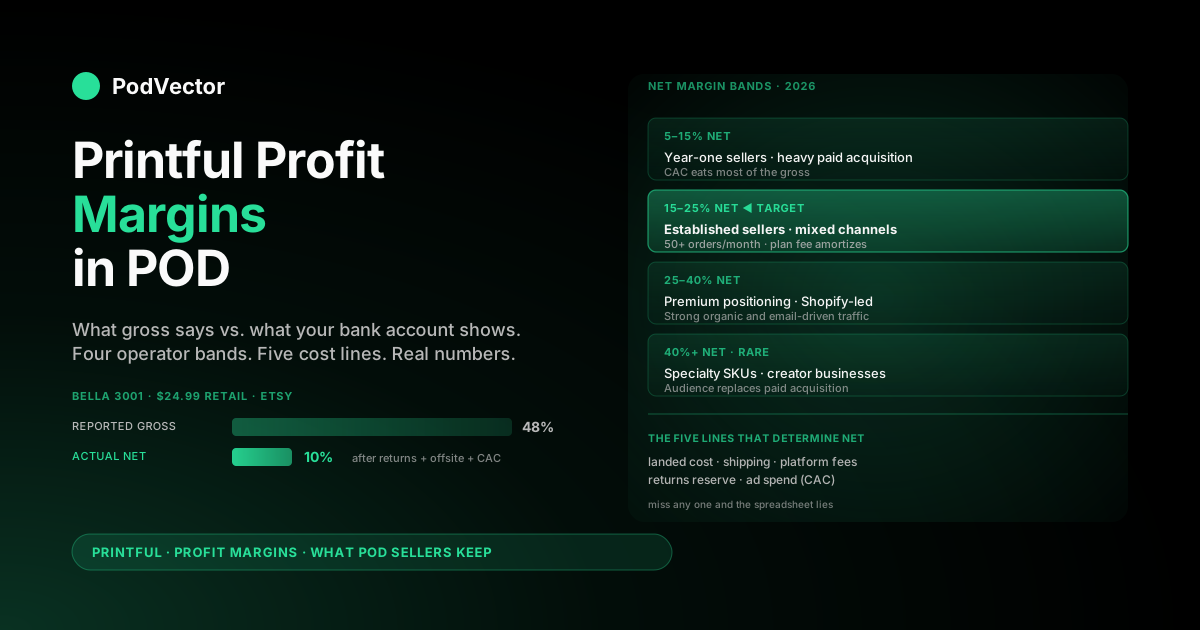
Quick Answer: Printful POD profit margins typically run 15–25% net for established sellers and 5–15% net for new ones — below the 30–40% gross most calculators report because they skip returns, plan amortization, and customer acquisition cost (CAC).
The number depends more on plan tier, channel mix, and product class than on retail price. A Bella 3001 tee on Etsy with offsite ads triggered can land at 5% net while the same SKU on Shopify with paid ads pencils at 18%.
This guide walks the actual margin ranges by product and channel, what drives the gap between gross and net, and the operator signals that tell you a SKU is bleeding before the monthly P&L makes it obvious.
Gross vs. net margin — the two numbers Printful sellers confuse
Most POD content reports a single “margin” figure. There are actually two, and the gap between them is where most Printful sellers lose money without noticing.
Gross margin is retail price minus product cost, divided by retail. On a $24.99 tee that costs Printful $12.95, gross is 48%. This is the number Printful's product page and most calculators show.
Net margin is what is left after every other cost line: shipping out, platform fees, returns reserve, payment processing, refunds, and ad spend per order. On that same tee, net usually lands somewhere between 8% and 18% depending on channel.
The 30-point gap between gross and net is not a rounding error. It is where the business actually lives or dies. Operators who plan against gross margin run out of cash; operators who plan against net margin can reinvest, raise retail with confidence, and decline orders that pencil underwater.
Every margin number in the rest of this guide is net unless we say otherwise. Gross is a useful sanity check, but it is not the number that pays rent.
Realistic Printful margin ranges in 2026
Across the operator data we see, Printful POD net margins cluster into four bands. The band a seller lives in tells you more about their business than the SKU mix does.
Printful's own guidance is to add at least a 30% markup over base price, and most POD content quotes 20–40% as a “good” margin. Both are gross-side benchmarks. They describe the markup you set, not the profit you keep. The bands below are net — what survives after fees, returns, and CAC — which is why they run lower than the sticker benchmark and are the number that actually predicts whether the business compounds.
5–15% net. First six months of operation, or any business running heavy paid acquisition on Meta or TikTok. CAC eats most of the gross.
15–25% net. Established sellers with a mix of paid and organic, decent product/market fit, and at least 50 orders per month so the plan fee amortizes. This is where most viable POD businesses live.
25–40% net. Premium positioning — specialty products, branded niches, design-forward stores with high repeat rates. Usually on Shopify with strong organic and email-driven traffic.
40%+ net. Rare. Usually a specialty SKU (canvas prints, signed posters, ultra-niche merchandise) at a meaningful retail premium, or a creator business where audience replaces paid acquisition entirely.
If your reported margin sits above 25% net and you have not consciously engineered the levers behind it — channel mix, plan tier, retail discipline — the number probably reflects gross, not net. Re-run the math with returns reserve and CAC included.
Margin by product class
Different Printful product lines have structurally different margin shapes. The cost stack changes more than retail flexibility does, so margin profiles cluster by category.
| Product class | Typical gross | Typical net | Main margin pressure |
|---|---|---|---|
| Bella 3001 tees | 40–55% | 8–20% | Etsy fees + offsite ads + CAC |
| Heavy hoodies | 35–50% | 15–30% | Size-mix upcharges, return rate |
| Ceramic mugs | 50–65% | 18–35% | Breakage in transit, separate shipping |
| Posters / canvas | 50–75% | 25–45% | Shipping cost on larger sizes |
| Phone cases | 45–60% | 15–30% | Compatibility return rate, model churn |
| Embroidered hats | 35–50% | 12–25% | Digitization fees, narrow design space |
| Stickers / kiss-cut | 55–75% | 25–45% | Low retail cap, thin absolute dollars per order |
| Tote bags | 45–60% | 18–35% | Single-print design space, seasonal demand |
Tees show the widest net spread because they sell most on Etsy, where offsite ads trigger automatically past $10K/year and claim 12–15% off the top. Posters carry the highest net margin profile because shipping is cheaper relative to retail and customer return rates are low.
For deeper category-specific work, the phone-case profit margin breakdown walks the accessory category in detail, and the Printful money-making cluster collects the apparel and cost-side deep dives.
The five cost lines that determine your margin
Every Printful net margin is the result of five subtractions from retail. Miss one and the spreadsheet predicts a margin the bank account never delivers.
1. Landed product cost. Printful base price plus print placement add-ons ($4.76–$5.95 for back print, $2.49 for sleeve), plus size upcharges ($2.00–$5.50 on 2XL through 4XL), plus the monthly plan fee amortized across orders.
2. Shipping out. Whether you charge the customer or absorb it, shipping always lands on the cost side. US first-item rates run $4.69 for tees, $5.95 for hoodies, $5.49–$13.95 for mugs.
3. Platform fees. Etsy takes ~9.7% combined (listing + transaction + processing) before offsite ads. Shopify takes 2.9% + $0.30 per transaction. Amazon takes a 15% referral fee. eBay takes ~13.25% as a final value fee.
4. Returns and reprints reserve. 2–5% of revenue depending on product. Tees and posters at 2%. Hoodies and mugs at 4–5%. Printful covers production defects but not customer-side returns — those come out of your pocket.
5. Ad spend (CAC) per order. Total ad spend in the period divided by paid orders in the period. On Meta-driven tees, CAC commonly runs $10–$18. On Google Shopping, $7–$14. On Etsy organic, effectively $0 until offsite ads triggers.
Subtract all five from retail. What is left is net profit. To price toward a target instead of checking after the fact, work the formula backwards: total the five cost lines, then divide by (1 − target margin). A tee with $16.80 of stacked costs priced for 20% net needs a retail of $16.80 ÷ 0.80 = $21.00. The reason most calculators land high is that they only load line 1 (product cost) into that total and leave lines 2–5 out, so the retail they hand back clears far less than the 30% it promises.
For the full per-line worked examples, the step-by-step Printful profit calculator walks two SKUs end to end.
How Printful's plan tier moves your margin
Printful's plan choice changes your gross margin by 6–10 percentage points on DTG products. It is the single highest-leverage cost-side decision a seller makes once volume picks up.
Free plan. No monthly fee. Base prices as published. Fine if you ship under ~20 orders per month or are still validating product/market fit.
Growth plan ($24.99/month). Discounts DTG base prices roughly 20%. A Bella 3001 drops from $13.50 to around $10.80. Pays for itself at roughly 9 garment orders per month and compounds from there.
Business plan ($49.99/month). Discounts DTG base prices roughly 30%. Same Bella 3001 lands near $9.45. Pays for itself near 50 garment orders per month.
The plan fee is a fixed cost amortized across orders. At 25 orders per month on Growth, the fee adds $1.00 per unit. At 100 orders, $0.25. That amortization rate matters more than the plan name — a Growth plan at 5 orders per month is worse than the Free plan because the unit fee swamps the discount.
Run the plan math against your actual current order count, not your aspirational one. A common mistake is upgrading to Business at 30 orders per month, where the $49.99 fee adds $1.67 per unit and the deeper discount does not fully cover it.
How channel choice moves your margin
The same SKU at the same retail price produces meaningfully different net margins on different channels. Channel mix is one of the top three margin levers and one of the most under-modeled.
| Channel | Fee structure | Tee net margin range | Margin trap |
|---|---|---|---|
| Etsy | $0.20 listing + 6.5% transaction + ~3% + $0.25 processing | 5–15% | Offsite ads auto-trigger past $10K/yr, 12–15% off the top |
| Shopify (Basic) | 2.9% + $0.30, plus $39/month subscription | 10–25% | You pay for your own traffic — CAC is the swing factor |
| Amazon Merch on Demand | Royalty model — Amazon handles everything | 13–20% | Locked margin, no way to raise retail without re-listing |
| eBay | ~13.25% final value fee + optional promoted listings | 8–18% | Lower buyer intent for premium designs |
| TikTok Shop | ~5% commission + 2.9% processing | 10–20% | Creator commissions of 10–20% on top if affiliate-driven |
Etsy is the lowest-margin channel for established Printful sellers because offsite ads cannot be opted out of past the revenue threshold. Most operators above $10K/year on Etsy effectively run at 12–15% lower gross than the sticker fee schedule shows.
Shopify gives the most retail and margin control but transfers acquisition risk to the seller. Net margin on Shopify is mostly a function of CAC — with $5 CAC the same tee that lands at 10% on Etsy can clear 25% on Shopify; with $20 CAC it goes underwater.
For international margin pressure, the channel question intersects with shipping. The Printful France shipping cost breakdown and the India shipping cost breakdown show how absorbing international shipping at constant retail crushes net margin on overseas orders — another reason regional pricing matters.
Why two sellers with the same SKUs land at different margins
Two POD operators can sell the same Bella 3001 tee at the same $24.99 retail and report margins of 22% and 8%. The SKU is identical. The business reality is not.
Channel mix. 80% Etsy at scale will pull net margin 8–10 points lower than a 60/40 Etsy/Shopify split because of offsite-ads exposure.
Plan tier and amortization. Growth plan at 100 orders/month is 6 points of gross margin better than Free plan at the same volume. The difference is invisible until you actually run it.
Size and placement mix. A store with 25% 2XL+ sales and 40% back-print orders carries $1.80–$2.20 more in landed cost per unit than a store selling 90% S–XL front-print only.
Returns rate. A 2% returns rate vs. a 6% returns rate is 4 points of net margin. Sizing-chart quality, mockup accuracy, and customer-service responsiveness drive that gap more than product quality does.
Repeat customer share. Repeat customers carry zero CAC for that order. A store with 30% repeat orders has effectively 30% of its revenue running at first-order-gross margin — often 10–15 points higher than the blended number suggests.
The number that matters is not “is my margin good.” It is “which of these five levers is dragging me down, and which is the cheapest to move first.” That diagnosis is portfolio work, not per-SKU work.
Margin red flags — when a SKU is quietly bleeding
Margin erosion almost never announces itself. A SKU stays profitable on paper for months while one of these five conditions silently turns it into a loss leader.
Returns rate above 5% on a tee, 8% on a hoodie. Returns rates north of these thresholds usually signal a sizing-chart or mockup problem. Each percentage point above the threshold is roughly half a point of net margin gone.
Base-price drift after a Printful adjustment. Printful changes base prices several times a year. If your retail has not moved in 12 months and the base went up $1.20, you are operating at 1.2 points of margin lower than the spreadsheet says.
Channel drift toward Etsy past $10K/year. If Etsy is growing faster than Shopify in your mix and you are past the offsite-ads threshold, the blended fee line is creeping up 1 point per quarter until it stops.
Rising CAC at constant retail. A $14 CAC last quarter and a $17 CAC this quarter on the same SKU means $3 of net margin per order has vanished. If retail has not moved, the SKU is now selling at a lower net than your reporting shows.
Plan-fee underutilization. Order count has fallen but the plan is still Growth. The $24.99 fee is now $2.50 per unit at 10 orders per month instead of $0.50 at 50. Either get volume back or downgrade.
These five questions — what is my returns rate, has base price drifted, is channel mix shifting, is CAC rising, is plan utilization right — are exactly the kinds of queries an AI employee connected to live Printful invoice data, Shopify orders, and ad-platform spend can answer in seconds. Asking them weekly catches margin erosion before it shows up in the monthly P&L.
What a healthy Printful margin profile looks like
A profitable Printful POD business does not have one number it stares at. It has five that move together, and a routine for catching when any one drifts.
Net margin sits in the 18–25% band on a blended basis. Top-quartile SKUs run 30%+ net, bottom-quartile SKUs run 10–15%, and the operator has a calibrated reason to keep the low-margin SKUs (volume driver, doorbuster, paid-traffic warm-up).
Channel mix is intentional. Etsy is fed for discovery and offsite-ads risk is priced into retail. Shopify is fed for margin and CAC is tracked against per-channel break-even. Amazon Merch is treated as passive royalty, not as the primary engine.
Plan tier is matched to volume. Growth at 50–200 orders/month. Business at 200+. Free below 25. The plan-fee-per-unit is held under $0.60.
Returns rate sits at 2–3% blended, with size mix and mockup quality reviewed quarterly. The reserve line in the cost stack is calibrated to actual experience, not a guess.
Retail is reviewed at least twice a year against Printful base-price changes and Etsy fee changes. The portfolio is repriced as a system, not SKU by SKU.
For sequencing all of that, the full Printful money-making cluster aggregates every margin-mechanics article we maintain, and the Printful topic hub indexes the broader cost and fulfillment context.
FAQs
What is a good Printful profit margin in 2026?
15–25% net margin is healthy for an established Printful POD business, after returns reserve and ad spend are included. Above 25% net suggests premium positioning or strong organic. Below 15% net usually means either heavy paid acquisition is eating gross or channel mix is too Etsy-heavy past the offsite-ads threshold.
Why is my Printful margin lower than the calculator shows?
Most online calculators omit two cost lines: returns reserve (2–5% of revenue) and ad spend per order. Together they routinely cut the calculator's “gross” margin in half. Add those two lines back and the result lands close to what your bank account actually shows.
Which Printful product class has the best margin?
By percentage, stickers (25–45%) and posters/canvas (25–45%) lead because shipping is cheap relative to retail and returns are rare. But watch absolute dollars: a 40% margin on a $4 sticker is $1.60, so stickers only pay as a volume or bundle add-on, not a primary engine. Mugs come next (18–35%) provided breakage is managed, then tote bags (18–35%). Tees are middling (8–20%) because Etsy fees and offsite ads compress them, and hoodies (15–30%) sit between with size mix as the swing factor.
How much does Printful's plan tier change my margin?
Growth plan ($24.99/month) cuts DTG base prices about 20% — roughly 6–8 points of gross margin gained at volume. Business plan ($49.99/month) cuts them about 30% — roughly 8–10 points gained. Below 25 orders per month, the plan fee amortization erases most of that gain. Above 50 orders per month, Growth pays for itself comfortably.
Is Etsy or Shopify better for Printful margin?
Shopify clears 8–15 points more net margin per order on average, because Etsy charges higher transaction fees and offsite ads auto-trigger past $10K/year. The trade-off is that Shopify requires you to fund your own traffic. If your CAC is under $8, Shopify wins on margin. If your CAC is above $15, Etsy's free organic discovery may net more dollars even at lower per-unit margin.
Does free shipping kill Printful margins?
Only if you absorb it without rolling the cost into retail. A $24.99 tee with absorbed $4.69 shipping nets the same as a $20.30 tee with paid shipping at checkout — assuming Etsy's percentage fees are applied to the same total. The trap is using “free shipping” as a discount on top of competitive retail rather than as a bundled retail line.
What return rate should I budget for?
2–3% of revenue for tees and posters. 4–5% for hoodies (size complaints) and mugs (breakage in transit). Phone cases vary widely (3–7%) depending on model coverage and compatibility errors. Pull your last 90 days of refund volume against gross sales to calibrate — the reserve number should reflect your actual experience, not a generic POD industry figure.
How often do Printful base prices change?
Several times per year, usually announced via email 30–60 days in advance. Apparel base prices have moved $0.50–$2.00 per garment in recent rounds. If your retail prices have not been refreshed against the latest base, you are operating at lower net margin than your spreadsheet shows. A quarterly base-price audit catches the drift before it compounds.
Do I need to include sales tax in my margin calculation?
Yes, on both sides. Sales tax collected from the customer is pass-through revenue. Sales tax Printful charges you on the production order is a real cost line — you pay it whether or not you collected from the customer. In high-tax US states it can shave 1–2 points off net margin if ignored.
What is the fastest way to raise my Printful net margin by 5 points?
Usually one of three moves: upgrade to Growth plan if you are above 25 orders/month on Free, shift channel mix away from Etsy if offsite ads is triggered, or raise retail $1–$2 on your top 10 SKUs and watch conversion. Each is worth 2–4 points alone and they stack. None of them require finding new customers or new products.
Stop guessing which lever is eating your Printful margin
The five-cost-line model is right for one SKU. It breaks down the moment you have 40 SKUs across two channels with a shifting size mix, a changing returns rate, and Printful base-price tweaks landing every quarter.
Victor reads your itemized Printful invoices, Shopify orders, refund history, and Meta/Google ad spend live from a unified data warehouse. Ask “which of my SKUs dropped below 18% net margin this week” or “is my Meta ad cost rising faster than Shopify organic revenue” — get the answer and the SKU list in seconds.
External reference: Printful's own good profit margin guide covers benchmark margin ranges across the most common POD product lines if you want a category-level overview.
Try Victor free