
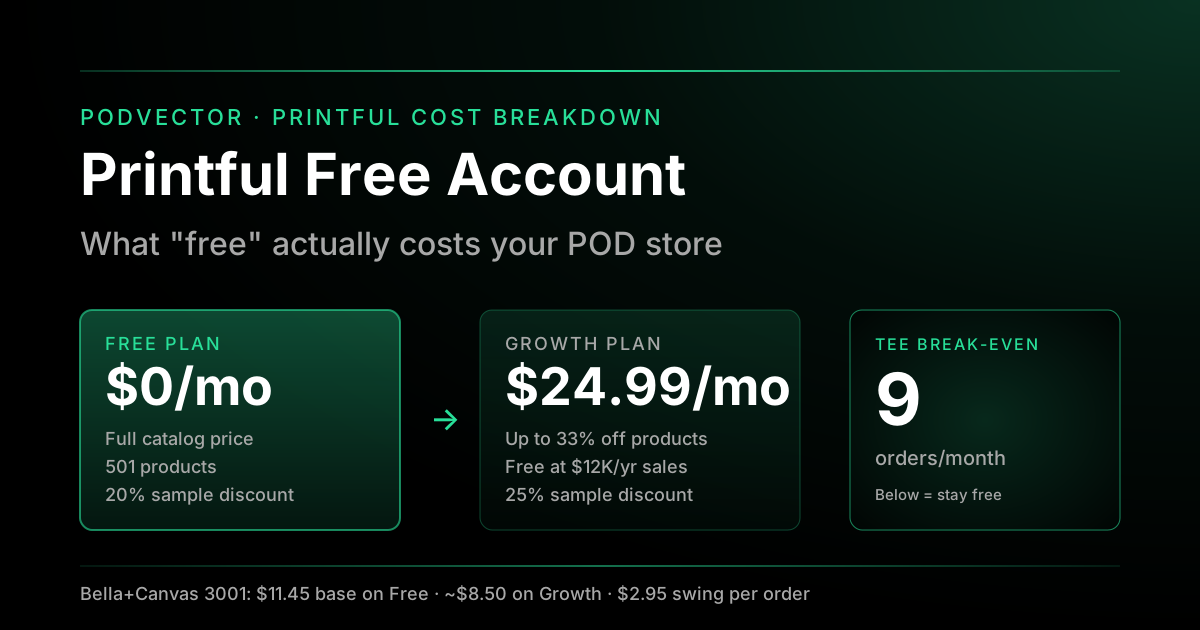
Quick Answer: A Printful free account costs $0/month. There is no signup fee, no monthly subscription, and no charge until a customer places an order — at which point you pay product base price + shipping + any optional extras.
The catch is the missing 33% discount that paid-plan sellers get. On a Bella+Canvas 3001 tee, Free pays $11.45 + $4.69 shipping = $16.14 per US order. The same SKU on Growth pays about $8.50 + $4.69 = $13.19. That $2.95 swing is what turns the "free" account into a real cost decision once you cross ~9 orders per month.
This breakdown walks the full Free-plan economics for 2026: what's actually included, what costs hit every order, where margin leaks, and the exact math for staying free vs. upgrading. For the wider pricing landscape, see our Printful pricing guide and the Printful costs and charges hub.
What "free account" actually means at Printful
A Printful free account costs nothing to open and nothing to maintain. You can create products, mock them up, list them across 20+ ecommerce platforms, and leave the account dormant for years without ever being charged.
That's the "free" part. It's accurate.
The part Printful's marketing soft-pedals: "free account" is not the same as "free to operate." Every order on the Free plan still costs you product base price, shipping, and any optional extras you've baked into the product. You only stop paying when no customer is buying — which means by definition no margin either.
The right way to think about the Free plan: it's the default tier, not a discount tier. You pay full catalog price on every unit. The paid tiers are where Printful trades subscription dollars for per-unit discounts.
What you get on the Free plan
The Free plan unlocks more than most sellers realize. Here's the 2026 inclusion list:
| Feature | Free plan |
|---|---|
| Catalog access | 501 customizable products |
| Stores you can connect | Unlimited stores, up to 10 Quick Stores |
| Ecommerce integrations | 20+ (Shopify, Etsy, WooCommerce, TikTok Shop, eBay, Wix, Squarespace, Amazon, etc.) |
| Design Maker & Mockup Generator | Included, unlimited use |
| Automated order fulfillment | Yes |
| Sample orders | 20% off, 1 order/month (up to 3 items) |
| Customer support | 24/7 access |
| Branded packaging slips | Standard pack-in available (no plan gate) |
| Inside & outside labels | Available, full price (no Growth discount) |
The feature gap between Free and Growth is narrower than the page implies. Most of what Growth adds is pricing, not capability — the same products, the same fulfillment, the same integrations, just at a lower per-unit cost.
That's important when modeling the "free" decision: you're not unlocking new tools by upgrading. You're buying down the unit cost on tools you already have access to.
What you don't get on Free
Three things sit behind the Growth paywall. None of them are deal-breakers if you're testing, but each becomes meaningful at scale.
The up-to-33% product discount. Growth gives you discounted catalog pricing across most SKUs — closer to 22–28% on tees and hoodies, and toward 33% on a small set of high-volume items. On Free, you pay the full sticker price every time.
Deeper branding discounts. Growth shaves about 9% off branding extras like custom labels and pack-in inserts. On Free, those extras cost full price ($0.99 for inside labels, $2.49 for outside labels, $0.25–$2.49 per packaging insert).
A higher sample-order discount. Free gets 20% off samples; Growth gets 25%. That's a small difference on a single tee, but it adds up if you're sampling a 30-SKU launch.
Notice what's not behind the paywall: faster shipping, better print quality, priority production, dedicated support. Printful treats all paying plans identically on fulfillment quality. The discount is the difference.
The real cost of a Free-plan order
To understand whether Free works for your store, model a single representative order all the way through.
Worked example: one Bella+Canvas 3001 tee with a single front print, shipped to a US customer, retail price $24.95.
| Cost line | Free plan | Notes |
|---|---|---|
| Product base price | $11.45 | Bella+Canvas 3001, single front print |
| US shipping (first item) | $4.69 | Standard rate |
| Printful subtotal | $16.14 | Before any platform/ad costs |
| Shopify transaction fee | $1.02 | 2.9% + $0.30 on $24.95 |
| Target marketing cost | $4.99 | 20% of revenue benchmark |
| Total cost to fulfill + acquire | $22.15 | |
| Operating profit on $24.95 retail | $2.80 (11.2% OPM) | Razor-thin |
The same SKU on Growth nets ~$5.75 operating profit (23% OPM). On Free, you're netting less than half that on every order. The Free plan looks like a deal on the marketing page; it's a margin compression on the P&L.
This isn't a reason to skip Free entirely. Test stores, hobby stores, and stores running fewer than 5 orders per month rationally stay on Free because the foregone discount is smaller than the $24.99 subscription. But once volume picks up, the math flips.
The hidden cost of the Free plan: foregone discount
The Free plan has a real cost. It's just not on the invoice — it's in the margin you didn't capture.
Foregone discount = (Free-plan base price − Growth-plan base price) × monthly order volume.
Here's how that number scales for common Printful SKUs:
| SKU | Free base | Growth base | Per-order savings | At 20 orders/mo | At 50 orders/mo |
|---|---|---|---|---|---|
| Bella+Canvas 3001 tee | $11.45 | ~$8.50 | $2.95 | $59 | $147.50 |
| Gildan 18500 hoodie | $22.25 | ~$17.45 | $4.80 | $96 | $240 |
| All-over print hoodie | $41.25 | ~$30.95 | $10.30 | $206 | $515 |
| 11oz ceramic mug | $6.50 | ~$5.05 | $1.45 | $29 | $72.50 |
| Embroidered snapback | $15.50 | ~$12.65 | $2.85 | $57 | $142.50 |
The per-order savings look small. The monthly totals don't. At 50 orders per month on a tee-heavy catalog, you're handing Printful ~$150 in foregone discount versus a $24.99 subscription that would unlock it.
For more on how the Growth discount actually plays out across product categories, see our Printful Growth cost breakdown, and the related plan-pricing detail in our Growth plan cost analysis and Growth plan pricing detail.
Free vs Growth: the break-even math
Growth costs $24.99/month. The break-even point is the number of orders per month where Growth's discount exactly covers the subscription.
For a tee-only store: $24.99 ÷ $2.95 savings per tee = 8.5 orders per month. Round up to 9.
For a hoodie-only store: $24.99 ÷ $4.80 = 5.2 orders per month. Round up to 6.
For a mug-only store: $24.99 ÷ $1.45 = 17.2 orders per month. Round up to 18.
Most POD sellers cross the 9-order tee threshold within their first 60–90 days of active selling. Below that, Free is mechanically correct. Above it, you're paying for the discount with foregone profit instead of with a subscription fee.
There's one more lever: Printful waives the Growth fee once your store crosses $12,000/year ($1,000/month) in Printful sales. Above that threshold, Growth is fully free and you keep the discount. That's the asymmetric upside — a paid plan that becomes a free plan with discounts attached.
The practical playbook: stay on Free for the first 60 days while you find product-market fit. Upgrade to Growth the month you cross 10 orders. Stay on Growth indefinitely; once you cross $12K/year, the subscription disappears and the discount stays.
When the Free plan is the right choice
Five scenarios where Free is correct:
1. You're testing the catalog. No volume yet, no marketing spend, no proven SKUs. The $24.99/month would buy a discount on zero orders. Free.
2. You sell <5 orders/month in low-margin categories. A mug-only store doing 4 orders/month saves ~$5.80 with Growth and pays $24.99 to get it. Stay free.
3. You run multiple stores and only one has volume. Free plans across all your accounts; upgrade only the one that crosses the volume threshold. Multi-store sellers often run 3–4 Free accounts and 1 Growth account.
4. Hobby or event merch. A band selling 10 tees a quarter at a merch table doesn't need Growth. The break-even math is wrong for them by an order of magnitude.
5. You're sampling before launch. Sample orders work fine on Free. The 20% sample discount is only 5 points behind the Growth 25%, which doesn't move the needle on 3-item sample runs.
When to leave Free behind
Four signals that Free is now costing you money:
1. Your monthly order count is steadily above 9 (tees) or 6 (hoodies). Run the per-SKU savings math. If foregone discount > $24.99/month, upgrade.
2. You've added extra print placements as a default. Back/sleeve prints cost $2.95–$5.95 each. Growth doesn't discount placements, but the lower base price on Growth absorbs more of the placement cost as a percentage of total fulfillment. Sellers with multi-placement designs benefit disproportionately.
3. You've moved from DTG to embroidery or AOP. Higher-base-price categories show bigger absolute Growth savings. AOP hoodie sellers cross the Growth break-even at ~3 orders/month.
4. You're approaching the $12K/year sales threshold. Once you're within 1–2 months of crossing it, switch to Growth so you capture the discount on the way up — and the moment you cross, the subscription stops being a cost.
The conversion from Free to Growth is instant. There's no migration, no data export, no setup fee. You toggle the plan and the next order ships at the new price.
How to maximize margin on the Free plan
If you're staying on Free deliberately, these are the levers that matter:
Avoid optional extras until you're sure they convert. Inside labels at $0.99/unit and outside labels at $2.49/unit add up fast on a Free-plan margin profile. Validate that the branding upgrade increases retail price or repeat-purchase rate before adding it as a default.
Choose lower-base SKUs. Gildan 5000 tees cost $7.95 base on Free versus $11.45 for Bella+Canvas 3001. The $3.50 gap absorbs most of the foregone Growth discount. Lower-quality fabric, sure — but for stores still validating, it's a viable cost lever.
Bundle multi-item orders. Printful charges $4.69 for the first US tee shipping and $2.20 for each additional item. A 2-tee order ships for $6.89 instead of $9.38. Free-plan stores benefit from this structure even more than Growth stores because the shipping savings aren't being competed against by a base-price discount.
Use Quick Stores for low-volume launches. If you're testing a niche design without committing to Shopify's $39/month, Printful's Quick Stores let you spin up a hosted storefront for free. You give up a lot of customization, but the cost stack is just Printful + payment processing.
Skip currency conversion losses. If your audience is mostly US-based, price in USD, ship US-only, and let Printful default to USD billing. A Free-plan store losing 2–3% of revenue to FX is throwing margin at the bank that the catalog isn't responsible for.
For sellers thinking through where margin actually comes from on Printful's catalog, see our deep-dives on Printful profit margin in POD and the related Printful profit margins guide.
Tracking Free-plan margin against your actual P&L
The math above assumes you know your real cost per order. Most Free-plan sellers don't, because Printful's order data lives in one system and Shopify's revenue/marketing data lives in another.
The hidden Free-plan problem isn't that the plan costs too much. It's that you can't see what it's costing. A Bella+Canvas tee that looked profitable in March can be break-even by May because shipping rates shifted, return rates ticked up, or ad CPCs rose — and the Free-plan margin is too thin to absorb the drift unnoticed.
This is what Victor — PodVector AI's AI business operator for POD stores — handles. Victor pulls itemized Printful costs live (every fee line on every order) into a unified data warehouse, joins them against your Shopify revenue and ad spend, and answers operator questions like:
- "Which Free-plan SKUs dropped below 15% OPM last week?"
- "How much would I have saved last month on Growth versus Free?"
- "What's my current break-even order volume for switching plans?"
And — this is the part that separates an AI employee from a dashboard — Victor can propose specific actions on your Shopify store (price changes, discount creation, collection updates) and execute them on your approval, with a full audit trail. The combo is POD playbook + live store data + ability to act on it, in a single agent.
You don't need it on day one. You need it the month your Free-plan store crosses 20+ SKUs and "is this product still profitable?" starts taking a spreadsheet afternoon to answer.
FAQs
Is the Printful free account really free?
Yes — there is no signup fee, no monthly platform fee, and no per-product charge on the Free plan. You only pay when a customer places an order, at which point you owe product base price + shipping + any optional extras. The platform itself is free to use indefinitely.
What's the difference between the Free plan and Growth?
Growth costs $24.99/month and gives you up to 33% off catalog product prices, 9% off branding extras, and a 25% sample discount (vs 20% on Free). Free has identical fulfillment quality, identical product catalog, and identical integrations — the difference is purely the discount tier on per-unit pricing.
How many orders do I need before upgrading from Free?
The break-even depends on what you sell. For tees, it's about 9 orders/month. For hoodies, 6. For AOP hoodies or premium garments, as few as 3. Run the math: ($24.99 ÷ your per-SKU Growth savings) = your break-even order count.
Are there any hidden fees on the Free plan?
Not from Printful's plan side — Free is genuinely $0/month. But every order on Free carries the same potential extra charges as any other plan: currency conversion (~2–3%), address corrections ($6.99+ per fix), customer-fault returns (you absorb the cost), and lost-package reships (sometimes covered, sometimes not). These hit Free harder because the margin cushion is thinner.
Can I sell across multiple stores on a Free account?
Yes. Free accounts support unlimited connected stores and up to 10 Quick Stores. Many multi-store POD sellers run a single Printful Free account that fans out to several Shopify, Etsy, and TikTok Shop storefronts. The discount tier is per-account, not per-store, so volume across stores compounds toward the Growth break-even.
Does the Free plan limit which products I can list?
Effectively no. Free accounts get access to the full 501-product catalog. There's no SKU gating, no premium product wall, and no embroidery or AOP restriction. The catalog Growth sees is the catalog Free sees — at full price.
How does the Free plan sample discount work?
Free gets 20% off, one sample order per month, with a cap of 3 items per order. Once your store crosses $300/month in Printful sales, the monthly item cap typically increases to 5. The discount applies automatically at checkout when you order from your own store's product list.
Does Printful offer bulk discounts on the Free plan?
Yes. Bulk discounts apply to any order of 10+ units of the same SKU shipping to one address, regardless of plan tier. Discounts range from ~5% at 10 units to ~55% at 500+ units. The bulk discount stacks with the Growth subscription discount, so Growth + bulk is the cheapest combination — but Free + bulk is still meaningfully cheaper than Free + single-unit orders.
Can I downgrade from Growth back to Free?
Yes, at any time, with no penalty. Plan changes take effect at the end of the current billing cycle, and there's no minimum term commitment on Growth. Sellers who have seasonal stores often run Growth during Q4 and Free during the off-season.
What happens to my products and stores if I close the Free account?
Your product templates and design files are deleted when the account is closed, but past orders remain in your records for tax and customer-service purposes. If you're stepping away temporarily, leave the account open — there's no cost to keeping a dormant Free account active.
Knowing the plan is free is one thing. Knowing your store is profitable is another.
Free-plan margin is thin. That's manageable when you know exactly which SKUs work and which don't — and impossible when Printful order data, Shopify revenue, and ad spend live in three different systems. Victor reads itemized Printful costs live, joins them against your store and ad data, and tells you which products are still profitable this week. Then he proposes specific actions (price changes, discount creation, collection updates) and executes them on your approval.
For the broader pricing landscape, jump to our Printful resource hub, the costs and charges cluster, or Printful's official pricing page for the source-of-truth plan tiers.
Try Victor free