
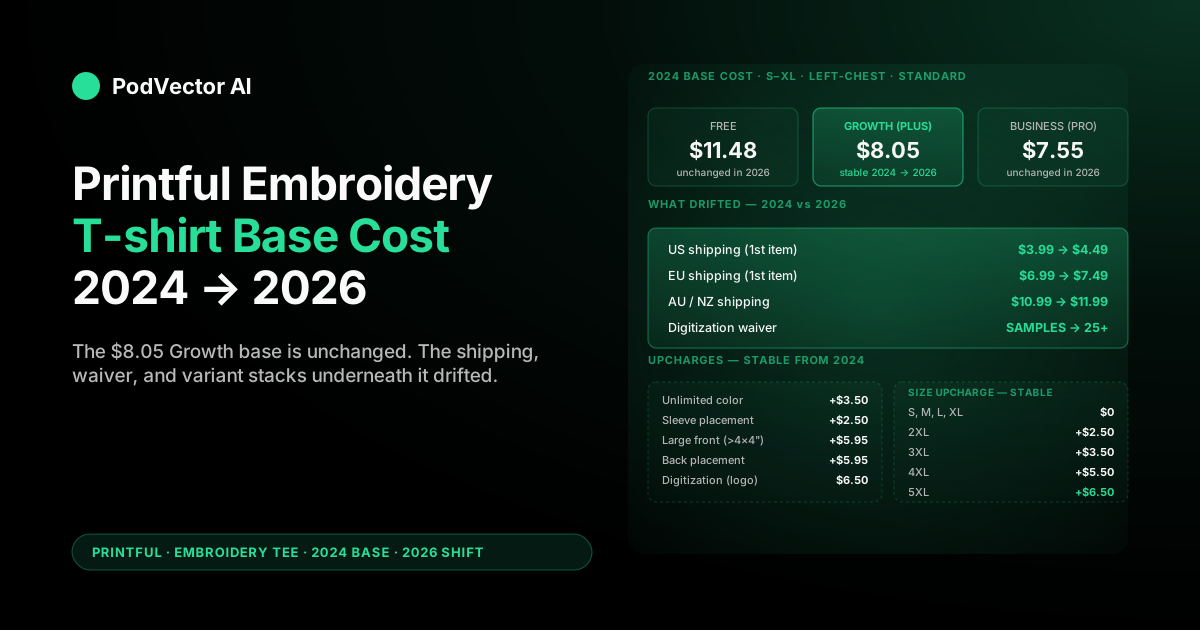
Quick Answer: In 2024, Printful's embroidered Gildan t-shirt base cost was $11.48 on the Free plan (left-chest standard-color embroidery, US fulfillment). Growth plan landed near $8.05; Business plan near $7.55.
Those base numbers carried into 2025 and are still the catalog anchor in May 2026 — but the surrounding fees (digitization, unlimited color, large-front, shipping) have shifted enough to move landed cost by $1.50–$3.00 per shirt.
This guide walks the 2024 baseline cost line by line, flags what's changed since, and shows what the embroidered tee actually costs to ship today.
The 2024 embroidered tee base cost
The 2024 Printful catalog priced a single-placement, standard-color embroidered Gildan tee at $11.48 on the Free plan for sizes S–XL, US fulfillment. That's a left-chest, ≤4" × 4" stitch area, default 15-color thread palette.
Subscription tiers pulled that number down further. Growth-plan members paid about $8.05; Business-plan members about $7.55. The Free-to-Business spread on the same shirt was $3.93 per unit — meaningful margin on every order.
| Plan (2024) | Monthly fee | Embroidered tee base (S–XL) | Discount vs Free |
|---|---|---|---|
| Free | $0 | $11.48 | — |
| Growth (then "Plus") | $9.99–$24.99 | $8.05 | ~30% |
| Business (then "Pro") | $49.99 | $7.55 | ~34% |
The plan names have shifted — Printful's mid-tier was rebranded from "Plus" to "Growth" during 2024–2025 — but the discount math and break-even points stayed effectively identical.
If you're auditing 2024 invoices and trying to reconcile what an embroidered tee cost you back then, $11.48 / $8.05 / $7.55 are the anchor numbers by plan. Any deviation almost always traces to placement, color mode, or size upcharges.
For the broader 2024–2026 picture across Printful's pricing model, see our full Printful pricing breakdown.
What's changed since 2024
If you ran an embroidered-tee SKU in 2024 and you're modeling 2026 economics, three things have moved enough to rewrite your unit-cost spreadsheet.
Plan structure consolidated. The mid-tier moved from "Plus" to "Growth" with a single price point ($24.99/month, waived above $12k annual). The Pro tier became Business at $49.99/month, waived above $150k annual. The 2024 ladder had more rungs.
Digitization waiver thresholds tightened. In 2024, sample-order digitization waivers were more generous on the Growth-equivalent tier. The current 25+ identical-item rule is now the cleanest path to a free digitization.
Shipping rates drifted up. US first-item embroidered-tee shipping was closer to $3.99 in early 2024. It now sits near $4.49 — a $0.50 per-order swing that compounds with order volume.
The base cost number itself didn't move much. The base $11.48 / $8.05 / $7.55 ladder is intact. What moved is the supporting fee structure around it.
The net effect on landed cost from 2024 to 2026: roughly $1.50–$3.00 per shirt depending on plan, placement, and destination. Material if your retail price stayed flat at $24.95 over the same period.
Digitization fee — 2024 vs 2026
Embroidery requires a digitized file — your artwork converted into a machine-stitch-path file. Printful charges a one-time digitization fee per design, not per shirt. The numbers in 2024 vs 2026:
| Digitization type | 2024 fee | 2026 fee | Notes |
|---|---|---|---|
| Text-only design | $3.95 | $3.95 | Unchanged — wordmarks, monograms |
| Standard logo or image | $6.50 | $6.50 | Unchanged — most custom artwork |
| File adjustment | $2.95 | $2.95 | Editing a previously digitized file |
| 25+ same-design bulk waiver | Yes | Yes | Digitization fee fully waived |
The fee line items are stable from 2024 through today. What's tightened is the path to waiver: 2024 had a more generous sample-order policy that could waive digitization on a 5–10 unit run; the current rule is a hard 25+ identical-item threshold.
For a store with three core designs, total digitization spend is still $11.85–$19.50 lifetime. Amortized over the first 100 shirts sold, that's $0.12–$0.20 per unit — a rounding error in your unit economics.
The fee bites differently if you're testing designs. Twenty standard logos at $6.50 is $130 before you ship a single shirt. That hasn't changed since 2024, and the more disciplined your design-testing workflow, the smaller this line gets.
Standard color vs unlimited color
Printful's embroidery has come in two color modes since 2024. Each prices differently.
Standard 15 thread colors are the default. Black, white, navy, royal blue, red, athletic gold, kelly green, purple, pink, grey, and a handful of others. Designs using only these hit the base $11.48 (Free) / $8.05 (Growth) / $7.55 (Business) numbers. No upcharge.
Unlimited color embroidery — the premium mode — adds +$3.50 per shirt. This unlocks gradient blends, photo-realistic stitching, and any color outside the standard palette. A Growth-plan tee jumps from $8.05 to $11.55 base.
The +$3.50 unlimited-color upcharge has held steady since 2024. The trade-off rules of thumb have held too: bold two-color wordmarks work in standard colors; vintage badges with sunset gradients need unlimited.
Test the design in standard colors first. If the conversion rate clears your margin floor at the lower base cost, ship it. If the design genuinely needs gradient or custom-Pantone colors to convert, the $3.50 upcharge is usually worth it on lifestyle SKUs.
Placement and stitch-area upcharges
The base embroidery cost covers one placement, up to a 4" × 4" stitch area. That's enough for a left-chest logo, a center-chest monogram, or a small sleeve hit. Anything beyond that is itemized — and these line items have been remarkably stable from 2024 through 2026.
| Placement / area | Typical add | When it applies |
|---|---|---|
| Left chest (≤4" × 4") | Included in base | Default placement |
| Center chest (≤4" × 4") | Included in base | Front-center logos |
| Sleeve (each) | +$2.50 | Left or right sleeve |
| Large front (full-chest) | +$5.95 | Design exceeds 4" × 4" |
| Back placement | +$5.95 | Any back design |
| Unlimited color upgrade | +$3.50 | Gradients or custom palette |
The line item that catches new POD sellers off guard is "large front." A center-chest badge that looks like one logo in your mockup may exceed 4" × 4" and trip the $5.95 large-front upcharge — three full points of margin on a $24.95 retail.
If you're modeling 2024 invoices against your storefront, the large-front line is the most common reason an "embroidered tee" SKU you sold for $24.95 didn't clear margin. The 2024 baseline cost was $8.05 — but a large-front variant on Growth was $14.00. Same SKU name, different invoice line.
Size upcharges on embroidery
Size upcharges on embroidered tees follow the same structure as DTG-printed tees, and the table hasn't moved meaningfully since 2024:
| Size | Upcharge vs S–XL | Growth base (left-chest, standard) |
|---|---|---|
| S, M, L, XL | $0 | $8.05 |
| 2XL | +$2.50 | $10.55 |
| 3XL | +$3.50 | $11.55 |
| 4XL | +$5.50 | $13.55 |
| 5XL | +$6.50 | $14.55 |
Size upcharges stack on top of the base cost before plan discounts apply. A 3XL Growth-plan embroidered tee is $11.55, not $8.05 + $3.50 minus a discount line.
The 2XL-to-5XL range is where embroidered-tee margins quietly die on extended-size offerings. A 4XL left-chest embroidered tee at $13.55 base, plus $4.49 shipping, plus processing, lands at $19.20+ before reserves. At a flat $24.95 retail, that's a 23% contribution margin — not 42%.
Most POD operators either drop the 4XL/5XL variants entirely or price them as separate SKUs at $27.95–$29.95 retail. Flat-retail-across-all-sizes pricing is the silent killer here.
Shipping — 2024 rate card vs 2026
The shipping line is where the 2024-to-2026 cost drift shows up most clearly. US first-item embroidered-tee shipping was closer to $3.99 in early 2024. The 2026 rate card sits at $4.49. International rates have drifted similarly.
| Destination | 2024 first item | 2026 first item | Shift |
|---|---|---|---|
| US domestic | $3.99 | $4.49 | +$0.50 |
| Canada | $5.49 | $5.99 | +$0.50 |
| UK | $5.49 | $5.99 | +$0.50 |
| EU | $6.99 | $7.49 | +$0.50 |
| Australia / NZ | $10.99 | $11.99 | +$1.00 |
Each-additional-item rates moved similarly. The cumulative drift across two years is roughly $0.50–$1.00 per order — small per shirt, real at 500-orders-a-month volume.
Embroidered tees ship under the apparel rate card. There's no surcharge for being embroidered vs DTG-printed — where shipping bites is destination, not technique. That was true in 2024 and it's still true now.
For Printful's broader pricing-model context, including how shipping interacts with subscription discounts, see our Printful pricing model breakdown.
Full landed-cost walk on an embroidered tee
Base cost is the floor. Landed cost — what the SKU actually costs you per order — is where margin is decided. A side-by-side walk on the same Growth-plan embroidered tee in 2024 vs 2026:
2024 — Growth plan, size M, left-chest standard, US, $24.95 retail:
- Base cost: $8.05
- + Shipping (US first tee, 2024): $3.99
- + Digitization (amortized over 100 units): $0.07
- + Payment processing (2.9% + $0.30): $1.02
- + Pro-rated Growth fee (at 50 orders/month): $0.50
- + Reprint/return reserve (2%): $0.40
- 2024 landed cost: $14.03
- Contribution margin: $10.92 (44%)
2026 — same plan, same product, same retail:
- Base cost: $8.05
- + Shipping (US first tee, 2026): $4.49
- + Digitization (amortized): $0.07
- + Payment processing: $1.02
- + Pro-rated Growth fee: $0.50
- + Reprint/return reserve: $0.40
- 2026 landed cost: $14.53
- Contribution margin: $10.42 (42%)
The 2024-to-2026 contribution-margin drift is 2 points. Small per shirt — but at 1,000 embroidered orders a year, that's $500 of margin you absorbed without changing anything.
The walk gets worse on the variants that stack upcharges. A 2024 vs 2026 walk on a 2XL, back-embroidery, unlimited-color variant lands at $22.06 vs $22.56 — 12% vs 10% margin at a flat $24.95 retail. Either variant is a money-loser once you include ad spend.
The lesson: flat-retail pricing across embroidered variants silently destroys margin on the size-and-placement combinations that cost the most. The fix is variant-level retail or a hard storefront rule against multi-placement embroidered tees.
Using 2024 data to plan 2026 SKUs
If you ran an embroidered-tee catalog in 2024 and you're rebuilding the pricing model for 2026, the actionable takeaways:
Don't trust your 2024 unit-cost spreadsheet. Shipping drifted, the plan structure renamed, and the variant upcharges that flew under the radar in 2024 are the same ones still eroding margin in 2026. Rebuild from current catalog numbers, not historical assumptions.
The base cost number ($8.05 Growth) is stable. What's volatile is everything stacked on top of it. Lock the base, but quote landed cost — that's the only number that survives variant pricing decisions.
Audit your variant pricing. If you set flat retail across S–5XL and across single/multi-placement embroidery in 2024, the 2026 margin profile on those variants is almost certainly worse than your spreadsheet says.
The hard part of embroidered-tee cost work isn't pulling a number from a 2024 invoice or a 2026 catalog. It's keeping the number current across every embroidered SKU and tying it back to the actual orders flowing through your store.
Most POD stores discover their embroidery margin problems after the fact. They quote $8.05 as "the embroidered tee base" in their pricing model, but the real invoice line shows $11.55 on unlimited-color orders, $14.00 on front-plus-back orders, and an extra $5.95 per unit on the large-front variants nobody flagged.
PodVector AI's Victor agent connects your Shopify webhook stream, Printful invoices, and payment processor fees into a single live data warehouse for your store. You can ask Victor "which of my embroidered SKUs dropped below 30% margin last month, broken down by size and placement?" and get a live answer — not a static dashboard frozen at month-end.
Victor can also propose specific Shopify actions in response: per-variant retail pricing on large-front embroidered SKUs to recover the upcharge, a free-shipping threshold to encourage two-tee bundles that amortize first-item shipping, or a retail bump on SKUs that drifted below your margin floor. Each proposal is executable on your approval with a full audit trail.
For external reference on current catalog prices, the Printful custom embroidered shirts product page is the canonical source. For a broader pricing-guide comparison covering 2024 and current rates, see our Printful pricing guide, the full Costs & Charges cluster, or the Printful topic hub.
If you're still weighing Printful against Printify on embroidery costs, see our Printify vs Printful comparison and the Printful vs Printify head-to-head.
FAQs
What was the Printful embroidered t-shirt base cost in 2024?
The 2024 entry-level Gildan embroidered tee was $11.48 on Free, $8.05 on Growth (then called Plus), and $7.55 on Business (then Pro), for sizes S–XL, US fulfillment, one left-chest standard-color embroidery. None of those numbers included shipping, digitization, or unlimited-color upgrades.
Has the embroidery base cost changed in 2025 or 2026?
The base cost numbers themselves are stable. The supporting fees moved: US first-item shipping rose from ~$3.99 to ~$4.49, the digitization waiver tightened to 25+ identical items, and plan names changed. Net landed-cost drift from 2024 to 2026 is roughly $0.50–$1.00 per order on common variants.
What was the digitization fee in 2024?
$3.95 for text-only designs, $6.50 for standard logos or images, $2.95 to adjust a file you'd already digitized. Those numbers haven't changed. The waiver rules tightened — 2024 had a more generous sample-order policy; 2026 enforces a hard 25+ identical-item threshold for the fully-waived digitization fee.
Why does embroidery cost more than DTG printing?
Embroidery runs through a multi-needle machine that stitches thread into fabric — 7–10 minutes per shirt on a 4,000-stitch logo. DTG sprays water-based ink in 2–3 minutes per shirt. The +$2 premium on Printful covers the additional machine time, thread, and operator handling. That cost differential was true in 2024 and remains true today.
Are there color limits on Printful embroidery?
The base price covers the standard 15 thread colors — black, white, navy, royal blue, red, athletic gold, kelly green, purple, pink, grey, and a few others. Designs using only those colors carry no upcharge. Unlimited color embroidery (gradients, custom Pantone, photo-realistic) adds +$3.50 per shirt. The upcharge has held steady since 2024.
Can I get a bulk discount on embroidered shirts?
Yes. Single orders of 25+ identical items unlock tiered discounts: ~5% at 25 units, ~15% at 50, ~25% at 100, ~35% at 250, ~55% at 500+. The discount stacks on top of your subscription tier discount, and the digitization fee is waived on any 25+ order. The discount applies to one design at a time — mixing designs doesn't count toward the threshold.
What's the size upcharge structure on embroidered tees?
Same as DTG-printed tees: $0 on S–XL, then +$2.50 on 2XL, +$3.50 on 3XL, +$5.50 on 4XL, +$6.50 on 5XL. The upcharge stacks on top of the base before plan discounts apply. This structure has held from 2024 through 2026.
Should I anchor my retail price on the 2024 base cost or the 2026 landed cost?
Landed cost — and the current one, not the 2024 one. The $8.05 Growth base is stable, but landed cost on a US single-placement embroidered tee is closer to $14.53 in 2026 after current shipping, processing, and reserves. Anchoring on a 2024 spreadsheet typically understates 2026 unit cost by $0.50–$1.50 per order — enough to silently push variants below margin.
Your 2024 unit-cost spreadsheet is out of date
The $8.05 Growth base is still right. The shipping line moved $0.50. The 2XL upcharge stacks differently. The variants you priced once in 2024 may have drifted below margin in the two years since.
PodVector AI's Victor agent connects your Shopify orders, Printful invoices, and payment fees into a live data warehouse, then surfaces which embroidered SKUs dropped below margin and proposes Shopify actions to fix it — per-variant retail pricing, free-shipping thresholds, BXGY discounts — all executable on your approval.
Try Victor free