
Quick Answer: Shopify's built-in fraud analysis scores every order Low/Medium/High on a handful of signals (AVS, CVV, IP distance, network history) and leaves the decision to you — it flags, it doesn't act. The AI fraud detection layer that actually does the work is third-party: Signifyd, NoFraud, Kount, Riskified, SEON, Chargeflow, and a few others, each scoring orders against thousands of behavioral and network signals in real time.
For a print-on-demand store, the cost of a single missed fraud order is higher than the average Shopify merchant pays — every chargeback also burns the production cost at Printify or Printful, which you can't claw back from a made-to-order garment that's already shipped. This guide walks how AI fraud detection actually works, the realistic options for a POD store on Shopify in 2026, the POD-specific fraud patterns rules miss, and the math no fraud app puts in front of you — the per-order true cost of fraud once production cost is included.
Why fraud hits POD stores harder than typical Shopify stores
Most Shopify fraud guides assume one cost model: a chargeback costs you the order revenue plus the chargeback fee (usually $15–$25), and if the product hadn't shipped you can sometimes recover the inventory. POD breaks both halves of that assumption.
The product is made-to-order, so by the time the chargeback files (typically 30–90 days after the order), Printify or Printful has already produced and shipped the garment from a print provider you don't control. There is no inventory to recover. There never was inventory in the first place.
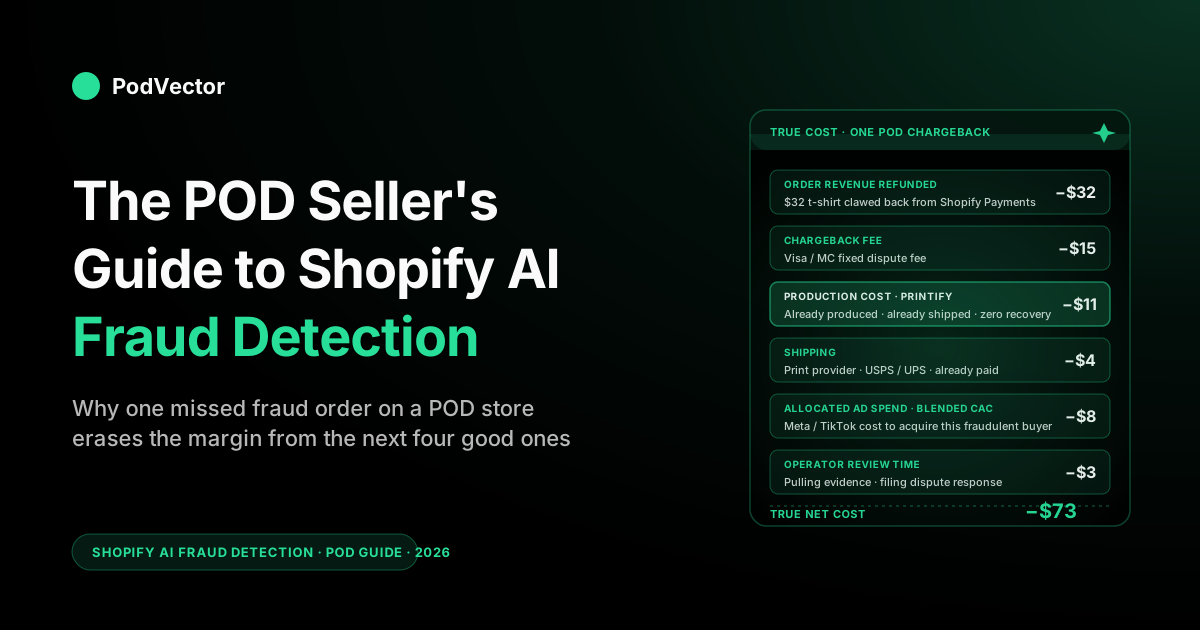
That changes the dollar math of every fraud decision. On a $32 t-shirt where Printify charged you $11 to produce and $4 to ship, a successful chargeback costs you the full $32 in revenue you have to refund (or more accurately, the bank claws back from your Shopify Payments balance), the $15 chargeback fee, the $11 production cost you already paid, and the $4 shipping.
The order that looked like an $18 gross-profit win became a $51 net loss the moment it flipped to fraud — a swing of nearly three orders' worth of margin. If your POD margin sits at 30–40%, you need three to four clean orders to cover one bad one. On a typical inventoried Shopify store, you need one or two.
That higher per-fraud cost is the reason POD operators care more about the false negative side of fraud detection (orders the system lets through that should have been blocked) than most Shopify guides emphasize. Most coverage focuses on conversion lift from reducing false positives — letting good orders through that rules-based systems would have flagged.
That matters too. But for POD, the asymmetric downside is the side that gets undercovered: missing one fraudulent $50 order on a custom-printed product erases the margin from the next four legitimate ones. Any tool you evaluate should be assessed on both axes, with the POD weighting tilted toward catch-rate.
It's also the reason the fraud question for POD is connected to the broader analytics question. If you don't know your true per-order production cost (Printify rates change, Printful shifts providers, ad spend per order varies), you can't compute the true cost of a missed fraud order — and you can't tell whether the fraud tool you're paying for is earning its keep. We come back to this in the cost-math section; for the broader analytics layer that surfaces it, see the complete guide to AI analytics for print-on-demand and the wider AI analytics topic hub.
Shopify's native fraud analysis — what it does and where it stops
Every Shopify store, on every plan, gets two built-in fraud features: Fraud Analysis on every order, and Shopify Protect on Shop Pay orders specifically. They're not the same thing and they're not AI in the modern sense.
Fraud Analysis: a rules-based scoring layer
Fraud Analysis runs automatically on every Shopify Payments order and tags it Low, Medium, or High risk. The signals it uses are public: AVS match (does the billing address match the card-on-file address), CVV match, IP-to-shipping geolocation distance, whether the email has prior fraud history on the network, whether there are multiple cards or multiple shipping addresses linked to the customer, whether the order placed multiple high-value items in a short window.
It surfaces a list of "fraud indicators" on each order's admin page, marks the score, and stops there. Shopify does not block, refund, or hold the order on its own. You — the merchant — decide what to do with Mediums and Highs.
For a small POD store doing a few orders a day, this is workable. You glance at the indicators, cancel orders flagged High before Printify has produced them, and accept the rest.
For any volume where manual review stops scaling — typically once a store hits ~30 orders/day, or runs a viral drop — Fraud Analysis becomes a per-order tax on your time. And the deeper limitation is that the indicators are a small set of rules, not a behavioral model.
They flag the obvious patterns. They miss the sophisticated ones (synthetic identities with clean AVS, mules with US billing addresses on stolen cards, account-takeover orders where the device fingerprint is the giveaway nothing in the rule set sees).
Shopify Protect: chargeback guarantee on Shop Pay only
Shopify Protect is the chargeback guarantee Shopify ships free with Shop Pay. If a Shop Pay order is later disputed as fraud, Shopify reimburses you the order amount and absorbs the chargeback fee.
It's genuinely good — but only on Shop Pay checkouts, only on orders Shopify itself approved at checkout time, and the eligibility rules vary by region. A Shopify Plus merchant doing $5M GMV who runs Shop Pay heavily will see meaningful coverage. A POD operator whose customers convert mostly through PayPal Express, credit-card-direct, or Apple Pay (not Shop Pay specifically) will see less than half their orders qualify.
Shopify Flow: the missing automation layer
The third Shopify-native piece is Flow, the automation engine. With the Winter '26 update and Sidekick's plain-language Flow generation, you can describe a fraud-flow rule in English ("when an order is High risk and over $100 and ships outside the US, hold it for 24 hours and email me") and Shopify builds it.
This is the lever most stores leave on the table. If you're not yet ready to pay for a third-party AI tool, a serious set of Flow automations against the Fraud Analysis output covers the obvious-fraud cases at zero cost. For a deeper read on Sidekick's automation surface, see the POD seller's guide to Shopify Sidekick AI.
The clear ceiling: native fraud analysis catches rule-defined fraud and leaves you to pattern-match the rest. The third-party AI layer exists because that ceiling is real and the cost of breaking through it manually doesn't scale. For the wider context of where fraud detection fits in Shopify's broader AI surface area, see the AI overview cluster and the POD seller's guide to Shopify AI.
How AI fraud detection actually works under the hood
The phrase "AI fraud detection" gets used to mean three different things, and they have different price points and different failure modes. Worth disambiguating before you compare tools.
1. Behavioral and network scoring (the real AI layer)
This is what Signifyd, Kount, Sift, NoFraud, and Riskified actually do. Their systems check two to three thousand clues about each order — things like the device being used, how trustworthy the IP address is, how the shopper moved on the page and typed their email, how old the email address is, whether that email, card, or shipping address has caused trouble at other stores on the same network, how many orders that same card placed in the last 24 hours across all stores, and whether the order matches known fraud patterns. From all of that, the system gives a risk score and a decision — approve, decline, or hold for review — right away. The system gets smarter from every store on the vendor's network. Signifyd sees orders from tens of thousands of merchants, so a card that just defrauded a fashion store six minutes ago is already flagged before it tries your POD store next.
The economic model is usually one of two: a percent-of-GMV fee (Signifyd, Riskified — typically 0.5%–1% of approved orders) usually paired with a chargeback guarantee (the vendor reimburses you for any approved-and-fraudulent order), or a per-transaction screening fee with no guarantee (Kount, Sift — cheaper per order, you absorb fraud risk).
2. Chargeback dispute automation (often called AI, often partly is)
Tools like Chargeflow and Disputifier sit downstream of fraud detection: when a chargeback files anyway, they auto-assemble the evidence (order details, IP logs, fulfillment proof, AVS match, customer communication) and submit the dispute response. The "AI" piece is mostly evidence selection and templating — choosing which evidence elements to include based on the dispute reason code, drafting the response narrative. The actual fraud-detection lift is small; the win-rate-on-disputes lift is real. For a POD store with a steady chargeback drumbeat, dispute automation pays for itself even if you also run a separate fraud-detection tool.
3. Returns and refund-abuse detection (the newest layer)
Tools like ForthRoute (and increasingly the bigger fraud platforms as a feature) score the return, not the order. Did the customer return six items in the last 90 days?
Are they a serial returner across merchants? Did they claim "item not received" three orders in a row? This matters for POD because policy abuse (claiming "wrong size" to get a refund on a custom shirt the buyer just changed their mind on) is the second-largest leak after card fraud, and Shopify's native fraud analysis doesn't see it at all.
Most of what follows in the tool roundup focuses on layer 1 — the behavioral and network scoring layer — because that's where the biggest dollar swing for a POD store sits. Dispute automation and return-abuse detection are usually layered on top once your order-fraud rate is under control.
The realistic AI fraud detection options for Shopify in 2026
This is a comparative roundup, not a ranking. Each of these is a real, in-market tool that a POD operator on Shopify can install today. The right pick depends on your GMV, your average order value, your geography mix, and how much Shopify Protect coverage you already have.
Signifyd
The market leader by a meaningful margin. Behavioral and network scoring against ~thousands of signals per order, real-time decisioning, and a chargeback guarantee on every approved order — meaning if an order Signifyd approves later flips to fraud, Signifyd reimburses you the full order amount.
The economics are percent-of-approved-GMV (roughly 0.5%–1.0%, negotiable above $1M GMV). The catch for POD: the guarantee covers the order revenue, not your production cost at Printify. A reimbursed $32 chargeback still leaves the $11 in production cost on you. Best for: POD stores doing $500K+/year on Shopify Payments where the operator's bandwidth for fraud review is the binding constraint.
NoFraud
Closest direct competitor to Signifyd at the SMB end. AI-driven scoring on ~one thousand+ data points per order, plus a manual review team that handles the orders the model isn't sure about (so you don't have to).
Offers chargeback guarantee plans and screening-only plans. Pricing tiered: a flat per-order fee on the screening tier, percent-of-GMV on the guarantee tier. Best for: POD stores doing $100K–$1M/year that want guarantee-backed coverage but don't yet have Signifyd-level GMV. The manual-review backstop is genuinely useful for the long tail of "is this order legit" judgment calls that pure AI scoring punts on.
Kount (an Equifax company)
Enterprise-grade AI scoring with deeper customization than Signifyd or NoFraud — you can write your own rules layered on top of Kount's models, set risk thresholds per product category, and integrate fraud signals back into your CRM. Per-transaction pricing, no guarantee by default.
Significantly more lift than Signifyd at scale, significantly more setup overhead. Best for: POD stores at $5M+ GMV with an in-house ops person willing to tune models. Below that, you're paying for surface area you won't use.
Riskified
Enterprise platform aimed at Shopify Plus, with behavioral scoring, chargeback guarantee, post-purchase abuse protection (so it covers refund-abuse and policy-abuse, not just card fraud), and explicit explainability features (why was this order declined). Highest price point among the major tools, but the broadest scope. Best for: Shopify Plus POD operators at $10M+ GMV where the fraud + returns + policy-abuse budget combined justifies a single platform.
SEON
The AI-and-rules hybrid that European operators tend to land on. Strong on email-domain enrichment, social-media-footprint signals (does this email have an associated LinkedIn / Twitter / Gravatar — fraudsters' synthetic emails usually don't), and IP / device fingerprinting.
No chargeback guarantee in the standard package. Pricing tilts cheap relative to Signifyd. Best for: POD stores with a heavy non-US shipping mix where Signifyd's primarily-US-merchant-network advantage is less load-bearing.
Sift
Originally a programmable fraud platform aimed at developers, now a full Shopify-app-ready suite. Highly customizable, real-time scoring, you build the workflows. No guarantee, per-transaction pricing. Best for: POD stores with engineering bandwidth that want to integrate fraud signals into custom Flow automations or tie scoring into a homegrown ops dashboard.
FraudLabs Pro
The budget option. Per-query screening (free up to 500 queries/month, then paid tiers from there), simpler rule-based + ML-assisted scoring, no guarantee. Realistic for very small stores or as a second-opinion layer behind Shopify's native scoring. Best for: POD stores under $50K/year that want better-than-Shopify-native at near-zero monthly spend.
Chargeflow
Not strictly fraud detection — chargeback dispute automation. Auto-files dispute responses on chargebacks that occur, takes a percentage of recovered funds.
Win rates on properly-evidenced fraud disputes typically 30%–50% depending on the issuer. Best for: Layering on top of any of the above. The fraud-detection tool prevents chargebacks; Chargeflow recovers the ones that file anyway. For more on chargeback automation specifically, the Chargeflow guide to Shopify fraud prevention solutions covers the dispute side in depth.
The honest comparison
For most POD stores in 2026, the realistic decision is between three options: (1) ride Shopify's native scoring + Shopify Protect on Shop Pay + a Flow automation set, free; (2) NoFraud or SEON, mid-range, picks up most of the lift; (3) Signifyd, premium, gets you the chargeback guarantee on top. Almost no SMB POD store needs Riskified or Kount.
The leap that pays for itself is from (1) to (2) — going from rules to behavioral scoring. The leap from (2) to (3) is mostly buying the guarantee, which is worth it past a certain GMV and not before.
The POD-specific fraud patterns AI catches that rules miss
This is the section the generic Shopify fraud guides skip because they don't operate POD stores. There are five fraud patterns a POD operator sees more often than the average Shopify merchant, and the difference between rules-based scoring (Shopify native) and behavioral AI scoring (the third-party tools) is most visible on these specific patterns.
Pattern 1 — viral-trend velocity fraud
Your design goes viral on TikTok and you get 800 orders in three days. Mixed in are 40 orders from cards that just stole someone's identity and are testing your storefront before going elsewhere.
Rules-based scoring catches the AVS mismatches. AI scoring catches the velocity-and-network signal: those same cards just placed orders at six other Shopify stores in the last 24 hours.
This is the most expensive miss for POD because viral drops are the highest-volume window and your manual review can't keep up. Tools with cross-merchant network signal (Signifyd, NoFraud, Kount) shine here.
Pattern 2 — the fluctuating-shipping-address fraud
The buyer places a $35 t-shirt order shipping to the billing address. Two weeks later they email saying "actually please ship to my office at [different state]." If you change the address (Printify is happy to update before the order ships), the chargeback files claiming "item not received" two months later — because the cardholder of record never received it.
Rules-based systems don't see this; the order was clean at checkout. Behavioral systems flag the post-order address-change pattern when it correlates with prior similar patterns across the network.
Pattern 3 — the size-exchange refund-abuse loop
The buyer orders a custom shirt, receives it, claims size is wrong, demands a refund, doesn't return. Then orders another shirt three weeks later under a slightly different email.
Most fraud platforms now have a return-abuse module that flags this; Shopify's native scoring doesn't see it at all. Riskified and the fraud platforms with return-abuse coverage catch this; the cheaper screening-only tools don't.
Pattern 4 — the bulk-cart card-test
A fraudster runs a quick card-validation script through your storefront — placing 12 small orders in 8 minutes from rotating IPs to test which cards live before going to high-value targets. Shopify's native fraud analysis catches a few of these but doesn't connect them as a coordinated session.
Behavioral AI catches the session pattern (same device fingerprint across the 12 cards, same browser entropy, same TCP fingerprint) and blocks the whole sequence. POD stores get hit by card-testers more than average because the typical POD AOV ($25–$60) is the sweet spot for a card-validation order.
Pattern 5 — the friendly-fraud chargeback
The buyer received the shirt, decided they didn't like it, didn't want to bother with a return, and called their bank to dispute as "didn't receive." Hardest pattern to catch at order time because the order itself was legitimate. The defense is downstream: tools that auto-assemble dispute evidence (delivery proof, IP-at-checkout, AVS match, prior order history with you) and file the dispute response inside the bank's narrow window. This is why Chargeflow-style dispute automation is usually a layer alongside fraud detection, not a substitute.
For the broader picture of how AI handles the analytics side of these patterns — surfacing them in your data before they cost you a quarter of margin — see AI-powered ecommerce analytics for POD sellers and the comparison roundup best AI tools for ecommerce data analysis.
How to evaluate a fraud tool for a POD store (not a generic store)
Most fraud-tool evaluation checklists were written for inventoried Shopify stores and emphasize the wrong things for POD. Here's the version that lines up with how POD economics actually work.
1. Net cost per order, not list price. Don't compare on monthly fee.
Compute: (fraud-tool cost per approved order) + (production cost lost on missed fraud orders × your post-tool fraud rate). The tool that costs more per approved order but cuts your fraud rate from 0.6% to 0.1% can be cheaper net than the tool that costs less and only takes you to 0.4%.
2. Geography fit. Tools trained primarily on US-merchant data underperform on EU and APAC orders. If 30%+ of your orders ship outside the US, evaluate SEON or a vendor with explicit non-US network coverage seriously, even at the cost of a small US-side accuracy penalty.
3. AOV bracket. Tools optimized for high-AOV (Riskified, Forter at $200+ AOV) will be expensive overhead for a POD store with $35 AOV. Tools optimized for the $20–$80 AOV range (NoFraud, SEON, the screening tier of Signifyd) pay back faster.
4. Chargeback guarantee terms (if applicable). If you're paying for a guarantee, read what's covered. Most cover order revenue. Few cover production cost. None cover ad spend on the order. Ask the vendor for their POD merchant case studies specifically.
5. Integration with Printify / Printful. Some tools surface a "hold this order before fulfillment" lever directly into the Shopify admin so the suspect order doesn't get auto-pushed to Printify.
The ones that don't will catch fraud after Printify has already produced and shipped — at which point the catch saves you the chargeback fee but not the production cost. Check the integration spec.
6. Manual review SLA. If the tool punts uncertain orders to a manual review queue, how fast does it clear? A 4-hour SLA means a viral drop on a Saturday afternoon doesn't ship until Sunday — a real conversion drag if your customers expect 24-hour fulfillment-init.
7. Reporting that connects to your real cost layer. The fraud dashboard tells you fraud rate.
It usually does not tell you: fraud rate by Printify provider, fraud rate by ad source (does Meta-acquired traffic fraud at a different rate than TikTok-acquired), fraud rate by SKU. You need that view in your own analytics layer, not the vendor's.
For the evaluation framework on the broader AI tool decision (not just fraud), the best AI for ecommerce, compared roundup covers the cross-cutting criteria.
A 30-day rollout plan
If you're going from no fraud tool to a real one, here's the cadence that works for a POD store doing $50K–$1M/year on Shopify.
Week 1 — instrument your baseline. Pull your last 90 days of orders. Tag every chargeback, every "item not received" claim, every refund.
Compute: fraud rate (chargebacks ÷ orders), refund-abuse rate (no-return-refunds ÷ orders), and total fraud cost (chargebacks × avg order value × (1 + production-cost-share)). That last number is the budget envelope for the fraud tool.
If your fraud cost is under $200/month, the answer is probably Shopify-native + Flow + Chargeflow on the back end. Above that, evaluate.
Week 2 — pick two finalists, install in shadow mode. Most of the major tools (Signifyd, NoFraud, Kount) offer a shadow / observation mode where they score every order but don't take action. Run two finalists in shadow for 14 days.
Compare their decisions against the orders that actually went bad. The vendor's marketing accuracy claim is usually 99%; their accuracy on your store, in your traffic mix, is the only number that matters.
Week 3 — activate one in low-confidence-only mode. Flip the chosen tool to active, but only on the slice of orders the tool itself flags low-confidence. Auto-approve everything else. This protects you from the tail risk of the tool being too aggressive on legitimate orders during the calibration window.
Week 4 — full active, with weekly review. Turn on full mode. Set a weekly Friday review where you eyeball the orders the tool declined and the orders it approved that flipped to chargeback. Tune from there. After 60 days the tool is mostly self-running; the first 30 are operator-attention-heavy on purpose.
The true cost of fraud no fraud app shows you
Every fraud tool's dashboard will tell you your fraud rate, your decline rate, and your guarantee payouts (if you have one). None of them tell you the number that matters: net dollars on your P&L from fraud, including the production cost layer the chargeback guarantee doesn't cover.
For a POD store, that calculation looks like:
True cost of a fraud chargeback = order revenue refunded + chargeback fee + Printify/Printful production cost + shipping cost + ad spend allocated to that order + (cost of operator time to review the dispute).
On the $32 t-shirt example: $32 + $15 + $11 + $4 + ~$8 (if your blended CAC is $8 on that channel) + ~$3 (15 minutes of operator time at $12/hr) = $73 net cost on a $32-revenue order. The chargeback guarantee, if you have one, claws back the $32. The other $41 is on you.
That's the number that should drive the decision on whether the fraud tool is earning its keep — and almost no fraud platform will compute it for you because the inputs (your real Printify cost, your real ad spend per order, your operator hourly rate) live in three other systems. This is the analytics gap behind every fraud-tool ROI conversation in POD: the tool gives you the fraud-rate output, but the dollar P&L layer that translates fraud rate into real lost margin requires pulling Shopify, Printify, Meta Ads, and TikTok Ads together at the order level. Most POD operators are doing this in a spreadsheet on Sundays, which is why the answer to "is your fraud tool worth it" is almost always "I think so."
This is the analytics half of the same problem the AI fraud tool half is solving — and it's the half PodVector AI's Victor was built for. Victor sits across your Shopify, Printify, and ad-spend data and answers questions like "what is my real net cost of fraud per order this quarter, including production cost" or "which traffic sources have higher chargeback rates after I net out production cost" against a live warehouse.
Victor answers those questions and acts on them — with your approval — auto-flag suspect orders before Printify produces, auto-pause an ad set whose chargeback-adjusted CAC just crossed your threshold. The fraud detection layer catches the fraud at order time. Victor tells you what it actually cost you, after the fact, in the only currency that matters.
FAQs
Is Shopify's built-in fraud analysis enough for a POD store?
For very small POD stores (under $50K/year, low order velocity, US-only shipping) yes — combined with Shopify Protect on Shop Pay orders and a few Flow automations, it covers the obvious fraud patterns. Above that, the manual review burden on Mediums and the missed-fraud rate on sophisticated patterns make a third-party AI tool pay back.
Does Shopify Protect cover Printify production cost on a fraud chargeback?
No. Shopify Protect reimburses the order revenue and absorbs the chargeback fee, but does not cover the production cost you already paid Printify. Same is true for chargeback guarantees from Signifyd, NoFraud, and Riskified. Production cost on fraud orders is a structural POD-specific loss that no consumer-side fraud product covers.
Will an AI fraud tool reduce conversion?
Slightly, in the short term. Any fraud tool that's tuned for catch-rate will decline some legitimate orders (false positives).
The cleanest tools sit around 0.5%–1.5% false-positive rate; the noisiest sit at 3%+. On a POD store with 30%–40% margin, a 1% false positive rate is easily justified by even a small reduction in actual fraud, because the asymmetric downside on POD (lost production cost) makes the true-positive value much higher than the false-positive cost.
Do AI fraud tools work on TikTok Shop or Etsy POD orders, or only Shopify?
Most of the major tools (Signifyd, NoFraud, Riskified) are Shopify-first and have integrations for Shopify Plus, plus general API integrations for custom platforms. TikTok Shop and Etsy run their own internal fraud layers and don't expose merchant-side hooks for third-party AI fraud detection in the same way. If you're a multi-channel POD operator, the fraud-tool conversation is mostly a Shopify conversation; on TikTok Shop and Etsy you're stuck with the platform's native scoring.
How is "AI fraud detection" different from a chargeback alerts service?
Chargeback alerts (Verifi, Ethoca) are a notification layer — when a buyer initiates a dispute with their bank, the alert service notifies you before the chargeback files, giving you a window to refund proactively and avoid the chargeback fee. They prevent the fee, not the fraud.
AI fraud detection prevents the fraudulent order from clearing in the first place. Most serious POD operators run both.
What chargeback rate is acceptable for a POD store?
Visa and Mastercard flag merchants whose monthly chargeback rate exceeds 0.9% of transactions; above 1.5%, you're at risk of being moved to the high-risk monitoring program with materially higher processing fees. A healthy POD store should sit under 0.5%. Anything above 0.7% means the fraud-tool conversation is overdue.
Should I run a chargeback dispute tool (like Chargeflow) even if I have a fraud-detection tool?
Usually yes. Fraud detection prevents chargebacks; dispute automation recovers the ones that file anyway (mostly friendly-fraud and family-fraud cases that the AI couldn't have caught at order time).
The two tools cover different stages of the funnel. The combined cost is usually 1.5%–2% of GMV in fees and is, for POD specifically, easily justified once your monthly fraud cost crosses ~$500.
Let Victor act on fraud before it eats your margin
The fraud-detection tool catches the order. Acting on what fraud actually costs you — production cost, ad spend, chargeback fees, the margin hit even after a won dispute — is the work, and it's what PodVector AI's Victor does.
Victor reads your Shopify, Printify, and ad-platform data live, then takes action with your approval: hold suspect orders before Printify produces them, pause an ad set whose chargeback-adjusted CAC just crossed your threshold, flag the SKUs and channels bleeding margin to friendly fraud. He knows the true net cost of fraud per order — and does something about it.
Try Victor free