
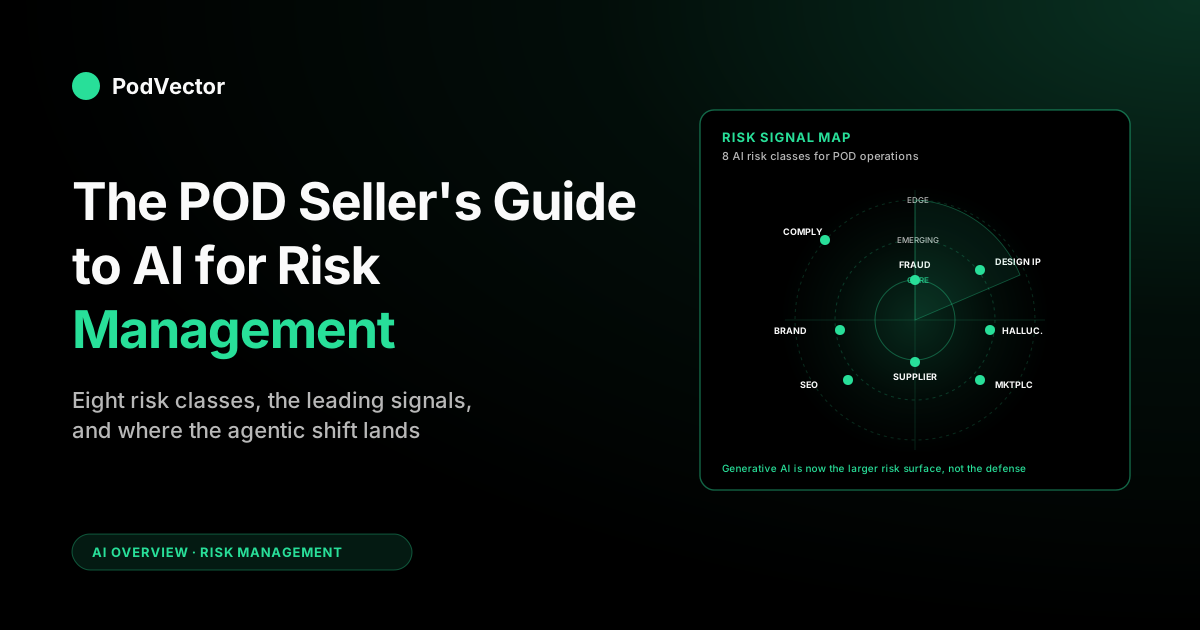
Quick Answer: "AI for risk management in ecommerce" covers two distinct things: AI used as a defensive tool (fraud detection, chargeback automation, listing-quality screening) and AI itself as a new risk surface (hallucinated product copy, IP-tainted designs, marketplace policy violations, agent-on-agent fraud). For print-on-demand sellers, the second category matters more than the first.
POD stores generate listings, designs, mockups, and ad creative at a volume no human review process can keep up with — and a single bad AI output can trigger a marketplace suspension, a Printify takedown, or a wave of refunds before anyone notices. The 2026 risk-management posture is less "buy a fraud tool" and more "instrument the live signals that would tell you an AI workflow has gone off-script before the marketplace, supplier, or customer notices first."
What "AI for risk management in ecommerce" actually means
Most articles in this category collapse two very different problems into one phrase. The first is AI as a defensive layer — machine-learning models that score transactions for fraud, automate chargeback evidence packs, and flag suspicious refund patterns.
That category has been mature for a decade. The second is AI as a source of risk — generative systems that produce listings, designs, ad creative, customer-support replies, and increasingly autonomous shopping agents that interact with your storefront. That category is roughly two years old and changes shape every quarter.
For an enterprise retailer the first category dominates the conversation because the second is bounded by review processes. For a POD seller, the proportions invert.
You are using generative AI for almost every operator workflow, your catalog turns over weekly, and there is no internal review team standing between AI output and a published listing. The risks worth budgeting attention for are the ones generated by your own AI stack, not the ones from external attackers.
This guide treats both, but biases toward the second. The defensive-AI tooling (fraud scoring, chargeback automation) is largely solved by Shopify's built-in tools and a handful of third-party apps; the in-depth coverage lives in the POD seller's guide to AI for fraud detection in ecommerce and the POD seller's guide to Shopify AI fraud detection. The harder problem — and the one no off-the-shelf product fully solves yet — is monitoring the risk surface created by your own use of generative AI.
Why the POD risk surface is different
POD operations look superficially similar to other ecommerce models but have four structural traits that change the risk profile.
You ship AI output to the public continuously
A wholesale brand publishes a new product description maybe twice a month, with a marketer reviewing the copy and a designer reviewing the imagery. A POD store can publish dozens or hundreds of new AI-generated artifacts a week — design files, listings, mockups, ads, support replies, SEO articles.
The denominator of "things AI made that the public sees" is orders of magnitude larger for a POD operator than for a traditional retailer. So is the number of opportunities for an AI mistake to become a customer-facing problem. According to Shopify's own 2026 benefits-of-AI guide, AI tools now span nearly every part of modern ecommerce — which means the blast radius when they go wrong has grown proportionally.
Marketplace platforms are increasingly AI-aware
Etsy, Amazon, and eBay all updated their AI-content policies in the past 18 months. Etsy now requires sellers to disclose AI involvement in design generation.
Amazon's listing-quality models are trained to detect AI-templated copy and downrank it. Detection is improving faster than generation. Listings that ranked fine a year ago are getting flagged or suppressed today, and the failure mode is silent — your listings just stop converting and you have to figure out why.
Your suppliers are part of the risk surface
Printify and Printful both run their own content-moderation and IP-detection layers. A design that passes your local check can be rejected at the print queue, leaving you with refunded orders and inventory you cannot fulfill. Their detection models update independently of your workflow, so a design technique that worked last month can suddenly start triggering rejections.
Per-order economics make every refund expensive
POD margins are thin. A refund triggered by an AI hallucination — a mockup that misrepresented the print, a listing that overstated the fabric weight, a chatbot that promised a delivery window your supplier cannot hit — costs more than the lost gross profit.
It costs the supplier production charge, the return shipping (where applicable), the chargeback fee if it escalates, and the long-tail effect of a negative review. The unit economics of AI mistakes are punitive in a way they are not for held-inventory retailers. See the Printify t-shirt cost and profit breakdown for a detailed look at how thin the margin buffer really is.
The 8 AI risk categories every POD seller should track
The risk surface broken into the eight slices that matter for an active POD operator. For each: what it actually looks like in production, what an early-warning signal would be, and what an off-the-shelf mitigation looks like in 2026.
1. Transaction fraud and chargebacks
The classic category. AI fraud-scoring models analyze IP, device fingerprint, payment method, and behavioral signals to flag risky orders. According to Shopify's benefits-of-AI guide, global losses from ecommerce payment fraud are expected to exceed $131 billion by 2030 — and traditional rule-based filters are increasingly falling short as transaction volume grows.
Coverage is mature; the failure mode for POD specifically is the false positive — a fraud model trained on retail patterns flagging legitimate POD customers (often international, often using a payment method the model under-weights) and choking your conversion rate. Worth measuring the false-positive rate explicitly, not just the fraud-loss rate.
2. AI-generated design IP risk
The fastest-moving category and the one most under-prepared for. Designs generated with image models trained on copyrighted artwork can trigger DMCA takedowns weeks or months after publication.
Common failure modes: a Midjourney design that includes a recognizable IP element, a Stable Diffusion output that closely mimics a specific artist's style, an AI-generated typeface that overlaps a licensed font. The early-warning signal is a sudden uptick in marketplace policy notifications. The mitigation is upstream: a brand-style prompt template that constrains generation away from copyrighted territory, plus a recognized-IP detection step before listing publication.
3. AI hallucination in listings and product copy
An LLM generating product copy at scale will, given enough volume, produce specifications that are not true. A claimed fabric weight your supplier does not stock. A care instruction that contradicts the product. A size chart that does not match your supplier's actual cut.
The customer-facing failure mode is a refund and a one-star review citing "not as described." The early-warning signal is the refund-reason field — track the share of refunds tagged "not as described" or "wrong size" weekly, and any spike traces back to either a supplier change or an AI-template change.
4. Marketplace policy and listing-takedown risk
Etsy, Amazon, and eBay each have AI-content disclosure rules and listing-quality models that detect templated copy. Listings can be silently downranked, removed, or have your account flagged.
The early-warning signal is a sudden drop in marketplace-channel impressions, not orders — orders are a lagging indicator and you will lose a week of attribution before noticing. The mitigation is to vary listing structure across SKUs (avoid the same prompt template producing near-identical descriptions) and to use the disclosure fields the marketplaces now provide rather than trying to obscure AI involvement.
5. Supplier cost variance and margin erosion
Not a generative-AI risk per se, but a risk that AI-driven listing automation amplifies: a Printify or Printful price update on a base product can quietly turn an entire AI-generated catalog from profitable to loss-making before anyone notices. Stores publishing large numbers of new listings a week with prompt-templated pricing logic are the most exposed.
The signal is per-design, per-supplier margin tracked weekly. Understanding your true contribution margin is the foundation of that tracking — see the guide on how to get contribution margin for the mechanics. The deep coverage of the per-order cost math lives in the complete guide to AI analytics for print-on-demand.
6. AI-content SEO penalty risk
Google's helpful-content systems and the search updates of 2024–2025 increased the penalty for low-quality AI-templated content. POD product pages and SEO blog posts generated without enough differentiation can end up deindexed or pushed far down search results, with no notification.
The signal is organic-impression decay on AI-generated pages versus baseline. Mitigation: editorial templates that enforce real differentiation per page (specific use-case, audience, or product detail) rather than swapping a noun in a generic template. The publishing pattern that produces this article is itself the mitigation — see the POD seller's guide to AI SEO strategy for ecommerce brands for the differentiation playbook.
7. Brand voice drift and customer-support hallucination
An AI customer-support chatbot left untuned will, over time, drift from your brand voice and (worse) start asserting things that are not policy — promising returns you don't accept, quoting delivery windows your supplier cannot hit, citing fabric specs that are wrong. And those statements can be binding — a tribunal held Air Canada liable for a refund policy its chatbot invented, so "the bot said it, not us" is not a defense.
The signal is the chatbot transcript log, sampled weekly. Mitigation: a tight system prompt with explicit "never state" guardrails, a human-escalation rule for any policy-adjacent question, and an audit cadence that scales with conversation volume.
8. Compliance and disclosure risk
The EU AI Act — whose high-risk and transparency obligations phase in through August 2026 — California's AB-2013, and a growing patchwork of state laws require disclosure when AI generates customer-facing content or makes consequential decisions. For POD sellers operating internationally, the practical exposure is: AI-generated images flagged by EU consumer-protection rules, chatbot interactions that need to disclose they are AI, and (depending on jurisdiction) data-processing notices for any AI tool that touches customer data. The mitigation is documentation, not a technical control: keep a list of every AI tool in your stack, what data it touches, and which disclosure regime applies.
Agentic AI: the new risk frontier
The shift in 2026 is from generative AI (which produces content) to agentic AI (which takes action). This expands the risk surface in two directions: the agents you deploy inside your operation, and the autonomous shopping agents that increasingly visit your storefront on behalf of human shoppers.
Agents you deploy
An AI agent that watches your store and surfaces findings is low-risk. An AI agent that takes actions — repricing a product, kill-listing an underperforming SKU, replying to a refund request — has a meaningfully larger blast radius.
The risk-management posture rests on three primitives: constrain agentic actions to reversible operations, require explicit operator confirmation for irreversible ones, and log every agent action with the chain of reasoning that produced it so each one is attributable back to a human approver. Enforce the permission check in the system the agent is acting on — your Shopify or supplier account — rather than trusting the model to police itself; an LLM talked into the wrong action will happily call a tool it technically has access to. The agentic landscape for POD specifically is covered in agentic AI for ecommerce: what it looks like for POD sellers and the complete guide to AI agents for ecommerce analytics.
Agents that visit your store
OpenAI's Operator, Perplexity's Comet, Amazon's Rufus, and payment rails like Mastercard's Agent Pay are pushing agent-driven checkout into the mainstream. For POD, the new failure modes are: an agent purchasing a SKU that is mid-update and getting a stale price; an agent placing bulk orders that trigger your fraud model and get blocked; an agent interpreting a misleading product description literally and surfacing a complaint to its human operator before any human ever saw the page. The early mitigation is to instrument bot-traffic share separately from human-traffic share so the two patterns can be tuned independently.
Prompt injection and the agent attack surface
The risk the 2026 commentary now leads with is prompt injection — hidden instructions in a product page, review, support message, or tool response that hijack an agent into doing something its operator never intended, like leaking data or taking an unauthorized action. It sits at #1 on the OWASP Top 10 for LLM applications, and the indirect variant — instructions buried in a review or support ticket the agent later reads — is the form most relevant to a storefront.
For a POD operator the exposure runs both ways. An agent you run that reads customer messages or supplier emails can be injected into leaking data or taking an unauthorized action. And an agent that visits your store can be nudged by content you did not write. The mitigations are the same least-privilege and reversibility primitives above, plus treating every model input as untrusted, never wiring a customer-facing agent directly to irreversible tools (refunds, payments, bulk listing edits), and keeping a record of every action it takes, so an off-script action is easy to spot after the fact.
The newer wrinkle is supply-chain risk in the tools themselves. Connecting an agent to MCP servers, plugins, and third-party "skills" widens the surface, and security researchers have found malicious skills seeded into public agent-skill registries. A connector you install to save time can carry an injection payload. The discipline is the same one enterprises now anchor to NIST's AI Risk Management Framework, which security teams operationalize as a four-step loop: discover every agent and integration you run, scope each to least privilege, defend the runtime, and attribute every action back to a human. For a one-person POD shop that collapses to a short, honest inventory — which agents touch which tools, and which of those tools can do something you cannot undo.
Shopify Magic, Sidekick, and the approval gate
As Shopify's own AI layer matures — Shopify Magic for content generation, Sidekick for admin-level assistance — alongside third-party agentic tools, more store-side actions become automatable: repricing, discount creation, collection organization, bulk edits. The risk-management question is the same regardless of which tool executes the action: is there a human approval gate before the write happens, and is the action reversible if the reasoning was wrong?
That question is structural, not tool-specific. Victor — PodVector AI's AI employee — is built around this principle: every proposed Shopify-side write requires explicit merchant approval before execution, and the guide to Shopify Admin API store modifications and automation covers what those write surfaces actually look like under the hood.
Shopify Magic output as an unreviewed risk surface
Shopify Magic ships product description suggestions, email subject lines, and FAQ drafts directly inside the admin interface — which means many merchants publish them without the same review cadence they apply to external AI tools. The risk is identical: hallucinated product specs, brand-voice drift, and AI-templated copy that marketplace listing-quality models detect and downrank. The fact that a suggestion originates inside the admin does not make it exempt. Apply the same sample-audit discipline you apply to any other generative tool in your stack.
The monitoring layer: where AI risk becomes measurable
Almost every risk category above shares the same operational shape: there is a leading signal that would have caught the problem days or weeks before the lagging signal (refund, takedown, deindex) hit. The hard part is not the mitigation — the hard part is noticing in time.
For a POD store, the leading signals live in five different systems: Shopify (refund rate, refund reasons, conversion rate by SKU), Printify and Printful (per-order cost, takedown notifications, fulfillment errors), Meta and Google Ads (CPM and CTR drift), Google Search Console (impression and position decay), and the chatbot platform (escalation rate, off-script flag rate). No off-the-shelf risk dashboard reads from all of those simultaneously, which is why most POD operators end up discovering AI risks the same way they discover most operational problems — when a customer or supplier escalates.
The monitoring posture worth building in 2026 lets someone ask risk questions in plain English and get answers pulled together from all five sources. "Has refund-rate-by-reason shifted week over week?" "Which AI-generated listings have seen meaningful organic impression decay in the last two weeks?" "Which designs have a Printify takedown ratio above the catalog average?" These are the questions that catch AI risks early, and they are the questions that traditional dashboards do not answer because the underlying data lives across five separate tools.
This is where Victor — PodVector AI's AI employee — fits the risk-management picture. Victor looks at your orders, costs, ad spend and supplier data together, which is how he spots per-design profit — and the same view also surfaces the leading risk signals: refund-reason drift, organic-impression decay, supplier-cost change events, fulfillment-error spikes. Victor reads live data from Shopify, Meta Ads, Google Ads, Printify, and Printful, proposes actions with reasoning, and only takes action after you approve it. For a deeper read on the analytics architecture this rests on, the complete guide to AI analytics for print-on-demand covers the full picture, and the AI Analytics topic hub indexes the cross-cluster reading list.
Ad-account health is a related risk surface that Victor reads but does not write to. If CPM or CTR drift is signaling a creative problem — a risk that compounds quickly in POD because ad creative and product listings are often AI-generated from the same templates — the guides on how to avoid ad fatigue and what is ad frequency cover the early-warning mechanics on the ad side. Checkout conversion is the downstream signal: see the ecommerce checkout conversion rate optimization guide for what a drop in conversion can indicate about listing quality or trust issues upstream.
A risk-mitigation playbook for a POD store
A pragmatic, low-overhead set of practices that addresses the eight categories without adding a part-time risk job to a one-person operation.
Upstream guardrails on generation
Lock the generation prompts for designs, listings, and ad copy into templates with explicit constraints — no IP-adjacent style references in design prompts, structured product attributes that match supplier specs in listings, brand-voice constraints in ad copy. The audit happens at the template level, not the per-output level. One template change is far easier to ship than thousands of individual reviews.
Sample audits, not exhaustive review
A regular sample audit on bulk-generated listings catches drift at a sustainable cost. Exhaustive review cancels the productivity gain. Zero review is what most operators default to, which is the failure mode. Pick a defensible cadence and stick to it.
Refund-reason instrumentation
Tag refund reasons consistently and review the distribution weekly. The weekly delta is the leading signal for nearly every AI quality risk — listing hallucinations, mockup-vs-reality mismatch, brand-voice drift in support, supplier fulfillment changes.
If you take only one practice from this guide, take this one. The POD seller's guide to AI for ecommerce document checks covers the structured-attribute side of the same problem.
Marketplace and supplier policy monitoring
Subscribe to Etsy, Amazon, eBay, Printify, and Printful policy update channels. The platforms are explicit when their AI-content rules change; most operators discover the change only when it bites. A short monthly review of pinned policy notifications is enough.
Bot-vs-human traffic separation
Tag traffic from known shopping-agent user agents and analyze the cohort separately. Their conversion patterns, basket composition, and fraud signature differ enough from human shoppers that mixing them in your funnel reports will distort both. The instrumentation is small and the option value is large as the agentic-traffic share grows through 2026 and beyond.
Reversible-only autonomous actions
If you deploy any agentic AI in your operation, constrain its action set to reversible operations by default — flagging, drafting, surfacing — and require explicit operator approval for anything irreversible (publishing, payment, refund issuance, supplier escalation). Reversibility is the core risk-management primitive for agentic systems.
Inventory of every AI tool in your stack
With AI tool counts in the tens of thousands according to Shopify's benefits-of-AI guide, most POD operators have accumulated more AI touchpoints than they track. A quarterly audit — tool name, what data it touches, what actions it can take, which disclosure regime applies — takes under an hour and is the foundation of both compliance documentation and supply-chain security. It also surfaces zombie integrations: connectors installed to test a feature and never removed, each one a potential injection surface.
Cash flow and capital risk
AI-driven catalog expansion can outpace cash reserves: you are running more ad spend, generating more supplier orders, and absorbing more refunds across a larger SKU base simultaneously. Understanding your working-capital position before scaling AI-generated catalog depth matters. The guides on how to get Shopify Capital and whether Shopify Capital checks credit are useful context if you are considering using Shopify's financing to fund a catalog expansion.
Risk-management anti-patterns to avoid
- Buying a fraud tool and calling it AI risk management. Fraud tooling addresses one of the eight categories. The other seven are not on its roadmap.
- Treating AI risk as a one-time policy review. The risk surface changes every quarter as model capabilities, marketplace rules, and supplier policies update. A static risk policy ages quickly.
- Auditing AI output exhaustively at first, then giving up. The sustainable cadence is sample-based and continuous. Most operators start with full review, find it unsustainable, and drop to zero. Pick the middle path on day one.
- Letting AI agents take irreversible actions without explicit confirmation. The blast radius of an autonomous mistake compounds with the action's reversibility cost.
- Treating compliance as a checkbox. EU AI Act and state-level disclosure rules carry meaningful penalties for international POD operations. Documentation is cheap; retroactive compliance after a notice is expensive.
- Discovering risk only at the lagging indicator. Refund spikes, takedown notices, and ranking drops are all weeks behind the leading signal. If your monitoring posture only catches lagging indicators, you are managing the consequence, not the risk.
- Ignoring Shopify Magic and built-in AI as a risk surface. Shopify's native AI layer — product description generation, email subject suggestions, Sidekick — is increasingly capable, but its output still needs brand-voice review before publish. The fact that it ships inside the admin does not make it exempt from the same hallucination and drift risks as external LLMs.
- Skipping the AI-tool inventory step. Compliance documentation, supply-chain security, and least-privilege scoping all start with knowing which AI tools are active in your stack. Most operators do not have this list and cannot produce it quickly when a policy question arises.
FAQs
What is the single highest-leverage AI risk-management practice for a POD seller?
Refund-reason instrumentation. Tag refund reasons consistently and review the weekly distribution. It is the leading indicator for at least four of the eight risk categories — listing hallucination, mockup-versus-reality mismatch, brand-voice drift, and supplier fulfillment change. The cost is essentially zero, and it routinely surfaces problems weeks before they become visible in revenue.
How worried should a small POD seller be about EU AI Act compliance?
Worried enough to keep a list of every AI tool in your stack and a one-line description of what data each one touches, but not worried enough to hire a compliance lawyer. The Act's heaviest obligations apply to high-risk use cases (biometric, employment, credit scoring) that POD operations don't typically hit. Disclosure obligations for AI-generated customer-facing content do apply, but are met by clear labeling rather than complex process.
What's the difference between AI fraud detection and AI risk management?
Fraud detection is one slice — defending against bad-actor transactions. Risk management is the broader discipline of identifying, measuring, and mitigating threats to the business, of which AI-generated risks (IP, hallucination, marketplace policy, brand drift, agentic actions) are a growing share.
A fraud tool covers one of eight categories described in this guide. Don't let vendor positioning conflate the two.
Should I use the same AI tool for risk monitoring that I use for analytics?
If the analytics tool reads live data from your full operational stack — store, suppliers, ad accounts, search console — yes, because risk monitoring just means asking the same data different questions. The hard part isn't the questions; it's pulling live data from all those different tools together in the first place.
If your analytics tool only reads one or two of those sources, you'll need a separate monitoring stack. Coverage of the analytics architecture is in the complete guide to AI analytics for print-on-demand.
How do I detect AI-generated design IP issues before publication?
Constrain prompts upstream (no specific-artist style references, no IP-adjacent property names, no brand or character names) and run a reverse-image search step on a sample of generated designs before bulk listing. Marketplace and supplier IP-detection layers will catch the rest, but at the cost of a takedown notice. Upstream prompt constraints are roughly an order of magnitude cheaper than post-publication mitigation.
What is prompt injection and should a POD seller worry about it?
Prompt injection is when hidden instructions in untrusted text — a product page, a customer message, a review, a tool response — hijack an AI agent into doing something its operator never intended, like leaking data or taking an unauthorized action. You should worry about it the moment you wire an AI agent to read customer or supplier messages, or to take any action in your store. The defense is not a clever counter-prompt; it is structural: giving the agent only the access it truly needs, no direct path from a customer-facing agent to irreversible actions (refunds, payments, bulk edits), and keeping a record of every action it takes so anything off-script gets caught. Until those are in place, keep agents in flag-and-draft mode, not act mode.
Does Shopify Magic count as an agentic AI risk?
Not in the agentic sense — Shopify Magic generates content suggestions but does not autonomously execute store changes without merchant confirmation. The risk it carries is the same as any generative tool: hallucinated product specs, brand-voice drift, and AI-templated copy that marketplaces detect and downrank. Treat its output with the same sample-audit cadence you apply to any other LLM in your stack.
How does Victor fit into a POD seller's risk-management stack?
Victor is the one who watches for risk. He reads live data from Shopify, Printify, Printful, Meta Ads, and Google Ads to work out per-design profit — and that same picture also surfaces the leading risk signals: refund-reason drift, organic-impression decay, supplier cost-change events, fulfillment-error spikes.
On the action side, Victor proposes Shopify-side writes — repricing, discount creation, collection organization — and executes them only after explicit merchant approval through an approve/reject gate. He reads Meta Ads and Google Ads and proposes moves, but ad-platform writes must be executed by the merchant on the ad platform. Victor does not replace your fraud-scoring tool or your compliance documentation, but he owns the monitoring slice that no off-the-shelf risk product currently covers for POD specifically. The broader product picture lives in the AI Overview cluster hub.
What about AI tools for inventory management and demand forecasting?
Standard inventory AI (demand forecasting, restock alerts) is relevant to hybrid POD/held-inventory sellers but largely moot for pure POD: your supplier prints on demand, so you carry no physical inventory. The risk analog for POD is supplier cost variance and SKU-level margin drift — which Victor tracks alongside your order and profit data, not through a separate inventory-forecasting tool. See the contribution margin guide for the per-SKU margin mechanics that serve the same early-warning function.
Catch AI risk at the leading signal, not the refund
The hardest part of AI risk management for a POD store is not picking a defensive tool — it is noticing that an AI workflow has gone off-script before a customer, marketplace, or supplier notices first. Victor reads live data from Shopify, Printify, Printful, Meta Ads, and Google Ads and surfaces the leading signals — refund-reason drift, organic-impression decay, supplier cost changes, fulfillment-error spikes — before they become revenue problems.
Try Victor free