
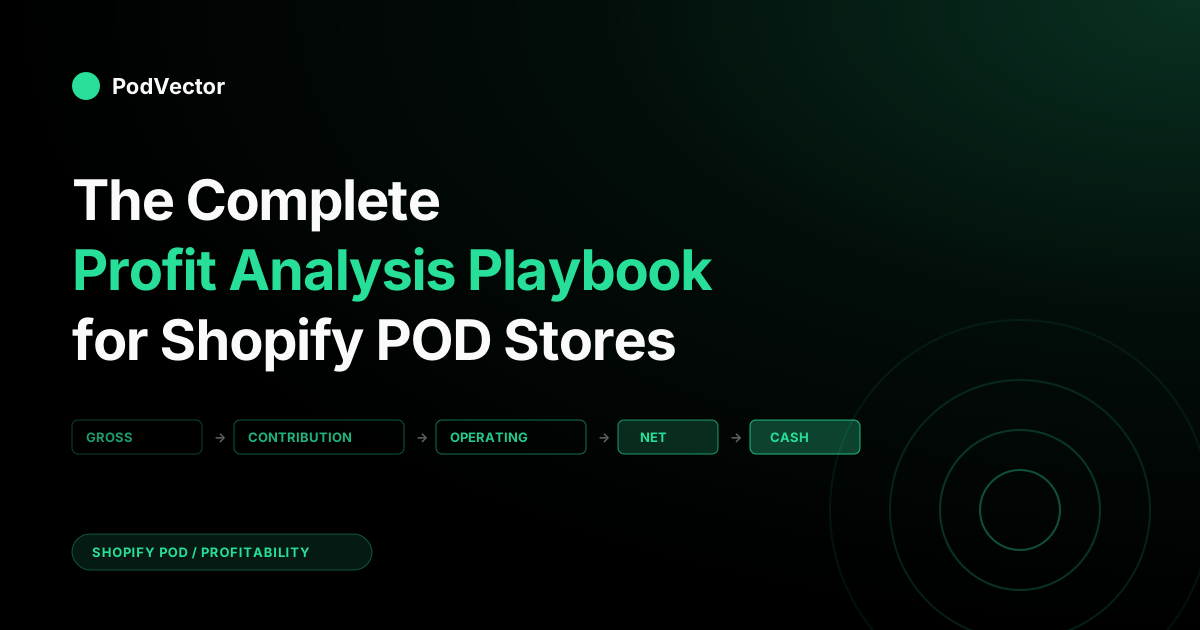
Quick Answer: Profit analysis for a Shopify POD store is the practice of turning tracked numbers into decisions — which SKU to scale, which country to cut, which ad to pause, which price to lift. It rests on five profit layers (gross, contribution, operating, net, cash), five levers (price, COGS, ad efficiency, refund rate, AOV), and a fixed cadence (daily scan, weekly review, monthly reset).
Healthy Shopify POD benchmarks: 35–50% gross margin, 15–25% contribution margin, 8–15% net margin. This playbook walks you through each layer, lever, and cadence — and shows where PodVector AI's Victor turns that analysis into action — repriced SKUs, moved ad spend, updated listings — faster than you could do it by hand.
This is the pillar hub for the Shopify POD Profit topic and the Profitability cluster. For the data-capture half of the problem, see The Complete Guide to Profit Tracking for Shopify POD Stores, The Complete Guide to Shopify COGS Tracking for POD, and The Complete Guide to Break-Even Analysis for Shopify POD.
For wider industry framing, Shopify's own guide to whether print-on-demand is profitable and Printify's Profit Navigator playbook are useful reference points — both lean on the generic "aim for a 40% margin" rule of thumb, which this playbook breaks down into the layers that rule of thumb hides.
Profit Analysis vs Profit Tracking
Tracking and analysis are adjacent, but they are not the same job. Tracking captures the data — every order, every COGS line, every ad dollar, every refund. Analysis takes the captured data and turns it into a decision: raise the price on the Gildan 5000 by $2, pause the "cold-audience-lookalike-3%" campaign, stop selling to Australia, refund proactively on size XS before Printify ships the order.
A Shopify POD store with perfect tracking and zero analysis is just a richer spreadsheet. A store with sharp analysis and sloppy tracking is running on vibes. The profitable stores are the ones where the tracking layer is automated and the analysis layer is disciplined — a fixed cadence, fixed levers, fixed diagnostic queries.
This playbook focuses on the analysis half. If your tracking stack is still being built, start with the profit tracking pillar first and come back.
The Five Profit Layers on a Shopify POD Store
Most POD sellers look at one number ("profit") and move on. That number is almost always net profit, which is the last layer in a five-layer stack.
Every layer above it tells you something different about where the money is going. Missing a layer is how stores scale into losses — the aggregate looked fine, but the layer that was about to break was hidden two levels up.
Layer 1: Gross margin
Revenue minus product COGS. Product COGS is the blank, the print or embroidery cost, and the real provider shipping charge on each order — not a static "Cost per Item" in Shopify. Detail: Gross Profit vs Net Sales in POD.
What it tells you: whether your pricing covers fulfillment. If gross margin is below 30%, no amount of ad optimization will save the store. Pricing or product selection has to change.
Layer 2: Contribution margin
Gross profit minus ad spend. This is the number that answers the single most important question in paid-acquisition POD: does each marginal order make us money after we've paid to acquire it?
What it tells you: whether scaling helps or hurts. A store with 40% gross margin and 35% ad-to-revenue ratio has a 5% contribution margin — marginally profitable, but any CPM spike wipes it out. The scaling decision lives here.
Layer 3: Operating margin
Contribution profit minus fixed operating expense — Shopify subscription, apps, payment processor fees, software, freelancers. Allocated on a per-order basis, this is the layer where a low-volume store often reveals that it's structurally unprofitable at current order count.
What it tells you: whether you're big enough to absorb your overhead. A $150/month app stack on 100 orders is $1.50 per order. On 2,000 orders it's $0.075. Stores usually cross their "fixed cost is forgivable" line somewhere between 500 and 1,500 orders per month.
Know your real fixed-cost floor. Shopify Basic runs $39/month and Advanced runs $399/month; Shopify Payments takes 2.9% + $0.30 per transaction; a typical profit-app and email stack adds $50–$300/month. None of that shows up in a gross-margin number — it lives here, in the operating layer, and it's the layer new stores most often forget to allocate.
Layer 4: Net profit margin
Operating profit minus refund losses (especially refund-after-fulfillment), chargebacks, and any other non-COGS cost. This is the bank-deposit number.
What it tells you: whether the business is actually working. Net margin is the one you'd quote to an investor. For a Shopify POD store at steady state, 8–15% is healthy; 15–20% is strong; above 20% is rare and usually niche-specific.
Layer 5: Cash margin
Net profit minus the cash-timing gap between when you pay Printify/Printful (on order charge) and when Shopify deposits your sales (T+2 to T+5 depending on payout schedule). For stores growing fast, this layer is where bankruptcy-by-growth happens — profitable on paper, broke in the bank.
What it tells you: whether growth rate is sustainable at current working-capital levels. Analyzed monthly; mostly ignored until scaling past ~$100K/month, when the cash gap can get to five figures.
Benchmarks That Actually Apply to POD
The single biggest mistake new POD sellers make is comparing margin against non-POD benchmarks. A dropshipper pulling generic products from AliExpress can hit 60–70% gross margin because the product costs $3. A Bella+Canvas 3001 from Printify costs $10.91 at best. The math is not the same.
Realistic benchmarks for a Shopify POD store in 2026, US-skewed traffic, mixed Printify/Printful fulfillment:
- Gross margin: 35–50%. Apparel clusters at 35–45%; all-over-print and accessories can push 45–55%. Below 30% is a pricing or product problem.
- Contribution margin: 15–25% at sustainable scale. Stores in early scaling (ROAS 1.5–2.0) sit at 5–10%.
- Operating margin: 10–18% for established stores; 0–5% in the first six months because fixed costs are spread over too few orders.
- Net profit margin: 8–15% healthy, 15–20% strong. Above 20% usually means premium pricing, niche targeting, or organic traffic.
- Refund rate: 1–3% on apparel; refund-after-fulfillment should be 60–80% of total refunds. Higher means a sizing/quality signal is being missed.
- Return on ad spend (ROAS): 2.0–3.0 for apparel POD at break-even or better. POAS (Profit on Ad Spend) > 1.0 is the real goal.
- Average order value: $35–$55 with shipping on single-item carts; $55–$85 on multi-item carts.
A useful aggregate check: if your Shopify Finance Summary "gross profit" is more than ~1.7× your actual bank-deposit profit, a layer is missing. Most often it's allocated ad spend, followed by refund-after-fulfillment. Detailed margin math: POD Profit Margins Explained.
What do those margins translate to in take-home? Most POD stores land somewhere between $100 and $10,000 a month in net profit, and the spread is mostly explained by net margin × volume, not luck. A store doing $20K/month at a 10% net margin keeps $2,000; the same revenue at a 4% margin — one bad ad-efficiency or refund layer — keeps $800.
That's the whole point of analyzing by layer instead of staring at one "profit" number: the difference between those two outcomes is a single lever moved two points, not a different business.
The Five Levers That Move Net Profit
Once the layers are measured and compared to benchmarks, every improvement in net profit comes from moving one of five levers. Prioritize by which lever is furthest off benchmark.
Lever 1: Price
The most leveraged variable. A $2 price increase on a product with $15 COGS and 35% gross margin lifts gross margin to ~42% — a 20% jump in gross profit per order, with no change in cost.
The ceiling is what the market will pay, which you find by testing. Real POD stores test price in $1–$2 increments, monitor conversion rate for 1–2 weeks, and keep the price if CVR drops less than ~10%.
What the layers tell you about price: if gross margin is below 35%, price is the first lever to pull before anything else. Long-form treatment: How to Increase POD Profits.
Lever 2: COGS (provider cost)
The second most leveraged. Options: switch Print Provider for the same SKU (providers on Printify/Printful can vary $1–$3 on the same blank), move to Printify Premium for the ~15% discount, reduce international shipping by routing through a provider with a local facility, or substitute the blank entirely (Gildan 5000 at $7 blank vs Bella+Canvas 3001 at $8 blank).
Full cost-structure detail: Printify Costs, Fees, and Discounts.
Lever 3: Ad efficiency
Contribution margin is the layer that lives or dies on this lever. Tactics that usually move it: tighter audience targeting (broad + interest stacking), better creative rotation (3–5 active creatives per ad set, weekly refresh), and more disciplined campaign-level POAS thresholds instead of platform-level ROAS.
The common trap: chasing ROAS on the ad platform while contribution margin drops. Platform ROAS doesn't know your COGS. A 3.0 ROAS on a $25 AOV product with $17 COGS is a losing order. Background: Break-Even ROAS in POD and Meta Ads ROAS and Attribution for POD.
Lever 4: Refund rate (especially post-fulfillment)
A 3% post-fulfillment refund rate on a 40%-gross-margin store wipes out ~7.5% of net profit. Most stores address this last because it's diffuse and painful to look at.
The highest-yield fix is almost always the product page: better sizing charts, actual-on-body photos, fabric/fit copy. Second-highest is pre-fulfillment quality checks on Printify — flag low-rated providers and reroute before production.
Lever 5: Average order value
Bumping AOV from $40 to $55 with a bundle or upsell has compounding effects: the $0.30 payment-fee flat charge becomes a smaller percentage, the allocated ad spend per dollar of revenue drops, and the shipping line is amortized across more units. Tactics: two-for-one bundles, post-purchase upsells (Rebuy / ReConvert), product-page cross-sells, and free-shipping thresholds set just above single-unit AOV. Detailed: How to Grow AOV in POD.
The Analysis Cadence: Daily, Weekly, Monthly
A healthy POD operator runs profit analysis on three clocks. Each clock has different metrics, different decisions, and different failure modes if skipped.
Daily (5–10 minutes)
The morning scan. Answers: are we on track today, and is anything on fire?
- Net profit yesterday vs same day last week.
- POAS (Profit on Ad Spend) by channel for yesterday.
- Top-5 SKUs by net profit yesterday.
- Refund-after-fulfillment events in the last 24 hours.
- Any provider delivery or production issues on open orders.
Decisions made daily: pause a campaign whose POAS dropped below 1.0 for two consecutive days; flag a SKU whose refund rate spiked; trigger a customer-support reach-out on any post-fulfillment refund.
Weekly (45–60 minutes)
The pattern review. Answers: what's the shape of the week, and what changes next week?
- Gross, contribution, operating, and net margin for the week.
- SKU contribution ranking (net profit, not revenue).
- Country-level profit slice — international shipping losses.
- Channel-level POAS and contribution margin.
- Refund cohort for orders placed 60 days ago (the "refund tail").
Decisions made weekly: reprice the underperforming SKUs, restrict ad targeting away from money-losing countries, rebalance ad spend across channels, unpublish the bottom-10% SKUs.
Monthly (90 minutes)
The strategy review. Answers: is the business actually working, and what structural change is the next month about?
- Month-over-month net margin trend, and which layer moved it.
- Cohort profit by acquisition month — are newer cohorts as profitable as older ones?
- Provider benchmarking — is our current Printify/Printful mix still optimal vs alternatives?
- App/software cost audit — which subscriptions are amortizing and which aren't.
- Cash-margin review — is the Shopify-to-Printify cash gap eating working capital?
Decisions made monthly: provider switches, app culls, pricing resets across catalog, paid-ads budget rebasing, working-capital moves (Shop Pay Installments vs not, payout frequency change).
Diagnostic Analyses Every POD Operator Runs
These are the specific queries that turn data into action. Each one is a one-line question you should be able to answer in under a minute on a live dashboard.
"Which SKUs are negative-profit after ad spend and refunds?"
Sort all SKUs by contribution margin. The bottom 10–20% of revenue typically produces 0% or negative profit once ad spend and refunds are in. Action: unpublish, reprice, or route to organic-only channels.
"Which countries are we losing money on?"
Net profit per order by destination. International orders frequently lose money because Printify/Printful shipping doubles on non-domestic. Action: raise international prices, restrict paid targeting to profitable countries, or add a shipping surcharge. See Does Printify Ship Internationally.
"What's the refund tail on last month's orders?"
Group orders by week and plot refund events at week+1, week+2, … week+8. A week that looked 12% profit on day 1 often lands at 6% by week 8 because of post-fulfillment refunds. If the tail is getting longer, sizing/quality is the issue.
"Which ad campaigns have POAS below 1.0?"
Net profit ÷ ad spend per campaign. Not platform ROAS — POAS, which includes COGS. This is the single most powerful ad-diagnostic in POD because platform ROAS consistently lies about which campaigns are actually making money.
"What's the gap between Shopify's profit number and my bank deposit?"
Run it monthly. Shopify Finance Summary "Gross Profit" vs actual bank-deposit net for the same month. A gap greater than 1.7× means the tracking stack is missing a layer. Usual suspects: allocated ad spend, refunds-after-fulfillment, or app/subscription costs.
"Which provider mix minimizes all-in COGS at our order volume?"
Run the top-20 SKUs through each available Print Provider on Printify and each alternative on Printful. For stores above 300 orders/month, switching provider on even one core SKU can be worth 2–4 points of gross margin. Background: POD Fulfillment Companies Compared.
Patterns and Anti-Patterns
Pattern: Gross margin stable, net margin collapsing
Almost always ad spend or refunds. Check contribution margin first — if it's falling while gross is stable, ad efficiency is the problem. If contribution is stable but net is falling, check refund-after-fulfillment or a new fixed-cost line (an app, a freelancer).
Pattern: Net profit positive, cash balance shrinking
The cash gap layer. You're profitable but funding Printify on credit while Shopify pays you on delay. Fix: faster payout cadence, higher AOV, or a working-capital buffer. Ignore this too long and growth itself becomes the problem that bankrupts the store.
Anti-pattern: Optimizing ROAS without POAS
Meta shows a 2.8 ROAS, Shopify shows profit, the bank balance shrinks. Because ROAS doesn't know COGS. The ad set with "good ROAS" is selling a $22 shirt that costs $16 to fulfill, at $6 CAC — a losing order. Always run POAS as the primary ad metric.
Anti-pattern: Chasing gross margin at the expense of conversion
Pricing a $22 tee to $38 because the spreadsheet says it should be there. Conversion drops 60%, revenue craters, contribution goes negative. Gross margin isn't the goal — contribution margin is. Test price increments small enough that CVR loss stays under ~10%.
Anti-pattern: One-off profit checks at month end
By the time the month-end number shows a problem, the problem is already four weeks old. The daily/weekly cadence exists so the decision window matches the cost structure's volatility. POD CPMs and provider prices move faster than monthly.
Pattern: The 80/20 SKU split
On almost every Shopify POD store, 20% of SKUs produce 80% of net profit, and another ~20% produce net-negative profit. The weekly SKU review exists to find both ends. Detail: Most Profitable POD Products in 2025.
From Analysis to Decision: Worked Examples
Example 1: Net margin slipping from 12% to 7%
A $60K/month Shopify POD store notices net margin has compressed over eight weeks. Gross margin is unchanged. Ad spend as a % of revenue is up from 28% to 34% — that's the culprit. Contribution margin fell 6 points, which flowed straight to net.
Diagnostic: POAS by campaign. Two campaigns (both lookalike-based) went POAS < 1.0 in the last three weeks. Action: pause the two campaigns, reallocate 60% of their budget to interest-stacked broad that still runs POAS 1.4, hold the other 40% as reserve. Expected recovery: 3–4 points of net margin within two weeks.
Example 2: Refund rate doubled on one product line
Hoodies went from 2% refund rate to 4.5% over a month. Post-fulfillment refund rate (what matters) went 1.5% → 3.5%. That's ~4% of net margin on the hoodie line at 40% gross.
Diagnostic: refunds by size. The XS and S sizes on one specific hoodie (Gildan 18500) are 70% of the spike — the sizing runs small.
Action: update product page with explicit "runs small — size up" copy, add side-by-side measurement chart, flag for reshoot on models. Expected recovery: post-fulfillment refund rate back to baseline within 6–8 weeks as new orders replace the cohort.
Example 3: International orders quietly losing money
Store runs open worldwide shipping. Net profit per order: $3.80 US, $3.90 Canada, $0.20 UK, $−2.10 Australia. Australian orders are 6% of volume but drag net margin down ~1 point.
Diagnostic: Printify shipping cost to Australia. It's $14.80 on a single tee, vs $4.95 to US. Action: add $10 Australia shipping surcharge at checkout, OR restrict paid-ad targeting away from AU. Choice depends on organic-Australian-traffic volume. Background: Free Shipping in POD.
Tools: Spreadsheet, Shopify App, PodVector AI
The tool is downstream of the analysis, not the other way around. Pick by honest volume and by how much the spreadsheet is eating your week.
Spreadsheet (under 50 orders/day)
Free, brittle, educational. Weekly exports from Shopify, Printify/Printful, Meta, and Google, reconciled in a single row-per-order sheet. Works for the first six months.
Time cost scales super-linearly with order volume — at 50/day you're spending 5 hours a week; at 100/day you're hiding errors faster than you can fix them. Step-by-step: How to Calculate POD Profits Step by Step.
Generic Shopify profit app (50–200 orders/day)
TrueProfit, BeProfit, Lifetimely, Profit Calc. All handle Shopify + payment fees + ad spend. Most don't natively understand POD-specific cost structure — destination-based shipping, Printify Premium discounts, provider price updates, refund-after-fulfillment separation — so plan to layer custom COGS mapping on top. Comparison: Best Shopify Apps to Track Profitability in POD.
PodVector AI (POD-specific, any volume)
Built for the Shopify + Printify/Printful + Meta/Google stack. PodVector AI connects to all five and keeps every order, ad dollar, refund, and supplier cost in sync, so it always knows your five profit layers — gross, contribution, operating, net, cash. Victor, your AI employee, doesn't just show you these numbers — he acts on them.
What that means for the playbook specifically: the diagnostic queries above ("which SKUs are negative-profit?", "which countries lose money?", "what's the refund tail?") aren't dashboards you build and stare at. You ask Victor, he runs the analysis against live data, and then — with your approval — he executes: reprices the under-margin SKU, pauses the POAS-negative campaign, restricts targeting on the money-losing country. For stores past the spreadsheet-cracks-weekly stage, this is the operator the playbook is written for.
Victor answers and acts on those answers — with your approval — flagging SKUs whose contribution margin has collapsed, proposing price increases on under-priced products, suggesting which campaigns to pause when POAS drops below threshold. For full comparison context: PodVector AI vs Competitors and PodVector AI Pricing and Features.
FAQs
How is "profit analysis" different from "profit tracking"?
Tracking captures the data (every order, every cost line, every ad dollar). Analysis interprets the captured data and turns it into a decision — which SKU to scale, which country to cut, which price to lift. Tracking without analysis is just a richer spreadsheet; analysis without tracking is guessing.
What net profit margin should I aim for on a Shopify POD store?
8–15% is healthy at steady-state scale. 15–20% is strong and usually requires either premium pricing, niche targeting, or a meaningful share of organic traffic. Above 20% is rare in apparel POD — typical for non-apparel niches (home decor, specialty products) or heavily organic-driven stores.
Why is gross margin so much lower for POD than for drop-shipping or DTC brands?
Because POD unit costs are structurally higher. A Bella+Canvas 3001 costs ~$8 as a blank plus ~$3 to print, before shipping — roughly $11 all-in before provider shipping. A dropshipped generic can cost $3. POD trades higher per-unit cost for zero inventory risk and zero fulfillment operations. The structural gross-margin ceiling is ~50% for apparel POD.
Which profit layer should I focus on first?
Gross margin, then contribution, then net. If gross is below 30%, no downstream optimization rescues the store — fix pricing or product selection first. If gross is healthy but contribution is thin, ad efficiency is the lever. If both look fine but net is compressing, fixed-cost drag or refunds are hiding a leak.
How often should I run each layer of analysis?
Daily scan of net profit and POAS (5–10 min). Weekly review of all five layers, SKU ranking, country slice, channel slice (45–60 min). Monthly strategic reset — cohort, provider mix, app audit, cash-margin (90 min). Any cadence slower than weekly is too slow for POD's cost volatility.
Do I need a dedicated profit tool or is Shopify's Profit by Product report enough?
Shopify Profit by Product uses a static "Cost per Item" value, ignores ad spend, doesn't separate refund-after-fulfillment, and excludes app/subscription costs. For a POD store past ~10 orders/day with any paid ads, the Shopify number will overstate profit by 20–40%. A tracker (generic or POD-specific) is the only way to analyze correctly above that volume.
What's POAS and why does it matter more than ROAS?
POAS is Profit on Ad Spend — net profit generated by a campaign ÷ ad spend on that campaign. ROAS is revenue ÷ ad spend.
ROAS doesn't know your COGS, so a 3.0 ROAS on a $25 AOV product that costs $17 to fulfill is a losing order. POAS includes COGS and is the only ad-efficiency metric that tells you whether the campaign is actually profitable.
How do I handle international orders that lose money?
Three options: raise prices for international destinations (Shopify Markets supports region-specific pricing), restrict paid-ad targeting to profitable countries only, or add a flat shipping surcharge at checkout. Choice depends on how much organic international traffic you have and whether the volume justifies a pricing rebuild.
What's the single biggest hidden profit leak in POD?
Refund-after-fulfillment. It's the one cost that Shopify's native reports blend with pre-fulfillment refunds, even though the economics are completely different.
A pre-fulfillment refund costs nothing; a post-fulfillment refund costs the full COGS. At 3% post-fulfillment rate on a 40% gross margin store, that's ~7.5% of net profit vanishing into it.
How long should I expect it to take to move net margin by 3 points?
Depends on which lever. Pricing (Lever 1): 2–3 weeks to validate. COGS/provider switch (Lever 2): 4–6 weeks including production transition. Ad efficiency (Lever 3): 2–4 weeks to rebalance campaigns. Refund rate (Lever 4): 6–8 weeks because the cohort needs to cycle through. AOV (Lever 5): 2–4 weeks after installing bundle/upsell logic.
Let Victor Run the Profit Levers — With Your Approval
PodVector AI connects Shopify, Printify, Printful, Meta, and Google so it always knows all five profit layers automatically. Victor finds the SKU bleeding margin, the campaign running POAS below 1.0, the country losing money on every order — then acts: reprice, move spend, restrict targeting. You approve each move.
Try Victor Free