
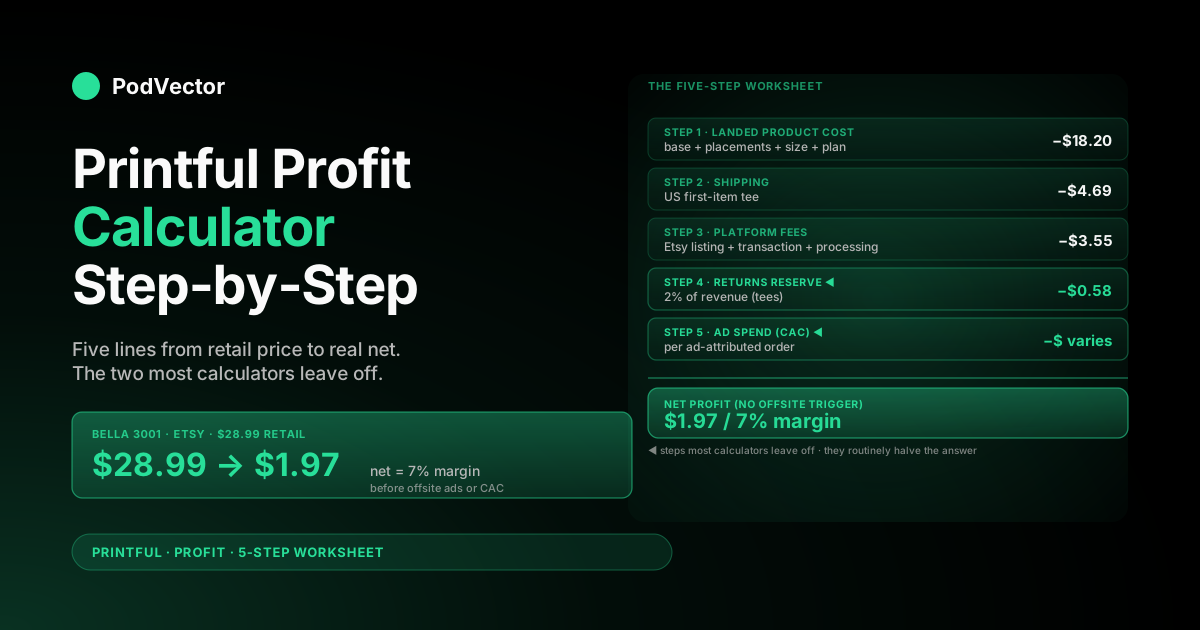
Quick Answer: A Printful profit calculator is a five-step worksheet — landed product cost, shipping, platform fees, returns reserve, and ad spend — and the answer is what is left after subtracting all five from your retail price.
Most online calculators stop at three of those lines. The two they skip (returns reserve and ad spend) are exactly the lines that turn a "30% margin" on the spreadsheet into a 6% margin in your bank account.
This guide walks the full calculation in order, with two worked examples (a Bella 3001 tee on Etsy and a hoodie on Shopify), the formulas to keep in a spreadsheet, and the operator metrics that signal when a SKU is about to go underwater.
Why a Printful profit calculator needs five steps, not three
Most calculators ask for three inputs: Printful product price, your retail price, and the platform (usually Etsy). They subtract the first from the second, take a fee percentage off the top, and call the difference your profit.
That math omits two real lines. Returns and reprints take 2–5% off your gross. Ad spend (the CAC line) takes 15–30% off on Etsy and often more on Shopify. Together they routinely halve the "profit" the simple calculator displays.
The fix is a five-step worksheet that mirrors what actually leaves your bank account on every order. Landed product cost. Shipping. Platform fees. Returns reserve. Ad spend. Subtract all five from retail. What is left is real net profit.
Step 1 — Calculate landed product cost
The Printful product page price is line one of the cost stack, not the cost itself. Three quiet modifiers stack on top before the unit even ships.
Print placement add-ons. The base price covers one front-side print. A back print adds $4.76 to $5.95. A sleeve print adds $2.49. An inside-neck branding add-on costs $2.49.
Size upcharges. Sizes 2XL through 4XL carry premiums of $2.00 to $5.50 per garment on most tees and hoodies. A 15% share of plus-sized orders shifts your blended cost upward by more than $1 per unit.
Plan amortization. If you pay $24.99/month for the Growth plan, that fee divides across your monthly order count. At 25 orders/month, plan amortization adds $1.00 per unit. At 50 orders, $0.50. Treat it as a cost line — Printful does not.
Add the four numbers — base price, placement add-ons, size upcharge expected from your size mix, and plan amortization — to get landed product cost. For a Bella 3001 on Growth, front and back print, 15% 2XL+ mix: $10.80 + $5.95 + $0.45 + $1.00 = $18.20.
Step 2 — Add Printful shipping to the cost line
Whether you "offer free shipping" or charge the customer, shipping always lands on the cost side of the worksheet. If you charge for it, retail price goes up by that amount on the revenue side too — net effect is the same.
US domestic shipping in 2026 runs $4.69 for the first tee, $1.85 for each additional tee. Hoodies cost $5.95 first / $2.95 additional. Mugs ship separately at $5.49–$13.95 because they are packed in protective cardboard. International rates climb to $14.95 for rest-of-world destinations on a single tee.
Two operator notes. Single-item orders carry the worst per-unit shipping economics — that is why bundle pricing lifts margin without raising retail. And if you "free shipping" a single-item international order, you absorb up to $14.95 of cost on a sub-$25 product.
For a full per-region breakdown, see Printful shipping rates, times, and costs.
Step 3 — Subtract platform fees by channel
Each sales channel takes a different cut. Plug in the channel where the order actually came from — channel mix changes your blended fee line item more than most operators realize.
| Channel | Listing fee | Transaction fee | Payment processing | Offsite / ad fee |
|---|---|---|---|---|
| Etsy | $0.20 per listing | 6.5% (price + shipping) | ~3% + $0.25 | 12–15% if offsite ads triggers |
| Shopify (Basic) | $0 | 0–2% (your plan) | 2.9% + $0.30 | 0% — you run ads separately |
| eBay | 250 free / mo | ~13.25% final value fee | Included in FVF | Optional promoted-listing 2–12% |
| Amazon (Merch on Demand parallel) | $0 | 15% referral fee | Included | Sponsored ads separate |
On a $29.99 Etsy tee with $4 of shipping captured at checkout, the platform stack is roughly $0.20 + $2.21 + $1.27 = $3.68. Add 15% offsite ads if it triggers, and the platform line becomes $8.18 — more than the back print and shipping combined.
Watch the offsite-ads trigger on Etsy carefully. It kicks in automatically once your store passes $10K/year in sales, and it cannot be opted out of. Most "20% margin" tee math evaporates the first time offsite ads claims a $4.50 cut.
Step 4 — Reserve for returns, reprints, and chargebacks
Printful covers reprints on its production defects — wrong size shipped from their side, misprint, garment defect, carrier damage. They do not cover customer-side returns: "wrong size ordered," "didn't like the print," "changed my mind."
You will eat one of three costs on a customer-side return. A reprint at full Printful cost if you offer a free replacement. A refund of the full retail price if you accept the return as a goodwill gesture. A chargeback if the customer escalates to their card issuer — that adds a $15 chargeback fee on top of the refund.
The defensible reserve is 2–5% of revenue, depending on product. Tees and posters cluster at 2%. Hoodies (size complaints) and mugs (breakage in transit) sit at 4–5%. Track your last 90 days of returns against gross sales to calibrate the percentage for your catalog.
On a $29.99 tee, that's a $0.60–$1.50 line item per order. Skipping it is the single most common reason POD spreadsheets predict margins the bank account never delivers.
Step 5 — Compute net profit and margin
With the four cost lines computed, the formulas are short.
Net profit per unit = Retail price − Landed product cost − Shipping cost − Platform fees − Returns reserve − Ad spend per order
Net margin = Net profit per unit ÷ Retail price
If you sell across multiple SKUs, blend retail and blended cost across the catalog using actual unit-sold weights, not equal weights. A 60/40 tee/hoodie split gives a different blended margin than averaging the two product-line margins straight.
For the broader cost picture across Printful's full fee surface, see the complete guide to Printful costs and fees.
Worked example: Bella 3001 tee on Etsy
Scenario: Bella + Canvas 3001 tee, Growth plan, front-and-back DTG, US shipping, listed at $24.99 with $4 shipping captured. Store is past the $10K/year offsite-ads threshold.
| Line | Amount | Notes |
|---|---|---|
| Retail (product + shipping captured) | $28.99 | $24.99 + $4.00 shipping |
| Landed product cost | −$18.20 | $10.80 base + $5.95 back + $0.45 size + $1.00 plan |
| Shipping (out) | −$4.69 | US first item |
| Etsy listing + transaction + processing | −$3.55 | $0.20 + 6.5%·$28.99 + 3%·$28.99 + $0.25 |
| Offsite ads (if triggered) | −$4.35 | 15% on $28.99 |
| Returns reserve | −$0.58 | 2% of $28.99 |
| Net profit (no ad spend) | −$2.38 | Underwater on triggered offsite-ads order |
| Net profit (no offsite trigger) | $1.97 | 7% margin |
That single calculation explains why Etsy POD sellers crossing $10K/year often watch margin collapse without changing a single SKU. Offsite ads is a 15% cut on top of every other fee, and it triggers without warning.
Two operator moves restore the math. Raise retail to $29.99 — every dollar at retail flows to the margin line. Skip the back print on test campaigns — saves $5.95 per order and lifts the same SKU back into healthy territory.
Worked example: unisex hoodie on Shopify
Scenario: Gildan 18500 hoodie, Growth plan, single front print, US shipping, listed at $49.99 with free shipping built into retail.
| Line | Amount | Notes |
|---|---|---|
| Retail price | $49.99 | Free shipping built in |
| Landed product cost | −$23.96 | $22.16 base (Growth) + $0.80 size + $1.00 plan |
| Shipping (out) | −$5.95 | US hoodie first item |
| Shopify processing | −$1.75 | 2.9% + $0.30 on $49.99 |
| Returns reserve | −$2.00 | 4% of $49.99 (hoodies skew high) |
| Net profit (before ads) | $16.33 | 33% margin |
The hoodie pencils at 33% gross before ad spend, almost 5x the tee's net on Etsy. Same cost stack, different platform, different SKU class. That spread is exactly why portfolio-level margin work matters more than per-SKU optimization.
Adding ad spend (CAC) to the calculation
If you acquire customers through paid channels — Meta, Google, TikTok — your blended customer acquisition cost (CAC) is line six of the worksheet. It is the most variable line and the one operators most often forget to apply per order.
The formula: CAC per order = Total ad spend in period ÷ Paid orders in period. If you spent $300 on Meta last week and got 25 paid orders, CAC = $12 per order.
Apply CAC only to ad-attributed orders, not to organic/repeat. Mixing the two understates how much margin organic orders carry and overstates how viable paid acquisition really is.
Back to the Shopify hoodie example: net $16.33 before ads, minus $12 CAC = $4.33 net margin (9%). Still positive, but you can see how a $14 CAC pushes the same product underwater. CAC sensitivity is the single highest-leverage variable in the model.
Common Printful profit-calculator mistakes
Skipping the returns reserve. Spreadsheet predicts 30%, bank account delivers 25%, and the operator never figures out where the gap came from. Five points of margin lives or dies on this line.
Forgetting plan amortization. The $24.99/month Growth fee is real cost. Spreading it across orders is the only way the plan-vs-Free decision actually pencils.
Averaging margin across SKUs. A simple average over-weights low-volume SKUs. Always blend by unit sold, not equal weight per SKU.
Treating offsite-ads as optional on Etsy. Past $10K/year it is automatic. The 15% cut needs to be modeled into every projection above the threshold.
Holding retail flat while costs move. Printful adjusts base prices several times a year. Most POD sellers refresh retail once a year if at all. The gap quietly erodes margin order by order.
For more sequencing on the financial fundamentals, the how to make money with Printful guide walks the operator path from first listing to repeatable profit.
Operator metrics worth tracking weekly
Once the five-step worksheet is wired up, the questions worth running every week are not "what is my margin." They are "what changed."
Which SKUs dropped below 20% gross margin this week? Catches base-price drift, refund spikes, and platform-fee changes the moment they hit.
What is my blended CAC trend across the last four weeks? Rising CAC at constant margin means each marginal order is less profitable. Flat-CAC, falling-margin means cost-side erosion. The two failure modes require different fixes.
Returns rate by SKU. A hoodie returning at 8% needs sizing-chart attention. A mug returning at 12% needs packaging attention. Aggregate returns rates hide both.
These are the kinds of questions Victor can answer in seconds, because he reads your Printful invoices for you, instead of you rebuilding a spreadsheet each week. For the broader portfolio view, see what you need to know about Printful profit margin, and the phone-case-specific margin breakdown for accessory categories that follow a different cost shape.
The full money-making cluster aggregates every Printful margin-mechanics article we maintain, and the Printful topic hub indexes the broader cost and fulfillment context.
FAQs
What is the basic Printful profit formula?
Retail price minus landed product cost (base + placements + size + plan amortization), minus shipping out, minus platform fees, minus returns reserve, minus ad spend per order. The remainder is net profit per unit. Divide by retail to get net margin percent.
How accurate are free online Printful profit calculators?
Most are accurate on the first three lines (product cost, shipping, platform fees) and miss two big ones (returns reserve and ad spend). Treat their output as your gross before reserves — then subtract another 5–8% for the lines they skipped to get a realistic net.
What is a healthy net margin for Printful POD?
Healthy POD net margins after all five cost lines sit at 15–25% for established sellers. New sellers usually land at 5–15% in the first six months because CAC is higher and product mix is less optimized. Past 25% net, the business compounds quickly because every reinvested marketing dollar carries through.
Does Printful tell me my profit per order?
Printful's Quick Stores feature shows a basic profit line — retail price minus Printful cost minus shipping. That ignores platform fees, returns, and ad spend, so its profit number is roughly your gross before half the real cost stack. Use it as a sanity check, not the final number.
Should I include sales tax in the calculator?
Yes, on both sides. Sales tax collected from the customer is a pass-through (revenue line plus, remittance line minus). Sales tax Printful charges you on the order is a cost line — you pay it whether or not you collected from the customer. Net effect is usually small, but in high-tax US states it can be 1–2 points of margin.
How often should I rerun the calculator on a SKU?
Monthly at minimum on your top 20 SKUs, quarterly on the long tail. Printful adjusts base prices several times a year, Etsy fee changes hit annually, and your returns rate drifts as size mix and customer mix evolve. A SKU that was a 25% margin winner six months ago can quietly slip to 12% without any visible signal.
What if my SKU shows a positive gross margin but I am still losing money?
Usually CAC or returns. If gross is 25% per unit but the business is losing money, blended CAC is probably eating the entire gross on paid orders, or returns rate is multiples of your reserve. Both fixes require looking at orders in cohorts, not per-unit averages.
Is it worth building this calculator in a spreadsheet versus using an online tool?
For 1–10 SKUs and a single platform, a spreadsheet is fine and arguably easier to audit. Past 20 SKUs across multiple channels, the spreadsheet becomes a maintenance burden — base prices change, fee schedules change, returns drift — and having Victor read your costs and orders for you pays off in saved audit time alone.
Does Printful's plan choice affect the calculator?
Yes, significantly. Growth plan ($24.99/month) cuts DTG base prices by 20% on most blanks. Business plan ($49.99/month) cuts them by 30%. The plan fee is a fixed cost amortized across orders, so it gets cheaper per unit as volume scales. Above 25 orders/month, Growth pays for itself on Bella 3001 alone.
How do I model bundled orders?
Compute per-unit base cost normally, but use the additional-item shipping rate (e.g., $1.85 for a second tee versus $4.69 for the first). A two-tee bundle drops blended shipping from $9.38 to $6.54 — roughly $1.40 of margin per unit recovered. Bundles also dilute the per-order Etsy listing fee across multiple units.
Stop running this calculator one SKU at a time
The five-step worksheet is right for a single product. It breaks down the moment you have 40 SKUs across two channels and four ad campaigns. The numbers change weekly. The spreadsheet does not keep up.
Victor reads your itemized Printful invoices, Shopify orders, and Meta/Google ad spend for you, and keeps them all tied together. Ask "which of my SKUs dropped below 20% gross margin this week" or "what is my blended CAC trend on tees vs hoodies in the last four weeks" — get the answer and the SKU list in seconds.
External reference: Printful's own good profit margin guide covers benchmark margin ranges across the most common POD product lines if you want a non-step-by-step overview.
Try Victor free