
Quick Answer: AI fraud detection scores ecommerce orders in real time using transaction signals, behavioral patterns, device fingerprints, and historical chargeback outcomes — flagging risky orders before they ship and learning from each new dispute. For print-on-demand sellers the stakes are different from generic ecommerce: a single chargeback wipes the profit on five to ten clean orders because COGS, shipping, and fees are already paid by the time a dispute lands. This guide walks through how the AI works, the fraud patterns POD sellers actually see (friendly fraud, sizing-disputes-as-fraud, address scams, AI-bot reorders), the Shopify + Printify/Printful stack that actually moves the chargeback rate, and where agentic monitoring is heading next.
What AI for fraud detection actually means in 2026
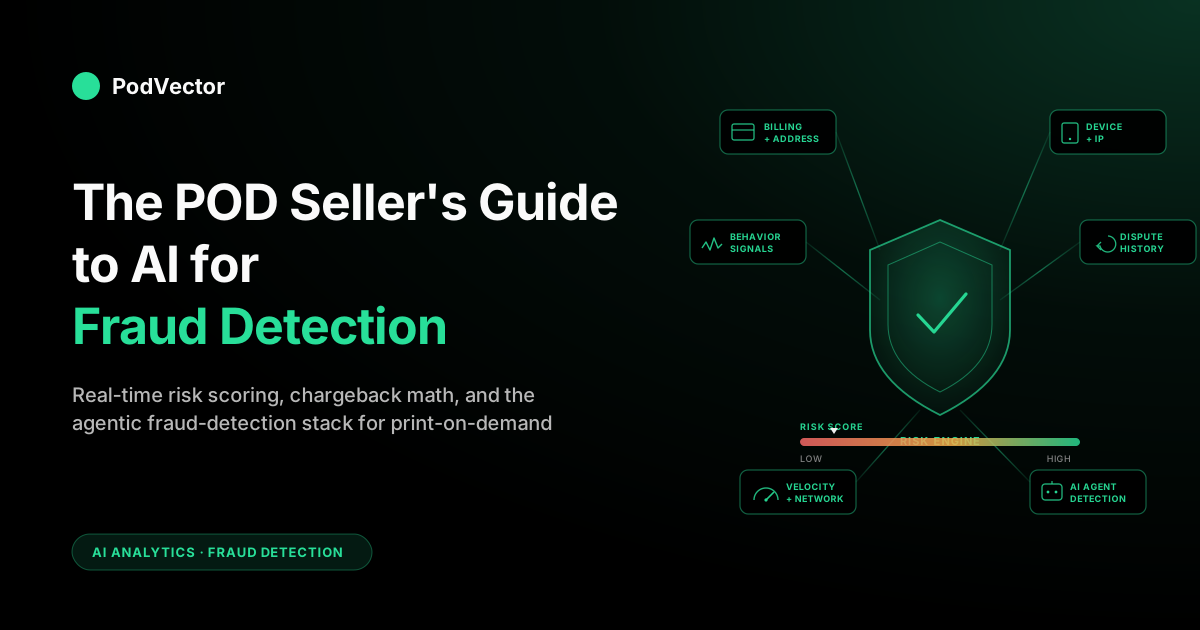
"AI fraud detection" used to mean a rules engine — block orders where the billing country doesn't match the IP, hold orders over $500, decline cards that fail AVS. Those rules still exist, but they're now the floor, not the ceiling. Modern AI fraud detection layers machine-learning models on top of those rules to score each transaction in real time using dozens to hundreds of signals: device fingerprint, browser entropy, IP reputation, velocity (how many orders from this email/card/device in the last hour, day, week), behavioral patterns (how the customer typed, scrolled, copy-pasted), historical chargeback outcomes for similar profiles, and increasingly the customer's broader identity graph across the merchant's data and third-party fraud networks.
The output is a risk score. Low risk passes through silently.
High risk gets declined or routed to manual review. The middle is where the system earns its money — orders that look mostly fine but carry one or two warning signals that a human eye would miss. That middle band is also where bad fraud detection costs you the most: too aggressive and you decline real customers (false positives are the silent margin killer), too lax and chargebacks pile up.
The AI part isn't magic. It's pattern matching at a scale and speed humans can't reach, retrained as new fraud tactics emerge. The shift from "rules" to "AI" is the shift from a static decision tree your processor wrote in 2019 to a model that reads what's happening on your store this week and adapts.
What changed between 2022 and 2026
- AI-driven fraud is now the majority threat. Surveys in early 2026 (notably from Darwinium, which launched dedicated AI-agent fraud detection in March) report that 97% of merchants saw AI-based fraud attacks rise in the past year, with about 40% of fraud attempts now using AI in some form — automated card testing, synthetic identity generation, deepfake voice for support social-engineering, agentic shoppers reordering at scale.
- Behavioral biometrics moved mainstream. Fraud platforms now look at how a session behaves (mouse movement, typing cadence, paste events) as much as what it claims to be (email, card, address). This is what catches well-equipped fraudsters who pass every traditional check.
- Real-time scoring became table stakes. The bar moved from batch overnight review to sub-second inline scoring at checkout, because anything slower lets bad orders through to fulfillment.
- Chargeback automation closed the loop. AI now drafts and submits chargeback responses automatically with order evidence, shrinking the response burden that used to swamp small POD shops.
Why POD fraud is its own animal
Most articles on AI fraud detection are written for retailers holding inventory at margins of 50% or higher. POD is different — and the differences change which fraud types matter, how much each one costs, and what the right tooling looks like. If you apply a generic ecommerce-fraud playbook to a POD store, you'll miss the patterns that actually drain your bank account.
One chargeback wipes 5–10 clean orders of profit
Run the math. A POD t-shirt sells for $25.
Printify or Printful invoice is $11. Shipping is $5.
Shopify and payment fees take roughly $1.50. Net contribution before ads is about $7.50.
Now the customer disputes the charge two weeks after delivery. You lose the $25, the chargeback fee is $15–$30 depending on the processor, and the supplier was already paid.
Round numbers: a single chargeback costs you $40–$55, which is roughly five to seven clean t-shirt orders of profit. On lower-margin products it's worse. This compounding ratio is why fraud detection matters disproportionately to POD sellers — and why generic "good enough" tools that miss 1% more than they should are not actually good enough.
You can't take the inventory back
Wholesale brands can refuse fraudulent orders before the warehouse picks. A POD order, once accepted, is auto-routed to Printify or Printful within minutes.
By the time you notice anything off, the supplier has already accepted the production order and you're paying for the print whether the dispute resolves in your favor or not. That makes pre-fulfillment fraud detection — flagging risky orders before they hit the supplier — vastly more valuable than post-shipment review.
The window is narrow. AI is the only thing fast enough to use it.
"Friendly fraud" and sizing disputes blur together
The largest single category of POD chargebacks isn't classic stolen-card fraud — it's friendly fraud, where a customer who actually placed the order disputes it later. They claim "item not received" when it was, or "item not as described" when it was, or simply forgot the purchase and called their bank.
POD specifically attracts a sizing-disputes-as-fraud subspecies: customer doesn't like the fit, doesn't want to deal with returns on a custom-printed shirt that can't be resold, files a chargeback instead. Pure rules-based fraud tools miss almost all of this, because the orders look perfectly clean at checkout. AI tools that incorporate post-purchase signals (return rate by SKU, dispute rate by buyer email, lifetime behavior) catch substantially more.
Address scams hit POD harder than DTC
Scammers test addresses through low-cost POD orders precisely because the order ships from a third-party warehouse the customer doesn't have a direct relationship with. They place a small POD order to a "drop site" or freight-forwarder address, see whether it goes through, then escalate.
Generic ecommerce fraud rules tuned to dollar thresholds miss this entirely — the order is small, the card looks fine. AI fraud detection that reasons about address risk (residential vs. commercial vs. forwarder, recent reuse, distance from billing) catches it.
Bot-driven reorders are a 2026 problem
Agentic AI shoppers — and adversarial agents trained to stress-test merchant defenses — are an emerging fraud vector specific to 2026. They behave differently from humans: deterministic timing, no real exploration of the catalog, abnormal field-fill order.
Detection requires behavioral models that distinguish a real shopper from a script. This is the part of the fraud-detection landscape moving fastest right now, and it's exactly the reason Darwinium and others released dedicated agent-detection products earlier this year.
The fraud patterns POD sellers actually face
Naming the threat surface clearly so you know what your fraud tool needs to catch.
1. Card testing
Bots place dozens to hundreds of small orders rapidly to test stolen card numbers. POD stores attract this because checkout is open and frictionless and the cost-to-test is low.
Symptoms: clusters of low-dollar orders, often within minutes, often from the same IP range or device fingerprint. AI catches it on velocity and device signals. Without AI, you discover it when your processor flags your account.
2. Stolen-card "true fraud"
Classic case: a real card is used by someone other than its holder. The shipping address often differs from billing, the IP doesn't match the cardholder's geography, and the basket size skews high. AI scores this with a combination of address mismatch, IP geolocation, BIN reputation, and behavioral signals.
3. Friendly fraud / chargeback abuse
The customer placed the order, received the item, then disputed it. Most prevalent and hardest to detect because the order looks clean at checkout. AI catches it later — by tracking dispute rate per email, per device, per address — and either blocks the buyer's future orders or escalates them to manual review.
4. Refund and return abuse
Customer files chargebacks claiming "not received" while the package shows delivered, or claims a defect that requires a refund without return. POD-specific because returns are usually impractical (custom-printed). AI helps by aggregating evidence — tracking, delivery photos, prior order behavior — for automated dispute response.
5. Address fraud and forwarders
Orders to freight-forwarder addresses, drop sites, or addresses recently used by other customers raise risk meaningfully. Address-intelligence APIs feed AI scoring with this signal so the model knows, before the order is approved, whether the destination has a fraud history.
6. Account takeover (ATO)
Less common on POD stores than on accounts-heavy retailers, but rising as POD operators add accounts for repeat customers and store credit. AI behavioral biometrics flag a session that "isn't acting like" the legitimate account holder.
7. Promo and discount abuse
Customers cycling through one-time discount codes via fresh accounts and emails. POD stores running aggressive new-customer promos see this most. AI catches it with email/device clustering and historical behavior matching.
8. Synthetic identity
Fraudsters build identities that don't correspond to a real person — combining real and fake data — to pass surface-level checks. AI catches synthetic identity by cross-referencing identity graphs and device-network signals across the merchant network the fraud tool participates in.
9. AI-agent and bot fraud (the 2026 wildcard)
Automated agents reordering, scraping, or stress-testing checkouts at machine speed. Different signature from card-testing bots — more sophisticated, more human-like — and is the category most likely to grow in the next 12 months.
How AI-powered fraud detection works under the hood
Understanding the mechanics helps you ask the right questions of any tool you evaluate.
Signal collection
The fraud system ingests dozens of inputs at the moment a customer hits "Pay." Some come from the checkout form (email, card BIN, billing/shipping address). Some come from the device (IP, device fingerprint, browser characteristics, time zone, language).
Some come from behavioral telemetry (how the customer navigated the site, typing cadence, paste events). Some come from third-party APIs (email reputation, address intelligence, IP risk). Some come from your own historical data (has this email ordered before, what was the outcome).
Feature engineering
Raw signals get turned into features the model can reason about. "Customer email" becomes "email age," "email reputation score," "domain risk class," "number of orders in the last 30 days from this email." "Billing address" becomes "address-geocode-confidence," "distance to shipping address," "address velocity in the merchant network." Good fraud tools have hundreds of engineered features tuned over years of fraud data. This is what's hard to replicate — not the model itself.
Model scoring
A trained model — usually some combination of gradient-boosted trees, neural networks, and rule-based overrides — produces a single risk score (often 0–100 or low/medium/high). The model is retrained on outcomes: orders that resulted in chargebacks teach the model what to flag; orders that cleared cleanly teach it what to approve. Over time, the model gets sharper for your specific customer base.
Decisioning
The risk score maps to actions. Below a low threshold → approve silently.
Above a high threshold → decline or route to manual review. In between → step-up authentication (3DS, OTP, friction increase). Good fraud tools let you tune these thresholds yourself; bad ones are a black box. Chargeflow's overview of AI-powered fraud detection walks through the decisioning logic in more depth for merchants new to the category.
Continuous learning
Every chargeback that comes in, every dispute that resolves, every "approved but later flagged" order feeds back into the model. The system you turn on Monday is not the system you have running in October. This is the part that justifies the AI label — static rules engines can't do it; AI fraud platforms do it automatically.
Network effects
The most powerful AI fraud platforms operate across many merchants. A device fingerprint that committed fraud on Merchant A is flagged before it ever hits Merchant B.
A synthetic identity that built up on one platform is recognized when it appears on the next. For a POD store, joining a fraud network is the difference between learning fraud one chargeback at a time and inheriting the lessons of millions of transactions.
Where AI fraud detection earns its keep on a POD store
Concrete payback areas where the math is clear for POD specifically.
Pre-fulfillment hold on high-risk orders
Catching a fraudulent order in the 30-minute window before it routes to Printify or Printful saves you the supplier cost, shipping cost, and the chargeback fee. On a $25 t-shirt, that's about $32 in protected margin per blocked fraud order. Multiply by the number of fraud attempts a typical POD store sees in a month (usually a few percent of order volume) and the math closes quickly.
Reduced false positives
The hidden cost of bad fraud rules is good customers turned away at checkout. AI tuned with sufficient data has substantially lower false-positive rates than rules-only systems — typically pulling 50–80% fewer good customers into manual review.
Each declined good order is also a customer who probably never tries again. This is uncounted revenue your generic fraud tool is leaking.
Chargeback dispute automation
When chargebacks do happen, AI tools assemble the evidence package — order details, tracking, delivery confirmation, customer correspondence — and submit it within the processor's deadline. POD shops without this typically respond to less than 30% of disputes; with automation, response rates approach 100% and win rates climb meaningfully. The marginal value per chargeback recovered: the full dollar amount minus the chargeback fee.
Friendly-fraud denylisting
Customers with a chargeback history elsewhere on the merchant network can be flagged on first order at your store. This single feature blocks one of the most damaging fraud types for POD before it costs you anything.
Fewer manual review hours
Without AI scoring, every "looks weird" order gets flagged for human review, and the human is usually you. AI scoring shrinks the manual queue by an order of magnitude on most stores. That time is the most valuable resource a POD operator has.
The Shopify + Printify/Printful fraud stack
What a working POD fraud setup actually looks like in 2026, layer by layer.
Layer 1: Shopify's built-in fraud analysis
Shopify ships fraud risk scoring on every order (low / medium / high) based on internal signals. It's free, it's reasonable for low-volume stores, and it's almost always insufficient on its own.
It misses behavioral biometrics, doesn't reason about post-purchase patterns, and doesn't automate dispute response. Treat Shopify's score as one signal among several, not as your fraud system.
Layer 2: Dedicated fraud apps
Tools like Signifyd, NoFraud, Riskified, FraudLabs Pro, and Subuno layer ML scoring, network data, and chargeback guarantees on top of Shopify. The chargeback-guarantee variants (where the vendor reimburses you for any chargeback they approved) are especially relevant for POD stores because they remove the tail risk entirely — at the cost of a per-transaction fee, usually 0.5%–1.5% of order value.
Layer 3: Printify and Printful settings
Both supplier dashboards have order-hold options that delay routing to production. Use them.
A 15- to 30-minute hold gives your fraud tools time to score and lets you cancel cleanly if a flag fires. Without this, an order routes to print before any fraud system has a chance to act on it. (See the broader Printful operations breakdown in the complete Printful review.)
Layer 4: Address verification
An address-intelligence API (Smarty, Lob, Melissa, AvaTax for tax) feeds your fraud tool the residential/commercial/forwarder classification it needs. Skipping this is one of the most common gaps on POD stores; address fraud sails through without it.
Layer 5: Behavioral analytics overlay
Tools like Sift, Forter, or the agent-detection layer Darwinium and others now offer add the behavioral biometrics signals that catch sophisticated fraud — including the AI-agent fraud category that's growing fastest in 2026.
Layer 6: An analytics layer that watches the whole picture
The pieces above each see one slice of the fraud problem. What they don't do is reconcile fraud cost across SKUs, designs, supplier routes, ad sources, and time. That reconciliation is an analytics problem, not a fraud-tool problem. The complete guide to AI analytics for print-on-demand walks through how a unified data layer turns fraud signals into design- and campaign-level decisions, which is where Victor sits in the stack — reading Shopify, Printify/Printful, and your fraud platform's outputs together to surface the patterns no individual tool sees alone.
Implementing AI fraud detection without breaking conversion
The risk in any fraud-tool rollout is catching bad orders at the cost of declining good ones. A few principles keep the tradeoff sane.
Start with the chargeback-guarantee model if you can afford the fee
For most POD stores under $1M ARR, the simplest move is a fraud platform that absorbs chargeback risk for a fixed per-transaction fee. You stop owning the false-positive vs. false-negative tradeoff entirely; the vendor does. The math works as long as the fee is below your historical chargeback cost rate, which it almost always is.
If you self-tune, set thresholds conservatively at first
Run two weeks in "score-only" mode where the fraud tool reports but doesn't act. Compare its scores to your actual outcomes. Then tune thresholds with the data you have, not the vendor's defaults. POD-specific patterns (address-forwarder risk, friendly-fraud rate by SKU type) almost always require local tuning to behave well.
Hold high-risk orders, don't decline them outright
A held order can be released after additional verification (3DS step-up, manual review, customer email confirmation). A declined order is a lost customer. For POD, where margins are tight and CAC matters, the held-order workflow recovers more revenue.
Measure false positives explicitly
Most fraud tool dashboards report "fraud caught" eagerly. They report "good customers declined" reluctantly or not at all. Set up a side-channel review of declines — periodically pull a random sample, check whether they look like real customers, estimate the false-positive rate. If it climbs above 1–2%, tune.
Wire chargeback evidence on day one
The fraud tool should automatically pull tracking, delivery confirmation, and order screenshots when a chargeback fires. If yours doesn't, you're leaving money on the table — manual evidence assembly is the bottleneck on dispute response.
The agentic shift: from flagging to acting
Today's fraud AI flags risky orders. Tomorrow's takes action on them — and on the rest of the fraud workflow — without requiring a human checkpoint.
The trajectory looks like this. Stage one (where most platforms are now): score the order, surface the score, leave the action to the merchant or the rules engine.
Stage two (rolling out across 2026): autonomously hold high-risk orders, request step-up auth, file chargeback evidence, denylist repeat offenders. Stage three (early demos in 2026, mainstream by 2027): the fraud agent reasons across the merchant's full data — Shopify orders, supplier costs, ad sources, customer history — and recommends or executes structural changes (routing rules, promo guardrails, supplier holds) when fraud patterns shift.
This is also where Victor fits in. PodVector AI's working positioning today is the AI operator layer for POD: Victor reads your Shopify, Printify/Printful, and ad-platform data live and answers profit, margin, and risk questions in plain English.
On the fraud side specifically, Victor today surfaces the patterns — chargeback rate by SKU, return rate by supplier route, refund spike on a specific design — that turn raw fraud-tool output into decisions about which products and routes to keep open. Tomorrow's roadmap moves from surfacing to acting: pausing risky SKUs, escalating disputes, throttling promo codes when abuse signals fire. The same agentic-commerce arc playing out in storefront chat is playing out in operations, and fraud is one of the cleanest use cases.
Background on where this category is heading: the complete guide to AI agents for ecommerce analytics, the AI analytics topic hub, and the broader AI overview cluster.
Mistakes POD sellers make adopting fraud AI
Treating Shopify's built-in score as sufficient
It catches obvious cases. It misses the modern fraud surface — friendly fraud, behavioral signals, address-forwarder patterns, AI-agent fraud — almost entirely. If chargeback rate is non-trivial, layer something on top.
Picking a fraud tool without checking POD-specific reviews
Generic Shopify fraud tools are tuned on storefront-brand data. Some perform noticeably worse on POD because the patterns differ (high-volume low-AOV traffic, design-specific return rates, supplier holds). Read POD-specific reviews and ask vendors directly how their model handles your category.
Ignoring the false-positive rate
A tool that catches 100% of fraud while declining 5% of good orders is worse than one that catches 80% with 1% false positives. POD margins don't survive aggressive declines. Demand reporting on both sides.
Routing orders to fulfillment before scoring
This single configuration mistake — accepting and routing in parallel rather than serially — costs more than any tool will ever save. Hold orders until the score arrives.
Not aggregating fraud data with profit data
Knowing your chargeback rate is half the picture. Knowing it by design, by SKU, by supplier route, by ad source is the full picture — and the only level at which you can do something structural about it. A comparison of AI tools for ecommerce data analysis covers the analytics-side of this stack.
Ignoring chargeback dispute response
Many POD shops accept chargebacks because responding is tedious. AI dispute automation removes the tedium. Win rates of 30–60% on properly-evidenced disputes are realistic; not responding wins zero.
Not revisiting tuning quarterly
Fraud patterns shift. The model retrains automatically on outcomes, but threshold tuning, allow/deny lists, and product-specific rules need a quarterly human review. Set the calendar reminder; it pays for itself.
FAQs
How accurate is AI fraud detection for POD stores?
Modern AI fraud platforms typically achieve 95%+ precision on flagged transactions for the e-commerce category as a whole, but POD-specific accuracy depends on whether the model has seen enough POD chargeback data to recognize sizing-disputes-as-fraud and friendly-fraud patterns. Vendors operating fraud networks across many merchants generally outperform single-merchant models. Always ask for category-specific performance numbers in evaluation.
What's the difference between AI fraud detection and AI fraud prevention?
Detection identifies fraud after or during a transaction (scoring, flagging, alerting). Prevention is the broader category that includes detection plus proactive measures (3DS, address verification, denylists, behavioral friction). Most modern platforms do both; the line is mostly marketing.
Will AI fraud detection slow down my checkout?
Properly integrated, no — scoring happens in under 200ms inline at checkout, faster than any human notices. The slowdown is usually from poor integration (synchronous calls without timeouts) rather than the AI itself. Test in staging and confirm the latency budget before going live.
How much does AI fraud detection cost for a small POD store?
Rules-based or basic-ML tools start at $0–$30/month; chargeback-guarantee platforms charge 0.5%–1.5% of transactions; enterprise platforms negotiate custom pricing. For a store doing $30k/month, expect $150–$450/month in fees on the chargeback-guarantee model. Compare against your current chargeback cost (chargeback rate × average order value × all-in chargeback cost per dispute) to decide whether the math is in your favor — for most POD shops with chargeback rates above 0.5%, it is.
Is AI fraud detection compliant with privacy regulations?
Yes — major fraud platforms are designed for GDPR, CCPA, and PCI compliance, with documented data-handling and customer-rights workflows. Verify the vendor's compliance documentation before signing, especially if you ship internationally. The data the system processes (device, behavior, transaction) is generally permitted under fraud-prevention legitimate-interest exemptions, but the documentation matters at audit time.
Can AI catch friendly fraud and chargeback abuse?
Better than rules systems, but not perfectly — friendly fraud is genuinely hard because the order looks clean at checkout. AI catches it through cross-merchant network signals (this email/device has disputed elsewhere) and through post-purchase behavior (return rate, dispute history).
Tools without network data or post-purchase signals miss most of it. This is one of the key questions to ask any vendor.
Should POD stores use chargeback-guarantee or self-managed fraud tools?
For stores under roughly $1M ARR, chargeback-guarantee is almost always the right call — the per-transaction fee buys away the tail risk, and small POD shops don't have the volume to tune a self-managed system well. Above $1M, the math sometimes favors self-managed because the per-transaction fee starts to outpace chargeback costs at scale. Run the actual numbers; defaults are wrong as often as right.
How does AI fraud detection handle AI-agent shoppers?
This is the newest part of the stack. Detection of agentic shoppers requires behavioral biometrics tuned for non-human interaction patterns (deterministic timing, no exploration, clean form-fills).
Vendors specifically marketing agent-detection (Darwinium, some Sift and Forter modules) are the leading edge here in 2026. For most POD stores it's not yet a critical layer — but the threat is rising fast enough that it'll be standard within a year.
See your real chargeback math, design by design
Fraud tools tell you about chargebacks. They don't tell you which design pulls them, which campaign sources them, or which supplier route makes them worse. Victor reads your Shopify, Printify/Printful, and fraud-platform data live and answers those questions in plain English — so the structural fixes are obvious before the next chargeback hits. And ask your first chargeback question in under five minutes.
Try Victor free