
What the markup formula actually measures
Markup is the gap between what a product costs you and what you charge for it. The markup formula turns that gap into a percentage of your cost, so you can price consistently across a whole catalog.
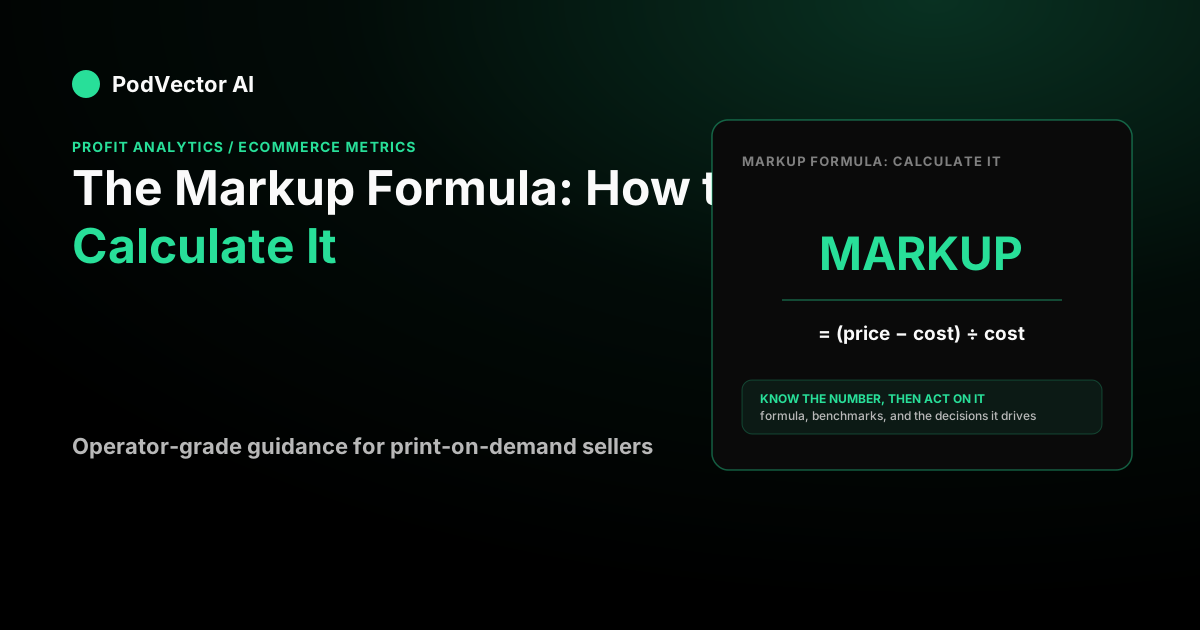
The formula is simple:
Markup % = (Selling Price − Cost) ÷ Cost × 100
The key word is cost. Markup is always measured against what you paid, never against what the customer paid. That single detail is what separates markup from margin, and confusing the two is the most expensive mistake in this whole topic.
How to calculate markup: a worked example
Say you run a print-on-demand apparel store. A blank tee plus printing and the supplier's base fulfillment charge costs you $16 to get to a ship-ready state. You list that shirt at $40.
Plug it in:
- Price − Cost = $40 − $16 = $24 (your gross profit per shirt)
- Markup % = $24 ÷ $16 × 100 = 150%
So you marked the shirt up 150% over its cost. Every additional dollar of cost, at that markup, would need $1.50 added on top to hold the same pricing rule.
You can also run the formula backward to set a price from a target markup. Price = Cost × (1 + Markup). Wanting a 150% markup on a $16 cost gives you $16 × 2.5 = $40 — the same list price you started with.
Markup vs. margin: same gap, two denominators
This is where most articles get thin, so here is the precise version. Markup and margin describe the same dollar gap — they just divide it by different numbers.
- Markup divides the gap by cost: $24 ÷ $16 = 150%.
- Margin divides the gap by price: $24 ÷ $40 = 60%.
Same $24, two very different percentages. A 150% markup is a 60% margin on the identical shirt. Suppliers and marketplaces usually quote markup; your profit-and-loss statement quotes margin. If you want the full breakdown of the term itself, our explainer on what markup is walks through it.
You never have to guess between the two, because they convert cleanly:
- Margin = Markup ÷ (1 + Markup) → 1.5 ÷ 2.5 = 0.60, i.e. 60%
- Markup = Margin ÷ (1 − Margin) → 0.60 ÷ 0.40 = 1.5, i.e. 150%
Keep those two identities handy and you will never mix up a supplier's markup quote with the margin your accountant expects.
Typical markup percentages by industry
Markup norms vary wildly by category, so a "good" markup only means something relative to your sector. According to Omnicalculator's markup guide, grocery retail runs a thin markup of roughly fifteen percent, jewelry sits around fifty percent, clothing typically lands between one hundred fifty and two hundred fifty percent, and restaurant beverages can be marked up several hundred percent.
Those are wide ranges, and they are benchmarks, not targets. A high markup on a low-volume item can still lose money once every downstream cost is counted — which is exactly the gap the formula alone can't see.
The profit your markup percentage is hiding
Here is the part the ranking guides skip entirely. A 150% markup and a 60% margin both sound healthy, but neither number is your profit. They only subtract the cost of the product itself.
Watch what happens when you keep subtracting the real costs of selling that $40 shirt:
- Revenue: $40.00
- − Product cost (COGS): −$16.00
- − Shipping: −$5.00
- − Payment processing (about 4%): −$1.60
- − Pick and pack labor: −$1.40
- = Contribution margin before ads: $16.00 (a 40% CM)
Your 60% margin just became a 40% contribution margin — and you haven't paid for a single ad yet. This fuller view is what our guide to finding contribution margin is built around, and it starts from the same markup you calculated above.
Now subtract advertising. Say you spend $10 in ads to sell that shirt:
- $16.00 contribution margin − $10.00 ad spend = $6.00 real profit per order (about 15%)
So a shirt with a 150% markup nets you roughly six dollars. That is still a profit, but it is a very different story than "150%" suggests. The costs that eat the gap — shipping, fees, fulfillment, ads — are the ones most sellers forget to fold into pricing in the first place. Our breakdown of incremental cost shows how to catch them before they surprise you.
Where markup fits in the bigger picture
Markup is the starting line, not the finish. It sets your price; contribution margin tells you whether that price survives contact with reality; and lifetime value tells you whether the customer you paid to acquire ever pays you back. You can see how all of these connect in the ecommerce metrics guide.
The reason this matters at the awareness stage is that a healthy markup can quietly mask an unprofitable business. If your real per-order profit is thin, the fastest lever often isn't raising markup — it's keeping the customers you already paid to win, which is why improving your churn rate tends to move profit more than a price hike does.
How PodVector keeps the whole chain honest
Calculating markup by hand is easy for one product. Tracking true per-order profit across hundreds of SKUs, live shipping costs, and shifting ad spend is where spreadsheets fall apart.
PodVector connects Shopify, Meta Ads, Google Ads, Printify, and Printful, then computes your true per-order profit — not just markup, but what actually lands after every variable cost. Victor, its AI employee, analyzes that data and proposes moves, taking Shopify-side actions only with your approval. Victor is not a dashboard, and he does not touch your ad account; he reads the numbers and helps you act on them.
If you want to see your real profit behind every markup, start with PodVector.
Common markup mistakes to avoid
The formula is trivial; the errors live in the inputs. Three catch almost everyone.
First, confusing markup with margin — quoting a "60% markup" when you meant a 60% margin (a 150% markup) can badly under-price your product. Second, marking up on an incomplete cost — if "cost" only includes the product and ignores shipping, fees, and fulfillment, your markup is built on a number that was never real. Third, treating markup as profit — as the worked example showed, a big markup can still leave thin per-order profit once ads are counted.
FAQs
What is the markup formula?
The markup formula is (Selling Price − Cost) ÷ Cost × 100. It expresses the difference between your selling price and your cost as a percentage of that cost. For a $16 item sold at $40, the markup is $24 ÷ $16 × 100 = 150%.
How is markup different from margin?
They measure the same dollar gap but divide it differently. Markup divides the gap by cost; margin divides it by price. The same $16-cost, $40-price shirt is a 150% markup and a 60% margin — always convert between them with Margin = Markup ÷ (1 + Markup).
How do I calculate selling price from a target markup?
Multiply your cost by one plus the markup expressed as a decimal. Price = Cost × (1 + Markup). A 150% markup on a $16 cost gives $16 × 2.5 = $40.
Is a high markup always good?
No. Markup only accounts for product cost, not shipping, payment fees, fulfillment, or ad spend. A shirt with a 150% markup can drop to roughly $6 of real profit per order once those costs come out, so the markup percentage alone can be misleading.
What is a good markup percentage?
It depends entirely on your industry and your other costs. Benchmarks range widely — from around fifteen percent in grocery to one hundred fifty percent or more in apparel, per Omnicalculator's markup guide — so the only markup that's truly "good" is one that still leaves profit after every variable cost is subtracted.