
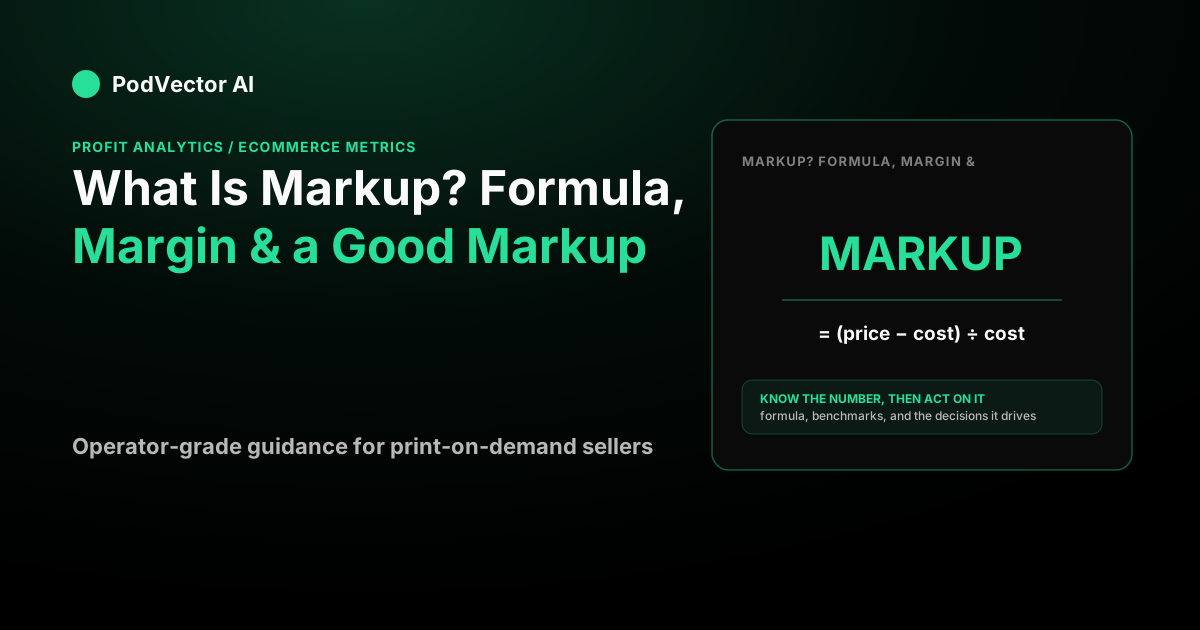
The markup formula
Markup is the gap between your selling price and your cost, measured against the cost. The formula is:
Markup % = (Price − Cost) ÷ Cost × 100
Say a print-on-demand tee costs you $16 (blank garment, printing, and the base fulfillment charge) and you sell it for $40. The gap is $24. Divide that by the $16 cost and you get 1.5, or a 150% markup.
You can run the formula backward, too. If you know your cost and the markup you want, the selling price is Cost × (1 + markup). At a 150% markup on a $16 cost, that's $16 × 2.5 = $40. The multiplier — 2.5× here — is the shorthand a lot of sellers actually use at the counter.
The Corporate Finance Institute notes that markup ranges enormously by industry, with some products marked up only 5% to 10% over cost and others many times higher. There is no single "normal" number — which is exactly why the rest of this guide is about how to judge yours.
Markup vs. margin: the same gap, two denominators
This is where money leaks. Markup and margin describe the same dollar gap between price and cost. They differ only in what you divide by.
- Markup divides the gap by cost:
($40 − $16) ÷ $16 = 150%. - Margin divides the gap by price:
($40 − $16) ÷ $40 = 60%.
Same $24. A 150% markup is a 60% margin. They are two views of one number, and they never match, because cost and price are never the same denominator.
Why does this matter? Because suppliers, marketplaces, and pricing calculators usually quote markup, while your profit-and-loss statement and most benchmarks are stated in margin. If you set a 50% markup thinking you'll keep half of every sale, you won't — a 50% markup is only a 33% margin. Here's the conversion both ways:
Margin = Markup ÷ (1 + Markup) and Markup = Margin ÷ (1 − Margin)
Check it: a 1.5 markup gives 1.5 ÷ 2.5 = 0.60 margin, and a 0.60 margin gives 0.60 ÷ 0.40 = 1.5 markup. If you only remember one thing from this article, remember that markup is always the bigger-looking number, and it is measured against cost. Margin is the honest read of what actually stays on your sale.
A worked example, start to finish
Let's price one order all the way through so the markup number connects to real profit.
Say you sell a shirt for $40 and it costs you $16 to make and fulfill. That's a 150% markup, a 60% gross margin, and $24 of gross profit per order. So far, so good.
But gross profit isn't take-home. Keep subtracting the variable costs that every order actually incurs:
- Carrier shipping: −$5.00
- Payment processing at 4% of $40: −$1.60
- Pick-and-pack labor: −$1.40
That leaves $24 − $5 − $1.60 − $1.40 = $16.00 in contribution margin before advertising — a 40% contribution margin, not the 60% the markup implied. Now allocate ad spend. If you're acquiring customers at a 4.0 return on ad spend, you're spending $10 in ads to sell that $40 order:
$16 − $10 = $6 of profit per order — a 15% margin after ads.
A 150% markup that looked like it left 60% actually left 15% once real costs came out. That's not a reason to distrust markup; it's a reason to never stop at it. Markup sets your price; the full stack of variable costs decides whether the price is any good. If this chain of subtractions is new to you, the ecommerce metrics guide walks through each layer with the same running store.
What is a good markup?
There's no universal answer, and anyone who gives you one flat number is selling you something. A good markup is one that covers every variable cost, funds your fixed costs and ads, and still leaves profit — after all of the subtractions above, not just after the cost of goods.
That said, a few reference points help you sanity-check yours.
Keystone pricing is the classic retail default: double your cost. Retail Dogma describes keystone as a 100% markup that yields a 50% gross margin — buy at $10, sell at $20. It became a standard because doubling cost historically covered store overhead and still left room for markdowns. The same source notes that differentiated or premium products can often support 60% to 70% gross margins, which translate to markups of 150% and roughly 233%.
So a rough ladder: a 100% markup (50% margin) is the baseline that keeps most retail businesses alive, and 150%-plus markups are where premium and print-on-demand brands aim so they can absorb shipping, fees, and paid acquisition. If your markup can't survive the full subtraction chain and still clear your break-even on ad spend, it's too low — no matter how big the percentage looks.
Why a big markup can still lose money
A high markup feels safe. It isn't, on its own, because markup only knows about the cost of the product. It has no idea what you spend to sell that product.
Two costs quietly eat markups alive. The first is shipping and fees — the $5 carrier charge and 4% processor cut in the example above turned a 60% gross margin into a 40% contribution margin before a single ad ran. The second is paid acquisition. If your break-even on ad spend is 1 ÷ contribution-margin ratio, then at a 40% contribution margin you need a 2.5 return on ad spend just to not lose money on the marketing. Push acquisition harder and even a fat markup goes underwater.
This is why the metrics that actually govern profit sit downstream of markup: contribution margin, return on ad spend, and profit on ad spend. If you're scaling paid traffic, watch signals like ad frequency and hook rate that tell you when acquisition is getting more expensive — because that's the moment a comfortable markup stops being comfortable. And because repeat buyers change the math entirely, your customer lifetime value can justify a thinner markup that a one-and-done sale never could.
The catch is that markup is trivial to compute per product, but true per-order profit is not — it lives across your store, your ad accounts, your fulfillment supplier, and your payment processor, and no single one of those sees the whole picture.
See your real markup, per order
PodVector connects Shopify, Meta Ads, Google Ads, Printify, and Printful, then computes your true per-order profit — the full subtraction chain in this article, done on live data instead of a spreadsheet guess. Victor, its AI employee, analyzes that data and proposes moves you approve, taking Shopify-side actions on your behalf. Victor does not touch your ad account; he reads the numbers and hands you the decision. It's the difference between knowing your markup and knowing whether that markup actually pays.
If your customers reorder, segmenting them by value sharpens which markups you can afford to protect and which need room to discount — the RFM segmentation guide shows how.
FAQs
What is markup in simple terms?
Markup is the amount you add to what a product costs you, written as a percentage of that cost. If it costs you $16 and you sell it for $40, you added $24, which is 150% of the cost — so your markup is 150%. It's the "how much did I mark it up from cost?" number.
What is a good markup percentage?
There's no single right number, but a useful floor is keystone pricing — a 100% markup, meaning you double your cost, which produces a 50% gross margin. Print-on-demand and premium brands often aim higher, at 150% or more, so the markup can absorb shipping, payment fees, and ad spend and still leave profit. A good markup is any markup that survives every one of those subtractions and still clears your break-even on advertising.
Is markup the same as profit?
No. Markup is added to cost before you subtract the other costs of doing business. A 150% markup on a $40 order looks like $24 of profit, but after shipping, payment fees, pick-and-pack, and ad spend, the same order in the example nets just $6. Markup sets the price; profit is what's left after every variable cost comes out.
How do I convert markup to margin?
Use Margin = Markup ÷ (1 + Markup). A 150% (1.5) markup becomes 1.5 ÷ 2.5 = 0.60, or a 60% margin. Going the other way, Markup = Margin ÷ (1 − Margin), so a 60% margin becomes 0.60 ÷ 0.40 = 1.5, or 150%. The gap in dollars is identical; only the denominator — cost for markup, price for margin — changes.
Why is my markup higher than my margin?
Because markup divides the price-cost gap by the smaller number (cost) and margin divides it by the larger number (price). Dividing by a smaller denominator always gives a bigger percentage. That's why a 50% markup is only a 33% margin, and why quoting markup can make pricing sound healthier than it is.