
If you have run a single Meta or Google campaign, you have paid a CPM whether you noticed it or not. It is the oldest pricing unit in advertising — radio and print sold on it long before the internet — and it still quietly sets the price of nearly every impression you buy. This guide explains what CPM advertising is, how to calculate it, how it compares to CPC and CPA, what a good rate actually looks like by platform in 2026, and the part most articles skip: how to tell whether a cheap CPM is making you any money.
What is CPM advertising?
CPM stands for cost per mille, meaning cost per thousand impressions. According to AdManage AI's 2026 dataset, CPM measures how much you pay for every 1,000 times your ad is displayed — where "mille" is Latin for thousand and an impression is a single instance of an ad being shown to a user. In a CPM model, you agree to pay a set price each time your ad loads and is seen one thousand times. You are buying exposure, not clicks and not sales.
An impression is counted when your ad renders as part of a page, feed, or video and has the chance to be seen. One thousand impressions might reach one thousand different people once each, or five hundred people twice — the platform counts the views, not the humans. (The average number of times each person sees your ad is a separate metric called frequency.)
That is the trade-off baked into the CPM model: it is built for visibility and brand awareness, not for guaranteed action. As FetchFunnel's 2026 CPM guide notes, if your goal is pure brand awareness and maximizing market presence, CPM is almost always the most cost-effective option — it lets you buy large volumes of inventory at a lower cost per eye-share. When your goal is a click or a purchase, you usually shift to a model that prices those directly.
The CPM formula
The math is simple:
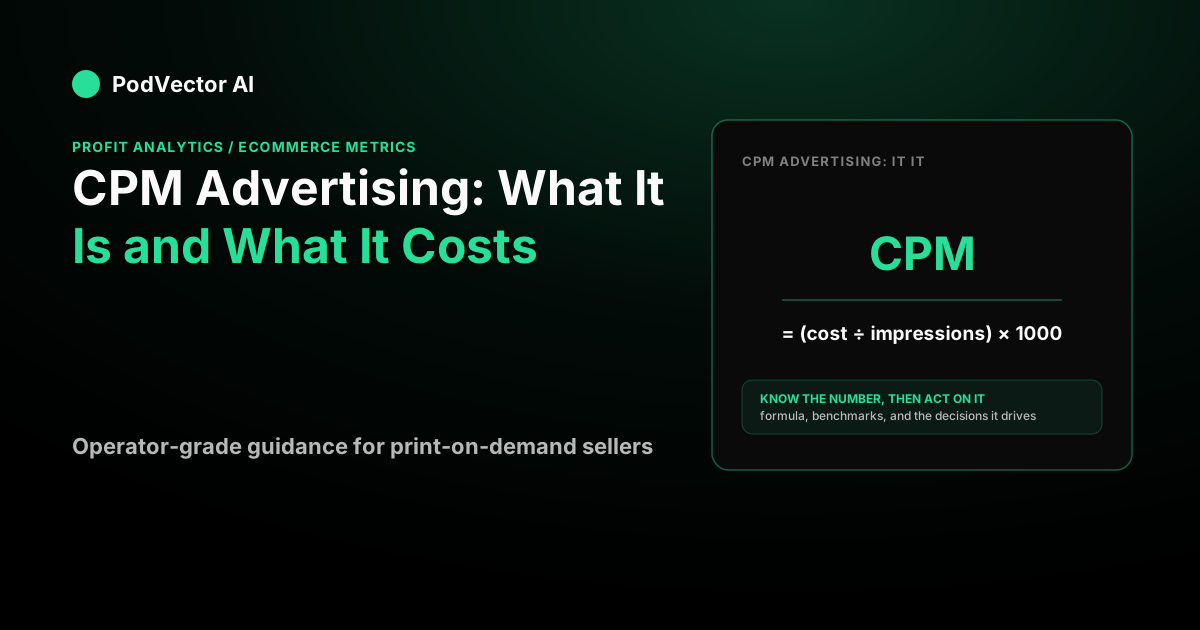
CPM = (Ad spend ÷ Impressions) × 1,000
The units are dollars per one thousand impressions. Say you spend $10,000 and your ad is served 1,000,000 times. Your CPM is ($10,000 ÷ 1,000,000) × 1,000 = $10.00. You can also run it backward: at a $10 CPM, a $2,500 budget buys you (2,500 ÷ 10) × 1,000 = 250,000 impressions.
Note that CPM is the denominator of every downstream metric. FetchFunnel explains that CPM is the metric that quietly sets the ceiling on every downstream number — a high CPM means your clicks and conversions cost more before your landing page even loads. Even when you bid for conversions, Meta still calculates a delivered CPM behind the scenes — you can't escape it by changing your campaign objective.
How to calculate CPM (worked example)
Say you are running a feed campaign for a print-on-demand apparel store. You set a budget of $6,000 and, when the campaign ends, the platform reports 750,000 impressions.
Your CPM is ($6,000 ÷ 750,000) × 1,000 = $8.00. That means every thousand times your ad appeared cost you eight dollars.
Now suppose those impressions drove a 2% click-through rate. That is 2% × 750,000 = 15,000 clicks. Your cost per click works out to $6,000 ÷ 15,000 = $0.40. CPM and CPC are two views of the same spend — one priced per impression, one priced per click, linked by how often people actually click. FetchFunnel illustrates this relationship: at a $10.00 CPM with a 1% CTR you get 10 clicks per thousand impressions, which translates to a $1.00 CPC — these models are different windows looking at the exact same conversion funnel.
CPM vs CPC vs CPA
CPM is one of three pricing models you will see quoted, and picking the wrong one for your goal is a common early mistake.
- CPM (cost per mille): you pay per thousand impressions. Best for awareness and reach, where the goal is eyeballs.
- CPC (cost per click): you pay only when someone clicks. Best for traffic and consideration, where the goal is a site visit.
- CPA (cost per acquisition): you pay per conversion — a sale, lead, or signup. Best for direct response, where the goal is an action.
These are not isolated. A conversion is a click that converted, and a click is an impression that earned a click. So your cost per acquisition is really your cost per click divided by your conversion rate — CPA = CPC ÷ CVR. If your CPC is $0.40 and 4% of clicks turn into orders, your CPA is $0.40 ÷ 0.04 = $10.00 per order. That chain — from the impression you bought on CPM all the way to the order — is why a low CPM is worthless if the clicks never convert. Our cost-per-acquisition guide breaks down that final step in detail.
Most platforms let you optimize toward any of these while still billing you on impressions under the hood, so understanding CPM matters even when you are chasing conversions.
What is a good CPM by platform in 2026?
There is no universal "good" CPM. AdManage AI's 2026 Facebook CPM dataset puts it plainly: what's normal depends on your industry, your country, and your campaign objective. Rates also swing significantly with geography: AdMake AI reports that Meta CPM varies roughly five to eight times between the US and India — so comparing your rate against someone selling in a different country is meaningless.
The 2026 platform ranges below draw on AdLibrary's 2026 CPM benchmark report, AdMake AI's platform analysis, Understory Agency's 2026 channel benchmarks, and AdLibrary's LinkedIn CPM data:
| Platform | Typical 2026 CPM range (US) |
|---|---|
| Meta (Facebook & Instagram) | $8–$15 for most verticals (AdLibrary); DTC ecommerce skews higher |
| TikTok | around $13 for DTC (AdMake AI) |
| YouTube (non-skippable) | $6–$10 CPM (Bir.ch / Store Growers 2026) |
| Google Display / Programmatic | around $3 (Understory / Digital Applied) |
| $28–$70 depending on industry and targeting depth (AdLibrary) |
A few patterns are worth reading off that table. Google Display clusters near the low end — cheap reach, but loose intent. AdLibrary's 2026 benchmark report notes that Meta sits in the $8–$15 range for most verticals, while LinkedIn's range of $28–$70 reflects audience data quality rather than arbitrary scarcity — a $35 CPM reaching decision-makers at target accounts can produce a lower cost per lead than a $10 Meta CPM reaching a broad audience. AdMake AI puts the DTC Meta benchmark at around $14 and TikTok at around $13, suggesting the two platforms have converged — the idea that TikTok is always cheaper has faded.
Seasonality matters too. AdMake AI reports that US Meta CPMs started 2025 at around $20, peaked at $28.09 in November, then dropped to $17.12 in January 2026 — and that Q4 typically runs 25–60% above the annual average across platforms. Stackmatix's 2026 Facebook CPM guide corroborates the seasonal pattern, noting that CPMs peaked at $28.09 in November before dropping to $17.12 in January 2026. That swing is a major factor for print-on-demand sellers planning holiday campaigns.
Campaign objective also drives CPM. Adamigo's 2026 Meta country benchmark data shows that Reach and Impressions campaigns in the US typically cost $10–$15 CPM, while Sales campaigns land in the $20–$30 range and Lead Generation can reach $25–$40 — bottom-funnel objectives face higher competition, which drives costs up.
A practical rule of thumb from AdMake AI: a good CPM is one within 10–15% of your own rolling 30-day baseline. If yours just jumped, check your creative refresh date first — ad fatigue is the most common culprit.
What drives CPM up or down?
Understanding what moves the needle helps you diagnose spikes before they drain budget. The main levers, drawn from AdLibrary, AdMake AI, and FetchFunnel:
- Audience size: smaller audiences give the auction fewer alternatives and push prices up. Broad targeting during off-peak seasons tends to yield lower rates; narrow targeting during high-demand periods does the opposite.
- Creative performance: a low CTR signals poor relevance to the platform's algorithm and inflates CPM. AdLibrary identifies creative quality score as one of the three core drivers of your rate, alongside audience competition and bid strategy. Refreshing creative is the fastest lever most sellers have.
- Geography: AdMake AI puts the US-to-India spread at roughly five to eight times on Meta. For POD sellers shipping domestically, US-only campaigns are inherently expensive.
- Campaign objective: Adamigo's 2026 data shows that bottom-funnel objectives like Sales carry meaningfully higher CPMs than awareness-focused Reach campaigns because the auction prices in the platform's confidence it can hit your goal.
- Seasonality: Q4 ecommerce competition compresses available inventory and drives rates sharply higher across every major platform. FetchFunnel notes that Q4 holiday competition alone can spike rates by 40–60%.
- Platform and format: Stackmatix's 2026 data finds that Feed placements carry the highest CPM on Meta at around $16, while Stories and Reels run cheaper at $10–$12.
What is a good CPM for print-on-demand sellers specifically?
POD sellers face a tighter profit stack than most ecommerce verticals. Your fulfillment cost — set by Printify or Printful — is fixed per order, which means your break-even ROAS is higher than a brand that manufactures in bulk. That fixed cost floor changes what "affordable" means on a CPM basis.
A CPM that looks reasonable for a high-margin SaaS brand or a bulk-inventory apparel brand can quietly lose you money on a $28 POD tee with a $14 base cost. The math works backward: start with the margin you need to survive after fulfillment fees, Shopify fees, and payment processing — then work out the maximum CPM that still leaves room for profit at your realistic conversion rate. If your CPM climbs above that ceiling, no amount of creative testing rescues the campaign.
Two things help POD sellers stay inside that ceiling: understanding true per-order costs (not just the sticker fulfillment price), and watching CPM trends in real time rather than monthly. Our guide to hidden POD costs covers the fees that most sellers miss when doing this math. For a breakdown of how Printify's base costs interact with ad budgets, see our Printify Premium subscription breakdown. For Printful sellers, the Printful Bella Canvas 3001 cost breakdown shows exactly where your margin floor sits before ad spend enters the equation.
The number that actually matters: profit, not CPM
Here is what the ranking guides almost never say plainly: a cheap CPM can lose you money and an expensive CPM can make you rich. CPM measures the price of attention, not the value of it. A low-cost impression in front of a cold, poorly-matched audience can perform worse than a pricier impression in front of ready buyers.
AdLibrary's 2026 benchmark report makes this point directly: a $35 CPM reaching decision-makers can produce a lower cost per lead than a $10 Meta CPM reaching a broad audience where your ideal customer is only a small fraction of the total. Understory Agency is more direct still: "a lower CPM is not automatically better" — you should judge CPM against CTR, cost per lead, and ultimately pipeline or profit.
Chase CPM in isolation and you optimize for the wrong thing. What you actually want to know is whether the revenue those impressions generate exceeds the cost — of the ads and the product.
Say you sell a shirt for $40 that costs $16 to make. That leaves $40 − $16 = $24 of gross profit, or a 60% gross margin. Now say a campaign returns a 4.0 return on ad spend — $4 of revenue per $1 of ad cost. On revenue that looks great, but the profit picture is what pays your bills. Multiply the return by your margin: 4.0 × 0.60 = 2.4 in profit per ad dollar. That figure — profit on ad spend — is the one that tells you the truth. A 4.0 return on a thin 20% margin product would instead be 4.0 × 0.20 = 0.8, meaning you lost money on every sale no matter how cheap the CPM looked. To see how return on ad spend and margin combine, our Performance Max strategy guide for POD works through how ad type and objective selection affects the profit math.
The break-even point falls out of the same math. Divide one by your margin: at a 60% gross margin, you break even at 1 ÷ 0.60 = 1.67 return on ad spend. Once you subtract shipping, payment fees, and fulfillment, your real margin is thinner and your break-even return climbs. That is why two stores with identical CPMs can have opposite fates: the one with the fatter margin can afford far more expensive impressions and still profit.
The catch is that this math only works if you know your true per-order cost — not the sticker COGS, but COGS plus shipping, processing, fulfillment, and the ad spend attributed to that order. Most sellers never assemble those numbers in one place, so they judge campaigns on CPM and ROAS and never notice the orders that quietly lose money. Our guide on the hidden costs that kill POD profits explains all of those costs in one place. For a broader look at how AI automation can systematize this analysis, see our POD seller's guide to AI automation for ecommerce.
That is the gap PodVector is built to close. It connects your Shopify, Meta Ads, Google Ads, Printify, and Printful accounts into a live data warehouse and computes the true per-order profit behind every sale — after ad cost and every fee. Victor, its AI employee, reads that live data, flags where cheap impressions are producing unprofitable orders, and proposes moves you approve. The actions Victor executes are on the Shopify side — repricing products to a target margin, adjusting discounts, managing collections, or raising your free-shipping threshold — with your sign-off on each move. It turns "our CPM is low" into "these orders actually make money." For a deeper look at how POD sellers use live data to find their next profitable move, see our PodVector strategy guide.
FAQs
What does CPM stand for in advertising?
CPM stands for cost per mille, where "mille" is Latin for thousand. It is the price you pay for every one thousand impressions your ad receives. It is sometimes written as cost per thousand or CPT, but CPM is the standard industry term.
How do you calculate CPM?
Divide your total ad spend by the number of impressions, then multiply by one thousand: CPM = (Ad spend ÷ Impressions) × 1,000. For example, $5,000 spent across 500,000 impressions is ($5,000 ÷ 500,000) × 1,000 = $10.00 CPM.
Is a lower CPM always better?
No. A lower CPM only means cheaper impressions, not more valuable ones. Understory Agency puts it plainly: judge CPM against CTR, cost per lead, and profit — not the price of attention alone. Impressions shown to a poorly-matched audience can convert worse than more expensive impressions shown to ready buyers.
When should I use CPM instead of CPC or CPA?
Use CPM when your goal is awareness and reach — getting your brand in front of the largest relevant audience. Use CPC when you are paying for traffic, and CPA when you are paying for conversions like sales or signups. The right model follows your campaign objective, not the other way around.
What is a good CPM rate?
There is no single good rate — it depends on platform, objective, audience, and geography. AdLibrary's 2026 benchmark report puts programmatic display at $1–$3 at the low end and LinkedIn at $25–$40 at the high end, with Meta sitting in the $8–$15 range for most verticals. AdMake AI suggests a good CPM for you is one within 10–15% of your own rolling 30-day baseline — your account history is a more reliable benchmark than any industry average.
Does a cheap CPM mean my ads are profitable?
Not on its own. CPM tells you the cost of showing your ad, not the revenue or margin it generates. To know if a campaign is profitable, compare the revenue it drives against your fully-loaded costs — product, shipping, fees, and the ad spend itself — and look at profit on ad spend rather than CPM alone.
Why did my CPM suddenly spike?
The most common causes are creative fatigue (your ad has been seen too many times by the same people and CTR is falling), a too-narrow audience, increased competition from other advertisers in your niche, or a seasonal surge. AdMake AI reports Q4 typically runs 25–60% above the annual average, and FetchFunnel notes that a stale creative can inflate your CPM just as fast as a crowded auction. Check your creative refresh date first; that resolves the majority of sudden spikes.
How does CPM relate to my Printful and Printify costs?
CPM is the entry cost of getting eyes on your products, but it is only one line in the profitability equation. Your Printful or Printify fulfillment cost — which varies by product, shipping destination, and provider — sets the floor on what you need to earn per order before ad spend even enters the picture. If your fulfillment margin is thin, even a low CPM campaign can quietly lose money. See how the two sides of that equation interact in our Printful Plus membership breakdown and our Printify Premium promo code guide.