
Quick Answer: Printful's 2026 t-shirt base cost ranges from $7.95 (Gildan 5000) on the low end to $22.50 (premium organic and tri-blend tees) on the high end. The most-sold Bella+Canvas 3001 sits at $12.95 on the Free plan and roughly $9.05 on the Growth plan.
That base price already includes one DTG print on the front. It does not include shipping, extra placements, size upcharges on 2XL+, branding, or the Growth/Business subscription that lowers the base.
This guide walks every tee SKU in the 2026 catalog, shows the size upcharges that quietly break margin, and builds the real per-tee cost POD sellers actually pay.
What "base cost" actually means on Printful
On a Printful t-shirt page, the price you see is the fully fulfilled base cost. That single number bundles three things: the blank tee from the manufacturer, one DTG (direct-to-garment) print on the front, and the handling/QA/pack work to get it out the door.
That bundling is what makes Printful's catalog look more expensive than Printify on a first read. Printify splits "blank price" and "print provider fulfillment fee" into two lines. Printful folds both into the base.
Once you compare landed cost on the same SKU through the same shipping zone, the spread narrows. We cover the side-by-side comparison in our Printify or Printful guide.
The catalog price does not include:
- Shipping (separate line, charged per order)
- Size upcharge on 2XL and up
- Extra print placements (back, sleeve, inside label)
- Custom branding (woven label, neck print, pack-in)
- The Growth or Business subscription (a separate monthly charge that lowers the base)
Reading the catalog and writing the base price into your margin spreadsheet without accounting for those five lines is the single most common margin error POD operators make on Printful.
2026 t-shirt base cost by SKU
These are Printful's 2026 catalog prices for the most-shipped tee SKUs, US fulfillment, size M, one front DTG print, Free plan. Growth-plan prices are roughly 30% lower on apparel (see the plan section below for the exact math).
| SKU | Free plan base | Growth plan base | Tier |
|---|---|---|---|
| Gildan 5000 Heavy Cotton | $7.95 | $5.55 | Budget |
| Gildan 64000 Softstyle | $9.50 | $6.65 | Budget |
| Gildan 980 Lightweight | $10.50 | $7.35 | Mid |
| Bella+Canvas 3001 Unisex Staple | $12.95 | $9.05 | Mid |
| Bella+Canvas 3413 Tri-blend | $17.50 | $12.25 | Premium |
| Bella+Canvas 8800 Flowy (women's) | $15.25 | $10.65 | Premium |
| Champion T425 Heritage | $18.95 | $13.25 | Premium |
| Stanley/Stella Creator Organic | $22.50 | $15.75 | Premium |
| All-Over-Print Tee (Subli) | $21.95 | $15.95 | Specialty |
Two patterns matter here. The Bella+Canvas 3001 is the gravitational center of US tee POD — most stores anchor their best-seller there because it hits the sweet spot of fabric quality, color range (40+ stocked colors), and a price that allows a $24.95–$29.95 retail tag with healthy margin.
The premium tier (tri-blend, organic, Champion) is where margin gets thin. A $17.50 base on a tri-blend tee means you need a $34.95–$39.95 retail tag to clear $10 contribution margin after shipping and payment fees. That's a real ask in most niches outside specialty/lifestyle.
Printful raised apparel base prices 0.4–2.4% in February 2026. Numbers in older blog posts and YouTube comparisons are slightly low. Re-pull catalog prices any time you're rebuilding your pricing model — Printful adjusts at least once a year, sometimes twice.
Size upcharges (the line that hides on the catalog)
Catalog prices are for sizes S–XL. Anything above that carries a size upcharge — and on a heavy-shipping SKU like a hoodie or a thick tee, the upcharge can swing a unit from profit to loss.
Printful's 2026 tee size upcharges:
| Size | Bella+Canvas 3001 | Gildan 5000 | Gildan 64000 |
|---|---|---|---|
| S–XL | Base | Base | Base |
| 2XL | +$2.50 | +$2.00 | +$2.25 |
| 3XL | +$3.50 | +$3.00 | +$3.25 |
| 4XL | +$5.50 | +$4.50 | +$5.00 |
| 5XL | +$6.50 | n/a | n/a |
If you price your tees at a single flat retail across all sizes, you're effectively subsidizing every 2XL+ sale from the S–XL pool. That's fine in niches where extended sizing converts well at the same price — but if 12%+ of your orders are 2XL+, you should test tiered retail pricing to recover the upcharge.
The simpler fix: a $2.00 retail bump on 2XL and $3.00 on 3XL, matching the cost. Most Shopify themes and the Printful sync handle this automatically. Most POD stores don't bother to set it up.
Color and dark-garment fees
Printful does not charge a dark-garment surcharge on DTG tees the way some print providers do. DTG on black, white, heather grey, or any of the 40+ Bella+Canvas 3001 colors all hits the same base price.
One catch: "true white" DTG prints are slightly muted on darker garments due to the under-base process. That's a print-quality consideration, not a cost one, but it surfaces as returns/reprint costs downstream if your design relies on pure white.
For all-over-print sublimation tees ($21.95 base), color works differently — the entire shirt is dye-sublimated, so you're not paying for ink coverage but for fabric (typically 100% polyester) and the more complex print process. The base price already accounts for full coverage.
How the Growth and Business plans change base cost
Printful's Growth membership ($24.99/mo, free when your store crosses $12k in trailing annual sales) is structurally the lever that makes US tee POD viable in 2026. The plan applies a discount to product base — roughly 30% on apparel, less on accessories and drinkware.
The math on a Bella+Canvas 3001:
- Free plan base: $12.95
- Growth plan base: $9.05 (30% off)
- Discount per unit: $3.90
- Break-even on the $24.99 fee: ~7 tees per month
Almost any active store crosses seven tees a month. The Growth plan is effectively free once you've validated the store. We walk the membership math in detail in our Growth plan cost breakdown and our Growth plan pricing breakdown.
The Business plan ($49.99/mo, free at $150k+ trailing annual sales) layers an additional ~7% discount on top of Growth, plus design transfer storage and free sample credits. The break-even is roughly 60 tees per month. Most six-figure stores qualify automatically and pay $0.
If you're benchmarking against blog posts that quote "Growth pricing" without specifying the tier, double-check whether they're showing Free, Growth, or Business numbers — the spread between Free and Business on a Bella+Canvas 3001 is over $4.50 per unit. That's the difference between a 22% gross margin and a 35% one. For a deeper read on the Growth tier specifically, see our Growth pricing breakdown.
Extra print placements: back, sleeve, label
The catalog base buys you one front DTG print. Every additional placement is itemized:
| Placement | Cost | When it makes sense |
|---|---|---|
| Back print | $5.95 | Streetwear, band tees, slogan designs |
| Sleeve print (per sleeve) | $2.95 | Subtle branding, niche callouts |
| Outside label print | $2.49 | Brand reinforcement on neck/inside back |
| Inside label print | $0.99 | Care instructions, brand mark |
A front + back tee on a Bella+Canvas 3001 takes the Free-plan base from $12.95 to $18.90. Adding a sleeve print pushes it to $21.85. Add a neck label and you're at $22.84.
None of those line items are wrong, but every additional placement compresses your margin unless you raise retail price to match. The common POD mistake: adding a back print to "look more premium" while keeping the retail tag flat. That's a $5.95 line straight out of margin.
Shipping cost per tee
Printful shipping on tees is zone-flat. You pay the first-item fee, then a smaller add-on per additional tee in the same order.
| Destination | First tee | Each additional tee |
|---|---|---|
| US | $3.99 | $1.25 |
| Canada | $5.99 | $1.75 |
| UK | $3.99 | $1.25 |
| EU (most countries) | $4.99 | $1.50 |
| Australia / NZ | $8.99 | $2.50 |
| Rest of world | $10.99–$14.99 | $3.00–$4.00 |
Two operational notes. First, the zone-flat structure means a single-tee order from Australia carries a $8.99 shipping line — almost as much as the tee itself for a Gildan 5000. International AOV stores often need to require two-unit minimums or carry a small shipping surcharge to keep international tees profitable.
Second, US fulfillment centers ship from California and North Carolina. Orders auto-route to the closer center to reduce transit time, but the price is the same. We walk the regional fulfillment routing in our Costs & Charges cluster hub.
True landed cost: three tee SKUs worked end-to-end
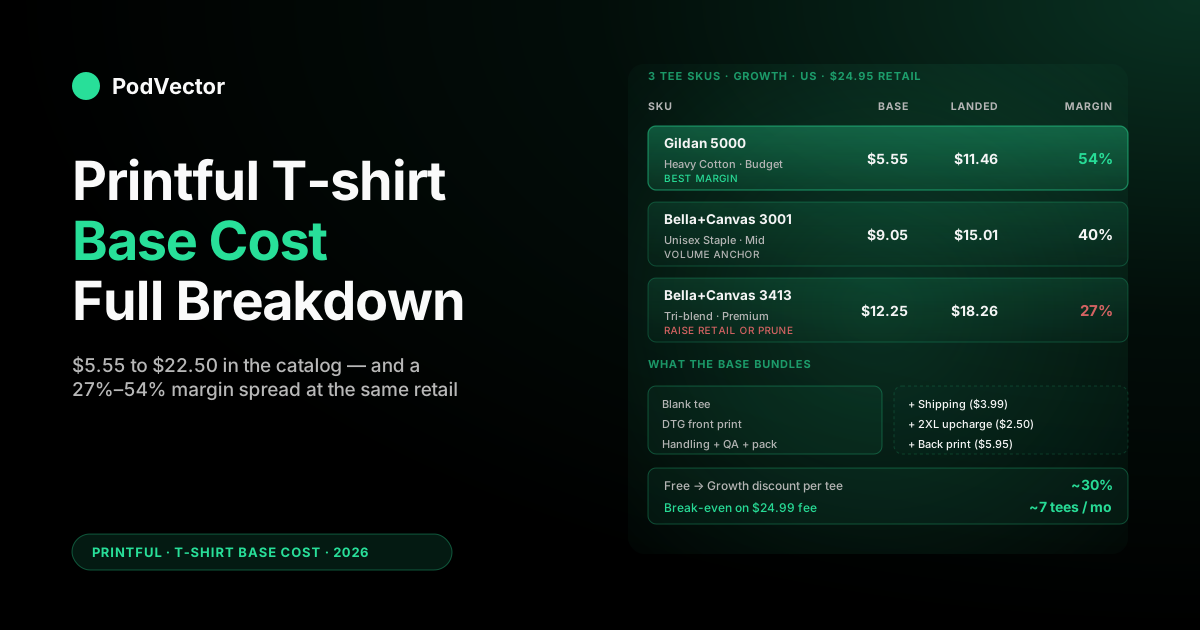
Headline base price is one number. Landed cost is the number that determines whether you're actually profitable. Here's the same exercise on three tee SKUs, US-fulfilled, Growth plan, one front print, size M, $24.95 retail.
SKU 1: Gildan 5000 Heavy Cotton (budget tier)
- Base cost (Growth): $5.55
- Shipping: $3.99
- Payment processing (Shopify, 2.9% + $0.30 on $24.95): $1.02
- Pro-rated Growth fee (across 50 monthly orders): $0.50
- Pro-rated return/reshipment reserve (2% rate): $0.40
- Landed cost: $11.46
- Contribution margin at $24.95 retail: $13.49 (54%)
SKU 2: Bella+Canvas 3001 Unisex Staple (mid tier)
- Base cost (Growth): $9.05
- Shipping: $3.99
- Payment processing: $1.02
- Pro-rated Growth fee: $0.50
- Pro-rated return reserve: $0.45
- Landed cost: $15.01
- Contribution margin at $24.95 retail: $9.94 (40%)
SKU 3: Bella+Canvas 3413 Tri-blend (premium tier)
- Base cost (Growth): $12.25
- Shipping: $3.99
- Payment processing: $1.02
- Pro-rated Growth fee: $0.50
- Pro-rated return reserve: $0.50
- Landed cost: $18.26
- Contribution margin at $24.95 retail: $6.69 (27%)
Three SKUs from the same Printful catalog, same retail price, same channel — and contribution margin ranges from 27% to 54%. That spread is invisible if you only look at base price. It's the entire reason POD operators need a true landed-cost view, not a catalog view.
The tri-blend SKU at $24.95 retail is structurally a money-loser once you account for Meta or Google ad cost. A 27% contribution margin needs a sub-$6.50 CAC to break even — which is unrealistic in any competitive niche in 2026. The fix is either raising retail to $32.95+ on tri-blend or pruning the SKU.
Printful tee base cost vs Printify
The Printful-vs-Printify question on tees usually comes down to whether you're price-anchored or quality-anchored. Same Bella+Canvas 3001 blank, single front print, US fulfillment:
| Line | Printful (Growth) | Printify (Premium, Monster Digital) |
|---|---|---|
| Blank tee | (bundled) | ~$5.50 |
| DTG fulfillment | (bundled) | ~$3.85 |
| Total base | $9.05 | ~$9.35 |
| Shipping (US, 1st tee) | $3.99 | $4.45 |
| Print quality | Tightly controlled, lower variance | Provider-dependent (varies) |
On the Growth/Premium tier, the per-unit base lands within $0.30 of each other. The real spread is consistency. Printful runs its own facilities. Printify is a marketplace of print providers, which means quality and turnaround time vary by which provider you route to.
The 2024 announcement that Printify and Printful are merging changed this calculus. The two catalogs are slowly being integrated, and base prices may converge further. We track the merger implications for sellers in our Printify-Printful merger guide.
How to lower your Printful tee base cost
Four levers actually move the number, in order of impact:
1. Move to the Growth plan (immediately). A 30% apparel discount on the base, $24.99/mo, paid off at 7 tees of volume. There's no reason to stay on Free past the validation phase.
2. Anchor your best-seller on Bella+Canvas 3001. The 3001 has the best price-quality ratio in the catalog for US tee POD. Premium tri-blends and organics are great for specialty SKUs, but they should be a secondary SKU, not the volume driver.
3. Bundle to amortize shipping. Shipping is $3.99 for the first tee, $1.25 each after. A 2-tee bundle drops per-unit shipping from $3.99 to $2.62. Cross-sells and tee+sticker combos materially improve landed-cost math.
4. Hit Business plan thresholds. Once you're at $150k+ annual sales, the Business plan ($0/mo at that volume) layers another ~7% on top of Growth. That's another $0.60–$1.20 per tee at no additional cost.
Levers that don't move tee base cost meaningfully: re-uploading designs in higher resolution (doesn't change DTG print cost), switching to embroidery (raises cost), using "premium printing" upsells (Printful doesn't have a paid quality tier on DTG tees).
Tracking tee base cost across your catalog
The hardest part of POD-tee margin work isn't knowing one SKU's cost — it's knowing all of them, kept current, mapped against actual orders. Most stores discover their margin problems in arrears, at the end of a quarter, after burning ad spend on SKUs that were underwater the whole time.
Two structural fixes solve this.
First: keep your catalog landed cost in one place, updated continuously. When Printful pushes a price change (twice a year on average), you want the new base flowing into your margin model without manual re-entry. A spreadsheet works for 10 SKUs. At 100+ SKUs it stops working.
Second: connect that landed cost to actual order data. Knowing your Bella+Canvas 3001 base is $9.05 is one thing. Knowing that 38% of your orders shipped to addresses that incurred address-correction fees last month, and that those fees pushed your real per-tee cost from $15.01 to $15.63, is what tells you whether to raise retail.
PodVector AI's Victor agent connects the Shopify webhook stream, the Printful itemized invoice, and the payment processor fee data into a single live data warehouse for your store. You can ask Victor questions like "which tee SKUs dropped below 30% margin after fulfillment this month?" and get a live answer — not a static dashboard frozen at the end of the last month. Victor can also propose specific Shopify actions in response (price changes on the underwater SKUs, a free-shipping threshold to drive bundling) and execute them on your approval, with full audit trail.
The combination of a POD-specific business playbook, live connection to your store data, and the ability to act on it is what we call agentic ecommerce ops for POD. For a wider read on the full Printful cost picture, see our Printful topic hub or work through the broader Costs & Charges cluster. For deeper benchmarks from Printful itself, the brand's own t-shirt pricing calculator guide is a useful complement.
FAQs
What is the cheapest Printful t-shirt?
The Gildan 5000 Heavy Cotton at $7.95 (Free plan) or $5.55 (Growth plan) is the cheapest tee in the 2026 catalog. It's a budget-tier blank — heavier weight, less soft hand-feel than Bella+Canvas — but the price gives the most room for retail markup in price-sensitive niches.
What is Printful's most popular t-shirt?
The Bella+Canvas 3001 Unisex Staple. Most active US tee stores anchor their best-seller on this SKU — the $12.95 Free / $9.05 Growth price hits the quality-price sweet spot, and the 40+ stocked colors cover almost every design palette.
Does Printful charge extra for dark colors?
No. DTG print on black, white, heather, or any color in Printful's catalog hits the same base price. The only DTG quality consideration is that white ink prints slightly muted on dark garments due to the under-base process — a quality factor, not a cost one.
How much do extra print placements cost?
Back print is $5.95, each sleeve print is $2.95, outside label print is $2.49, inside label print is $0.99. None of these are bundled into the base — they're per-unit additions on top of the catalog price.
What's the size upcharge on 2XL+?
Roughly $2.00–$2.50 for 2XL, $3.00–$3.50 for 3XL, and $4.50–$5.50 for 4XL, depending on the SKU. If 10%+ of your orders are extended sizing, tier your retail price to recover the upcharge rather than subsidizing it from the S–XL pool.
Does the Growth plan really lower the base cost?
Yes, by roughly 30% on apparel. A $12.95 Bella+Canvas 3001 drops to $9.05 on Growth. The $24.99 monthly fee breaks even at ~7 tees per month, which almost every active store crosses.
How does Printful's tee base cost compare to Printify?
On the same Bella+Canvas 3001, US-fulfilled, the Growth-plan Printful base ($9.05) is within $0.30 of Printify's Premium-plan equivalent (~$9.35). The real spread is quality consistency — Printful runs its own facilities; Printify routes through third-party providers.
Why is my Printful invoice higher than the catalog price?
The catalog price excludes shipping (separate line), size upcharges (2XL+), extra print placements (back/sleeve/label), and any branding adds (woven label, neck print, pack-in). Pull the invoice CSV and itemize — the gap is almost always one of those lines.
Does Printful offer volume discounts on tees?
Yes, on bulk orders of 25+ units. The discount starts at 5% and scales to 55% on 500-unit orders. Most POD stores ship one tee at a time per customer order, so the volume discount only applies if you batch-order samples or run a fulfillment-by-merchant model.
Stop guessing at tee margin
Catalog base is the easy line. Real landed cost — base + shipping + size upcharges + extra placements + payment fees + the pro-rated subscription — is the line that tells you whether a SKU is actually making money.
PodVector AI's Victor agent connects your Shopify orders, Printful invoices, and payment fees into a live data warehouse, then surfaces which SKUs dropped below margin and proposes specific Shopify actions to fix it — price changes, free-shipping thresholds, BXGY discounts — all executable on your approval.
Try Victor free