
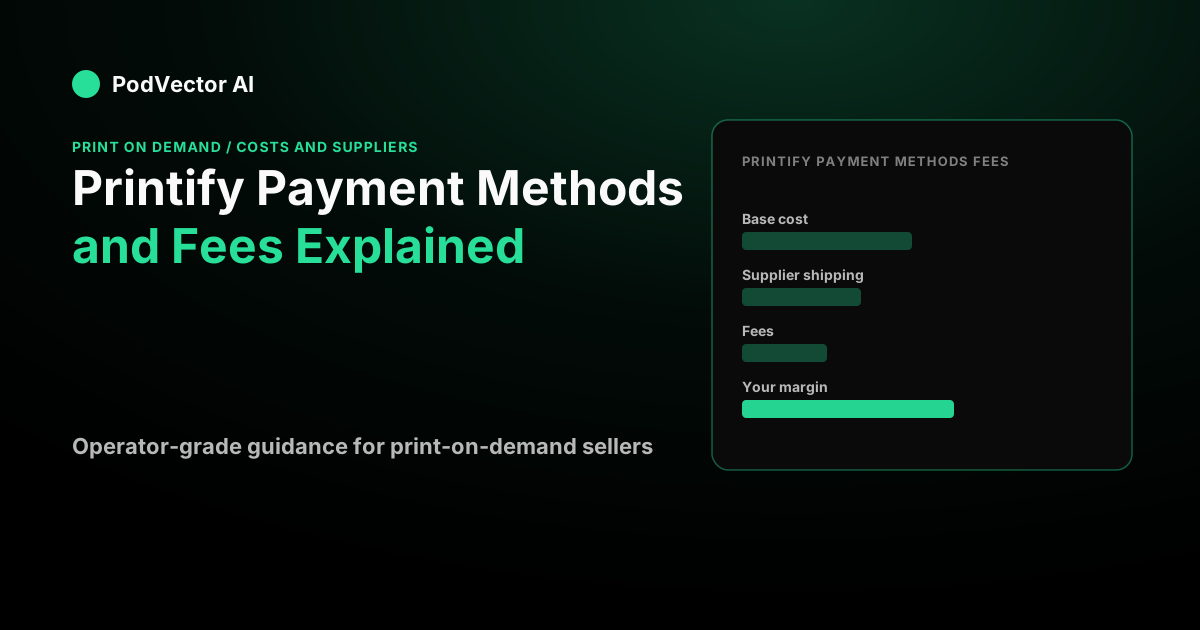
If you are comparing suppliers or building a pricing model, "what does Printify charge me?" is the wrong question to stop at. Printify itself is close to free. The real cost of running orders through it is spread across four buckets, and only one of them is optional. Let's walk each method and each fee with real numbers, then run a full order so you can see where the money actually goes.
How Printify charges you
Printify runs on a pay-after-you-sell model. There is no inventory and no upfront cost. A customer buys, and only then does Printify bill you for the base product cost plus supplier shipping (and tax where it applies). That charge hits whichever payment method you have on file.
The important mental shift: the price you see in the product editor is what you pay the print provider, not what your customer pays you. Your job is to set a retail price above that landed cost. For the full breakdown of how base cost, shipping, and tax stack into a supplier invoice, see our POD cost economics guide.
Printify's accepted payment methods
You need a valid payment method on file before Printify will send an order to production. There are three ways to fund orders, and you can mix them.
Credit or debit card (automatic)
The default. You link a card and Printify charges it automatically as orders come in. You can save up to five cards in your Printify wallet and set one as the default, per Printify's payment help docs. Printify adds no surcharge for paying by card — you only pay your card's own foreign-transaction fee if your card currency differs from your billing currency.
PayPal
You can also connect PayPal as your payment method, according to the same Printify help documentation. It works the same way: orders are charged automatically. Printify does not tack on an extra fee for using it.
Printify Balance (and Payoneer top-up)
Instead of a card charged per order, you can pre-load a Printify Balance and have order costs drawn from it. You top the balance up manually, which some sellers prefer for cash-flow control or to avoid repeated card declines during a busy launch.
Top-up funding is the one place Printify surfaces an explicit percentage. When you add funds via Payoneer, Printify's own announcement lists the fees: payments from another Payoneer balance are free, credit-card top-ups carry a 3% fee, and US ACH bank debit carries a 1% fee, per that Printify post. Note that Payoneer top-ups cannot be withdrawn once deposited, so only load what you expect to spend.
The fees that exist — and the ones that don't
Here is the part every "Printify fees" article gets vague about. Four buckets, ranked by how much they actually matter.
1. No platform, listing, or per-order fees
Printify states plainly that there are "no platform fees, listing fees, or hidden charges," on its pricing page. Unlike a marketplace that skims each sale, Printify doesn't take a cut of your revenue. Its margin is already baked into the fulfillment price you pay per unit — so the base cost you see is how Printify gets paid.
2. The fulfillment margin (the invisible fee)
This is the fee nobody labels a fee. When a US provider lists a tee at roughly $9 to fulfill, Printify's markup on the blank and print is already inside that figure. You never see it broken out, and you can't remove it — but it is the single biggest "cost of using Printify."
Because it's provider-set, the same blueprint can cost different amounts depending on which print provider fills it. Tracking that true per-unit cost across products is its own discipline; our guide on per-product COGS tracking covers how to keep it accurate as prices move.
3. The Premium subscription (optional)
Printify Premium costs $39 per month, or $24.99 per month billed annually at $299 per year — a "save 36%" annual rate, per Printify's pricing page. The Free plan is $0 with up to five stores and no time limit, also per that page.
Premium's headline benefit is a product discount — "up to 33% discount on products and custom branding," as stated on Printify's pricing page. In practice most sellers cite a closer-to-20% effective discount on common blueprints, according to ecommerce guides tracking Printify's plans, so it's safest to plan on the conservative figure. We run the break-even math below.
4. Payment-processing fees (the one that quietly bleeds you)
This is the fee people forget because Printify doesn't charge it — your storefront's payment gateway does. When a customer pays you through Shopify Payments, Stripe, or PayPal, a typical online card rate is about 2.9% plus 30 cents per transaction, per Stripe's published pricing. That comes off your revenue on every single sale, and on small orders the flat 30 cents stings more than the percentage.
Worked example: what one order really costs you
Say you sell a Bella+Canvas tee. Assume a mid-range fulfillment cost around $9 for the base and a US first-item shipping rate near $3.99 — both representative apparel figures tracked by ecommerce cost guides, and both provider-specific, so check your own editor.
You price the shirt at $24.99 and charge $5.99 shipping. Here is the ledger:
| Line | Amount |
|---|---|
| Customer pays ($24.99 + $5.99) | +$30.98 |
| Printify base cost | −$9.00 |
| Supplier shipping (first item) | −$3.99 |
| Payment processing (2.9% + $0.30 on $30.98) | −$1.20 |
| Your profit | ≈ $16.79 |
The arithmetic: $30.98 − $9.00 − $3.99 − $1.20 = $16.79. Notice that Printify's own "fee" (the base cost) and the processing fee together take about $10 of a $31 order. If you'd used the naive formula of retail minus base cost, you'd have overstated profit by more than $5.
Now add a second shirt to the same order. The customer pays one more $24.99, shipping stays a flat $5.99, and the additional-item supplier shipping is far lower — roughly $2.00 rather than another $3.99. Bundling is where POD margin actually lives, which is why average order value beats shaving pennies off base cost. Our markup strategy guide for Shopify digs into pricing for exactly this.
Is Printify Premium worth the fee?
Premium is a pure volume decision. Using the conservative assumptions — about $12 average base cost and a 20% discount — Premium saves roughly $12 × 20% = $2.40 per order.
- Monthly at $39: $39 ÷ $2.40 ≈ 16 to 17 orders per month to break even.
- Annual at $24.99 effective: $24.99 ÷ $2.40 ≈ 10 to 11 orders per month to break even.
Below that volume, Free is the correct plan and Premium just burns cash. Above it, the annual rate is the better deal. If your discount runs closer to the 33% headline on qualifying items, break-even drops — but planning on 20% keeps you safe. The same volume logic applies to supplier shipping tiers; see how the math compares in our breakdown of the drop-ship fee structure.
Seeing every fee on one order
Here's the operational problem. Printify shows the fulfillment charge. Your payment gateway shows its cut. Your ad platform shows spend. None of them show you the net profit on a single order after all three are subtracted — and that's the number that tells you whether a product or a campaign is actually making money.
That's the gap PodVector closes. It connects Shopify, Meta Ads, Google Ads, Printify, and Printful, then computes your true per-order profit with the fulfillment cost, processing fee, and ad spend already netted out. Victor, its AI employee, analyzes that live data and proposes moves — and with your approval takes Shopify-side actions like adjusting a price. Victor reads your ad data but does not touch your ad account, and he's not a dashboard you have to go read. Connect your stack and see real per-order profit.
For a deeper cost comparison once you're weighing providers, our Printful vs Printify cost breakdown walks a real product side by side.
FAQs
Does Printify charge a monthly fee?
Only if you choose Premium. The Free plan is $0 per month with no time limit and up to five stores, per Printify's pricing page. Premium is $39 monthly or $24.99 per month billed annually, also per that page — a discount plan you opt into, not a required cost.
Does Printify take a percentage of each sale?
No. Printify states it charges no platform, listing, or per-order fees, on its pricing page. It makes money on the fulfillment price you pay per unit, not by skimming your revenue. The percentage that does come off each sale is your storefront's payment-processing fee, which Printify doesn't control.
What payment methods does Printify accept?
You can pay with a credit or debit card (up to five saved), PayPal, or a prepaid Printify Balance, according to Printify's payment help docs. The Balance can be topped up by card, ACH, or Payoneer.
Are there fees to add funds to my Printify Balance?
Only on Payoneer top-ups. Credit-card top-ups carry a 3% fee and US ACH carries 1%, while transfers from another Payoneer balance are free, per Printify's Payoneer announcement. Paying orders directly by card or PayPal adds no Printify surcharge.
When does Printify actually charge me?
After a customer places an order, not before. Printify bills your payment method for the base cost, supplier shipping, and any applicable tax once the order is submitted for production, per its payment documentation. You've usually already been paid by the customer through your own store, so you're funding it with their money.
What's the biggest hidden cost of using Printify?
The fulfillment margin baked into each product's base cost, followed by your payment-processing fee. Neither is labeled as a "fee," but together they can take roughly a third of a small order's revenue, as the worked example above shows. Model both before you set a retail price.