
If you are pricing your first products, the drop ship fee is the line most beginners forget. You see the wholesale product price, you add shipping, and you assume the gap is your profit. It isn't — there is usually a handling charge sitting between those two numbers, and it quietly compounds across hundreds of orders.
This guide breaks down exactly what a drop ship fee is, how big it usually is, and how to fold it into a per-order profit calculation you can trust. For the full picture of how these costs affect your store's bottom line, see the net profit margin benchmark for ecommerce.
What is a drop ship fee?
A drop ship fee is what a supplier charges to fulfill one order for you — receiving the order, pulling the item, packing it, and handing it to a carrier under your brand. You never touch inventory, so you are paying the supplier for the labor of doing that work per order.
It is a service charge, not the price of the product and not the postage. On a real invoice you can see three or four different numbers, and the drop ship fee is only one of them.
The confusion comes from the word "fee." Some suppliers list it as an explicit "drop ship fee" or "handling fee." Others bury it inside a slightly higher product price so you never see a separate line — but you are still paying it. As Frienddropshipping's 2026 Shopify fulfillment cost guide notes, in dropshipping several of these costs "may be bundled into one product-plus-shipping quote" — convenient, but sometimes less transparent.
Drop ship fee vs. the rest of your invoice
The number your supplier bills you on a fulfilled order almost always has multiple parts. Treating them as one blob is how margins disappear.
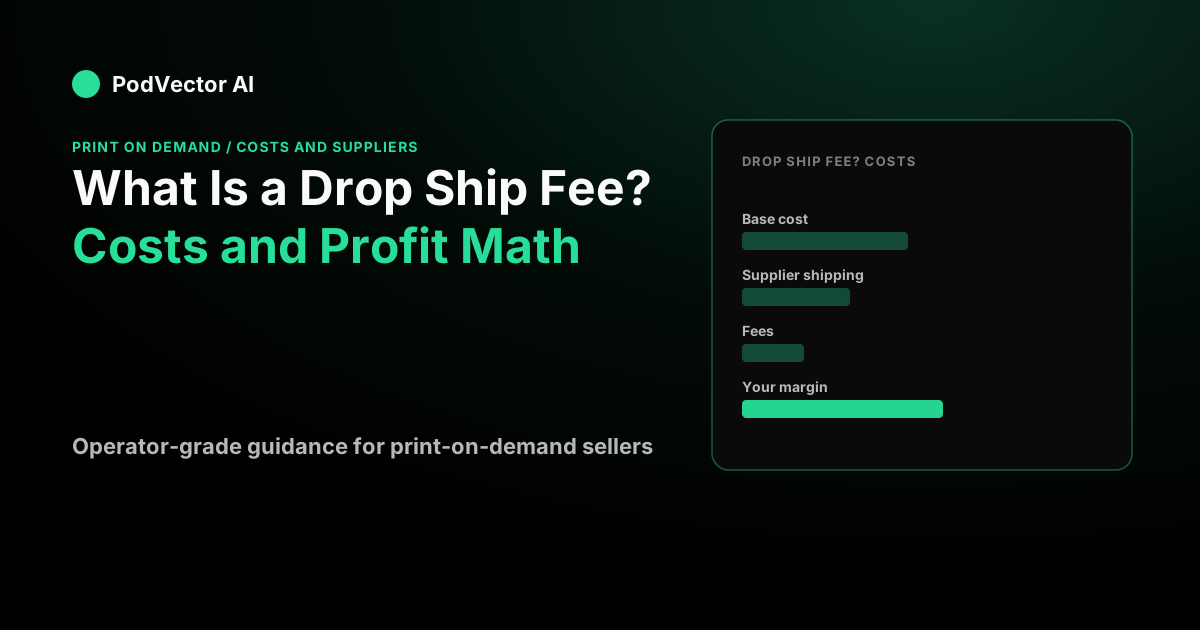
- Base cost (product cost): what the supplier charges to make or supply the item itself.
- Drop ship / handling fee: the per-order charge for fulfilling that single order.
- Supplier shipping: what the supplier bills you to move the parcel to your customer.
- Import duty (new since 2025): the de minimis exemption that let sub-$800 imports enter the US duty-free ended in 2025, and the temporary postal grace period expired in early 2026, so low-value parcels now carry duty that varies by product and destination — build it into your pricing so customers aren't surprised at the door (DailyFulfill, June 2026).
- Supplier tax (where applicable): sales tax or VAT on the fulfillment transaction, depending on your tax setup.
Your true cost on a line is the sum of all five, and your profit is what's left after you also subtract your payment processor's cut:
Profit = (retail price + shipping you charge the customer) − (base cost + drop ship fee + supplier shipping + import duty + supplier tax) − payment fees.
Never use the shortcut "retail − base cost = profit." It ignores the drop ship fee, supplier shipping, duties, and processing fees — the single most common margin error in beginner dropshipping content. The same layered-cost logic applies when you raise average order value to dilute fixed per-order costs.
How much is a typical drop ship fee?
Per-order fulfillment fees vary by supplier type, product category, and order origin. According to Dropship China Pro (June 2026), ecommerce fulfillment typically costs $3 to $8 per order for a standard single-item order, covering pick-and-pack, packaging, and shipping combined — with shipping the single largest piece of that stack. Frienddropshipping's 2026 Shopify fulfillment pricing guide puts the planning range for a small, lightweight ecommerce product at roughly $6–$15 per fulfilled order before product cost, noting that heavy, bulky, or multi-item orders run higher.
Two other charges often travel alongside the per-order fee:
- One-time setup fee to open a wholesale account with some suppliers.
- Monthly membership fee for access to a supplier's catalog and drop ship service. The membership model changes the math: a fixed monthly cost only pays off above a certain order volume — a break-even calculation, not a flat "worth it" answer.
Note also that import duties are no longer negligible for US-bound parcels — factor them in at the same time as the drop ship fee when building your price.
Do Printify and Printful charge a drop ship fee?
In print-on-demand, the big platforms usually don't bill a separate per-order "drop ship fee." Instead, they bake their margin into the base cost and charge an optional monthly membership that lowers that base cost — the membership is the print-on-demand analog of a drop ship fee.
Printify's free plan carries no platform or per-order fee, while its paid Premium plan (check Printify's current pricing page for the latest rate) exchanges a monthly subscription for lower product costs. Printful runs the same pattern: a free tier, with Printful Growth (see Printful's pricing page) unlocking discounted product pricing rather than new fulfillment features.
So the honest way to compare a classic dropshipping supplier to a POD platform is total landed cost per order, not the presence or absence of a line labeled "drop ship fee." A supplier with no membership but a per-order fee can easily cost more than one with a monthly plan if you ship enough volume.
If you're weighing Etsy-sourced products against a POD supplier, the guide on whether you can dropship from Etsy to Shopify covers the cost and compliance picture.
What the 2025 de minimis change means for your drop ship costs
This is the cost the current top-ranking guides cover that older dropshipping articles miss entirely. The de minimis exemption that let sub-$800 imports enter the US duty-free ended in 2025, and the temporary postal grace period expired in early 2026 (DailyFulfill, June 2026). Low-value parcels now carry import duty that varies by product category and destination country.
For print-on-demand sellers fulfilling from overseas print partners, this can add a meaningful line to per-order cost. The practical responses are:
- Switch to domestic or near-shore print facilities where your supplier network supports it — US-based fulfillment eliminates import duty on US orders, though it typically costs more per unit.
- Reprice to absorb the duty, using the same landed-cost formula above.
- Confirm with your supplier how duties are handled on their invoices — some include them in the stated fee, others pass them through separately.
Worked example: where the drop ship fee hits profit
Say you sell a printed tee. Here is a single-order calculation with round, illustrative numbers — treat these as an example, not a market quote, since your real figures live in your supplier's editor at order time.
| Line | Amount |
|---|---|
| Retail price | $24.99 |
| Shipping charged to customer | $5.99 |
| Customer pays | $30.98 |
| Base cost (example) | −$9.00 |
| Drop ship / handling fee (example) | −$3.00 |
| Supplier shipping (example) | −$4.00 |
| Import duty (example — verify with your supplier) | −$0.00 to −$2.00 |
| Payment processing (2.9% + $0.30 — verify with your processor) | −$1.20 |
| Your profit (before duty) | ≈ $13.78 |
Now watch what the drop ship fee does at scale. On its own, $3 looks trivial. Across 300 orders a month, that same $3 fee is $900 of cost — the difference between a healthy month and a break-even one. Add even a modest import duty line and the gap widens further.
That is why average order value and bundling matter so much. If the customer adds a second tee and your supplier charges the drop ship fee once per order (not per item), the fixed handling cost spreads across more revenue and your margin per unit climbs. See the guide on increasing AOV with AI for tactics that move this lever.
How fulfillment costs sit inside your total cost stack
It helps to see where the drop ship fee sits relative to your other costs. According to TrueProfit's analysis of 1,000+ Shopify stores (August 2025), the average cost breakdown is: ad spend around 45%, COGS 35%, shipping roughly 6.5%, transaction fees about 5%, and other costs close to 8.5%. Shipping and fulfillment fees together ranked third — meaning even small per-order improvements in this line compound meaningfully at volume.
The implication: optimizing your drop ship fee is high-leverage, but it's downstream of ad efficiency. Overspending on ads while trying to save $1 on fulfillment is a losing trade. The right sequence is to know your true per-order cost first, then dial ad spend to the margin that's actually left. The average checkout completion rate benchmark is a useful companion — conversion rate and AOV together determine how much ad spend each order can absorb.
How to keep drop ship fees from eating your margin
The fee itself is mostly fixed, so the levers are on the other side of the ledger. A few reliably move the needle:
- Raise average order value. A per-order fee spread over a two- or three-item order costs less per unit. Bundle, cross-sell, and set volume incentives.
- Mind the shipping spread. The gap between what you charge the customer for shipping and what the supplier bills you is a real margin lever — offering "free shipping" just means you absorbed that cost, so it has to be priced in.
- Compare suppliers on landed cost. Base cost + drop ship fee + shipping + import duty together, per destination — not the cheapest single line.
- Recheck the numbers periodically. Supplier fees and shipping rates get repriced; a spread that worked last quarter can quietly go negative.
- Fix your worst-margin SKUs first. Not every product in your catalog is equally profitable after fees. Identify the SKUs where the drop ship fee erodes margin past a threshold and reprice or replace them. The CRO techniques guide covers how to lift conversion once your pricing is right.
If you run paid traffic, the fee also eats into your ad math, because it stacks on top of customer acquisition cost. Fixing the interaction between fulfillment costs and ad efficiency is also addressed in the Klaviyo browse-abandonment flow setup — recovering abandoned sessions is more profitable when your margins are already clean.
Knowing your true per-order profit
The hard part isn't the definition of a drop ship fee — it's tracking it, supplier shipping, import duty, ad spend, and payment fees together on every single order, then knowing which products and campaigns actually clear a profit.
That is what PodVector is built for. It connects your Shopify, Meta Ads, Google Ads, Printify, and Printful accounts and computes true per-order profit — base cost, fees, shipping, and ad spend netted out — so you see the real number, not retail minus base cost. Victor, PodVector's AI employee, reads that live data, proposes moves as approval cards showing old and new values, and executes Shopify-side actions only after you approve. He is not a dashboard, and he does not take any action on your ad accounts without your say-so.
For example, once Victor surfaces your worst-margin SKUs, he can propose repricing them to a target margin — you review the old and new values, approve or reject, and he applies the change in Shopify. That kind of move is meaningless without knowing your true landed cost per order, which is exactly what PodVector's data warehouse is tracking.
Start computing your true per-order profit with PodVector →
Once you can see profit per order cleanly, the next question is what "good" looks like — that benchmark is covered in the net profit margin benchmark. And if you want to understand how PodVector fits the broader POD workflow, the PodVector overview is the place to start.
FAQs
Is a drop ship fee the same as shipping cost?
No. Shipping cost is what the carrier charges to move the parcel; the drop ship fee is what the supplier charges for the labor of processing and packing the order. They are separate lines, and a single order can carry both.
Do all dropshipping suppliers charge a drop ship fee?
Not always as a separate line. Some list an explicit per-order fee, some fold it into a higher product price, and print-on-demand platforms tend to bake their margin into base cost while offering a paid membership that lowers it. Either way, you are paying for fulfillment somewhere — read the invoice, not just the catalog price.
How do I calculate profit after the drop ship fee?
Add up everything the customer pays you (product price plus any shipping you charge), then subtract base cost, the drop ship fee, supplier shipping, import duty (where applicable as of 2026), supplier tax, and your payment processing fees. Whatever remains is profit — and it is usually meaningfully lower than "retail minus product cost."
Is a monthly membership cheaper than a per-order drop ship fee?
It depends on volume. A membership is a fixed monthly cost, so it beats a per-order fee only once you ship enough orders for the per-order savings to exceed the subscription. Below that threshold, a no-membership supplier or a free plan is usually the better choice.
Can I pass the drop ship fee on to the customer?
Indirectly, yes — you build it into your retail price or your shipping charge, the same way you cover base cost. What you can't do is ignore it, because charging too little to absorb your fees is how stores run at a loss while looking busy.
Does the 2025 de minimis change affect print-on-demand sellers?
It can, depending on where your print partner fulfills from. If your POD supplier produces and ships from outside the US, orders to US customers may now carry import duty that didn't exist before 2025. Confirm with your supplier how they handle duty on outbound orders, and update your landed-cost formula accordingly. Domestic print facilities avoid this issue entirely.
How does Google Ads or Meta spending interact with fulfillment costs?
Ad spend stacks on top of fulfillment costs — both come out of the same per-order margin. If your drop ship fee rises but your retail price and ad spend stay flat, your return on ad spend falls automatically. That's why it's worth modeling fulfillment costs and ad efficiency together. The Google Ads for Shopify step-by-step guide covers how to structure campaigns once your margin picture is clear.