
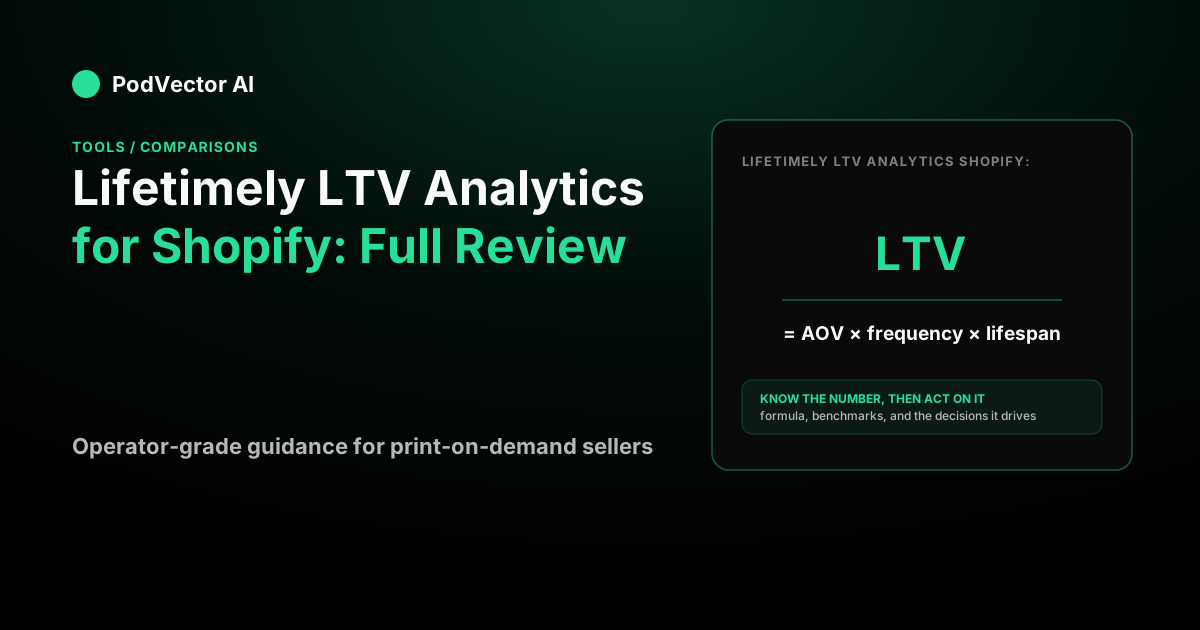
What Lifetimely actually does
Lifetimely is a Shopify-native analytics app built around one question: how much profit does a customer generate over their whole life, not just on the first order? It installs into your Shopify admin and produces four things automatically — a real-time profit-and-loss statement, predictive LTV, cohort reports, and a marketing view that lines up ad spend against revenue (useamp.com).
The headline feature is cohort analysis. Lifetimely groups your customers by first-purchase month, first product, or acquisition channel, then tracks accumulated revenue per customer over time. That lets you answer questions Shopify's default reports can't: which channel brings customers who actually come back, and how long it takes to earn your acquisition cost back.
On top of that sits "Profit Agent," an AI layer that monitors your P&L, CAC, LTV, and attribution around the clock and surfaces changes it thinks matter (useamp.com). It reads and flags; it does not act on your store.
Lifetimely pricing (and where it jumps)
Lifetimely prices by monthly order volume, not by revenue, which is fairer to low-priced POD catalogs than the GMV-based tools. As of this review (accessed 2026-07-29 on the Shopify App Store listing), the tiers are:
| Plan | Price/mo | Monthly orders |
|---|---|---|
| Free | $0 | up to 50 |
| S | $79 | up to 500 |
| M | $149 | up to 3,000 |
| L | $299 | up to 7,000 |
Source: Shopify App Store listing, accessed 2026-07-29. Amazon data integration is a separate add-on at $75/mo on paid tiers (Shopify App Store listing).
The catch is the gap between free and paid. The free plan caps at fifty orders a month, which most stores clear in a week. The moment you cross it, the next real tier is a step up — so budget for the S plan from the start if you plan to grow.
LTV and cohort analysis: the real strength
This is where Lifetimely beats the broader profit trackers. Its predictive LTV model forecasts future customer spend from historical patterns, and its cohort engine is deep enough that reviewers describe it as best-in-class for a Shopify app — the app currently holds a 4.9-star rating across 459 reviews, about 97% of them five-star (Shopify App Store listing, accessed 2026-07-29).
If your whole strategy hinges on repeat purchase — subscriptions, consumables, a strong second-order rate — Lifetimely's cohort depth is genuinely useful. You can see that your March Meta cohort paid back its CAC in sixty days while your TikTok cohort still hasn't, and shift budget accordingly.
For a full look at how it stacks against the field, our profit analytics tools comparison breaks down every major option side by side.
Where Lifetimely is thin for a POD store
Print-on-demand breaks assumptions that LTV tools quietly rely on. Two of them matter most.
COGS is not a number you type once
For a POD seller, cost of goods is set per variant by your supplier — the base garment, the print method, the supplier's own price changes. Sell the same design as a hoodie and a mug and your margin is completely different per order. Any tool that stores a single static cost per product will misstate your margin the day a supplier reprices.
Lifetimely ingests COGS into its P&L, but it does not publish print-provider-specific, per-variant COGS logic the way some rivals do. By contrast, TrueProfit advertises quantity-based COGS and direct Printful and Printify integrations from its entry tier (Shopify App Store listing); our TrueProfit review covers exactly how that cost handling works. If POD-accurate COGS is your first requirement, verify it before choosing.
Attribution is first- and last-touch only
Lifetimely's marketing view centralizes ad spend, ROAS, and CAC across channels using first- and last-touch attribution (useamp.com). That's simpler than the server-side, multi-touch attribution in tools like Triple Whale — and for a POD seller spreading budget across Meta, TikTok, and Google, single-touch credit can flatter or punish a channel unfairly. Lifetimely also integrates a narrower set of ad platforms (Google, Meta, TikTok) than some competitors, so a Pinterest advertiser won't see that spend natively.
Worked example: what LTV analytics misses about your margin
Say you sell a print-on-demand hoodie for $45. Your Printify cost is $22, Shopify and payment fees run about $1.80, and you spend $12 to acquire that order in Meta ads.
Revenue $45 − COGS $22 − fees $1.80 − ad spend $12 = $9.20 net profit per order.
Now the supplier raises the blank by $3. Your real profit drops to $6.20 — a 33% cut — but if your analytics tool still holds the old $22 cost, your dashboard shows $9.20 and your reported LTV is inflated on every repeat order that customer makes. The prettiest cohort chart in the world is wrong if the per-order cost underneath it is stale. That's the risk with any static-COGS setup, Lifetimely included.
Lifetimely vs. the other profit tools
Every tool in this category is a reporting layer — the differences are price basis, depth, and platform.
For pure LTV and cohort depth on Shopify, Lifetimely leads. For POD-accurate cost tracking and the widest ad-network coverage, TrueProfit is the stronger pick at a lower $35 entry price (Shopify App Store listing); if you're weighing it against BeProfit, our TrueProfit vs. BeProfit comparison lays out the trade-offs.
For attribution-first brands with real budget, Triple Whale and Polar Analytics compete on server-side tracking — but they price for scale, with Triple Whale's paid tier starting at $219/mo (triplewhale.com) and Polar's Full Platform at $750/mo even below $5M GMV (pricing.polaranalytics.ai). Both are hard to justify under $50k/mo in revenue. See our Polar Analytics vs. Triple Whale breakdown if attribution is your priority.
When a dashboard isn't the thing you need
Here's the honest limit of every tool above, and we'll disclose our stake plainly: we're PodVector, so we have an interest in this comparison. Lifetimely, TrueProfit, Triple Whale, and Polar all do the same core job well — they show you numbers. Then you have to interpret them, decide what to change, and go do it across Shopify, Printify, and your ad platforms yourself.
PodVector is built for the step after the chart. It connects Shopify, Meta Ads, Google Ads, Printify, and Printful, and computes your true per-order profit from live data. On top of that sits Victor, an AI employee that analyzes what's happening and proposes concrete moves — and, with your approval, executes the Shopify-side actions himself. Victor reads your ad data to reason about spend, but he does not touch your ad account. He's not a dashboard you have to read; he's an employee you can delegate to.
If you'd rather act on your profit numbers than just watch them, try PodVector and see what Victor would change first.
None of that makes Lifetimely a bad choice — if deep LTV reporting is what you're after, it's one of the best on Shopify. Just be clear about which job you're hiring a tool to do.
FAQs
Is Lifetimely worth it for a Shopify store?
If customer lifetime value and cohort analysis are central to how you make decisions, yes — it's among the highest-rated LTV tools on the App Store at 4.9 stars across 459 reviews (Shopify App Store listing, accessed 2026-07-29). If you mainly need accurate per-order profit on thin POD margins, weigh a COGS-focused tool first.
Does Lifetimely handle print-on-demand COGS automatically?
Lifetimely ingests COGS into its P&L, but it does not publish per-variant, print-provider-specific cost logic, so confirm how it maps your Printify or Printful costs before relying on it. Tools like TrueProfit publish direct Printful and Printify integrations (Shopify App Store listing).
Is Lifetimely the same company as Ampla?
No. Lifetimely is owned by AMP, a Singapore-based Shopify app company that acquired it in 2022. Ampla is an unrelated New York fintech lender. The two are frequently confused, but the app you install on Shopify is AMP's and is actively maintained.
Does Lifetimely have a free plan?
Yes — a free tier covers up to fifty orders a month, with paid plans starting at the S tier for stores up to five hundred orders (Shopify App Store listing, accessed 2026-07-29). Most growing stores outgrow the free cap quickly.
What's the difference between Lifetimely and PodVector?
Lifetimely is an analytics dashboard that reports your LTV and profit. PodVector connects Shopify, Meta Ads, Google Ads, Printify, and Printful to compute true per-order profit, and pairs it with Victor, an AI employee that proposes and — with your approval — executes Shopify-side changes. One shows you the numbers; the other acts on them.