
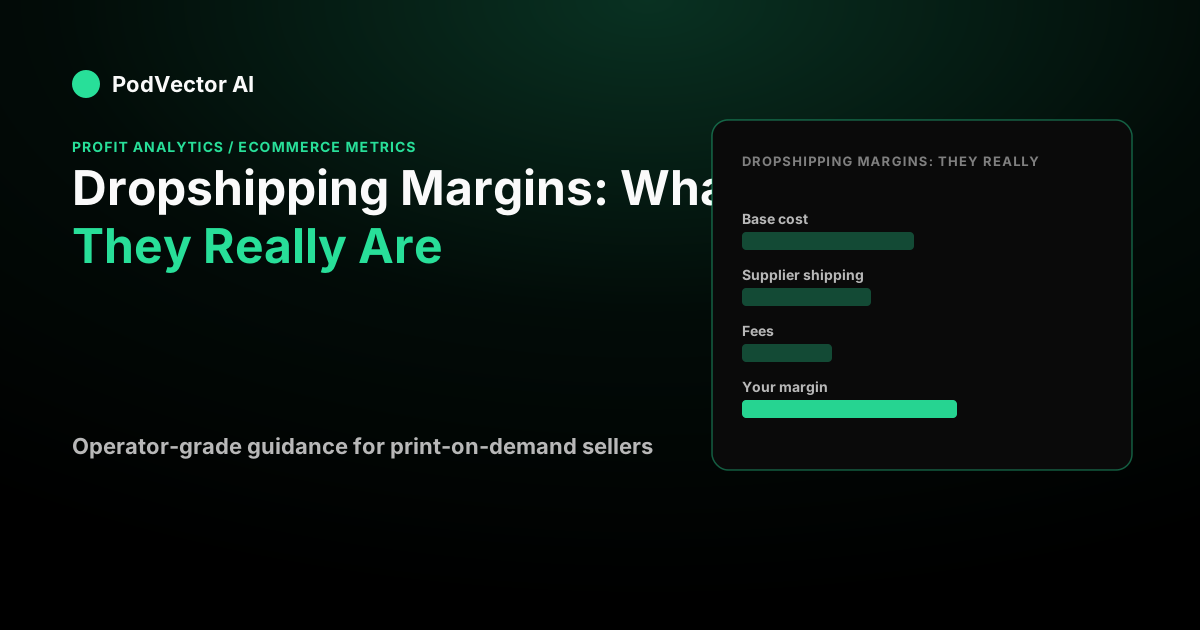
"Dropshipping margins" is really three different numbers, and confusing them is the most expensive mistake new sellers make. There's the margin on the product, the margin after you actually deliver and get paid, and the margin after advertising eats its share. Each one is smaller than the last.
This guide walks all three, with a worked per-order example you can copy for your own store. If you want the broader vocabulary these numbers live inside, our ecommerce metrics guide defines each term with the same running math.
What "dropshipping margin" actually means
A margin is profit expressed as a share of the selling price. The formula never changes — (price − cost) ÷ price × 100 — but which costs you subtract changes everything.
- Gross margin subtracts only the product cost (COGS).
- Contribution margin subtracts every variable cost: product, shipping, payment fees, fulfillment, and often the ad spend for that order.
- Net margin subtracts everything, including fixed overhead like software and salaries.
When a blog says dropshipping margins are "healthy," it usually means gross. When your bank account disagrees, it's talking about net. The gap between them is the whole game.
What's a typical dropshipping margin?
Benchmarks vary widely by niche and platform, so treat these as reference points, not promises.
On the gross side, most dropshipping stores keep roughly sixty-five to seventy cents of gross profit per dollar of revenue, according to TrueProfit. That's before ads and fees.
On the net side — the money you actually keep — the numbers compress hard. TrueProfit puts a strong net margin around the mid-teens, with the mid-teens to mid-twenties range considered good, while Printify cites an industry average net margin of roughly fifteen to twenty percent. Others frame per-sale margins more loosely; Zippia reports margins that typically run twenty to thirty percent per sale, and AutoDS notes a good margin generally falls between fifteen and thirty percent, varying by marketplace.
For context on why dropshippers tolerate thin margins at all: traditional retail fulfillment runs a margin of only about three to ten percent, so even a modest dropshipping net can beat carrying inventory. The catch is that the storefront number and the take-home number are rarely the same.
A worked example, one order at a time
Say you sell a print-on-demand hoodie for $40. Here's where the money goes, step by step. These are illustrative figures — plug in your own.
| Line | Amount | What it is |
|---|---|---|
| Revenue (your price) | $40.00 | what the customer pays |
| − Product cost (COGS) | −$16.00 | blank + print + supplier base fee |
| = Gross profit | $24.00 | gross margin = 60% |
| − Shipping | −$5.00 | carrier cost |
| − Payment processing | −$1.60 | say your processor takes about 4% |
| − Pick / pack | −$1.40 | handling labor |
| = Contribution margin (before ads) | $16.00 | 40% of revenue |
| − Ad spend for this order | −$10.00 | at a 4.0 return on ad spend |
| = Contribution margin (after ads) | $6.00 | 15% of revenue |
Notice what happened. The 60% gross margin that looked so healthy became 40% the moment shipping and fees landed, then 15% once advertising took its cut. The arithmetic — $40 − $16 = $24, then $24 − $8 = $16, then $16 − $10 = $6 — is the entire story of dropshipping margins.
Gross margin: the ceiling, not the reality
Gross margin (($40 − $16) ÷ $40 = 60%) tells you whether a product is worth making. It's the ceiling on everything downstream. If your gross margin is thin, no amount of ad optimization saves you — there's nothing left to cover the other costs. But gross margin never touches your bank account on its own.
Contribution margin: where dropshipping margins actually get decided
Contribution margin is the honest working number. In the example, subtracting shipping, fees, and fulfillment drops you from $24 to $16 per order before you spend a cent on ads. That $16 is what's available to pay for customer acquisition and still leave a profit.
This matters because it sets your break-even on advertising. On a 40% contribution margin, you need every ad dollar to bring back at least $2.50 in revenue (1 ÷ 0.40) just to break even. Sellers who track only gross margin think they break even at a much lower return — and quietly lose money on every sale. The mechanics behind that identity are covered in our piece on incremental revenue and the true return on marketing.
Net margin: what you actually keep
Net margin subtracts fixed costs too. Say your store does 1,000 orders a month at $6 contribution each — that's $6,000 — and your fixed costs (apps, a freelancer, your subscription tools) run $4,000. Net profit is $2,000, or a 5% net margin on $40,000 of revenue. That's below the benchmark range above, which is exactly the point: averages hide how easily a good-looking store nets almost nothing.
Why dropshipping margins look bigger than they are
Three habits inflate the number in your head versus the number in your account.
Quoting gross as if it were net. The storefront math (price minus product cost) ignores the biggest variable cost most stores carry: advertising. A "60% margin" product can be a losing product.
Averaging away the ad spend. Blended across a whole month, ads feel like a line item. Per order, they're often your single largest cost after COGS — bigger than shipping and fees combined, as in the example above.
Ignoring returns and refunds. A margin measured on gross sales evaporates when a percentage of orders come back. Your platform books the refund later, after you've already declared the campaign profitable.
The fix isn't a better guess — it's measuring the real cost of each order instead of a category average. That's the difference between knowing your margin and hoping it.
How to protect your dropshipping margins
You have four honest levers, and they compound.
- Raise price or lower COGS to widen gross margin — the ceiling every other number sits under.
- Cut variable costs like shipping and fees, which quietly turn a 60% gross into a 40% contribution.
- Lower acquisition cost so ads eat less of each order's contribution margin.
- Increase repeat purchases, because the second order carries no acquisition cost and lands almost entirely in your margin.
If you want a structured walkthrough of the first two, our guide on how to improve gross profit breaks down the pricing and cost moves in order of impact. And if you're comparing your storefront numbers against your accounting statements, why revenue and profit-and-loss views diverge explains the reconciliation.
See your real per-order margin, not an average
The hard part of dropshipping margins isn't the formula — it's assembling the numbers. Your product cost lives with your supplier, your ad spend lives on Meta and Google, and your sales live in Shopify. Stitching them together per order by hand is where most sellers give up and fall back on a gross-margin guess.
PodVector connects Shopify, Meta Ads, Google Ads, Printify, and Printful and computes true per-order profit from that live data — the $6, not the $24. Victor, its AI employee, analyzes that data and proposes Shopify-side moves you approve; he reads your ad performance to inform them but does not touch your ad account. It's not a dashboard you have to read — it's an employee that does the margin math for you.
FAQs
What is a good profit margin for dropshipping?
A commonly cited healthy net margin sits in the mid-teens to mid-twenties percent range, per TrueProfit, while Printify cites an industry average of about fifteen to twenty percent. But "good" depends on your gross margin and acquisition cost. A 15% net on a high-volume store can out-earn a 30% net on a store that sells five orders a week. Judge the dollars, not just the percentage.
Is gross margin or net margin more important for dropshipping?
Both, for different decisions. Gross margin decides whether a product is worth selling at all — it's the ceiling. Net margin decides whether your business made money. In between sits contribution margin, which decides how much you can afford to spend on ads. Track all three; the one you ignore is usually the one bleeding.
Why is my dropshipping margin lower than the benchmark numbers?
Most benchmarks quote gross or per-sale margins and quietly omit advertising. Once you subtract ad spend, shipping, payment fees, and fixed overhead per order, a 60% gross routinely becomes a single-digit net — as the worked example above shows. Your number isn't necessarily wrong; the benchmark is often measuring a different, earlier line.
How do dropshipping margins compare to traditional retail?
Dropshipping usually carries a higher percentage margin because you don't buy inventory upfront. Traditional retail fulfillment runs a margin of roughly three to ten percent, and the same source frames dropshipping margins as several times higher. The trade-off is that dropshipping's lower barrier means more competition and heavier ad costs, which is precisely what compresses that margin back down.
How do I calculate my true dropshipping margin?
Start from the selling price, then subtract every cost tied to that one order: product, shipping, payment processing, fulfillment labor, and the ad spend it took to win the sale. What's left is your contribution margin. Subtract a fair share of monthly fixed costs to reach net margin. If you sell across platforms, connecting your sales, supplier, and ad data — as in the dropshipping revenue breakdown — is the only way to get the ad cost right per order.