
CPM, short for cost per mille, is the price a platform charges to put your ad in front of eyeballs one thousand times. It is the base cost of visibility on Meta, Google, TikTok, and nearly every display network. Get the formula right and you can compare channels, spot when your ad costs are creeping up, and — the part most guides skip — work out the CPM your product can actually afford.
This article gives you the exact formula, a worked example, real benchmark ranges, and the profit math that turns CPM from a vanity number into a decision.
What the CPM formula is
The CPM formula has three inputs and one operation:
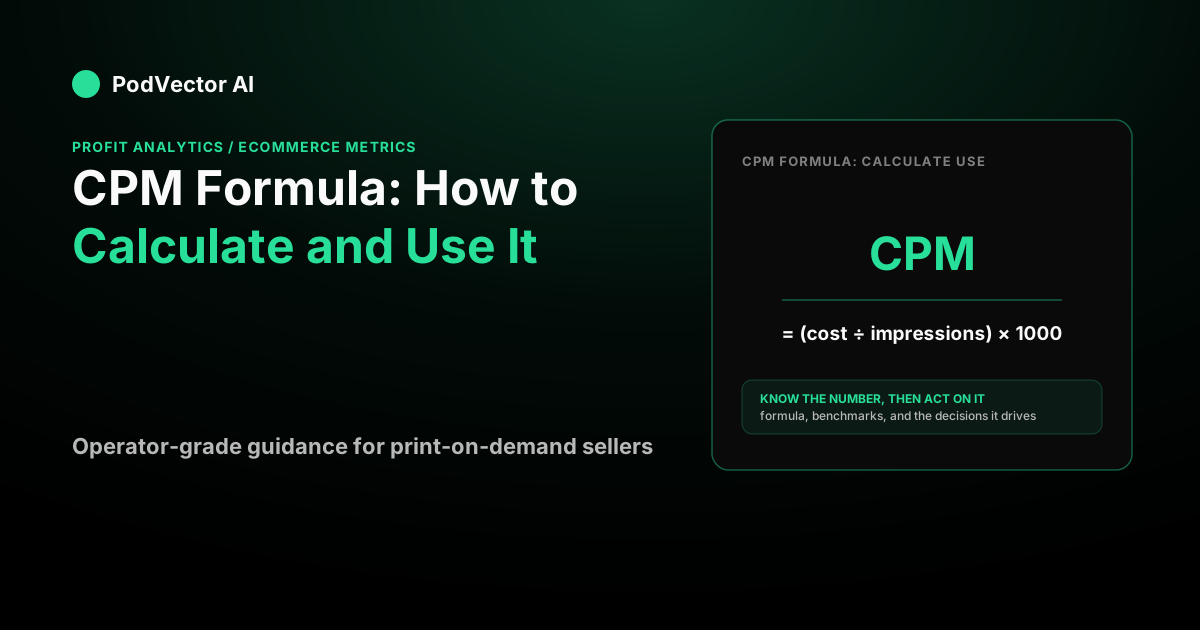
CPM = (Ad spend ÷ Impressions) × 1,000
- Ad spend is the dollars you paid over the period.
- Impressions is the number of times your ad was served (not unique people — that is reach).
- × 1,000 rescales the answer to a per-thousand basis so the number is readable.
The units are dollars per 1,000 impressions. A "$10 CPM" means every thousand times your ad shows, you pay ten dollars. Because it is a rate, you can compare a $50/day test against a $5,000/day campaign directly — the spend cancels out.
If you ever need to rearrange it, the algebra is simple. To find how many impressions a budget buys: Impressions = (Ad spend ÷ CPM) × 1,000. To find the spend a CPM implies for a target reach: Ad spend = (Impressions ÷ 1,000) × CPM.
How to calculate CPM: a worked example
Say you run a print-on-demand apparel store and put $10,000 into a Meta campaign one month. The platform reports 1,000,000 impressions.
CPM = ($10,000 ÷ 1,000,000) × 1,000 = $10.00
Now compare two ad sets from the same budget:
- Ad set A: $3,000 spend, 500,000 impressions →
($3,000 ÷ 500,000) × 1,000 = $6.00 CPM - Ad set B: $3,000 spend, 250,000 impressions →
($3,000 ÷ 250,000) × 1,000 = $12.00 CPM
Ad set B costs twice as much to reach the same number of screens. That does not automatically make it worse — a pricier, tighter audience can convert better — but it is the first flag to investigate. CPM is a starting question, not a verdict, which is exactly why it sits alongside the other numbers in this ecommerce metrics guide.
What a "normal" CPM actually costs
CPM swings hard by platform, audience, season, and industry, so treat benchmarks as rough guardrails, not targets. Approximate channel ranges reported in StoreRadar's CPM guide put display advertising around one to ten dollars, Facebook and Instagram around five to fifteen dollars, and video ads from ten dollars into the thirties per thousand impressions.
Platform-level figures tell a similar story. AppsFlyer's CPM glossary reports a recent average near six dollars per thousand impressions, with Meta running above seven dollars and X closer to a dollar and change. Costs also climb in the fourth quarter as retailers bid up inventory before the holidays.
The takeaway: a $12 CPM might be alarming on a display network and completely normal for a narrow Meta retargeting audience. Compare CPM within the same platform and audience type, never across them.
The CPM you can afford: the profit angle guides skip
Most CPM articles stop at "lower is better." That is wrong. The only CPM that matters is the one your margin can carry — and you can calculate it.
CPM connects to your acquisition cost through two conversion steps. An impression becomes a click at your click-through rate (CTR), and a click becomes an order at your conversion rate (CVR). Chain them together:
Cost per order = CPM ÷ (1,000 × CTR × CVR)
Say your average order is $40. After the blank garment, printing, shipping, payment fees, and pick-and-pack, you keep $16 of variable profit per order — your contribution margin before ads. That $16 is the most you can spend to acquire an order and still break even. Understanding that number is what a gross margin calculator and a clear read on your revenue formula are for.
Now solve the formula for the CPM ceiling. With a 2% CTR and a 4% click-to-order CVR:
Max CPM = Break-even cost per order × 1,000 × CTR × CVR
Max CPM = $16 × 1,000 × 0.02 × 0.04 = $12.80
So this store can pay up to about $12.80 CPM before ads stop paying for themselves at those conversion rates. If real CPMs run near the Meta benchmark, there is room. If they push past thirteen dollars, something else has to give: a higher CTR, a better CVR, a bigger order value, or a cheaper product.
Notice the two hidden levers. Double your CTR and your affordable CPM doubles. Double your CVR and it doubles again. A "high" CPM is often really a low-CTR or low-CVR problem wearing a costume — the ad reaches people fine; it just does not persuade them.
CPM vs CPC vs CPA
These three costs measure different rungs of the same ladder, and mixing them up leads to bad calls.
- CPM is cost per 1,000 impressions — the price of being seen.
- CPC is cost per click —
Ad spend ÷ Clicks. It folds in your CTR:CPC = CPM ÷ (1,000 × CTR). - CPA is cost per action (usually an order) —
Ad spend ÷ Actions. It folds in CVR too:CPA = CPC ÷ CVR.
Walk it with the numbers above. A $10 CPM at 2% CTR gives a CPC of $10 ÷ (1,000 × 0.02) = $0.50. At a 4% order CVR, that is a CPA of $0.50 ÷ 0.04 = $12.50 per order. CPM is upstream; CPA is where profit is decided. A cheap CPM with a weak CTR and CVR can still produce a ruinous CPA.
CPM is the cost of attention. Whether that attention becomes profit depends on everything downstream — which is why you eventually need to trace the full path from spend to per-order profit, and to know your break-even point formula cold.
How to lower your CPM (when it is actually the problem)
If your CPM is genuinely high for the platform, a few levers move it:
- Widen or refresh the audience. Very narrow audiences and heavy overlap drive prices up as the auction thins out.
- Fight ad fatigue. When the same people see an ad too many times, engagement drops and platforms charge more to keep serving it. New creative resets this.
- Improve engagement signals. Platforms reward ads people interact with by lowering their effective cost, so stronger hooks and formats often pull CPM down on their own.
- Mind the calendar. Bidding into the fourth-quarter retail rush costs more; steadier year-round spending avoids the worst spikes.
But before you chase a lower CPM, confirm CPM is the constraint. If your affordable ceiling is $12.80 and you are paying $7, the CPM is not your problem — your CTR, CVR, or margin is.
Watch the impression definition
One quiet trap: platforms count impressions and clicks differently, and the denominator is where CPM math goes wrong. Meta's "clicks (all)" includes likes, comments, and profile taps, not just visits to your site. Compute CPC or CVR off that inflated number and every downstream figure lies. Use link clicks or landing-page views for anything tied to on-site conversion, and keep your impression source consistent when comparing periods.
Turn CPM into per-order profit
Calculating CPM by hand is easy. Keeping it honest against your true per-order profit — across products, campaigns, and platforms that each count things their own way — is the hard part.
PodVector connects your Shopify, Meta Ads, Google Ads, Printify, and Printful accounts and computes your true per-order profit, so you can see whether the CPMs you are paying actually leave money on the table after COGS, shipping, and fees. Victor, its AI employee, reads that live data, flags where ad costs are outrunning margin, and proposes moves — with your approval on any Shopify-side change. Victor does not touch your ad account; he reads the numbers and tells you what they mean. Connect your store and see your real numbers.
Once you know the CPM you can afford, the next step is nailing the number underneath it — run your own figures through the break-even point calculator to set the ceiling before you spend.
FAQs
What is the CPM formula?
CPM = (Ad spend ÷ Impressions) × 1,000. You divide what you spent by how many times the ad was shown, then multiply by a thousand so the result reads as a cost per 1,000 impressions. For example, $500 spent for 200,000 impressions is ($500 ÷ 200,000) × 1,000 = $2.50 CPM.
What does CPM stand for?
CPM stands for cost per mille. "Mille" is Latin for thousand, so CPM is the cost per one thousand ad impressions. It is written with an "M" for the Roman numeral, not for "million" — a common mix-up.
Is a lower CPM always better?
No. A low CPM only helps if those impressions convert. A cheap CPM paired with a weak click-through or conversion rate can still produce a higher cost per order than a pricier, better-targeted campaign. Judge CPM by the cost per order and profit it ultimately drives, not in isolation.
What is a good CPM?
There is no universal number — it depends on platform, audience, industry, and season. Published ranges put display ads in the low single digits and Meta and video ads higher, per StoreRadar, but the only CPM that is truly "good" for you is one below the ceiling your margin can afford. Calculate that ceiling from your contribution margin, CTR, and CVR rather than copying an average.
How is CPM different from CPC and CPA?
CPM is cost per 1,000 impressions, CPC is cost per click, and CPA is cost per action such as an order. They chain together: CPC = CPM ÷ (1,000 × CTR), and CPA = CPC ÷ CVR. CPM measures the price of attention; CPA measures the price of a result.
How do I calculate the CPM I can afford?
Start with your contribution margin per order — revenue minus COGS, shipping, fees, and fulfillment. That is your break-even cost per order. Then multiply: Max CPM = break-even cost per order × 1,000 × CTR × CVR. If your affordable CPM sits above what the platform charges, you have room to scale; if not, work on CTR, CVR, order value, or product cost.