
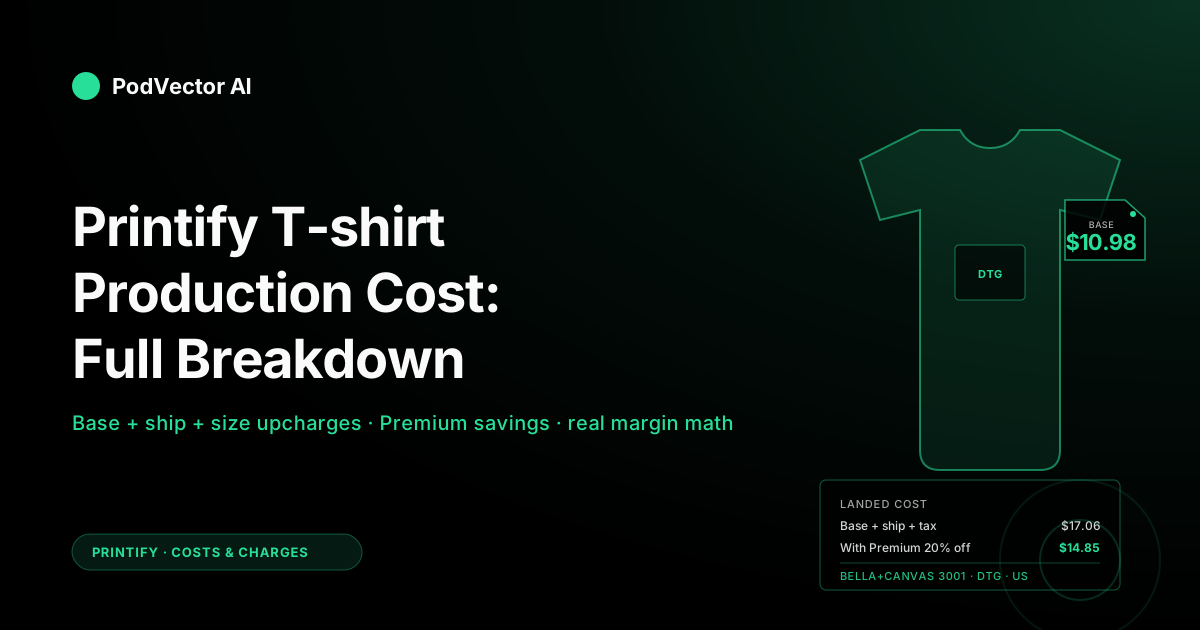
Quick Answer: A Printify t-shirt's production cost typically runs $7–$13 base for the blank plus DTG print, then $3.99–$6 US shipping for the first shirt and ~$2 per additional shirt in the same order. Expect $11–$19 total landed cost for a one-shirt order.
The exact number depends on three things: blank choice (Gildan 5000 is cheapest, Bella+Canvas 3001 is mid, Stanley/Stella is premium), size (2XL–5XL adds $1–$4), and whether you're on Printify Premium (up to 20% off base).
Production cost is what you pay the print provider. It is not your retail price — and it is not your profit margin until shipping, transaction fees, ad spend, and refunds come out.
What a Printify t-shirt actually costs to produce
Production cost is what the print provider charges Printify to make and ship one t-shirt. It is not what you charge your customer.
For the most common SKUs — a single-side DTG print on a standard-size blank — production cost lands in a tight band: $7–$13 base plus $3.99–$6 shipping domestically in the US.
The bottom of that range is a Gildan 5000 from a US-based provider. The top is a Bella+Canvas 3001 or Stanley/Stella organic blank from a European provider shipping internationally. Almost every shirt in your catalog will fall somewhere inside this window.
Where operators get burned is treating "production cost" and "landed cost" as the same number. They are not. Production cost is just the first line item.
The four line items in every t-shirt production cost
Every t-shirt order, sample or customer, has the same anatomy. The dollar values shift with blank and provider, but the line items don't.
1. Base product cost. The blank shirt plus the DTG print on the print provider's machines. Listed in Printify's product editor next to each variant.
2. Shipping. Charged by the provider, not Printify. First-item rate plus a smaller per-additional-item rate when items ship together.
3. Sales tax / VAT. Applied based on the shipping destination, not your business location. Most US states tax POD orders as normal retail.
4. Optional surcharges. Size upcharges (2XL–5XL), second print location, AOP (all-over print), embroidery, premium fabric, neck-tag swap-in. These are line items on the same invoice but easy to miss when you're scanning a quote.
Your retail markup is set in your storefront, not in Printify. The print provider always charges you base cost — your customers pay retail, Printify pays the provider, and Printify wires you the difference minus any platform fees.
Production cost by blank: Gildan, Bella+Canvas, Stanley/Stella
The blank you pick is the single biggest lever on production cost. Here's how the three most popular Printify blanks compare on standard size (S–XL), single-side DTG, US fulfillment.
Gildan 5000 (Heavy Cotton): base around $8.80, drops to roughly $5.92 with Premium. The default budget workhorse. Heavier 6.0 oz fabric, less premium drape, but the cheapest per-unit on the platform.
Bella+Canvas 3001 (Unisex Jersey): base around $10.98, drops to roughly $8.77 with Premium. The mid-tier default. Softer hand, more retail-style fit, what most apparel POD stores actually ship.
Stanley/Stella Creator 2.0: base around $13–$15 depending on provider, with similar Premium discounting. European blank, organic cotton, the premium pick when your brand is positioning above generic dropship.
That's a $5+ swing per shirt from cheapest to premium blank, before size upcharges and shipping. On a 1,000-shirt year that's $5,000 of margin you keep or lose just on blank selection.
The right choice isn't always the cheapest. A Gildan 5000 at $20 retail looks like a steal until customers compare it to the Bella+Canvas your competitor sells for $24 — and the cheaper blank's lower perceived value eats the price-gap advantage.
Size upcharges (2XL–5XL) and why they matter
Larger sizes cost more to produce because they use more fabric and more ink coverage. Printify's providers pass that through as a per-size upcharge on top of the base.
Typical Printify size upcharges:
- 2XL: +$1.50 to +$2.50
- 3XL: +$2.50 to +$3.50
- 4XL: +$3.00 to +$4.50
- 5XL: +$4.00 to +$6.00
Most stores set one retail price across all sizes. When a 5XL costs you $4 more to produce, every 5XL sale is $4 of margin you didn't get on an S–XL sale at the same price.
Two ways to handle it. Charge a size-tier upcharge in your store (most apparel brands add $2–$5 for 2XL+). Or price your S–XL with enough cushion to absorb the larger sizes at a flat retail.
The wrong move is to ignore it. If 12% of your orders are 2XL+ and you priced flat against S–XL margin, your blended unit margin is meaningfully below what your dashboard implies.
DTG vs. screen vs. AOP vs. embroidery cost differences
DTG (direct-to-garment) is the default print method on Printify and is included in the base price. Other print methods cost more.
DTG, single-side: included in base. No setup fees. Per-shirt economics regardless of order quantity.
DTG, two-sided: roughly +$3–$5 per shirt. The second print is its own pass on the machine — second pass, second cost.
AOP (all-over print): uses sublimation on cut-and-sew blanks. Base cost is structurally higher — typically $15–$22 for the equivalent shirt — because the entire blank is custom-printed before assembly.
Embroidery: charged by stitch count, usually +$3–$8 over the DTG base for a chest or sleeve logo. Larger or more colorful embroidery scales up.
Screen printing: Printify offers it on select providers for bulk orders. Per-color and per-design setup fees apply, which makes it cheaper than DTG only above ~50 units of the same design.
The practical takeaway: DTG single-side is the lowest cost method for most POD stores. Add a second print location or switch to AOP only when the design genuinely needs it — the cost difference doesn't get recovered without a matching retail price bump.
Shipping costs by provider and destination
Shipping is per-provider, not per-Printify. Each provider sets its own rates, and a single order with shirts from two providers ships as two separate parcels with two separate shipping charges.
US domestic shipping, single shirt:
- Most US providers: $3.99–$5.50 for the first shirt
- Additional shirts in the same order: $1.50–$2.50 each
US-to-international shipping, single shirt:
- US-to-Canada / EU: $7–$12 for the first shirt
- US-to-rest-of-world: $10–$18
EU domestic and EU-to-EU:
- EU-based provider to EU customer: $4–$6.50 for the first shirt
The single biggest shipping cost mistake is using a provider on the wrong continent for your customer base. A US customer ordering a shirt from a Latvian provider can pay $10–$15 shipping on a $9 shirt — your product looks cheap, your total at checkout looks expensive, your conversion drops.
Use Printify's provider filter to limit suggestions to providers in your customers' region. The base cost may be $0.50 higher, but the shipping difference pays for it many times over.
Does Premium make production cheaper?
Yes. Printify Premium is $24.99/month (or $299/year annual) and gives up to 20% off the base cost of most products. The discount applies to your samples and your customer orders alike.
On a Gildan 5000 at $8.80 base, Premium drops the per-shirt cost to about $5.92 — a $2.88 saving. On a Bella+Canvas 3001 at $10.98, you save about $2.21.
The breakeven math: Premium costs $24.99/month. At an average $2.50 savings per shirt, you breakeven at 10 shirts sold per month. Below that, you're paying for the subscription. Above it, you're banking margin.
For a store doing 50+ orders/month, Premium is a clean yes. For a store still doing first-month testing, stick with the free tier and switch once orders are consistent. The full math is in our Printify free tier breakdown.
A real production cost example, line by line
Let's price a real shirt. Customer order: one Bella+Canvas 3001 in black, size L, single-side DTG print on the chest, shipping to California from a Texas-based provider.
| Line item | Amount |
|---|---|
| Bella+Canvas 3001 black, size L, DTG print | $10.98 |
| Premium discount (if subscribed) | −$2.21 |
| Provider shipping (TX → CA, first shirt) | $4.85 |
| California sales tax (on shirt + shipping) | $1.23 |
| Total production cost | $14.85 |
Now the same shirt without Premium: $10.98 + $4.85 + $1.23 = $17.06. That $2.21 Premium discount is real money.
Now the same shirt as a 2XL: add $2 size upcharge. Now $19.06 without Premium, $16.85 with Premium.
Now the same shirt with a second print on the back: add $4. Now $23.06 without Premium, $20.85 with Premium.
If you list this shirt at $24 retail across all sizes and all print configs, your 2XL-two-sided variant is breaking even at best. Your S–XL single-side variant on Premium clears about $9 gross — before Shopify fees, ad spend, returns, and chargebacks.
The hidden costs that quietly eat your margin
The line items above are what Printify charges. The numbers below are what you pay everywhere else, and they're easy to miss.
Payment processing: Shopify Payments, Stripe, and PayPal all charge roughly 2.9% + $0.30 per transaction. On a $24 shirt, that's $1.00 off the top.
Platform fees: Etsy charges 6.5% + $0.20 per sale. Shopify charges $39/month on Basic plus a 0% additional fee for using Shopify Payments (or 2% extra if you use another processor). TikTok Shop charges 6–8% commission.
Ad spend per acquired customer: POD CAC on Meta and Google in 2026 runs $10–$25 per first-time buyer for apparel niches. If your average order is one shirt, your effective product cost just doubled.
Returns and refunds: Printify refunds for defects only. Customer-side "wrong size" or "doesn't fit" refunds come out of your margin, not Printify's.
Chargebacks: $15 chargeback fee per disputed transaction on most processors, regardless of dispute outcome.
Stack these honestly and the $9 gross margin on a $24 shirt becomes closer to $3–$5 net. That's the number your bank statement reflects at year-end — and the number most POD operators don't see until tax season.
How to set retail price from production cost
The standard cost-plus formula is: Retail price = Total landed cost ÷ (1 − target margin). For a 40% target margin on a $15 landed cost, that's $15 ÷ 0.60 = $25 retail.
That gets you a starting price. Three adjustments matter more than the formula.
1. Include all fees in landed cost, not just Printify's invoice. Add payment processing, ad CAC, expected refund rate (~3% of revenue), and platform fees before you divide.
2. Price by perceived value, not by cost. A graphic-tee niche where customers expect $28–$35 retail will tolerate Bella+Canvas. A bulk-merch niche where customers expect $18 won't.
3. Build in a size-upcharge band. Add $2 for 2XL, $3 for 3XL, $4 for 4XL+, or absorb it into a higher flat base price across all sizes. Either works. Pretending the upcharge doesn't exist does not.
For a deeper walkthrough of pricing strategy across multiple blank tiers, see the Printify hoodie cost breakdown and the Printify hoodie base cost guide, which use the same framework applied to a higher-ticket apparel SKU.
FAQs
What is the cheapest t-shirt to produce on Printify?
The Gildan 5000 from a US-based provider runs about $8.80 base, dropping to roughly $5.92 with Printify Premium. With $4–$5 US domestic shipping on a single shirt, total landed cost is about $13 without Premium, $10 with Premium.
How much does Printify charge per t-shirt?
Printify itself doesn't charge a per-shirt fee — the print provider does. Base costs run $7–$13 for the most popular blanks (Gildan 5000, Bella+Canvas 3001, Stanley/Stella) and shipping adds $4–$6 US domestic on a single shirt.
Does Printify charge a setup fee?
No setup fees for DTG. You can list and sell shirts with custom designs at no upfront cost. Setup fees can apply on screen printing for bulk orders, but those are bulk-only workflows.
How do I see the exact production cost for one of my shirts?
Open the product in your Printify dashboard. The "Pricing" tab lists base cost for every size and color variant, with the Premium discount applied if you're subscribed. Shipping is shown at checkout based on destination.
Why is the 2XL more expensive than the L?
Larger sizes use more fabric (the blank wholesale costs more) and require more ink coverage on the DTG pass. Providers pass that through as a per-size upcharge of $1.50–$6 depending on size and provider.
Does shipping count as production cost?
Technically no — production cost is the cost to make the shirt, shipping is separate. For margin math, treat them as one number ("landed cost"). Your customer pays one combined total at checkout; your accounting should match.
Can I lower my Printify production cost?
Three levers: subscribe to Premium for up to 20% off base, choose a cheaper blank (Gildan 5000 over Bella+Canvas 3001 saves ~$2 per shirt), and pick a provider in your customers' region to cut shipping. Stacked, these typically save $4–$6 per shirt.
What's the difference between Printify's base cost and my customer's invoice?
Base cost is what Printify pays the provider. Your customer pays your retail price (which you set). Printify deducts base cost + shipping from your retail price and wires you the difference — that's your gross margin before payment processing, platform fees, and other costs.
How does Printify production cost compare to Printful?
Printful is generally $1–$3 more per shirt on equivalent blanks, but bundles more services (better mockups, easier branding inserts, more provider control). On pure cost, Printify wins; on the operations side, the gap is closer than the base prices suggest.
Stop guessing what your real per-shirt margin is
Base costs shift. Size upcharges add up. Premium discounts apply differently per blank. Ad CAC moves week to week. Most POD operators look at their Printify invoice and assume that's their cost — then can't explain why their bank balance doesn't match their dashboard.
Victor is an AI employee that connects your Printify, Shopify, and Meta and Google ad accounts into one live view. He recalculates your true per-shirt margin in real time as base costs shift, flags variants where the 2XL upcharge is eating profit, and shows you where your Meta and Google spend is leaking — you make the call on every change — so your winning SKUs get the budget and your losers get cut.
Built on a single source of truth that unifies your store, supplier, and ad accounts. And see your real shirt margins in under 10 minutes.
Try Victor freeRelated reading:
- All Printify articles
- Printify costs & charges hub
- Printify Hoodie Base Cost: Full Breakdown for POD Sellers
- Printify Hoodie Cost: Full Breakdown for POD Sellers
- Printify Mockup Generator Free: Full Breakdown for POD Sellers
- Linking Printify to Etsy: Setup Guide for POD Sellers
- Printify Amazon Integration: Setup Guide for POD Sellers
- Printify: How to price custom shirts (2026 guide)