
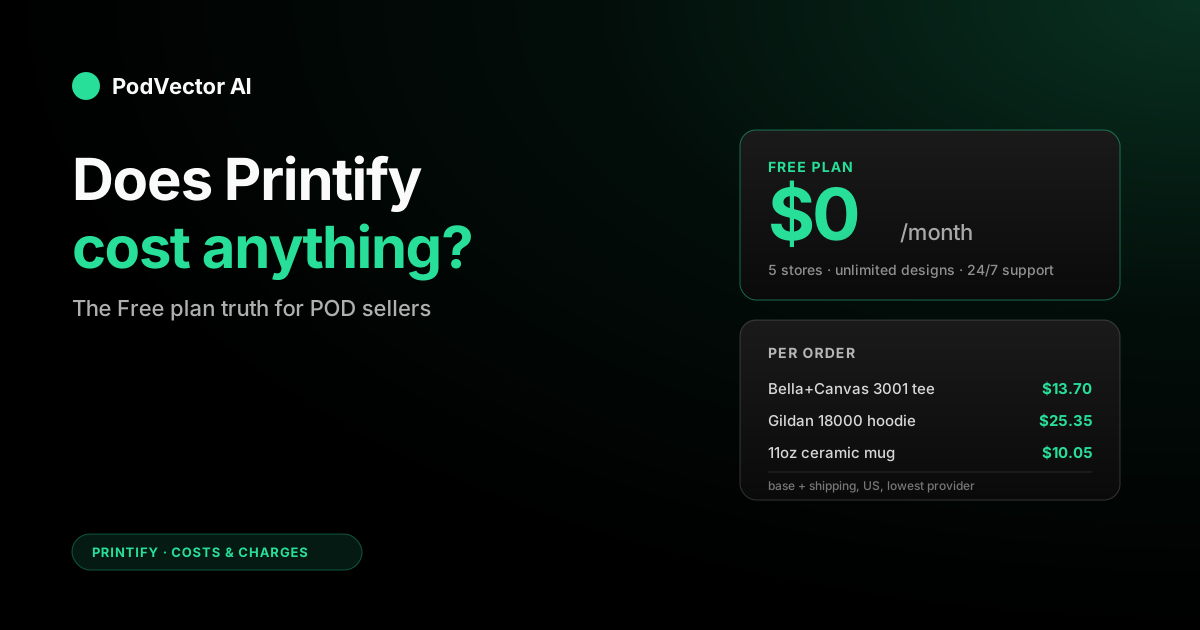
Quick Answer: Printify's Free plan costs $0/month. You only pay the base product cost plus shipping each time a customer orders — no setup fees, no listing fees, no monthly subscription.
According to Printify's official pricing page, there are no platform fees, listing fees, or hidden charges — Printify earns a margin on the fulfillment price you pay when a customer orders. Every t-shirt, mug, or hoodie still carries a wholesale cost, and that's where most new POD sellers underestimate the real number.
This article breaks down what Free actually includes, what you still pay per order, and the exact volume where Printify Premium ($39/month) starts paying for itself.
Is Printify Actually Free?
Yes. According to Printify's own help center, you can create an account, connect your store, and use the Product Creator to design items without any upfront fees. You only pay the cost of the products and shipping when an order is placed.
According to Printify's official pricing page, Printify is the largest print-on-demand marketplace with over 2,000 products and 90+ print providers, and there are no upfront costs. The advice is to start free and upgrade only when the discounts outearn the fee.
The catch — and it's the same catch every print-on-demand platform has — is that Printify still has to print, pack, and ship your products. So while the platform is free, the products aren't. Every time a customer buys, you pay Printify the wholesale base cost plus shipping, and you keep the margin.
That's the model. No "free plan with a 14-day trap." No hidden subscription that activates after a threshold. As noted by EcommerceCEO, there's no time limit and no hidden restrictions on the product catalog — no pressure to upgrade. You only pay when an order is placed.
What the Free Plan Includes
Here's exactly what you get on Printify Free as of mid-2026, per Printify's pricing page:
- 5 stores per account — connect any combination of Shopify, Etsy, eBay, WooCommerce, TikTok Shop, Wix, Squarespace, Amazon, BigCommerce, and others
- Unlimited product designs — no cap on how many SKUs you create
- Full product catalog access — 2,000+ products from 90+ global print providers
- Mockup generator (Product Creator) — built-in product mockups for every listing
- Automatic order routing — Printify forwards customer orders to the print provider you selected
- Merchant support — chat and email support included
According to Printify's own Free vs. Premium comparison, the Free plan gives you everything required to build, manage, and sell from a single storefront with full control over your products and settings. For most sellers starting out, this covers everything needed to launch and run a real POD store.
What You Still Pay on Every Order
This is the part most "is Printify free" articles skip past in one sentence. Let's itemize.
For every order a customer places, Printify charges you:
- Base product cost — the wholesale price Printify pays the print provider, plus their margin
- Shipping cost — calculated by destination and provider
- Tax — where applicable, depending on the print provider's jurisdiction
According to Printify's pricing page, a tee with an $8.77 fulfillment cost sold at $19.99 earns over $11 per sale — illustrating how margin works on the Free plan. You set your own retail prices and keep the difference.
The Free plan doesn't change any of those numbers. The base costs you see when you build a product in Printify are the base costs you pay. There's no markup added because you're on Free.
For a granular breakdown of what the most popular blanks cost through Printify and how to protect your margin at scale, see our Printify t-shirt cost and profit breakdown.
Free vs Premium: When $39/Month Actually Pays Off
According to Printify's pricing page, Premium costs $39/month billed monthly, or $24.99/month billed annually ($299/year). According to Printify's Free vs. Premium guide, the main benefit is up to 20% off every product in the catalog — making it "the clear winner for sellers scaling a print-on-demand business with consistent order volume."
So the break-even math is simple. If you're saving up to 20% of base cost on every order, how many orders does it take to recover the subscription? EcommerceCEO's 2026 Printify pricing guide confirms the three-tier structure: Free ($0), Premium ($39/month or $24.99/month billed annually), and Enterprise (custom pricing).
Here's a concrete example from Printify's own blog: at low sales volume, the monthly subscription cost isn't yet justified by the savings from product discounts. The trigger is consistent order volume.
According to Chayaani's 2026 Printify pricing guide, selling 100 t-shirts per month saves significantly more than the $39 subscription cost. On the annual plan, the math improves further — $24.99/month means a lower volume threshold before Premium pays for itself.
A rough rule of thumb: if you're consistently selling more than 15–20 units a month of any mix of products, Premium typically starts paying for itself on the monthly plan. Below that, stay on Free. The trap is paying for Premium before you have the volume — a new store with 3 sales a month loses money on a Premium subscription every month.
What Else Premium Adds Beyond the Discount
The discount gets all the attention, but according to Chayaani's 2026 guide, Premium at $39/month (or $24.99/month annually) also includes 10 connected stores (vs. 5 on Free), priority support, Printify Connect for better order tracking, and early access to new features.
According to Printify's comparison page, Premium raises the store limit to ten — making it the right plan for anyone running stores across multiple niches, platforms, or audiences. If you're managing more than five storefronts, that alone can justify the upgrade regardless of volume.
There's also a select-product discount tier: according to Chayaani's guide, some new products carry up to 33% off for Premium subscribers, above the standard 20% catalog discount.
Hidden Costs Most Guides Miss
"Free" isn't the same as "no other costs to worry about." Here's what catches POD sellers off guard:
Payment processing on your sales channel. Shopify charges transaction fees per sale. Etsy takes a transaction fee plus payment processing on top. These come out of your gross sale, not Printify's side.
Shopify subscription itself. If you sell through Shopify, there's a monthly plan fee. Printify Free doesn't change that.
Etsy listing and renewal fees. Per-listing fees renewing every four months add up once you have a large catalog.
Sample orders. You pay full base + shipping for samples — same as a customer order. Printify offers some discount through its Sample Order program, but samples are not free.
Returns and reprints. Printify covers reprints for printing defects. Anything else — wrong size ordered by a customer, address typo, buyer's remorse — is on you.
Tax remittance. Some print providers charge sales tax. You're responsible for collecting from the customer and remitting where required. Printify doesn't handle that for you.
None of these are Printify fees. They're real operational costs the "Printify is free!" headline doesn't mention. Understanding your true contribution margin — revenue minus product cost, shipping, fees, and ad spend — is the only way to know whether a product is actually profitable.
The Operational Cost of Staying on Free
The bigger hidden cost of Free isn't a dollar figure — it's time and decision quality.
On Free, you're tracking itemized base costs across hundreds of SKUs in a spreadsheet that goes stale the moment a print provider updates pricing. When a tee jumps in cost, you don't notice until your margin reports come in weeks later.
You're also flying blind on the unit economics that actually drive POD profit: ad spend per SKU, refund rate per print provider, true gross margin per product, contribution margin after Shopify and channel fees. Most sellers don't have any of that itemized at the SKU level. That's directly connected to decisions about checkout conversion and ad fatigue — you can't optimize spend you can't measure.
That's the real operational tax. Not the $39/month Premium fee — the cost of making blind decisions about which products to scale, which to kill, and which Meta or Google ad campaigns to fund. Understanding ad frequency is meaningless if you don't know which products have margin to support the spend.
Victor — PodVector's AI employee — reads your live Printify costs, Shopify orders, and Meta and Google ad spend in one place, then proposes actions like repricing your worst-margin SKUs to a target margin, with your approval before anything changes. That's the layer most sellers don't think about until they're already losing money on the volume side. The unit-economics problem doesn't go away with Premium — it goes away when you stop running the business out of spreadsheets.
If you're evaluating capital options to fund inventory or growth, also see our guide on how to get Shopify Capital and whether Shopify Capital checks credit — both decisions hinge on having clean margin data first.
Related Guides
If you're evaluating Printify against your sales channel, these next steps help close the loop:
- Printify t-shirt cost and profit breakdown — every line item that eats your margin
- How to get contribution margin — the metric that tells you if a product is actually profitable
- How to get Shopify Capital — funding options once your store has margin data to show
- Shopify store automation for POD — how to automate the Shopify-side ops that Free plan sellers do manually
- Printify's official pricing page — current plan terms direct from Printify
FAQs
Does Printify charge a setup fee?
No. According to Printify's pricing page, there are no platform fees, listing fees, or hidden charges — Printify earns only when you sell.
Is there a free trial of Premium?
Printify periodically offers a trial through promotions, but it's not a permanent feature of the signup flow. The Free plan is the always-available no-cost option.
Can I switch between Free and Premium?
Yes. You can upgrade to Premium anytime, and you can cancel and drop back to Free before the next renewal date. According to Printify's pricing page, downgrading means you lose the product discounts but don't lose any platform functionality or access to sales channels.
How many products does Printify have?
According to Printify's pricing page, the catalog includes 2,000+ products across 90+ print providers — all accessible on the Free plan with no restrictions.
Do I need to enter a credit card to use the Free plan?
According to Chayaani's 2026 guide, Printify's Free plan is genuinely free — no credit card required, no trial period. You only pay when a customer places an order.
Does Printify take a cut of my sales?
No. According to Printify's pricing page, Printify earns a margin on the fulfillment price you pay per order — not a percentage of your retail price. Whatever you sell the product for on Shopify, Etsy, or your other channels is yours.
Is the Free plan good enough for a real business?
Yes, up to a point. According to Printify's own Free vs. Premium comparison, at low sales volume the monthly subscription cost isn't yet justified by the savings from product discounts. There's no reason to upgrade until you're consistently getting orders. Above a consistent order volume, Premium's discount pays for itself — especially on higher-base-cost items like hoodies and all-over-print apparel.
What's the Enterprise plan?
According to EcommerceCEO's 2026 Printify pricing guide, Printify offers a custom-priced Enterprise tier for high-volume merchants, above the Free and Premium tiers. Pricing is quoted based on business size and volume.
Let Victor run your Printify ops with your approval
Printify Free is the right call for most new POD sellers — but the moment you have more than a few SKUs, the real cost is the spreadsheet sprawl, not the platform fee. Victor is PodVector's AI employee: he reads your live Printify costs, Shopify orders, and Meta and Google ad spend, then proposes actions — like repricing your worst-margin SKUs to a target margin or updating prices in bulk — with your approval before each change executes.
Stop running unit economics in your head. And see what an AI employee on top of your real numbers looks like.
Try Victor free