
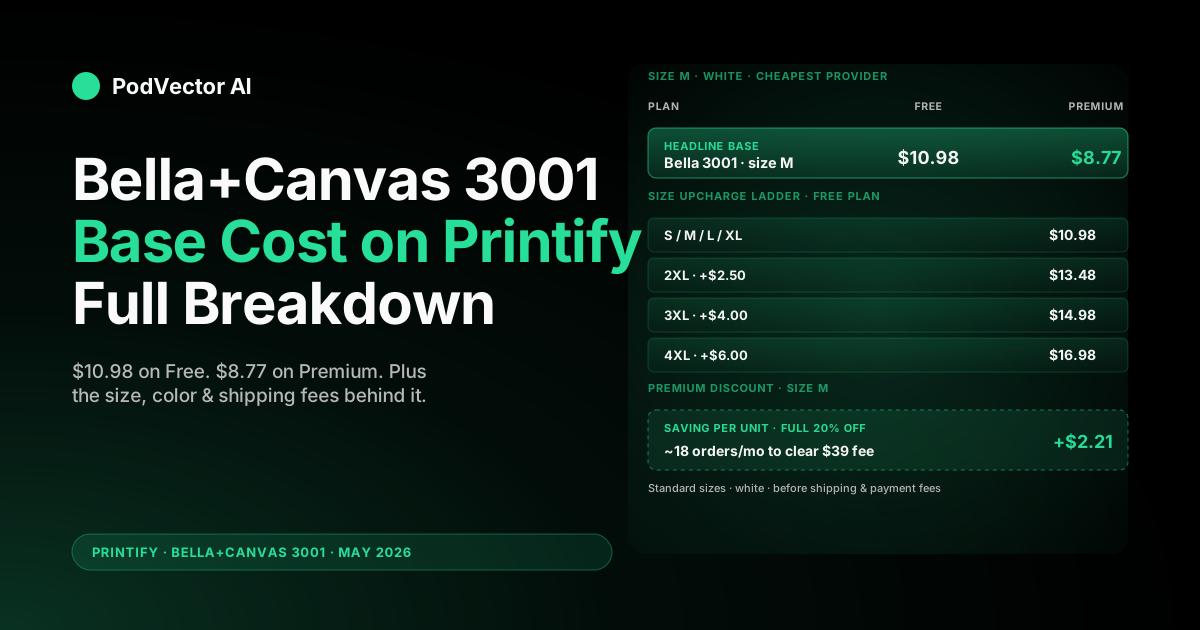
Quick Answer: The Printify Bella Canvas 3001 base cost varies by print provider — verify the current number in your Printify product editor, where providers are listed side by side. The range across the provider network for a standard-size white tee spans roughly $8.50–$13 on the Free plan, with Printify Premium (up to 20% off base cost) compressing that range meaningfully. Size upcharges, color premiums, second-side print fees, and shipping all stack on top — the sticker base cost is the floor, not the ceiling.
The "real" cost is base + size upcharge + color premium + DTG fee + shipping, and that landed cost is what decides whether your retail tee actually nets profit. All figures in this article are ranges drawn from the Printify product editor; confirm live rates there before pricing a new product line.
Printify Bella Canvas 3001 base cost in 2026
The Bella+Canvas 3001 (Unisex Jersey Short Sleeve Tee) is Printify's most-listed mid-tier blank. According to Printify's catalog, the base cost depends on three things: the print provider you pick, the size, and whether you're on Free or Premium.
The headline number: across Printify's full provider network for the 3001, standard-size base prices for a white tee span a wide range depending on provider. The cheapest budget providers sit at the lower end of that range; specialty and US-made providers sit at the top. Printify Premium (up to 20% off base cost) compresses those numbers further.
That's a significant swing on the exact same blank — same supplier SKU, different fulfillment partner. The reason: Printify aggregates dozens of print providers, and each sets its own production cost. Some are large warehouses with volume pricing; others are smaller shops with premium positioning. You pick the provider; Printify routes your order.
Always verify the current number in your Printify product editor. The editor shows live per-provider pricing side by side for any size and color you select — it is the authoritative source. Published guides (including this one) capture a moment in time; providers rotate and base costs update without announcement.
Base cost by print provider
Printify's product page for the 3001 shows side-by-side base cost per provider once you select a size and color. The exact list changes as Printify onboards and rotates providers, but the typical tiers look like this for a standard-size white tee on the Free plan.
| Provider tier | Relative cost position | What you're paying for |
|---|---|---|
| Budget DTG providers | Lowest in the network | Volume warehouses, basic DTG quality, fast turnaround in their region |
| Mid-tier providers | Mid-range | Solid DTG print, reliable QC, broader color and size catalog |
| Premium / US-made providers | Highest in the network | USA fulfillment (3001U variant), tighter color matching, faster domestic shipping |
The "right" tier depends on your buyer expectations. If you're competing on budget graphic tees against Amazon and Etsy volume sellers, a budget provider keeps you margin-positive. If you're selling premium niche-design tees, the higher-tier provider is worth it for print quality.
One trap: provider switching mid-store is messy. Each provider has its own color availability, size range, mockup angles, and turnaround. Listing on Provider A and then routing orders to Provider B without re-checking inventory is how you end up with surprise out-of-stock variants. Pick a provider for a product line and stick with it.
Also worth knowing: most providers carry the 3001 in a wide color range, but rare colors (Heather Mint, Heather Peach, Soft Cream) may only stock at one or two providers. If your design depends on a specific color, check the per-color provider list before locking in your store-wide preferred provider.
Size upcharges: where 2XL+ quietly eats margin
Standard sizes (S, M, L, XL) all cost the same. Extended sizes don't — and the upcharge is steep enough to wreck the margin on extended-size orders if you forgot to price them differently in your store.
| Size | Upcharge direction over M | Margin risk |
|---|---|---|
| S / M / L / XL | No upcharge | Baseline margin — price as normal |
| 2XL | Moderate upcharge | Noticeable margin compression at flat retail pricing |
| 3XL | Significant upcharge | Meaningful hit if retail is not adjusted |
| 4XL | Large upcharge | Can eliminate margin entirely at a mid-range retail price |
| 5XL (limited) | Largest upcharge | Rarely profitable at standard retail unless priced separately |
The fix is simple: in Shopify set per-size retail pricing that mirrors the provider's per-size base cost step. A common pattern is standard retail for S–XL, then stepped increases for 2XL, 3XL, and 4XL+. Buyers expect it; competitors do it; you're just defending the margin you priced for.
Printify's product editor shows per-size base costs side by side. Use that view when you publish — don't just glance at the M price and assume the rest follow.
If your Shopify margins are drifting and you're not sure whether extended sizes are the culprit, the Printify revenue reconciliation guide walks through how to cross-check what Printify charges against what Shopify records per order.
The color and fabric-blend premium
White is the cheapest Bella 3001 color on every provider. Everything else costs more — sometimes a few cents, sometimes nearly a dollar.
According to Printify's official blog, the Bella+Canvas 3001's fabric composition varies by color: solid colors are 100% Airlume combed and ring-spun cotton, while heather variants add polyester (52% cotton / 48% polyester for most heathers; 90% cotton / 10% polyester for Black and Athletic Heather). That fabric difference passes through to your base cost.
- White: baseline cost, cheapest variant on every provider
- Standard solids (Black, Navy, Red, Royal): small premium over white
- Heather variants (Athletic Heather, Dark Grey Heather): moderate premium — polyester blend increases material cost
- Trend colors (Soft Cream, Heather Mint, Peach): often the highest premium and limited provider availability
For a single-design store this rounds to noise. For a store with many designs across multiple colors and sizes, the color premium is a real line item that compounds across orders. The move for a new design: start with white plus two cheap solids (Black, Navy) and see which converts. Then add trend colors only if the design actually needs them. Don't list a dozen colors on day one — most won't sell, and you've paid the catalog management and mockup generation cost for nothing.
Print-area, second-side, and embroidery fees
The base cost includes one DTG (direct-to-garment) print on one side — usually front or back, your choice. The moment you add print to a second side, embroidery, or all-over print, the cost jumps.
Second-side DTG print: adds a meaningful per-shirt cost depending on provider. A front + back design effectively doubles the print labor, which is what you're paying for. Check the provider's pricing tab in the product editor for the exact rate.
Embroidery on the 3001: rarely available — the 3001 is a DTG-first blank. According to Printify's official blog, the 3001's cotton fabric is specifically suited for sharp, long-lasting DTG prints, not embroidery. When embroidery is offered, it carries a stitch-count-based fee. Consider a Bella sweatshirt or hoodie if embroidery is your aesthetic.
All-over print (AOP): not available on the standard 3001 — AOP requires a sublimation-friendly blank, which the 3001 isn't. If your design depends on edge-to-edge print, switch product entirely (sublimation polyester tees, AOP-spec blanks).
Sleeve prints / pocket prints / neck labels: available on supported providers at an additional per-location fee. Useful for premium positioning; rarely justifies itself on a budget listing.
The honest read: if you're new to POD, design for one DTG print on one side until you've validated demand. Adding side-2 or sleeve prints before a design proves itself is a margin trap dressed up as a feature.
Shipping: the line item nobody discounts
Printify shipping rates are set by each print provider — not by Printify centrally. For a single 3001 inside the US, you're typically looking at a first-item rate in the mid-single digits, with a lower add-on rate for additional items in the same shipment.
International shipping is where margin compresses fast. Selling tees to buyers in Europe or Australia with a US-based provider incurs materially higher shipping than a regional provider would. If you sell internationally at any volume:
Provider region vs. buyer region matters. A US-based provider shipping to a UK buyer costs significantly more than a UK-based provider shipping to the same UK buyer. If you sell internationally at volume, list the same design with both a US and EU provider, then route orders by buyer geography.
Shipping isn't discounted by Premium. Printify Premium's discount applies to the base product cost only — shipping is full rate on Free and Premium alike. Factor this in when calculating the true value of a Premium subscription: the effective discount on total landed cost (base + shipping) is lower than the headline product-cost discount rate.
If you're seeing mismatches between what Printify charges for shipping and what shows up in Shopify, the Printify revenue reconciliation guide and the Stripe revenue reconciliation guide explain the most common causes.
Premium discount on Bella 3001 in real dollars
Printify Premium takes up to 20% off the base product cost. The Bella 3001 is one of the products that consistently gets the full 20%, not the "up to" qualifier that some products have — verify this in your account's product editor, as Printify can adjust discount tiers.
The math on whether Premium pays for itself depends on your order volume and the base cost of the products you sell. At the standard discount rate, the saving per unit on a Bella 3001 is meaningful; at low monthly order volumes, the subscription fee exceeds the savings.
A simple break-even check: divide the monthly Premium subscription cost by the per-unit saving you see in your product editor. The result is the monthly order quantity needed to cover the subscription. If you're above that number, Premium is margin-accretive. If you're below it, the Free plan keeps more money in your pocket until volume climbs.
Important: the annual Premium plan carries a lower monthly equivalent cost than the monthly plan, which reduces the break-even order count. If you're confident in sustained volume, annual is the better deal.
If your store sells a higher mix of 2XL+ Bella 3001s (common in niche apparel — band tees, plus-size streetwear, sports fan designs), the break-even drops further because the absolute discount is bigger on the upcharged sizes.
For the full Premium subscription economics — the break-even math and hidden costs the discount math ignores — see our Printify promo codes guide and the deeper dive on sample coupon codes that can stack on your first orders.
Sustainability and ethical manufacturing
This is a subtopic the top results cover that frequently appears in buyer decision-making — and it matters for how you position the Bella 3001 in your store copy.
According to Printify's official blog, Bella+Canvas is part of the Fair Labor Association and holds Platinum WRAP certification, meaning products are manufactured in humane, sustainable conditions under a strict no-sweatshop policy. The company integrates eco-friendly initiatives including water-efficient dye machines, motion-sensor LED lighting, and a near-zero waste policy that minimizes plastic use and repurposes excess fabric.
Why this matters for POD sellers:
- Marketing angle: "ethically made" and "sustainably produced" are copy hooks that resonate in fashion-adjacent and lifestyle niches. If you're charging a premium retail price, the Bella 3001's supply chain story supports that positioning in a way a generic blank doesn't.
- Buyer objection handling: shoppers in the $30–$45 tee category increasingly ask about manufacturing conditions. Having an answer ready (or including it in your product description) reduces hesitation at checkout.
- B2B wholesale buyers: if you sell to small boutiques or corporate clients who care about ESG procurement, the WRAP certification and Fair Labor Association membership are credentialing points.
None of this changes the cost math — but it changes what you can credibly charge and how easily you can justify the price gap over a commodity blank.
Bella 3001 vs Gildan 64000: when the cost gap is worth it
The Bella 3001's main competitor on Printify is the Gildan 64000 (Softstyle T-Shirt). The Gildan is consistently cheaper — check both products in your Printify editor to see the current per-provider gap at the sizes and colors you carry.
The cost gap is real, and at volume it compounds significantly. So why would anyone pick the Bella?
The buyer can tell. According to Printify's official blog, the Bella 3001 is made from 100% Airlume combed and ring-spun cotton (4.2 oz/yd²) — a refining process that reduces impurities in the cotton fibers for exceptional softness. It also features side seams, a ribbed collar, and twill shoulder taping that help maintain its shape through many wash cycles. Gildan 64000 is a heavier, boxier basic. For fashion-leaning niches (streetwear, women's apparel, premium graphic tees), the Bella feel justifies a higher retail price. For budget niches (event tees, fan tees, novelty), Gildan is the right pick.
Print quality on dark colors. According to Printify's blog, the Bella 3001's cotton fabric is "the perfect canvas for sharp and long-lasting direct-to-garment (DTG) prints." On black or navy with fine line work, the difference is visible in product photography — which moves conversion rate.
Buyer review sentiment. Bella 3001 review sentiment tends to run higher than Gildan 64000 across most marketplaces. Higher review averages improve algorithmic positioning on Etsy — compounding returns over time.
Ethical supply chain story. As covered above, the WRAP / Fair Labor Association credentials give premium-positioned stores a marketing angle Gildan can't match at the same price point.
Rule of thumb: Bella for fashion and premium niches, Gildan for volume and budget niches. Don't mix on the same design — pick the blank that matches your retail price and stick with it.
The full landed-cost math on a retail tee
The base cost is the start of the math, not the end. The line items that stack on top of base cost are:
- Shipping (first item, domestic): varies by provider — check your provider's shipping tab
- Shopify payment processing: Shopify charges a transaction fee on each order (rate depends on your Shopify plan and whether you use Shopify Payments); factor this in at your actual rate
- Allocated ad cost: if you run Meta or Google ads, your customer acquisition cost (CAC) is a real per-order cost — divide your monthly ad spend by your monthly order count to get a blended per-order ad cost
- Printify Premium subscription (amortized): if you pay for Premium, divide the monthly cost by your monthly order count to get the per-order subscription overhead
The most common mistake POD sellers make: pricing against base cost alone, then discovering that shipping + payment processing + ad cost leaves them with a fraction of the apparent margin — or nothing.
The two levers that move landed cost the most are traffic mix (organic vs. paid — paid acquisition adds a large per-order cost) and provider choice (the spread between the cheapest and most expensive provider on the same blank is often larger than the Premium discount). Optimizing both before scaling ad spend is the correct order of operations.
If your Shopify revenue and your Printify charge records aren't reconciling cleanly, the Printify revenue reconciliation guide and the Stripe orders reconciliation guide cover the most common discrepancies. For ad cost attribution — understanding which orders were actually ad-driven — see the channel attribution guide.
Tracking Bella 3001 margin across providers
Most POD operators never know their per-SKU per-provider margin in real time. They calculate it once when they list the product, then run on assumption for the next year. When Printify rotates a provider, updates a base cost, or shipping zones shift, the assumption drifts — usually silently, always downward.
The honest version is a spreadsheet: per-SKU base cost + per-order shipping + payment fees + allocated ad spend, refreshed weekly. Tedious, error-prone, and almost nobody does it consistently.
Victor — PodVector's AI employee for POD sellers on Shopify — connects your Printify, Shopify, Meta Ads, and Google Ads accounts into one live data warehouse and computes per-SKU landed margin from actual order data. When a Bella 3001 SKU's margin drifts because a provider raised base cost, shipping rates changed, or ad CPMs spiked, he flags it. With your approval, he can reprice the affected listings to restore your target margin or surface the data you need to make the provider decision yourself.
Victor reads Printify order-side cost data — meaning the per-order production cost that flows through completed orders — rather than a synced catalog. So his margin calculations reflect what you actually paid, not an assumed list price. That matters because the catalog price and the order-side price can diverge, especially during provider transitions or promotional periods. For more on this dynamic, see the Printify revenue reconciliation guide.
If your Meta or Google ad spend attribution is adding noise to the landed-cost calculation, see the Facebook Ads orders reconciliation guide and the Meta Ads conversions reconciliation guide — both explain why ad-platform reported conversions and Shopify order counts diverge, and how to get to a clean number.
If you're publishing a new design via the API, our Printify API integration setup guide and the matching API setup walkthrough cover the pipe Victor reads from.
FAQs
What is the Printify Bella Canvas 3001 base cost in 2026?
Base cost varies by print provider, size, and color, and changes as Printify rotates providers. The authoritative number is in your Printify product editor — select the 3001, choose your size and color, and the editor lists every available provider with its current base cost side by side. Published guides capture a moment in time; always verify before pricing a new product line.
Why is the Bella 3001 more expensive than the Gildan 64000?
According to Printify's official blog, the Bella 3001 uses 100% Airlume combed and ring-spun cotton (4.2 oz/yd²) — a refining process that reduces impurities for exceptional softness — plus side seams, a ribbed collar, and twill shoulder taping. It's a more expensive blank to produce than the heavier Gildan basic. Pick Bella for fashion-leaning niches where the fabric feel justifies a higher retail price; pick Gildan for budget and event tees where landed cost is the priority.
How much extra do 2XL, 3XL, 4XL, and 5XL cost?
Extended sizes carry upcharges over the standard S/M/L/XL price — check the per-size cost in your Printify product editor for exact numbers. The upcharges are large enough that a flat retail price across all sizes will materially compress margin on 3XL and larger orders. Price per-size to match the stepped base cost.
Does the Bella 3001 base cost include the print?
Yes — the base cost includes one DTG (direct-to-garment) print on one side, typically the front or back of your choice. Second-side prints, sleeve prints, and neck labels each add an additional per-location fee set by the provider. Check the provider's pricing tab in the product editor for exact add-on rates.
Which Printify provider is cheapest for the Bella 3001?
The specific cheapest provider changes as Printify onboards new partners and adjusts pricing. Check the product editor's per-provider comparison view — it shows live base cost, shipping rate, production time, and review score for every provider carrying the 3001 at your selected size and color. Sort by base cost to find the current lowest.
Does Printify Premium discount the Bella 3001?
Yes. The Bella 3001 consistently receives the Premium discount on base cost — verify the exact rate in your account's product editor. The discount applies to the production cost only, not shipping. Factor shipping into your break-even calculation to get the true per-order saving from Premium.
How much does shipping add to a Bella 3001 order?
Shipping rates are set by each print provider and vary by destination. Domestic US shipping is typically a few dollars for the first item, with a lower add-on rate for additional items. International shipping to Europe, Australia, and Asia is materially higher. If you sell internationally, consider listing with a regional provider to reduce cross-border shipping cost. Premium does not discount shipping.
What's the Bella 3001's full landed cost on a retail tee?
Landed cost = base cost + shipping + payment processing fee + allocated ad cost (and amortized Premium subscription if applicable). The base cost is usually the smallest variable once paid ad spend enters the equation. Build your retail price from a target landed cost, not from the base cost alone.
What sizes and colors does the Bella 3001 come in on Printify?
Sizes XS–5XL (5XL availability varies by provider), with a wide color range across solids and heathers. According to Printify's blog, solid colors are 100% cotton; heather variants add polyester (52/48 or 90/10 depending on the shade). Trend colors like Soft Cream, Heather Mint, and Peach may only be available at one or two providers — check per-provider color availability before publishing.
Is the Bella 3001 available with all-over print or embroidery?
No on AOP — the 3001 is a DTG-first cotton blank, not sublimation-friendly. Embroidery is rarely offered on the 3001 specifically. According to Printify's blog, the cotton fabric is optimized for DTG printing. For embroidery or AOP, switch to a Bella sweatshirt, a sublimation polyester tee, or an AOP-spec blank.
How often do Printify Bella 3001 base costs change?
Provider base costs change occasionally — when Printify rotates the provider list, runs launch pricing, or providers adjust their rates. There's no public announcement cadence. The only reliable way to catch a change is to check the product editor before repricing, or to track order-side COGS through a tool that reads Printify order data. Verify current numbers in your product editor before pricing a new product line.
Is the Bella 3001 ethically made?
Yes. According to Printify's official blog, Bella+Canvas holds Platinum WRAP certification and is a member of the Fair Labor Association, with products manufactured under a strict no-sweatshop policy. The brand also integrates eco-friendly production initiatives. This is a legitimate marketing angle for premium-positioned stores and a credentialing point for B2B buyers with ESG procurement requirements.
Let Victor track your Bella 3001 margins from actual order data
The Bella 3001's base cost is one variable in your margin equation. Provider rotations, size-mix shifts, shipping rate changes, ad CPM spikes, and Premium subscription overhead all move the number — and most POD operators only discover the drift months later, after a quarter of compressed margins they didn't notice.
Victor is PodVector's AI employee for Shopify-based POD sellers. He connects your Printify, Shopify, Meta Ads, and Google Ads accounts into one live data warehouse and computes per-SKU landed cost from actual order-side data — not assumed catalog prices. When a Bella 3001 listing's real margin shifts under your threshold, he flags it. With your approval, he can reprice affected listings in Shopify to restore your target margin.
Built for POD operators who want to operate against real margins every week, not discover the leak in quarterly accounting. And see your real Bella 3001 margins from actual order data.
Try Victor freeRelated reading:
- All Printify articles
- Printify costs & charges hub
- Printify Promo Codes: Full Breakdown for POD Sellers
- Printify Sample Coupon Code: Full Breakdown for POD Sellers
- Printify Sample Coupon: Full Breakdown for POD Sellers
- Printify API Integration: Setup Guide for POD Sellers
- Printify API: Setup Guide for POD Sellers
- Printify Revenue Doesn't Match Shopify: Reconciliation Guide
- Stripe Revenue Doesn't Match Shopify: Reconciliation Guide
- Stripe Orders Don't Match Shopify: Reconciliation Guide
- Channel Attribution for POD Sellers
- Facebook Ads Orders Don't Match Shopify: Reconciliation Guide
- Meta Ads Conversions Don't Match Shopify: Reconciliation Guide
- Printify blog: Bella+Canvas 3001 full guide (official)