
Customer lifetime value tells you how much a customer is worth over their whole relationship with your store. Get it right and you know exactly how much you can afford to spend to acquire the next one. Get it wrong — by measuring revenue instead of profit — and you overpay for customers who never actually pay you back.
Most "ecommerce LTV software" roundups stop at the formula and a loyalty-app pitch. This guide names the tools people actually shortlist, quotes their live prices and ratings, and adds the part the others skip: LTV is meaningless without accurate cost of goods and ad spend behind it. For a wider view of this category, see our hub on profit analytics tools for Shopify.
Full disclosure: PodVector publishes this article and has a stake in the comparison. We keep our claims and the competitor facts visibly separated, and where a competitor does something better, we say so.
What LTV software should actually do
Before comparing tools, know what "good" looks like. Strong ecommerce LTV software should:
- Calculate LTV on net profit, not gross revenue — a $120 order with a $70 supplier cost is worth $50, not $120.
- Support cohort analysis so you can see how customers acquired in one month behave over the next twelve.
- Offer predictive LTV so you can forecast a customer's value before they finish buying.
- Tie LTV back to CAC so you can hit a healthy ratio. Yotpo's Shopify LTV guide cites an ideal LTV:CAC ratio of at least three to one.
The formula, worked once
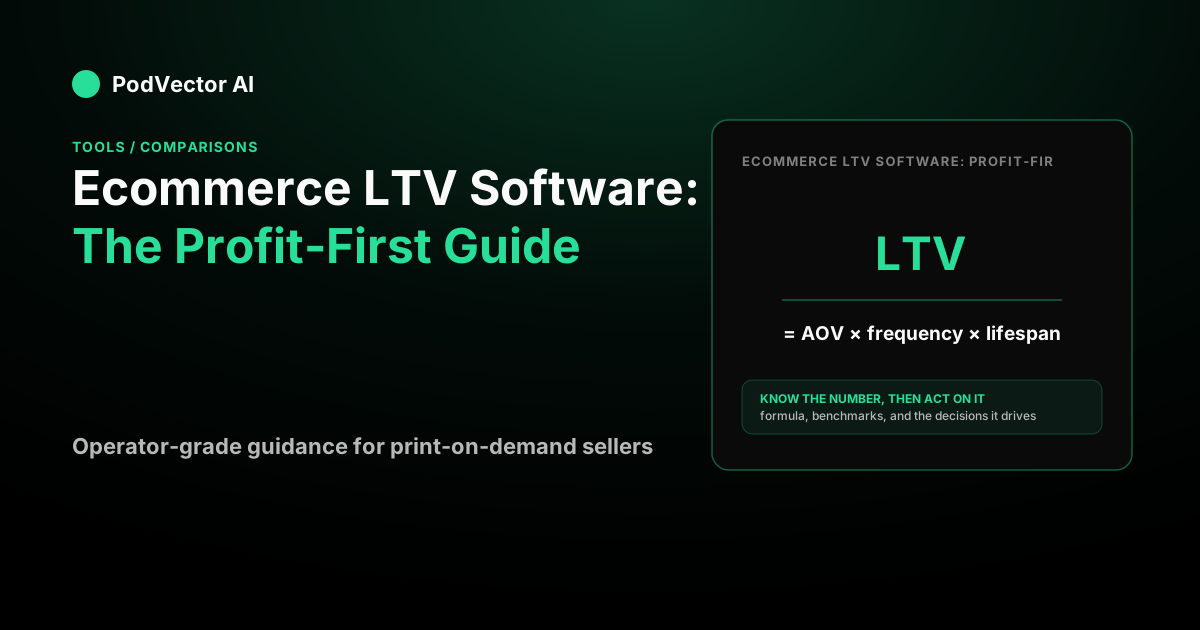
The standard model, used by both Yotpo and Finaloop, is LTV = Average Order Value × Purchase Frequency × Customer Lifespan.
Say your average order is $120, a customer buys 2.5 times a year, and stays 3 years: 120 × 2.5 × 3 = $900 in revenue LTV. But if each order carries $70 of product cost, $12 of fees, and $8 of shipping, your profit per order is 120 − 90 = $30. Your profit LTV is 30 × 2.5 × 3 = $225 — one quarter of the revenue figure. If your CAC is $80, the revenue-based ratio looks like a fine 11:1, while the honest profit ratio is a much tighter 2.8:1. That gap is why the cost engine underneath your LTV tool matters more than the LTV dashboard itself.
The top ecommerce LTV software, compared
Prices and ratings below were verified on each tool's live Shopify App Store listing and pricing page (linked in each section) as of August 2026. Ratings and prices move — re-check before you buy.
TrueProfit — best low-cost all-rounder
TrueProfit pairs customer LTV and CAC with cohort tracking and automated cost tracking. On its pricing page, the Basic plan is $35/mo for up to 300 orders, with LTV, quantity-based COGS, and custom costs included at that entry tier; multi-touch attribution is gated to the $200 Enterprise plan. It holds a 4.9 out of 5 rating across 779 reviews on the Shopify App Store. For print-on-demand sellers it also integrates Printful, Printify, and Gelato directly — the strongest published POD-cost story of this group.
Lifetimely — deepest cohort and predictive LTV
If LTV depth is your priority, Lifetimely (by AMP) is the most focused option. Its pricing starts free for up to 50 orders a month, then jumps to $149/mo at the M tier for 501–3,000 orders. It offers predictive LTV, RFM segmentation, CAC payback, and cohort reporting that reviewers rate as best-in-class for a Shopify app, plus a 4.8 out of 5 rating across 504 reviews. Note the free-to-paid jump is real — there is no cheap middle tier once you outgrow 50 orders.
Polar Analytics — enterprise BI with LTV built in
Polar is a multichannel analytics platform with LTV, cohorts, and multi-touch attribution among its features. Per its own pricing calculator, the Full Platform plan runs $750/mo for brands under $5M GMV and scales up from there. It carries a 4.9 out of 5 rating across 112 reviews. It is powerful, but reviewers consistently flag the price as enterprise-leaning — hard to justify for a store doing under $50k/mo. See our deeper look at Polar Analytics and its competitors and our review of Polar's customer analytics.
Triple Whale — attribution-first, LTV secondary
Triple Whale leads with server-side attribution via its Triple Pixel and the Moby AI operator; profit and LTV dashboards exist but are not the headline. Its pricing page lists a free tier, then Foundation at $219/mo, scaling with GMV above that. The Shopify listing shows a 4.0 out of 5 rating across 95 reviews. If attribution recovery is your real problem, it is genuinely strong there — but that is a different job than measuring LTV cheaply.
BeProfit and sellerboard — multichannel and budget picks
BeProfit (now under Viably) adds LTV and cohort analysis with multichannel coverage across Shopify, Amazon, and WooCommerce. Its Shopify listing shows a Basic plan at $49/mo and a 4.3 out of 5 rating across 188 reviews; recent one-star reviews cluster around billing and cancellation friction. sellerboard is the budget entry — its Shopify app starts at $9/mo for 600 orders and carries a 4.2 out of 5 rating across 67 reviews, though its Shopify side is less mature than its core Amazon product, and reviewers report ad-cost sync lag on Meta.
Where all of these leave a gap
Every tool above is, at heart, a dashboard: it measures LTV and shows you a number. That is useful. But two problems recur for thin-margin and print-on-demand sellers.
First, COGS accuracy. For POD, cost of goods is not one number you type once — it is set per-variant by Printful, Printify, or Gelato and shifts when a supplier reprices. A tool that stores a single static cost misstates margin, and therefore misstates profit LTV, the moment that happens.
Second, the number just sits there. Knowing a cohort's LTV is worthless if nothing changes because of it. That is the gap PodVector is built to close.
PodVector is not a dashboard. It connects Shopify, Meta Ads, Google Ads, Printify, and Printful, and computes your true per-order profit — the honest denominator every LTV calculation depends on. On top of that sits Victor, an AI employee that analyzes your live data and acts on it, taking Shopify-side actions with your approval. Victor reads your ad data and proposes moves; he does not touch your ad account. The point is not another LTV chart — it is turning accurate profit and LTV into decisions. If that fits how you want to run your store, you can start with PodVector here.
FAQs
What is ecommerce LTV software?
It is a tool that calculates customer lifetime value — the total worth of a customer over their relationship with your store — usually alongside CAC, cohort retention, and profit metrics. The best versions calculate LTV on net profit rather than gross revenue, so the number reflects what a customer actually earns you.
What is a good LTV:CAC ratio for ecommerce?
A common benchmark is at least three to one, meaning a customer should be worth roughly three times what you spent to acquire them, per Yotpo's Shopify LTV guide. Just make sure both sides use profit, not revenue — a healthy-looking revenue ratio can hide an unprofitable one, as the worked example above shows.
Does Shopify calculate LTV on its own?
Shopify surfaces some customer analytics, but its default view is revenue-oriented and does not subtract COGS, ad spend, shipping, and fees to give you profit LTV. That is the gap dedicated LTV and profit tools fill.
Which ecommerce LTV software is cheapest?
Among the tools here, sellerboard's Shopify app is the lowest published entry price at $9/mo for 600 orders, followed by TrueProfit at $35/mo, per their respective listings. Lifetimely is free up to 50 orders a month. GMV-priced platforms like Triple Whale and Polar cost substantially more regardless of store size.
Do these tools handle print-on-demand costs correctly?
Coverage varies, so verify before you buy. TrueProfit publishes direct Printful, Printify, and Gelato integrations; others ingest COGS but do not all document per-variant POD-cost syncing. Because a POD supplier's cost shifts per variant, an accurate cost feed is the single most important thing to check for a print-on-demand store — it is the foundation every LTV number rests on.