
What "high" actually means for CLV
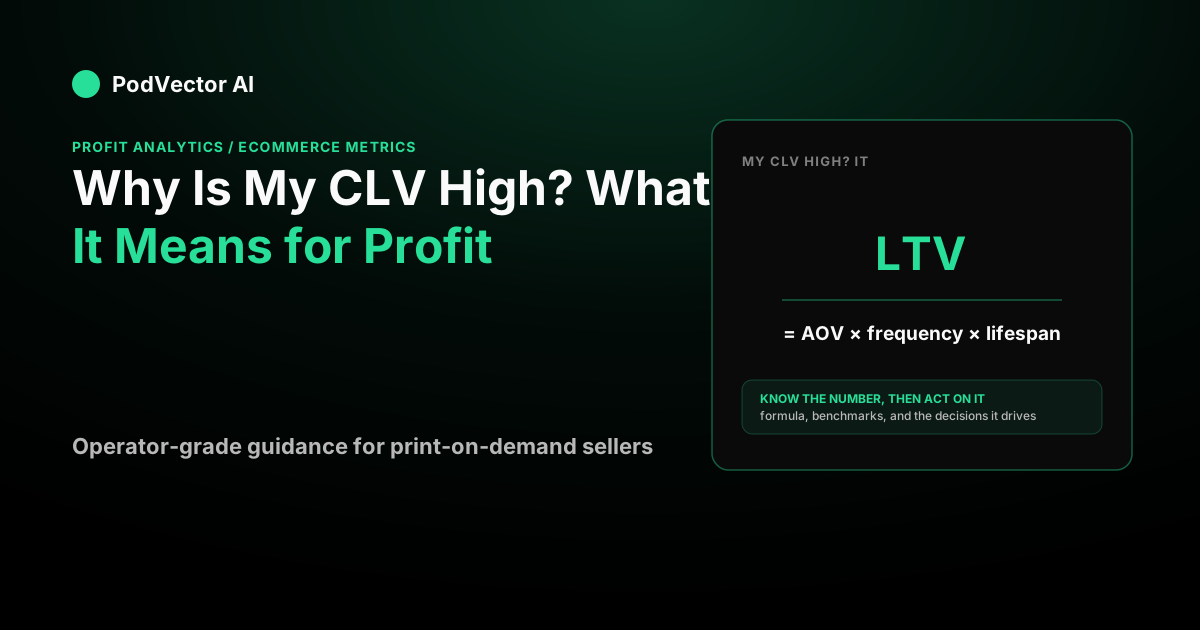
CLV (customer lifetime value, also written LTV) is the total value a customer generates across their whole relationship with you. The standard revenue formula is average order value × purchase frequency × customer lifespan. Because those three factors multiply, CLV climbs fast when any one of them improves.
So when someone asks "why is my CLV high," the honest first answer is: because one or more of AOV, frequency, and lifespan is running above your baseline. The harder question — the one most guides skip — is whether that high number represents real, bankable profit or just a big-looking figure.
This article walks through both the legitimate drivers and the ways CLV inflates itself, then shows you how to pressure-test the number. If you're diagnosing the opposite problem, see why is my CLV low. For the full set of definitions, the ecommerce metrics guide is the hub this article sits under.
The legitimate reasons your CLV is high
1. Customers buy again — and again
Repeat purchase behavior is the single biggest lever on CLV, because it drives up both frequency and lifespan at the same time. A customer who reorders every quarter for two years is worth many times a one-and-done buyer.
This is why retention economics dominate the CLV conversation. A five percent increase in customer retention can lift profits by 25 to 95 percent, according to Bain & Company research cited by Bloomreach, and the same source notes that established customers spend meaningfully more later in the relationship than they did in the first few months. If your repeat rate has climbed, your CLV climbing with it is exactly what you'd expect. To dig into that driver, read why is my repeat customer rate low.
2. A higher average order value
If you've added upsells, bundles, or raised prices, each order carries more revenue — and CLV scales linearly with AOV. Say your average order climbs from thirty-five to forty dollars. That's about a fourteen percent bump per order, and it flows straight through every purchase a customer ever makes.
3. A loyal, satisfied base
Satisfaction feeds retention, and retention feeds lifespan. Customers who've had positive experiences spend far more over time than unhappy ones — one widely cited figure puts it at 140 percent more, per HubSpot. A high CLV can simply be the downstream signal of a product people love and keep coming back to.
The reasons your CLV looks high but isn't
Here's where the popular articles go quiet. A high CLV can be an artifact of how you calculated it. Four traps to check before you celebrate.
Trap 1: You measured revenue, not profit
This is the big one. The revenue-basis CLV formula ignores what it costs to make and ship the product. The margin-basis version — the one worth trusting — multiplies by your margin ratio: AOV × frequency × lifespan × gross-margin ratio.
Say you run a print-on-demand store. Your average order is forty dollars, customers buy 1.6 times a year, and they stick around two years:
- Revenue-basis CLV: $40 × 1.6 × 2 = $128
- Margin-basis CLV (at a 60% gross margin): $40 × 1.6 × 2 × 0.60 = $76.80
Same customer, same behavior — but the honest number is 40 percent smaller. If your "high" CLV is a revenue figure, you're looking at top line, not take-home. And that gap widens further once you subtract shipping, payment fees, and fulfillment labor to get to contribution margin.
Trap 2: A few whales are skewing the average
CLV is usually reported as an average, and averages hide their distribution. A base of mostly one-time buyers plus a handful of high-frequency superfans can produce an impressive average CLV that describes almost none of your actual customers.
Before you make decisions on the number, segment it — a Recency-Frequency-Monetary (RFM) split will show whether your "high CLV" is broad-based or propped up by a thin top tier. If it's the latter, your acquisition math for a typical new customer is far weaker than the average implies.
Trap 3: Your lifespan assumption is optimistic
Lifespan is the shakiest input in the formula. Many CLV models estimate it as 1 ÷ churn rate, so a low churn assumption stretches lifespan and inflates CLV. If you assume 8 percent annual churn, that implies a 12.5-year customer lifespan — which is almost certainly longer than your cohorts actually stay.
A young store is especially vulnerable here: customers haven't had time to churn yet, so early lifespan looks artificially long and CLV looks artificially high. Recompute it once real cohorts age.
Trap 4: High CLV from low frequency and high prices
A luxury or big-ticket store can post a high CLV off a single expensive order. That's not wrong, but it means your entire lifetime value is concentrated in one transaction — with none of the repeat-purchase resilience that makes CLV valuable in the first place. If frequency is your weak link, why is my purchase frequency high covers the flip side of that dynamic.
The test that actually matters: CLV against CAC
A high CLV in isolation tells you nothing. What matters is the ratio of lifetime value to what you paid to acquire the customer — the LTV:CAC ratio.
Healthy LTV:CAC ratios generally run from about 2:1 to 8:1, with 3:1 as the common benchmark, according to McKinsey research summarized by Bloomreach. Below roughly 1:1, you lose money on every customer no matter how "high" CLV looks. Far above 5:1, you may actually be under-investing in growth — leaving acquisition on the table because you're being too conservative.
Let's put a number on it. Continuing the print-on-demand example, say your margin-basis CLV is $76.80 and your blended acquisition cost (all sales and marketing spend ÷ new customers) works out to $15.63:
$76.80 ÷ $15.63 = 4.9:1
That's a healthy ratio — comfortably above 3:1 without straying into under-investment territory. But notice what happened: if you'd used the revenue CLV of $128 against that same CAC, you'd have reported 8.2:1 and concluded you had tons of headroom. The revenue basis overstated your ratio by about 1.7×. Mixing a revenue-basis CLV with a profit-basis CAC is one of the most common ways ecommerce decks lie to their owners.
The two levers that move this ratio most are lifespan (≈ 1 ÷ churn) and margin. Cutting churn stretches lifespan and lifts CLV without touching CAC at all — which is why retention work so often beats another push on ad spend.
How to verify your high CLV in five minutes
Run this quick checklist against your own number:
- Is it margin-based? If not, multiply by your gross-margin ratio and re-read it. Better still, net out shipping and fees to a contribution-margin basis.
- Is it segmented? Split by RFM or at least by first-order cohort so whales don't flatter the average.
- Is the lifespan real? Compare your assumed lifespan against how long your oldest cohorts have actually stayed active.
- Does it clear CAC? Compute LTV:CAC on consistent bases (profit numerator, profit denominator).
- Does it survive returns? Net out refunds and returns before you treat the number as final.
If your CLV passes all five, it's genuinely high — and that's a strong position. Your job then is to spend into it: a healthy ratio is permission to acquire more aggressively.
Where the true-profit number comes from
Every check above depends on knowing your real per-order economics — COGS, shipping, payment fees, fulfillment, and ad allocation — not just revenue. That's exactly the gap most store owners hit: the storefront reports revenue, the ad platforms report their own attributed revenue, and nobody stitches them into one honest profit figure.
PodVector connects Shopify, Meta Ads, Google Ads, Printify, and Printful, then computes your true per-order profit across all of them — the foundation you need for a margin-basis CLV and an honest LTV:CAC. Victor, its AI employee, analyzes that live data and proposes moves you can approve, executing the Shopify-side actions himself while leaving your ad accounts untouched. It's not a dashboard you have to read; it's an employee that works your numbers with you.
If you want to start with the acquisition side of the ratio, our cost-per-order calculator breaks down what each order really costs to win. Or you can connect your stack and see your true per-order profit directly.
FAQs
Is a high CLV always a good thing?
Not automatically. A high CLV is good only if it's measured on profit rather than revenue and it comfortably exceeds your cost to acquire the customer. A revenue-basis figure, an average skewed by a few high spenders, or an optimistic lifespan assumption can all make CLV look high while your actual margins stay thin. Run it against CAC before you treat it as a win.
Why is my CLV high but my profit still low?
Almost always because your CLV is measured on revenue, not margin — or because your acquisition cost is eating the difference. A forty-dollar order can carry only a few dollars of contribution margin after product cost, shipping, fees, and ad spend. If CLV is high but the bank account isn't growing, recompute CLV on a margin basis and check your LTV:CAC ratio and your per-order contribution margin.
What's a good LTV:CAC ratio?
Around 3:1 is the widely cited benchmark, with healthy ranges spanning roughly 2:1 to 8:1, according to McKinsey research via Bloomreach. Below 1:1 you're losing money per customer; well above 5:1 you may be under-investing in growth. Always compute both sides on consistent bases — a profit-basis CLV against a profit-inclusive CAC.
Should I use revenue-basis or margin-basis CLV?
Margin-basis, in almost every case. Revenue-basis CLV overstates value by ignoring what it costs to deliver the product, which then inflates any ratio you build from it. Multiply by your gross-margin ratio at minimum, and ideally net out shipping, fees, and fulfillment to a contribution-margin basis for decisions about acquisition spend.
How does churn affect my CLV?
Directly and powerfully, because lifespan is often modeled as 1 ÷ churn rate. Lower churn stretches the assumed lifespan, which multiplies straight through the CLV formula. That's why retention improvements can raise CLV — and your LTV:CAC ratio — without any change to acquisition cost. It's also why an over-optimistic (too low) churn assumption is a common cause of an artificially high CLV.