
If you already run a store, you don't need another lecture on what gross profit is. You need the formula pinned down, a worked example with numbers that look like yours, and an honest read on what the number does and doesn't tell you. This guide does that, then connects it to the metrics that decide whether you actually keep money — the way the broader ecommerce metrics guide ties them together.
The gross profit margin formula
Gross profit margin is a percentage. Two steps get you there.
First, find gross profit:
Gross profit = Revenue − COGS
Then divide by revenue and convert to a percent:
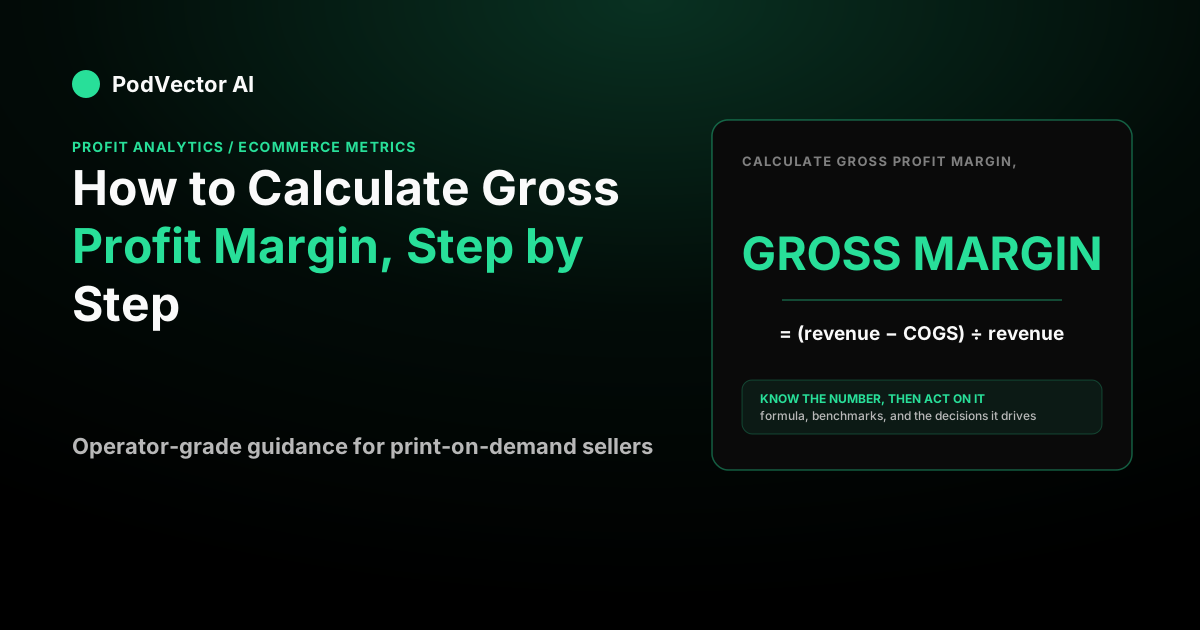
Gross profit margin % = (Revenue − COGS) ÷ Revenue × 100
COGS is the direct cost of the product you sold — nothing else. For a print-on-demand apparel store, that's the blank garment, the print, and the supplier's base fulfillment charge baked into the item. It does not include your ad spend, your Shopify subscription, or your own time. Those belong to other margins further down.
One thing that trips people up: gross margin is always measured against price, not cost. If you divide the same dollar gap by cost instead, you get markup — a different, larger number. More on that trap below.
A worked example from an operating store
Say you run a POD store doing 1,000 orders a month at a $40 average order value. That's $40,000 in monthly revenue.
Say your supplier charges $16 for the blank, the print, and base fulfillment on an average order. So:
- Revenue per order: $40.00
- COGS per order: $16.00
- Gross profit per order: $40 − $16 = $24.00
- Gross profit margin: $24 ÷ $40 = 60%
Run the same math on the month and nothing changes, because margin is a ratio: $40,000 revenue − $16,000 COGS = $24,000 gross profit, and $24,000 ÷ $40,000 = 60%. Per-order or per-month, the margin is identical. That's the point of expressing it as a percentage — it's scale-independent, so you can compare a single SKU to your whole catalog on the same footing.
Now change one input. Suppose a supplier price increase pushes COGS to $19 on that same $40 order. Gross profit drops to $21, and margin falls to $21 ÷ $40 = 52.5%. A $3 cost change — less than a coffee — just moved your margin almost eight points. On 1,000 orders, that's $3,000 of gross profit a month, gone, without a single lost sale.
Gross margin vs. markup — the costly mix-up
These describe the same $24 gap between your $40 price and $16 cost, but from opposite sides:
- Margin is the gap over price: ($40 − $16) ÷ $40 = 60%.
- Markup is the gap over cost: ($40 − $16) ÷ $16 = 150%.
Same product. 60% margin equals 150% markup. Suppliers and marketplaces usually quote markup; your profit-and-loss statement speaks in margin. Confuse the two and you'll badly misread how much room you actually have — a "50% markup" is only a 33% margin, not the half-the-price cushion it sounds like. If you ever price off a markup target, convert it first: margin = markup ÷ (1 + markup).
Gross margin vs. net margin — the number margin hides
Here's what the top-ranking "how to calculate gross profit margin" pages almost always skip: a healthy gross margin can still hide a store that loses money.
Gross margin subtracts only COGS. It says nothing about the shipping label, the payment processor's cut, the pick-and-pack labor, or the ad spend it took to win the order. Keep going on that same $40 order:
- Gross profit: $24.00 (the 60% margin)
- − Shipping: $5.00
- − Payment processing (~4% of $40): $1.60
- − Pick/pack: $1.40
- = Contribution margin before ads: $16.00 (40% of revenue)
- − Ad spend (at a 4.0 return on ad spend): $10.00
- = Contribution margin after ads: $6.00 (15% of revenue)
Your 60% gross margin is real — but only $6 of that $40 order survives to cover rent, software, and salaries. Subtract those fixed costs and you reach net margin, the true bottom line. This is why gross margin is a ceiling, not a verdict: it tells you whether a product is worth making, while contribution margin tells you whether it's worth selling through this channel at this ad cost. The gap between them is also where your break-even point lives.
What counts as a "good" gross profit margin?
There is no single ecommerce average, and anyone who quotes one is flattening a huge spread. An analysis of 18 public DTC brands found gross margins ranging from 25% to 75.4% with band averages clustering within just five points of each other — meaning the variance within a revenue tier dwarfs the gap between big and small brands. Scale alone does not fix a thin margin.
Specialty apparel — the category most POD stores live in — tends to run higher. The same analysis puts the apparel sweet spot in roughly the 50% to 67% corridor, with FIGS at 66.5% and Lululemon at 56.6%. As a general rule of thumb, accounting guides peg a good gross margin at anywhere between 50% and 70%, while noting it swings hard by industry. For a 60%-margin POD store, you're in a defensible range — but the benchmark that matters is your own trend, not a stranger's survey.
How to raise your gross profit margin
Gross margin moves on exactly two levers: price up or cost down. Everything else is a version of those.
- Reprice the thin SKUs. The products dragging your blended margin down are usually a small set. Nudge their price, not the whole catalog.
- Negotiate or switch suppliers. A $2 cost cut on a $40 order is a five-point margin gain — larger than most price tests dare.
- Raise average order value. Bundles and volume tiers spread fixed-ish order costs across more revenue, which lifts the margin that reaches the bottom line. The tactics in the guide on how to increase average order value do exactly that.
- Watch the ratio, not just the dollars. Rising revenue with a sliding margin is a warning, not a win. Track the gross margin ratio over time so a creeping supplier price or a discount-heavy month shows up early.
Let Victor keep the margin math honest
The formula is easy. Keeping it accurate across hundreds of orders, shifting supplier prices, and live ad spend is the hard part — and it's where most stores fly blind.
Victor is the AI employee inside PodVector AI. He sees every order, every ad dollar, and every supplier cost together, so he computes the true per-order profit on each product — not just the gross margin, but what actually survives after shipping, fees, and ads. Victor knows your Printify, Printful, and Gelato costs before the first sale, so the margin is right from order one. He reprices the thin-margin SKUs in Shopify, pauses the Meta or Google ad set that's dragging a product underwater, and delivers the profit report to your Google Drive so the numbers live somewhere you'll actually read them.
See your true per-order margin with PodVector AI and stop guessing which products really pay.
FAQs
What is the gross profit margin formula?
Gross profit margin % = (Revenue − COGS) ÷ Revenue × 100. First subtract cost of goods sold from revenue to get gross profit, then divide that by revenue and multiply by 100 to express it as a percentage. For a $40 order costing $16, that's ($40 − $16) ÷ $40 × 100 = 60%.
Is gross profit margin the same as the gross margin ratio?
They're the same calculation — gross profit as a share of revenue. "Margin" is usually quoted as a percentage and "ratio" sometimes as a decimal, but they measure the identical thing. The gross margin ratio breakdown walks through the decimal form and how to read it over time.
What's the difference between gross margin and net margin?
Gross margin subtracts only COGS — the direct product cost. Net margin subtracts everything else too: shipping, payment fees, fulfillment labor, ad spend, and fixed costs like rent and software. A store can post a strong gross margin and still have a thin or negative net margin once ads and overhead are counted.
What counts as COGS for a print-on-demand store?
Only the direct cost of the item sold: the blank garment, the print or decoration, and the supplier's base fulfillment charge included in the product price. Keep shipping, payment processing, and ad spend out of COGS — fold those into contribution margin instead. The key is to pick one treatment for the supplier's print fee and hold it, so your margin doesn't silently drift.
Is a 60% gross margin good for an ecommerce store?
For POD apparel, a 60% gross margin sits comfortably inside the typical range, since accounting guides put a healthy gross margin around 50% to 70%. But gross margin is only the ceiling — what you keep depends on shipping, fees, and ad efficiency. Track your own margin trend and your true per-order profit before calling any number "good."