
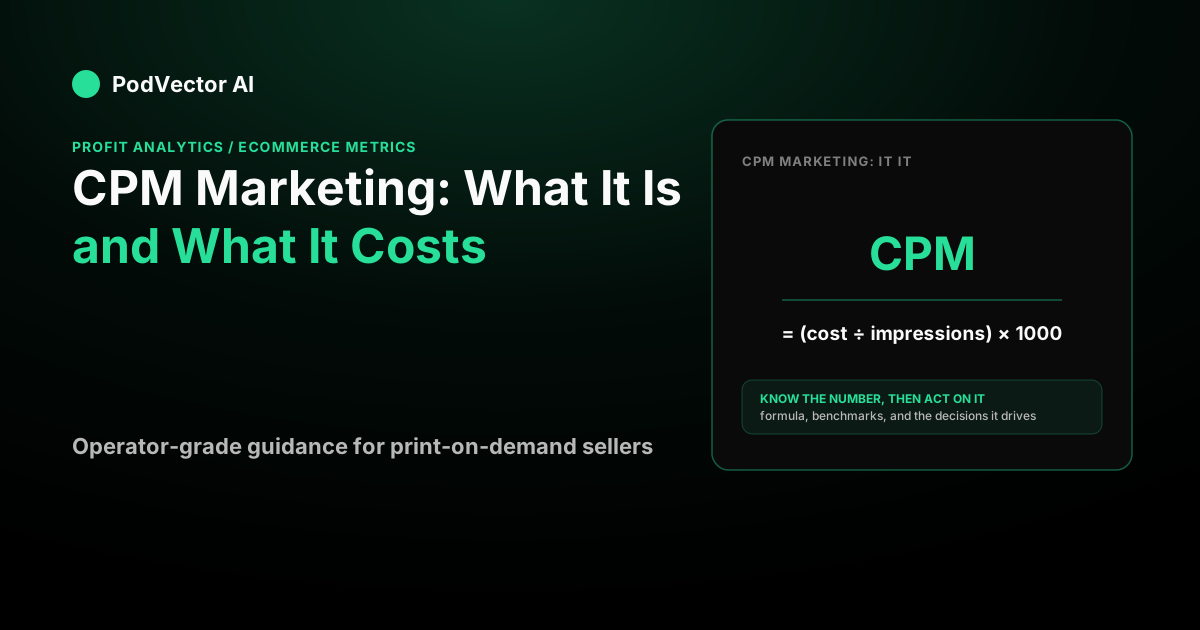
What is CPM in marketing?
CPM is the price of a thousand ad impressions. According to Mailchimp, an impression is counted when an ad, as an element of a web page, loads and receives a view — not a click, not a sale, just a view. Platforms like Meta and Google auction impressions in real time, and CPM is how the winning price gets expressed.
You will see CPM in two roles. As a buying model, you agree to pay per thousand impressions regardless of what happens next — common in display, video, and brand campaigns. As a reporting metric, CPM is calculated after the fact from any campaign, even a conversion-optimised one, so you can compare how expensive it is to reach people across channels. According to Wikipedia's Cost per mille article, the core purpose of CPM is to compare the costs of advertising campaigns within and across different media.
The "M" trips people up. It is the Roman numeral for 1,000, not "million." So CPM is cost per thousand, and a higher CPM means each thousand views costs you more. Marketers lean on CPM because reach is the one thing almost every campaign produces, which makes it a clean common denominator across very different objectives.
vCPM: viewable impressions explained
A standard impression is counted the moment an ad renders on a page — even if it loads below the fold and nobody sees it. To address this, the industry developed viewable CPM (vCPM). According to Wikipedia's Cost per impression article, an ad is considered viewable when at least 50% of a display ad is shown for one second or longer, or a video ad plays continuously for two seconds or more. When you bid on vCPM, you pay only for impressions that meet that threshold — a more accurate signal of real exposure, and increasingly the standard on programmatic networks.
The CPM formula, worked
The formula is short:
CPM = (Ad spend ÷ Impressions) × 1,000
Say you run a print-on-demand apparel store and spend $10,000 on a Meta awareness campaign that serves 1,000,000 impressions. Your CPM is ($10,000 ÷ 1,000,000) × 1,000 = $10.00. You paid ten dollars for every thousand times the ad appeared.
Turn it around to budget by reach. If you want 500,000 impressions at a $10 CPM, you multiply: (500,000 ÷ 1,000) × $10 = $5,000. That is the whole arithmetic — CPM is deliberately simple so it can travel across TV, radio, out-of-home, and every digital surface using the same shape.
The simplicity is also the trap. CPM tells you the price of attention and nothing about the value of it, which is where most awareness budgets quietly leak money. To see that, you have to chain CPM to the metrics downstream of the impression.
CPM in email marketing
CPM is not limited to display and social ads. According to Wikipedia, in email marketing CPM refers to the cost of sending a thousand email messages — a pricing method email service providers use to cover server, bandwidth, hosting, deliverability, and bounce management costs. If you are renting a slot in a high-volume newsletter or paying a platform to send to a list, you are almost certainly paying on a CPM basis. The same thousand-impression logic applies; the "impression" is just an email send or open rather than a page render.
What is a good CPM?
There is no universal "good" number — CPM swings with platform, audience, country, format, and season. Treat any benchmark as a starting reference, then compare against your own history.
For context on Meta specifically, one 2025–2026 benchmark set from SuperAds pegs the average Facebook CPM near twenty dollars and change across the thirteen months from July 2025 to July 2026, with a fall peak of about $24.26 in November 2025 as holiday competition bid prices up. The same source notes that across most industries CPMs range from roughly $5 to $18 depending on region and objective, with US retail inventory sitting at the higher end.
Three forces move your CPM the most:
- Audience competition. The more advertisers bidding for the same people, the higher the clearing price. US consumers and high-value niches cost more.
- Season. Q4 and big sale windows spike CPMs because everyone floods the auction at once.
- Ad quality and relevance. Platforms discount delivery for ads people engage with, so a better creative can lower your CPM without you touching a bid.
A "good" CPM, then, is one that reaches the right people cheaply enough that the revenue those people generate clears your costs. That last clause is the part the impression price alone can never tell you.
CPM vs CPC vs CPA: how they chain together
CPM, CPC, and CPA measure different steps of the same funnel, and they are linked by simple ratios rather than being rival choices. According to Amazon Ads, CPC is where advertisers pay each time consumers click an ad, while CPA is where the advertiser pays only when consumers make a purchase after clicking — so the three models sit at successive points on the same journey from impression to order.
Start with impressions and layer on behavior. Suppose that same $10 CPM campaign serves 1,000,000 impressions and 1% of them click. That is 10,000 clicks on $10,000 of spend, so your effective cost per click is $10,000 ÷ 10,000 = $1.00 CPC. Now lift the click-through rate to 2% — same ad cost, more clicks — and you get 20,000 clicks, halving your effective CPC to $0.50 without renegotiating a cent of the CPM. Better creative buys you cheaper clicks off an unchanged impression price.
Push one more step to cost per acquisition. If 4% of those clicks turn into orders, then 20,000 clicks yield 800 orders, and $10,000 ÷ 800 = $12.50 CPA. That reveals the identity every media buyer should memorize: CPA = CPC ÷ conversion rate. Cheaper clicks or a higher on-site conversion rate both drag your acquisition cost down. For on-site conversion tactics that work alongside your ad spend, see the CRO techniques guide and the average checkout completion rate benchmarks to know what a healthy rate looks like.
So CPM is not "worse" than CPC or CPA — it sits upstream of both. A low CPM with a terrible CTR still produces expensive customers. The metrics only make sense as a chain.
Why CPM alone can lie: the profit angle
Here is the subtopic almost every CPM guide skips. You can win the CPM game — cheapest impressions in your category — and still lose money on every order. Impression price is a cost input; whether the campaign is profitable depends on the margin on what those impressions sell.
Walk it through. Say each order brings $40 in revenue, and after the blank garment, printing, shipping, payment fees, and pick-pack labor you keep $16 of contribution margin before advertising. From the chain above, ads cost you $12.50 to land that order. So your real profit is $16 − $12.50 = $3.50 per order — thin, but positive.
Now imagine a "great" quarter where your CPM drops but a competitor's price war pushes your product margin down to $10 of contribution before ads. Same $12.50 acquisition cost, and every order now loses $2.50 even though your CPM never looked better. The impression price told you nothing about the loss. That is why break-even ROAS ties to margin, not to CPM: you break even when ad-driven margin equals ad spend, so the thinner your margin, the higher the return every thousand impressions has to earn. Check your net profit margin benchmark to see where your store stands relative to healthy POD operations.
The blended view matters too. CPM and channel ROAS are reported per platform, and platforms grade their own homework — Meta and Google both claim the same order, so summing their credited revenue over-counts. A store-wide marketing efficiency ratio — total revenue over total marketing spend — sidesteps that double-counting entirely and tells you whether the whole engine, CPM and all, actually pays. The increase AOV guide shows how lifting average order value is often the fastest way to make a given CPM work harder without changing a single bid.
CPM in influencer and programmatic advertising
CPM extends well beyond self-serve ad platforms. According to PropellerAds, influencers with a loyal audience can work with brands on CPM terms — earning revenue even if followers scroll past without clicking. That makes CPM a natural fit for newsletter sponsorships and influencer partnerships where reach, not conversion, is the deliverable. On the programmatic side, according to Adjust, CPM is a core programmatic pricing model where advertisers pay a fixed rate for every thousand impressions served — the real-time bidding (RTB) infrastructure that powers most display inventory runs on CPM clearing prices. Understanding which type of CPM you are buying (auction-based platform vs. direct publisher deal vs. influencer rate card) matters because each carries different quality controls and measurement standards.
How to lower your effective CPM (and effective cost per order)
You have two levers: pay less per thousand impressions, or squeeze more value out of each thousand.
- Improve relevance. Platforms reward ads people engage with by serving them more cheaply, so testing creative is often the fastest CPM win available.
- Refine targeting and timing. Overlapping audiences make you bid against yourself; broad or off-peak delivery frequently clears cheaper than crowded interest stacks in Q4.
- Watch frequency. When the same people see an ad too many times, response falls while impressions keep billing — refresh creative before fatigue inflates your effective cost.
- Raise CTR and conversion rate. As the worked example showed, doubling CTR halves your effective CPC on an unchanged CPM, and lifting on-site conversion drops your CPA the same way.
- Bid on vCPM where available. Paying only for viewable impressions removes the low-value below-the-fold inventory that inflates raw impression counts without adding real exposure.
Every one of these bends the cost curve, but none tells you the profit outcome — that still depends on per-order margin, which lives in your store data, not your ad manager. If you are on Printful, see the Printful embroidery pricing breakdown for a concrete example of how fulfillment costs erode the margin your CPM has to earn back.
Where PodVector fits
Reading CPM in Meta or Google Ads Manager shows you the price of attention. It cannot show you what an order actually keeps, because the margin data lives in Shopify, your fulfillment costs, and your payment fees — three places your ad platform never sees.
PodVector connects Shopify, Meta Ads, Google Ads, Printify, and Printful into a live data warehouse, then computes your true per-order profit — the after-everything number, not a platform-reported ROAS. Victor, its AI employee, reads your ad data alongside your real costs, flags where a low CPM is still selling at a loss, and proposes Shopify-side moves you approve: repricing worst-margin SKUs, raising your free-shipping threshold, or scheduling a Klaviyo email campaign to squeeze more revenue out of the traffic your impressions already bought. Victor never acts on your ad account directly — he reads it and hands you the profit math the impression price hides. For a fuller picture of how that plays out in a POD operation, see the PodVector strategy overview and the Klaviyo browse-abandonment flow setup for turning ad traffic into retained revenue. You can start free and connect your stores in minutes.
FAQs
What does CPM stand for in marketing?
CPM stands for cost per mille, where "mille" is Latin for one thousand. It is the amount you pay for one thousand ad impressions — one thousand instances of your ad being shown. Despite the "M," it never means cost per million.
How is CPM calculated?
Divide your total ad spend by total impressions, then multiply by 1,000: CPM = (Ad spend ÷ Impressions) × 1,000. For example, $10,000 spent across 1,000,000 impressions is ($10,000 ÷ 1,000,000) × 1,000 = $10.00. The formula is identical across TV, radio, display, and social so you can compare channels.
What is vCPM?
vCPM stands for viewable CPM. According to Wikipedia, an ad qualifies as viewable when at least 50% of a display ad is on-screen for one second or longer, or a video plays continuously for two seconds or more. Bidding on vCPM means you only pay for impressions that meet that visibility standard, making it a more accurate — and often more efficient — currency than raw CPM on display networks.
Is CPM better than CPC?
Neither is better — they measure different funnel steps. CPM prices impressions; CPC prices clicks; they are linked because CPC depends on your click-through rate off a given CPM. According to Adjust, CPM is more effective for visibility and brand awareness, while CPC offers a direct link between investment and specific user actions — making CPC popular for performance-focused campaigns. Most sophisticated advertisers track all of them together rather than choosing one.
What is a good CPM for Facebook or Instagram ads?
It depends heavily on your industry, country, and season, so use benchmarks only as a reference point. SuperAds' 2025–2026 data put the average Facebook CPM around twenty dollars, with US retail sitting at the higher end of the range. Compare against your own historical CPM before calling any number good or bad.
Why is my CPM high but my sales still low?
CPM only measures the price of reaching people, not whether those people are the right audience or whether they buy. According to One Day Agency, without proper targeting the impressions gained might not be meaningful, resulting in a wasted budget. A high CPM combined with weak targeting, a low click-through rate, or thin product margins can all produce few profitable sales. Trace the whole chain — CPM, CTR, conversion rate, and per-order margin — to find where the money actually leaks.
Does a lower CPM mean a more profitable campaign?
No. A lower CPM only means cheaper impressions; profit depends on the margin of what those impressions sell. You can have the cheapest CPM in your category and still lose money per order if your acquisition cost exceeds your contribution margin. Always tie CPM back to true per-order profit before judging a campaign. For a deeper look at that calculation, the dropshipping margin analysis and the net profit margin benchmark give you the reference points to anchor it.